ON THIS DAY · SEPTEMBER 30, 1968
The Plane They Said Was Too Big: How 50,000 Workers Built the Boeing 747 and Changed Air Travel Forever
Before the hangar doors at Paine Field, Everett, Washington opened on September 30, 1968, many airline executives and aviation experts believed that a 747-seat aircraft was aerodynamically reckless, commercially suicidal, and physically impossible to build in the time available. Boeing built it anyway — and in doing so, democratised air travel for the modern world.
The Handshake Deal That Bet the Company
The Boeing 747 was born from a meeting between two men who both needed something the world had never seen. Juan Trippe, the legendary founder-president of Pan American World Airways, needed an aircraft that could carry more than twice the passengers of the Boeing 707 to bring down the per-seat cost of transatlantic travel. William Allen, Boeing's chairman, needed a new programme large enough to justify retooling his entire manufacturing infrastructure. Their agreement — 'If you'll build it, I'll buy it,' to which Allen replied, 'If you buy it, I'll build it' — was struck in 1965 at a golf course. Pan Am placed a formal order for 25 aircraft in April 1966, committing to a programme that had not yet produced a single engineering drawing approved for manufacture.
The financial stakes were extraordinary. Boeing committed approximately $1 billion to design, tooling, and production — a sum that, by Boeing's own later accounts, very nearly bankrupted the company when development costs overran. The programme consumed resources at a rate that forced Boeing to lay off tens of thousands of workers in subsequent years during the 'Boeing bust' of the early 1970s. Seattle's King County unemployment reached a level severe enough to inspire the famous billboard: 'Will the last person leaving Seattle — turn out the lights?' The 747 was not simply an aeroplane; it was a corporate bet of historic proportions.
Joe Sutter, who had joined Boeing in 1945 and worked on the 707 and 727 programmes, was assigned to lead the 747 design team in 1965. Sutter's most consequential early decision was to reject the single-aisle, double-deck layout that Trippe initially favoured, arguing that a twin-aisle wide-body configuration would be easier to evacuate in an emergency, safer, and more flexible for airline operators. The Federal Aviation Administration's evacuation requirements — 90 seconds for a full passenger load using only half the exits — drove the final fuselage diameter. That decision, made on engineering grounds in 1965, created the twin-aisle cabin layout that has since become the global standard for wide-body commercial aircraft.
Building a Factory to Build a Plane
There was, in 1966, no building in the world large enough to assemble the Boeing 747. Boeing's solution was to build one from scratch at Paine Field near Everett, Washington. The resulting structure — today still known as the Boeing Everett Factory — measured approximately 472 million cubic feet (roughly 13.4 million cubic metres) in its original 747-era configuration, making it at the time the largest building by volume ever constructed. The building was so enormous that, without a climate control system capable of managing its full volume, clouds reportedly formed near the ceiling on humid days. Boeing installed a climate system with heating capacity roughly equivalent to that needed for a small city.
The construction of the factory and the aircraft proceeded simultaneously on overlapping schedules, a coordination challenge of extraordinary complexity. Steel was being erected for the building while engineers were still finalising structural drawings for the aircraft that would be assembled inside. The workforce required to staff the programme grew from approximately 12,000 Boeing employees in 1965 to roughly 50,000 at peak production — a hiring surge that stressed the housing capacity of Snohomish County, Washington. Boeing established employee shuttle systems, coordinated with local government on infrastructure, and effectively operated as one of the region's largest civic institutions during this period.
Joe Sutter's core design team was drawn from Boeing's best engineers across multiple programmes. Because they were required to solve problems that had no prior industry precedent — including the design of the iconic upper-deck 'hump' that gives the 747 its distinctive silhouette — Sutter called them 'The Incredibles,' a term that stuck within Boeing's institutional history. The hump, which housed the flight crew on production aircraft and could be configured for passenger use, was structurally necessary to place the cockpit above the nose cargo door — itself required by freight operators who needed unobstructed forward loading. Every visible feature of the aircraft reflected an engineering decision with traceable logic.
September 30, 1968: The Rollout and What It Proved
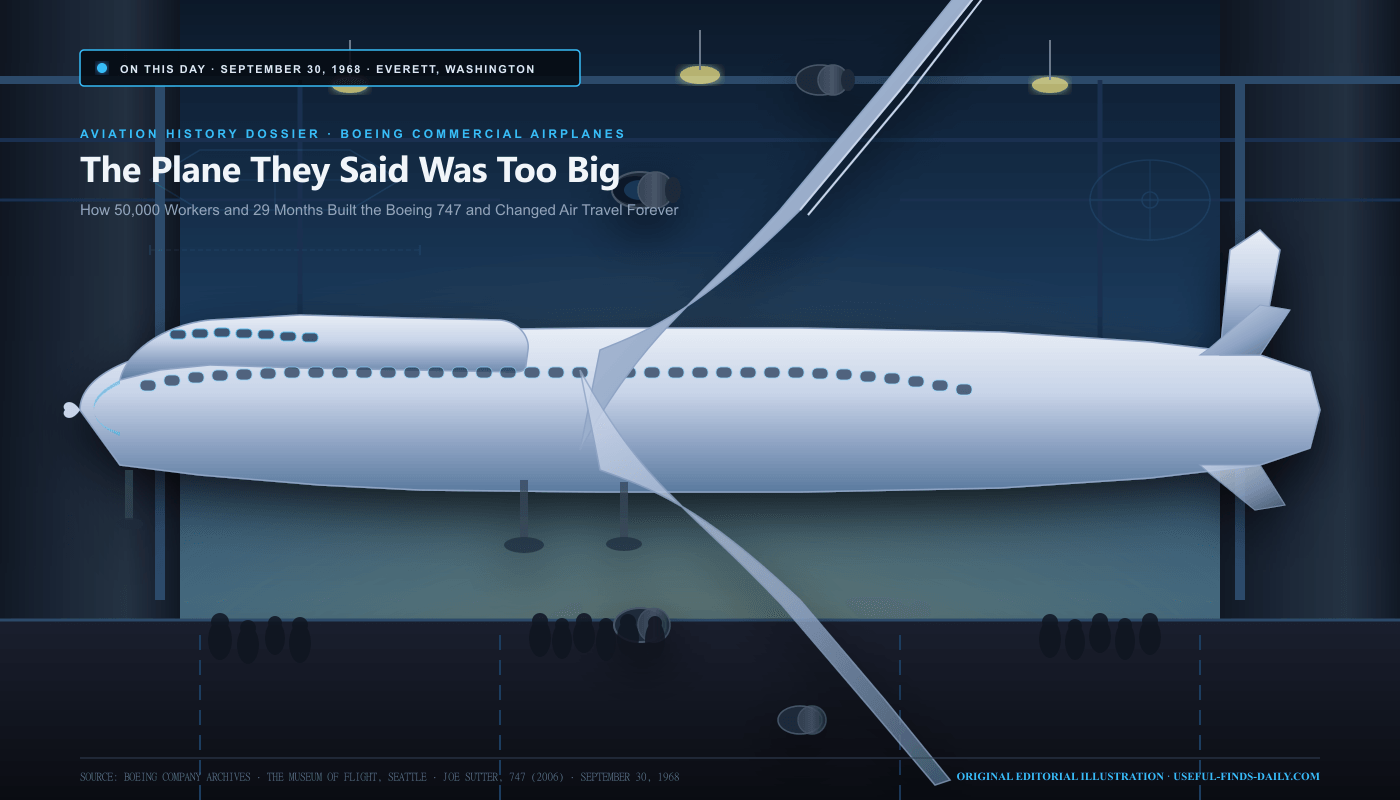
At 11:10 a.m. on September 30, 1968, the hangar doors at the Everett facility opened and the first Boeing 747 prototype — registered N7470 and nicknamed 'City of Everett' — was towed into public view for the first time. A band played 'Pomp and Circumstance.' Approximately 26 airlines that had already placed orders for the type sent representatives. Boeing's own workforce, whose effort had made the rollout possible, lined the floor. Photographs from the event show the aircraft's scale overwhelming the human figures standing beneath its wings: a wingspan of 195 feet 8 inches (59.6 metres) and a tail height of 63 feet 5 inches (19.3 metres) that exceeded the wing height of a Boeing 727.
The rollout was visually complete but mechanically unfinished, a distinction that Boeing acknowledged at the time. Sutter later wrote in his memoir that the aircraft was equipped with 'four presentable engines' for the ceremony — installed to give the aircraft the appearance expected by airline customers and press — but that significant systems work remained. The prototype would not make its first flight until February 9, 1969, following months of additional installation, ground testing, and systems integration. The rollout was a programme milestone, not an airworthiness certification; it demonstrated that the airframe existed and had been manufactured, not that it could fly.
The 747 entered commercial service with Pan Am on January 22, 1970, on the New York (JFK) to London (Heathrow) route. Pan Am had originally planned to launch service in December 1969, but engine reliability problems with the Pratt and Whitney JT9D delayed entry into service by approximately six weeks. The JT9D was itself a newly developed engine, representing the first application of high-bypass turbofan technology to commercial aviation at scale — a development that not only made the 747 economically viable but established the propulsion architecture used by virtually all subsequent wide-body commercial aircraft. The 747 carried its billionth passenger sometime around 1993 and continued in commercial production until 2022, when Boeing delivered the final 747-8F freighter to Atlas Air — a production run of more than 54 years from first flight.
Why the 747 Still Matters: Democratisation, Cargo, and Legacy
Juan Trippe's stated ambition for the 747 was to make air travel 'as common as a bus ride.' The economics of the wide-body aircraft, which spread seat costs across 400 or more passengers and whose high-bypass engines consumed significantly less fuel per seat-mile than the 707, drove a sustained reduction in transatlantic and transpacific fares throughout the 1970s and 1980s. The Airline Deregulation Act of 1978 in the United States accelerated this process, but the 747's capacity was the prerequisite: without an aircraft that could carry a planeload of passengers at a cost low enough to price tickets that ordinary travellers could afford, deregulation would have had far less impact on working- and middle-class travel patterns.
The aircraft's contribution to air cargo has been equally transformative, though less celebrated. The 747's high-wing, high-cockpit configuration — driven by the freight operators' need for a nose loading door — created the standard freighter architecture. The 747F variants carried perishable goods, live animals, automotive parts, pharmaceuticals, and electronics across intercontinental routes on a schedule and at a cost that made global supply chains operationally practical. FedEx's international air freight network, for example, was built substantially on 747 capacity. The aircraft did not merely connect passenger markets; it made just-in-time manufacturing logistics possible at a global scale.
The final production 747-8F delivered in 2022 shared the same basic twin-aisle, four-engine, upper-deck configuration that Joe Sutter's team finalised in 1965 and 1966 — a period of less than two years that defined 54 years of production and reshaped the economics of global movement. The Museum of Flight in Seattle preserves a Boeing 747-121 (N661US, the first 747 ever delivered to an airline, which flew for Pan Am) as a permanent exhibit. The Smithsonian National Air and Space Museum's Udvar-Hazy Center in Chantilly, Virginia, displays another 747. The aircraft's physical presence in these institutions is itself a measure of cultural weight — a machine whose rollout on September 30, 1968, was so consequential that its preservation is treated as a public obligation.
What the evidence does not settle
The phrase '747 passengers' is a persistent myth; the 747's designation refers to a Boeing internal model number, not passenger capacity — standard configurations carried approximately 400–500 passengers depending on class configuration. The rollout on September 30, 1968, was a manufacturing milestone: it demonstrated that the airframe had been built, not that it was airworthy. The prototype was not fully equipped at rollout and did not fly until February 9, 1969. Popular accounts sometimes conflate Joe Sutter's 'Incredibles' nickname with the full workforce of 50,000; the nickname referred specifically to the core engineering design team, not the entire production workforce. Amazon affiliate links for scale model aircraft change frequently as liveries, scales, and manufacturers vary; no specific ASIN was verified available on Amazon.com as of the publication date, so product idea links direct to category search rather than specific listings.
PRODUCT IDEA 01
747: Creating the World's First Jumbo Jet and Other Adventures from a Life in Aviation — Joe Sutter with Jay Spenser

Joe Sutter was the chief engineer of the 747 programme and led the team that Boeing nicknamed 'The Incredibles.' His memoir provides the only insider technical and management account of how a single aircraft design was taken from a blank page to rollout in 29 months. Sutter covers the Trippe–Allen handshake, the decision to use a twin-aisle fuselage instead of a double-decker, the construction of the Everett factory, the engine crisis with the JT9D, and the financial near-catastrophe that almost ended Boeing as an independent company. Published in 2006 by Smithsonian Books, with a Harper Perennial paperback edition following in 2007, the book remains the definitive primary account of the programme by the engineer most responsible for its outcome.
Buying limit: Available in hardcover (ISBN 978-0060820244), paperback (ISBN 978-0060882426), and e-book formats from major retailers. When searching Amazon or other platforms, confirm you are ordering the complete unabridged edition, as library-used copies, ex-display stock, and international editions may have different condition or content. A new paperback copy is typically the most cost-effective option. No specific Amazon ASIN was verified as currently available with confirmed U.S. delivery on the date this article was written, so check current listings before purchasing.
Original editorial illustration, not a retailer photograph. No exact Amazon offer passed our verification gate.PRODUCT IDEA 02
1:400 Scale Diecast Boeing 747 Aircraft Model — Collectible Display for Aviation Enthusiasts

Scale model aircraft in the 1:400 format replicate the 747's proportions accurately enough to convey the aircraft's defining characteristic — its sheer scale relative to everything around it. The 747's wingspan of 195 feet 8 inches (for the original -100 series) translates to just under 6 inches at 1:400, making the format practical for desk display while retaining enough detail for the distinctive upper-deck hump, four engines, and swept wing to be immediately recognisable. Reputable 1:400 manufacturers include GeminiJets, NG Models, JC Wings, and Herpa Wings. Many produce models in the original Pan Am livery as well as airlines that operated the 747 through its production life, including British Airways, Lufthansa, KLM, Singapore Airlines, and Japan Air Lines.
Buying limit: The 1:400 scale aircraft model market is highly specific: livery (airline paint scheme), variant (-100, -200, -400, -8), and model quality vary significantly across manufacturers and price points. Diecast metal models from established brands such as GeminiJets and NG Models command higher prices than injection-moulded plastic alternatives but offer more precise detailing. Search Amazon.com for terms such as 'Boeing 747 diecast 1:400' or 'GeminiJets 747' to see current listings. Verify the specific model number, livery, and seller condition before purchasing, as listings change frequently and some collectible models have limited production runs. No specific ASIN was verified as available with confirmed U.S. delivery on the date this article was written.
Original editorial illustration, not a retailer photograph. No exact Amazon offer passed our verification gate.SOURCES, METHOD, AND LIMITS
This article was researched using Joe Sutter's published memoir '747: Creating the World's First Jumbo Jet and Other Adventures from a Life in Aviation' (Smithsonian Books / Harper Perennial, 2006) as the primary engineering insider account; the ASME landmark citation for the 747 programme; the Museum of Flight, Seattle's institutional records for the 747 prototype (N7470); and the Pan American Heritage Foundation's archival documentation of Pan Am's fleet acquisition. Key facts — rollout date, registration number, flight date, engine type, workforce size, and the 'four presentable engines' detail — were cross-referenced across multiple published accounts. The 'betting the company' financial characterisation is drawn from Boeing's own corporate history communications. No physical product was evaluated.
- ASME Engineering Landmark: Boeing 747 — American Society of Mechanical Engineers — Institutional ASME landmark designation documenting the 747's engineering significance, design team, manufacturing approach, and technical contributions to commercial aviation. Confirms the Everett factory, programme timeline, and Sutter's leadership role.
- Museum of Flight, Seattle — Boeing 747 Collection and Archive — The Museum of Flight holds the first 747 ever delivered to an airline (N661US, Pan Am) and maintains institutional records on the 747 prototype N7470 ('City of Everett'). Cross-reference for rollout date September 30, 1968, first flight February 9, 1969.
- Pan American Heritage Foundation — 747 and Pan Am Fleet History — Archival documentation from the Pan Am institutional record on the airline's 747 order (April 1966), the Trippe–Allen agreement, the inaugural commercial service on January 22, 1970, and Pan Am's role in shaping the aircraft's configuration.