ON THIS DAY · HISTORY WITH A PRACTICAL THREAD
Small dates.
Long shadows.
Stories about the inventions, discoveries, and technical pivots that quietly shaped modern life. From mid-century cleanrooms and deep-space telemetry to the materials and mechanisms sitting on our desks, we trace how decisive engineering breakthroughs became everyday reality.
THE 365-DAY ARCHIVAL MATRIX
Explore Tech History by Month
Permanent monthly sub-hubs preserving all verified historical investigations across computing, physics, aerospace, and everyday engineering.
ACTIVE TIMELINE · OCTOBER 2026
Latest October Milestones
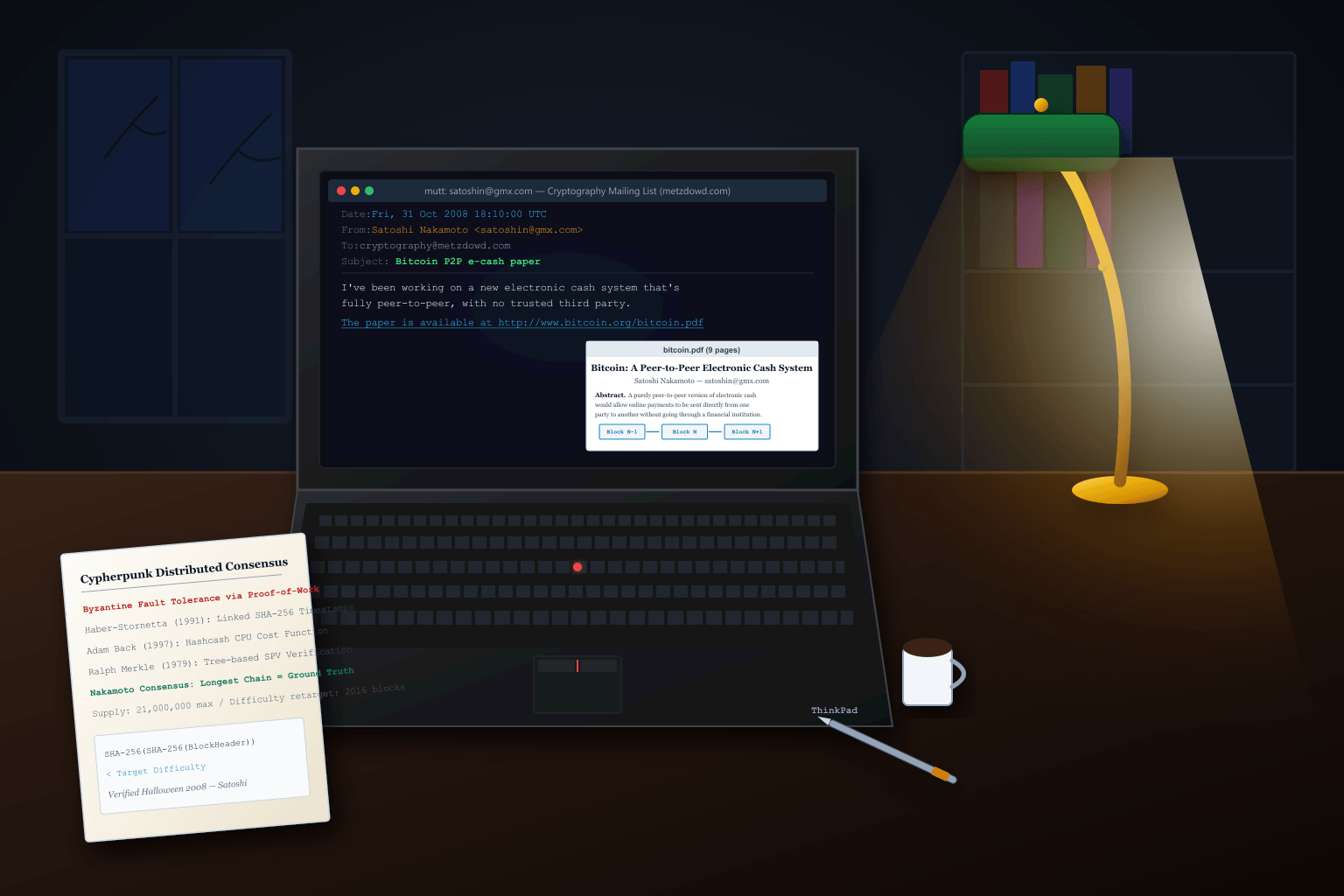
The Nine-Page Whitepaper That Rewrote Money How Satoshi Nakamoto Solved Double-Spending on October 31, 2008
On October 31, 2008, an anonymous cryptographer writing under the pseudonym Satoshi Nakamoto dispatched a nine-page paper to the Cypherpunk Cryptography Mailing List titled 'Bitcoin: A Peer-to-Peer Electronic Cash System.' By uniting cryptographic proof-of-work with distributed timestamped blocks, the proposal solved the computer science dilemma of double-spending without requiring a central clearinghouse or government central bank. Issued amidst the collapse of global investment banks and emergency economic bailouts, Nakamoto's protocol initiated the modern era of decentralized consensus and self-sovereign digital currency.
Read the source-led story →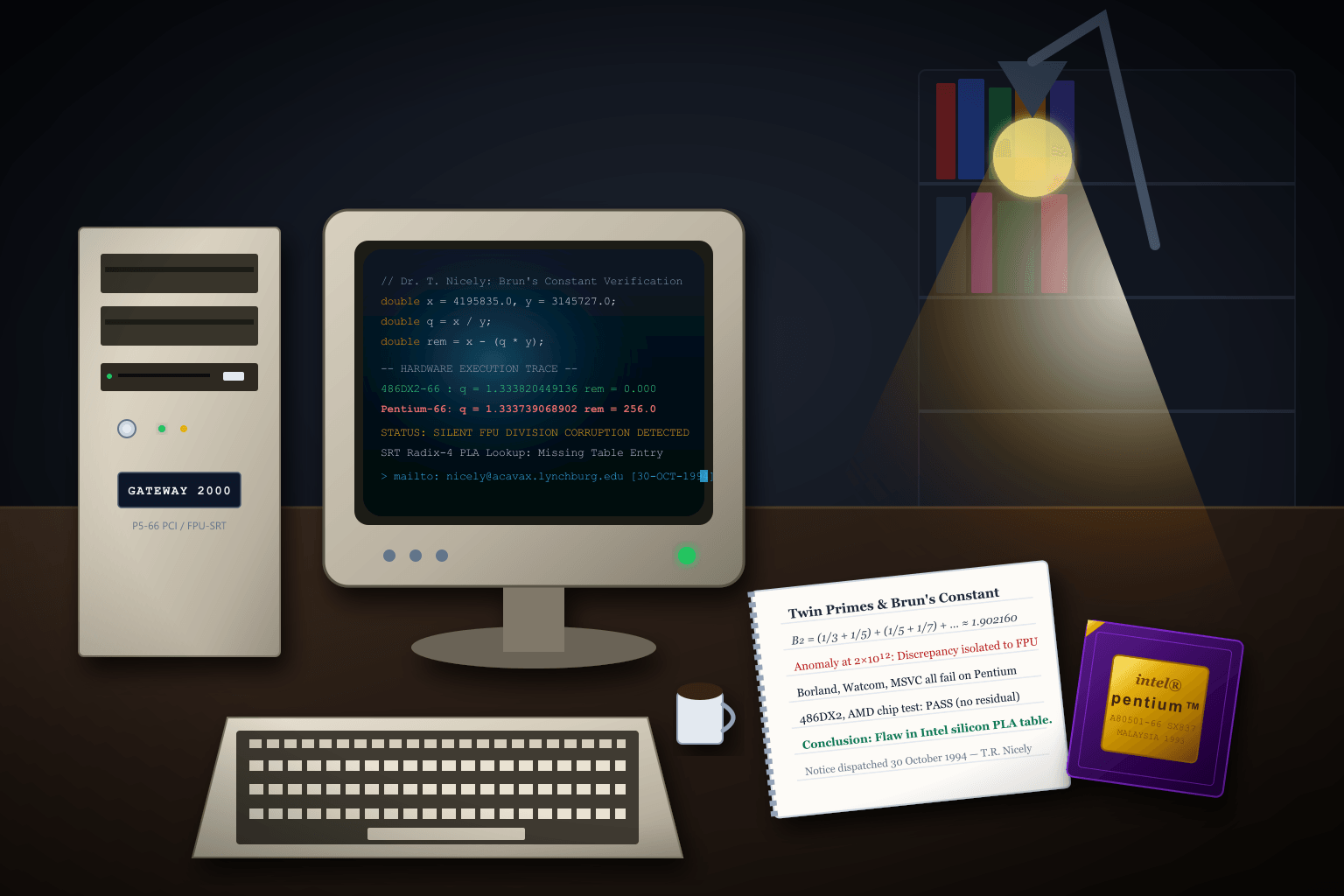
The Flaw in the Silicon How Thomas Nicely Discovered the Pentium FDIV Bug on October 30, 1994
On October 30, 1994, Dr. Thomas R. Nicely, a mathematics professor at Lynchburg College, dispatched a historic email to a circle of academic contacts detailing a silent floating-point division flaw inside Intel's flagship Pentium microprocessor. Uncovered while calculating Brun's constant for twin primes on a Gateway 2000 PC, the error stemmed from just five missing entries in an on-chip hardware lookup table. The resulting public furor, viral Usenet debate, and eventual $475 million recall fundamentally transformed hardware verification, Silicon Valley transparency, and consumer expectations of computing hardware forever.
Read the source-led story →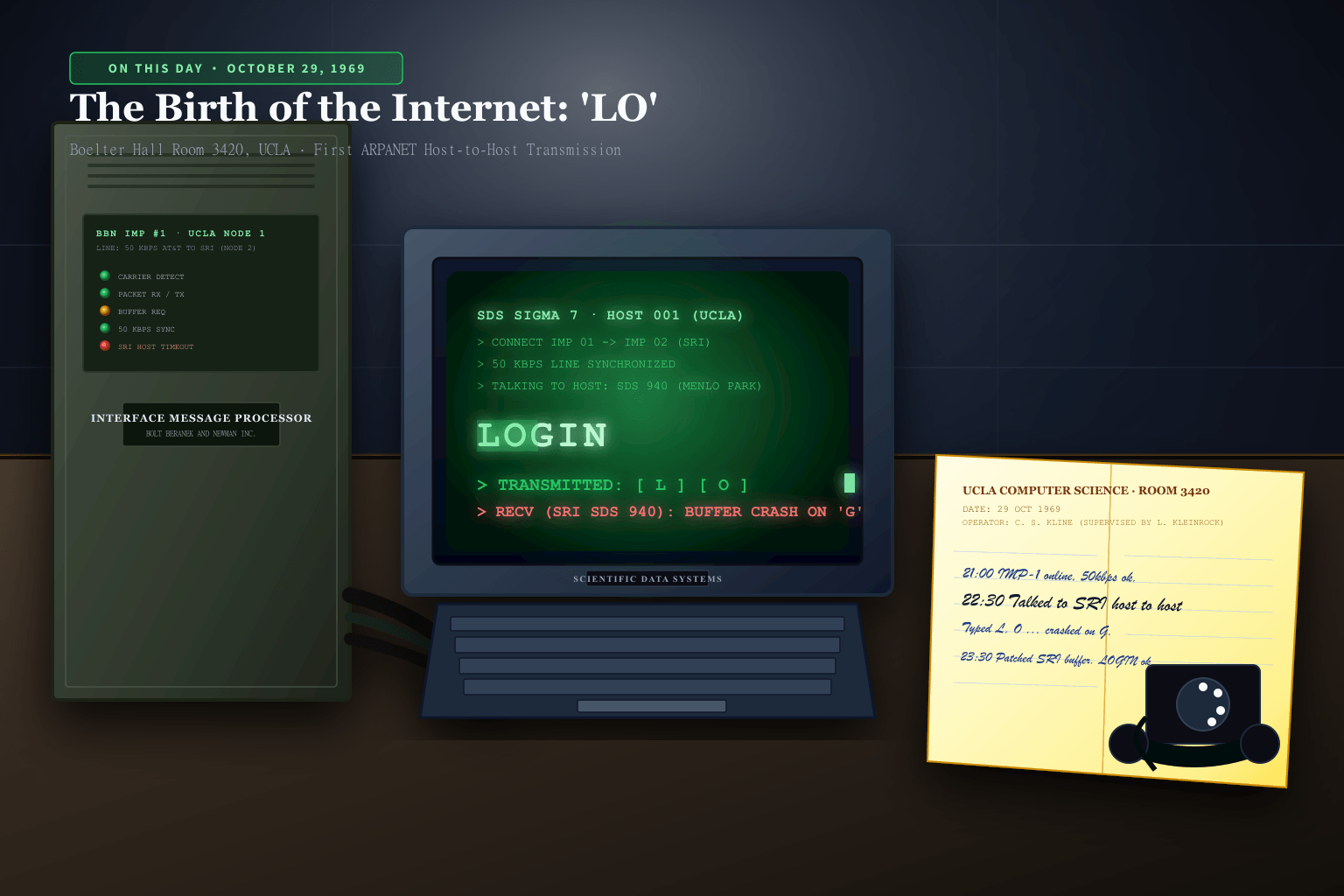
The Accidental Prophecy of LO How the First ARPANET Message on October 29, 1969 Launched the Internet
At 10:30 PM on October 29, 1969, inside Boelter Hall Room 3420 at UCLA, student programmer Charley Kline sat before an SDS Sigma 7 terminal wired to the world's first Interface Message Processor. Communicating over a telephone headset with Bill Duvall at the Stanford Research Institute 350 miles away, Kline set out to type LOGIN. He transmitted L, confirmed its arrival, transmitted O, and then pressed G—whereupon the SRI host memory buffer crashed. That accidental two-letter transmission, spelling the biblical greeting LO, inaugurated the era of packet switching and sparked the digital revolution.
Read the source-led story →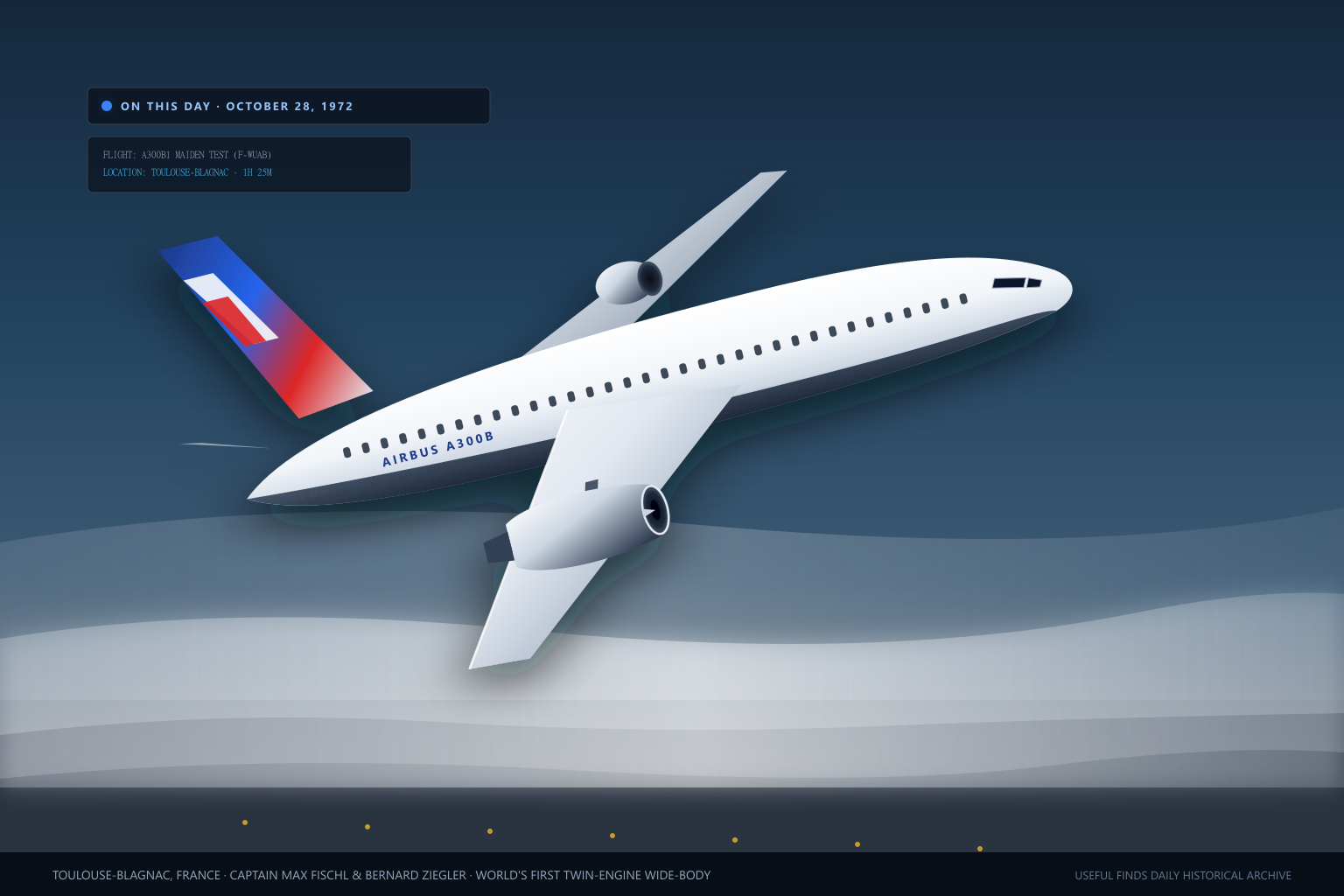
The Two-Engine Gamble That Changed Aviation How the Airbus A300B1 Shattered the Trijet Dogma and Created Modern Flying
On October 28, 1972, prototype F-WUAB lifted off from Toulouse-Blagnac into an overcast French sky, inaugurating the Airbus A300B1 as the world's first twin-engine wide-body commercial airliner. Defying American skepticism and conservative three- and four-engine airline dogma, the European consortium proved two massive high-bypass turbofans could fly intercity passenger routes with unprecedented fuel economy, laying the architectural foundation for every modern twin-engine airliner flying today.
Read the source-led story →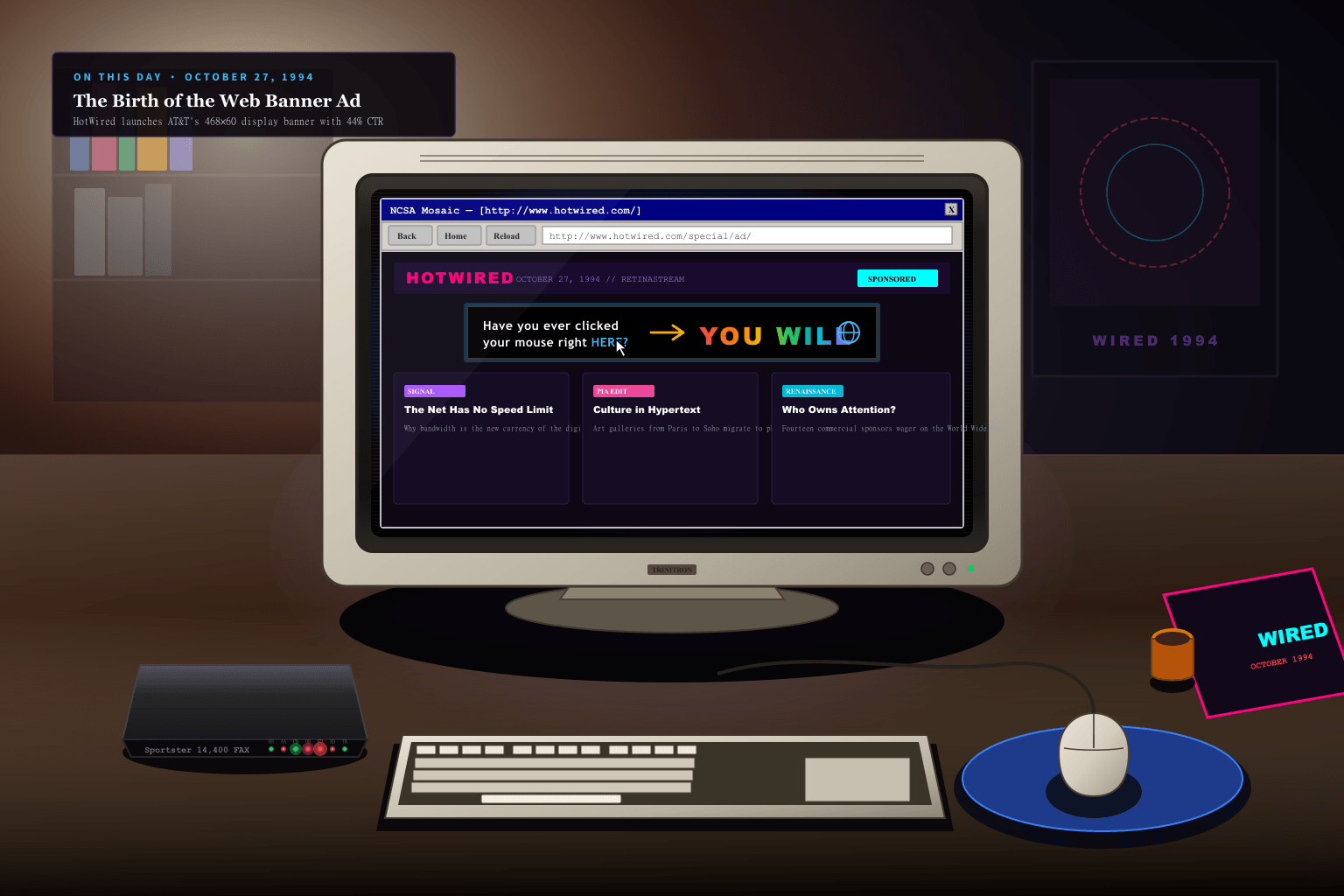
Have You Ever Clicked Your Mouse Right Here? How HotWired's 1994 Banner Ad Created the Commercial Web
On October 27, 1994, Wired's digital magazine HotWired went live with a black, rainbow-lettered rectangle from AT&T that changed the economics of human attention forever. Carrying an astonishing 44% click-through rate, the world's first web banner ad proved that the free, open internet could be monetized—unleashing three decades of digital display advertising, tracking cookies, and the attention economy.
Read the source-led story →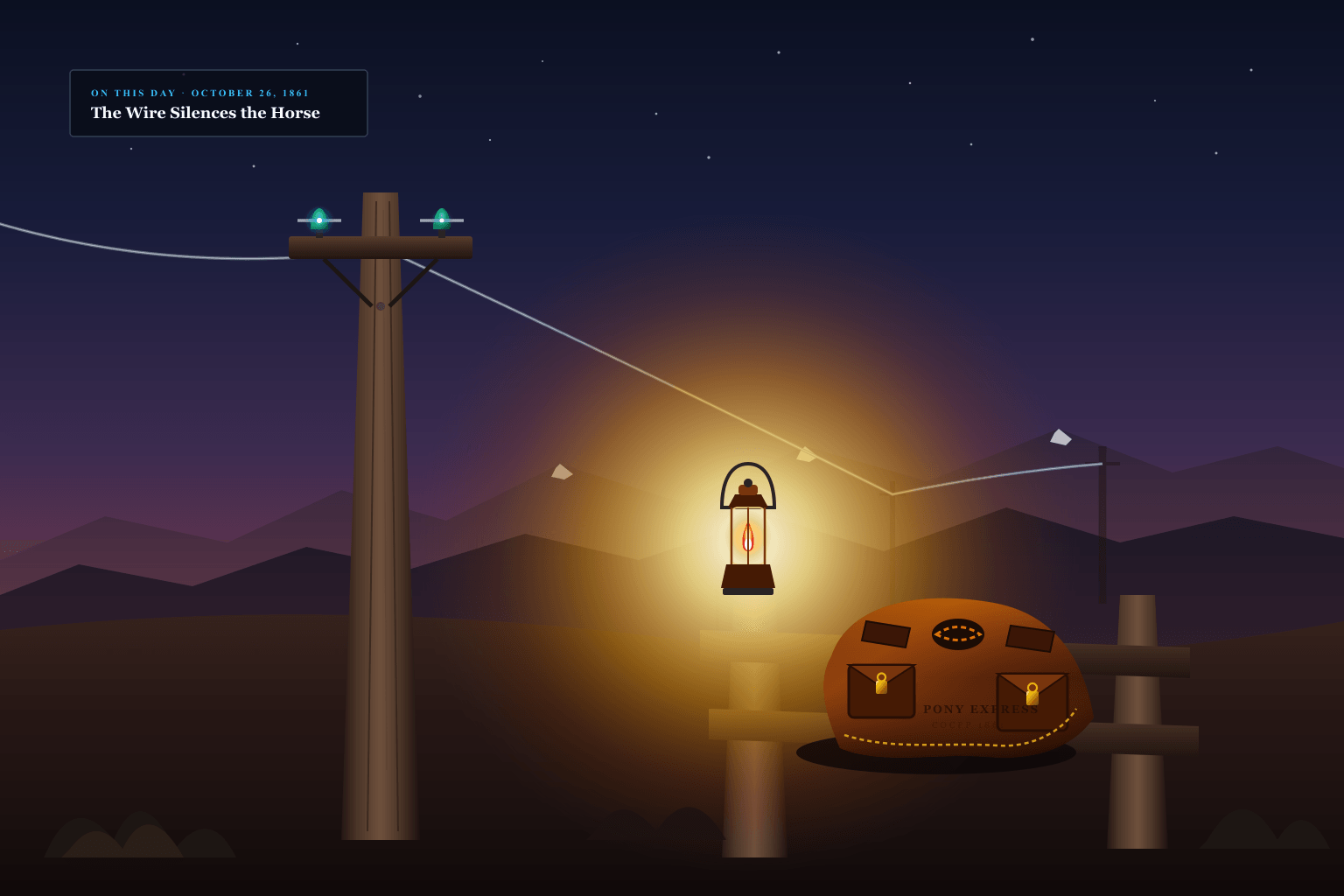
The Day the Wire Silenced the Horse: How the 1861 Transcontinental Telegraph Ended the Pony Express and Created Real-Time America
On October 26, 1861, the Central Overland California and Pikes Peak Express Company issued a terse public notice that brought the most romanticized mail experiment in American history to an abrupt close: the Pony Express was discontinued. Just two days earlier in Salt Lake City, two rival construction crews working for Western Union joined the final strands of the transcontinental telegraph, allowing electrical pulses carrying Morse code to leap from Sacramento to Washington, D.C. in seconds. For eighteen months, wiry young riders had galloped 1,900 miles across deserts, blizzards, and hostile mountain passes in ten grueling days. But when electrons began coursing down a single galvanized iron wire at the speed of light, mammalian muscle power was rendered instantly obsolete, forever severing human communication from physical transportation.
Read the source-led story →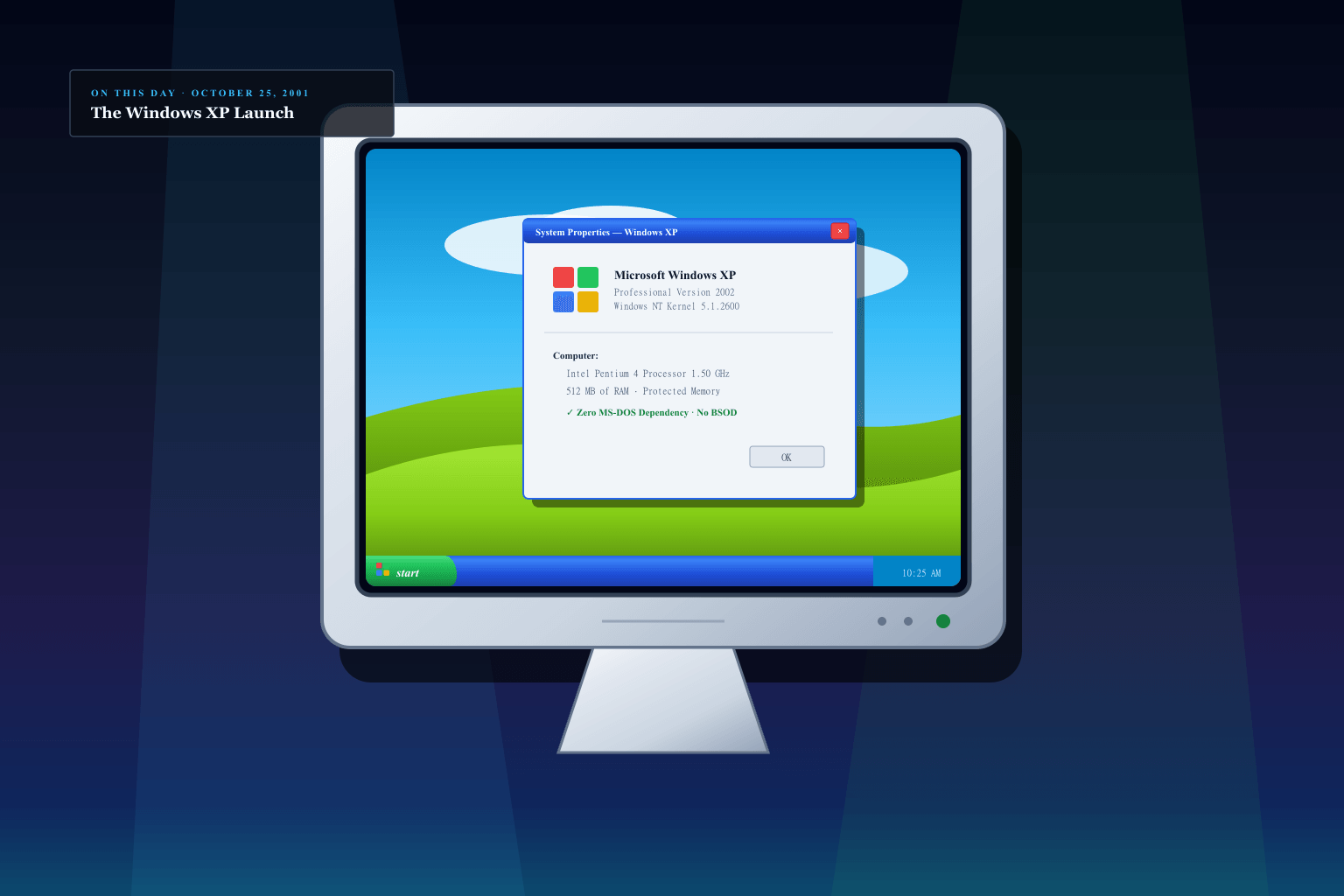
The Day the Blue Screen Vanished: How Microsoft's Windows XP Launch on October 25, 2001 United the PC World
On October 25, 2001, inside the Marriott Marquis Theater in New York's Times Square, Microsoft Chairman Bill Gates walked onto a neon-lit stage to officially launch Windows XP. Arriving barely six weeks after the September 11 terrorist attacks in a subdued, resilient Manhattan, the release marked the most significant software transition in the history of personal computing. For a decade, Microsoft had maintained a chaotic architectural split between its fragile, crash-prone MS-DOS-based consumer operating systems—Windows 95, 98, and Millennium Edition—and its rock-solid, enterprise-grade Windows NT. With Windows XP, Microsoft permanently retired the legacy MS-DOS foundation, bringing Dave Cutler's 32-bit protected-memory NT kernel to hundreds of millions of home desktops. Wrapped in the colorful 'Luna' interface, ClearType sub-pixel font smoothing, and Charles O'Rear's immortal rolling-green-hill 'Bliss' wallpaper, Windows XP virtually banished the infamous Blue Screen of Death and became the most durable desktop operating system ever created.
Read the source-led story →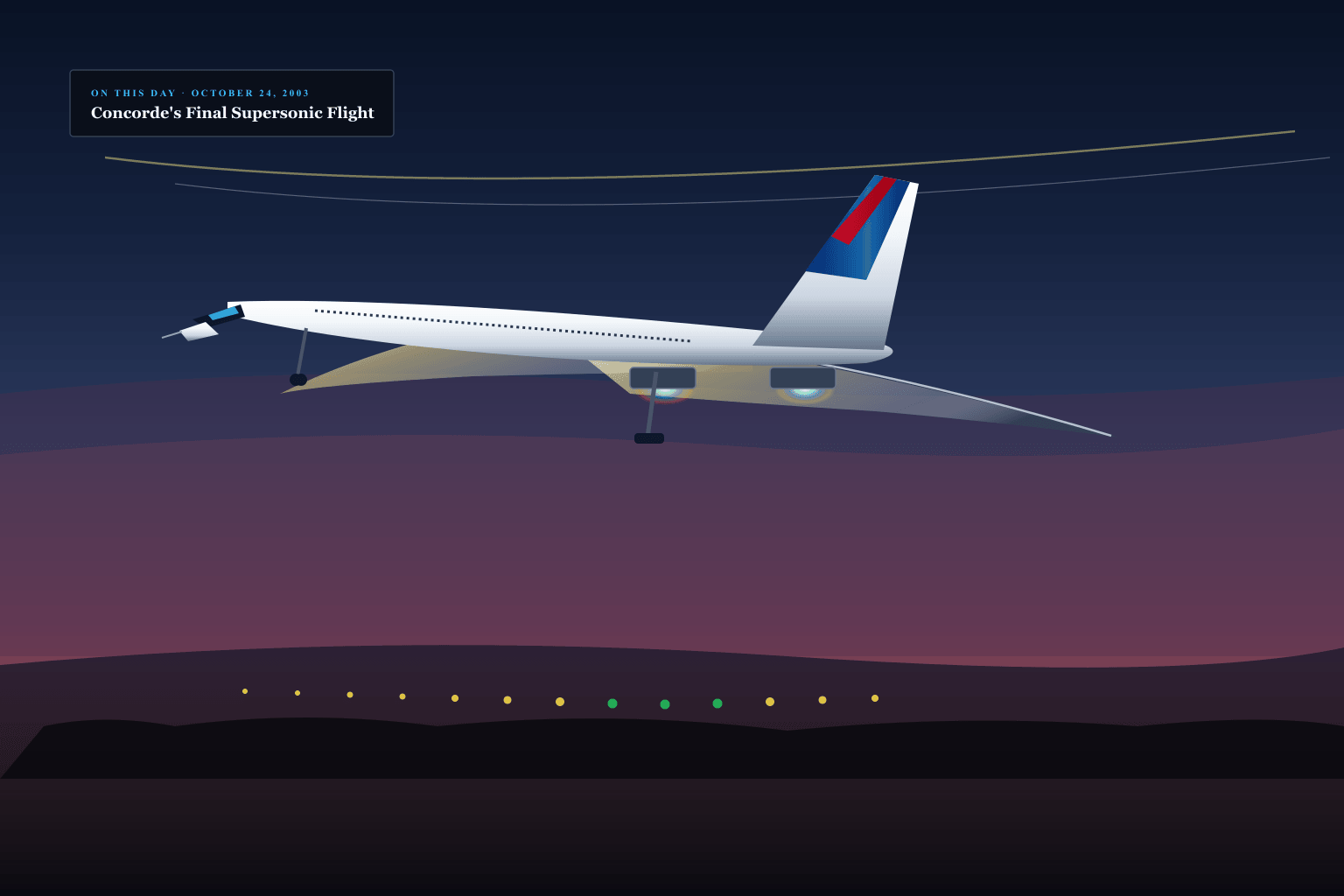
The Day Supersonic Passenger Flight Died: How Concorde's Final Commercial Landing on October 24, 2003 Closed the Speed Frontier
On October 24, 2003, at 4:05 PM, British Airways flight BA002 from New York touched down on Runway 27R at London Heathrow Airport, followed in tight formation by two companion flights from Edinburgh and the Bay of Biscay. With tens of thousands of spectators crowding perimeter fences and millions watching live television broadcasts, the graceful white delta-wing airliner taxied to a halt, bringing twenty-seven years of scheduled commercial supersonic aviation to an emotional, definitive end. Cruising at Mach 2.04—twice the speed of sound—and sixty thousand feet above the curvature of the Earth, Concorde had allowed passengers to cross the Atlantic in barely three hours and twenty minutes, racing the sun so fast that they landed hours earlier by the clock than they departed. Yet behind its peerless aerodynamic beauty and technological triumph lay fatal economic, environmental, and geopolitical realities that modern commercial aviation has never dared to repeat.
Read the source-led story →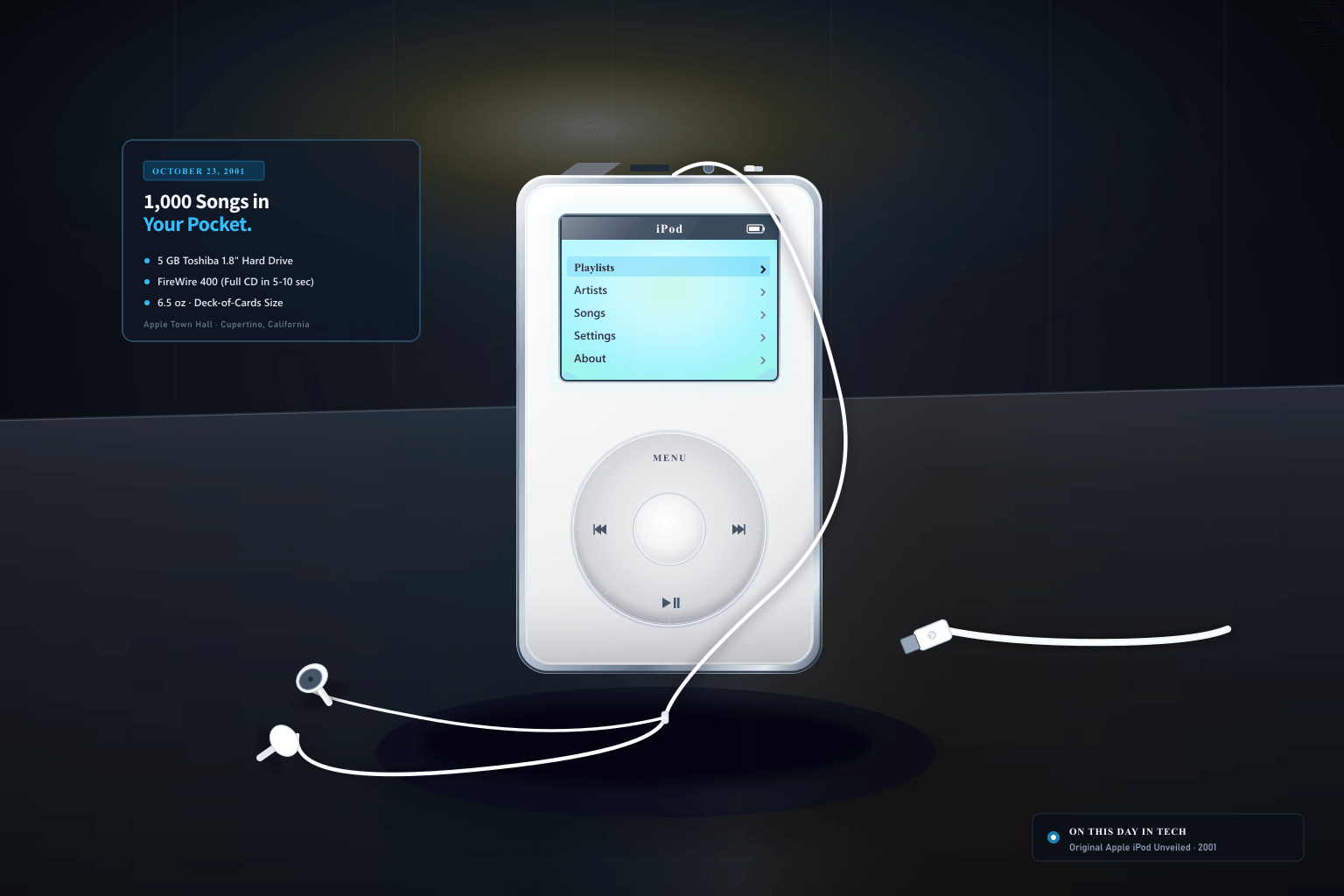
1,000 Songs in Your Pocket: How Apple's Original iPod Transformed Portable Audio and Digital Culture
On October 23, 2001, inside Apple's modest Town Hall auditorium in Cupertino, Steve Jobs reached into his jeans pocket and pulled out a sleek, deck-of-cards-sized device made of polished stainless steel and lucite white polycarbonate: the original iPod. Packing an ultra-thin 5-gigabyte Toshiba hard drive, a tactile mechanical scroll wheel, and lightning-fast FireWire syncing that transferred an entire CD in five seconds, the iPod promised '1,000 songs in your pocket.' While cynical industry pundits scoffed at its $399 price tag and Mac-only compatibility, the device sparked a consumer electronics revolution, dismantled the physical album, saved Apple from dot-com irrelevance, and created the technological, operational, and interface foundation for the modern smartphone era.
Read the source-led story →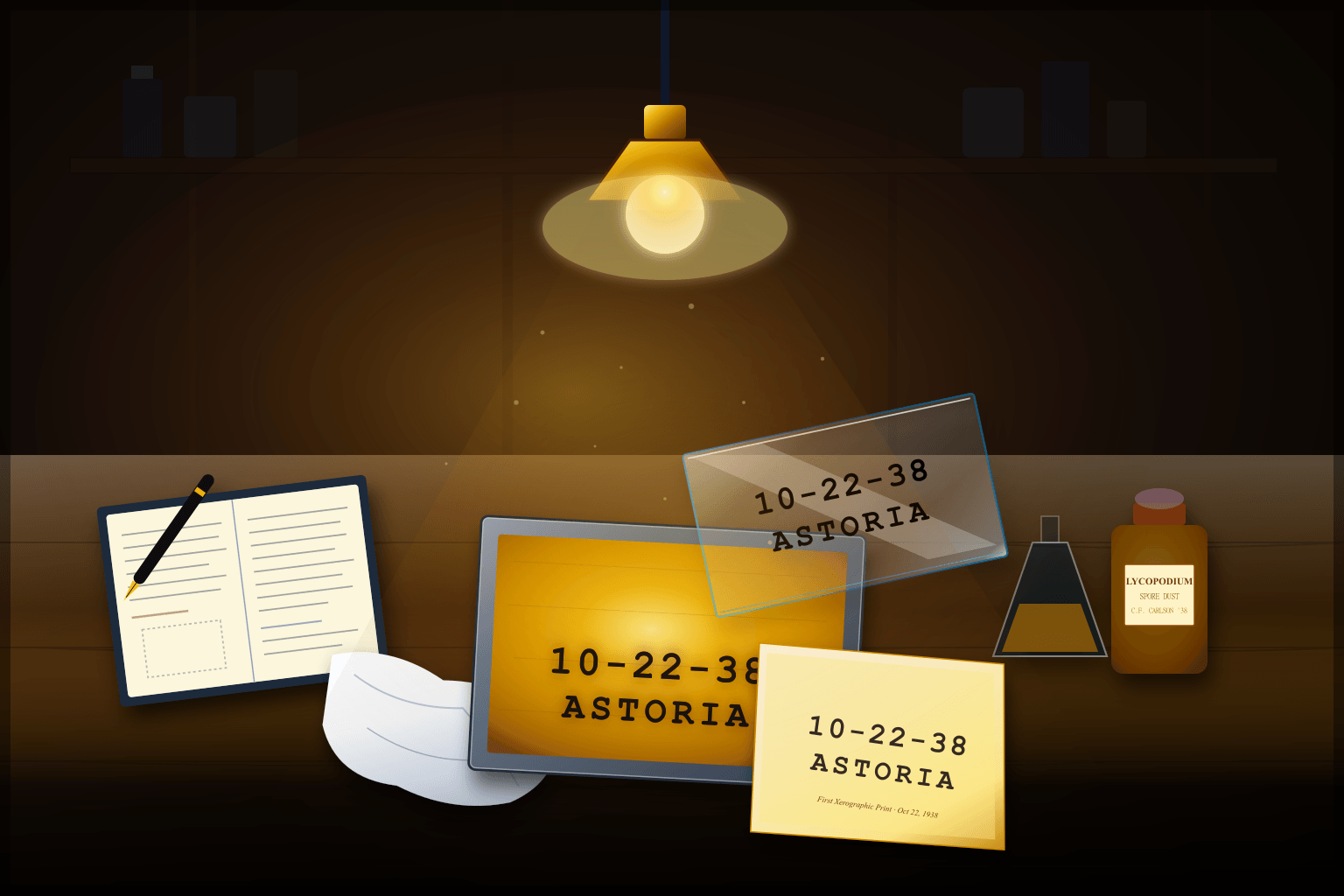
10-22-38 Astoria: How Chester Carlson's Makeshift Lab Invented Xerography and the Plain-Paper Copy
On October 22, 1938, in a rented second-floor apartment above a tavern in Astoria, Queens, an impoverished, arthritic patent attorney named Chester Carlson and Austrian refugee physicist Otto Kornei pressed an ink-inscribed glass microscope slide against a sulfur-coated zinc plate rubbed with a cotton handkerchief. Exposing the plate to an incandescent floodlamp, dusting it with clubmoss spores, and pressing it against a sheet of waxed paper over a gas flame, they created a faint brown smear bearing the immortal inscription: '10-22-38 ASTORIA'. It was the world's first successful electrophotographic copy—an unheralded experiment in 'dry writing' that defied twenty years of corporate skepticism, created the Xerox Corporation, and permanently liberated human knowledge from the tyranny of carbon paper.
Read the source-led story →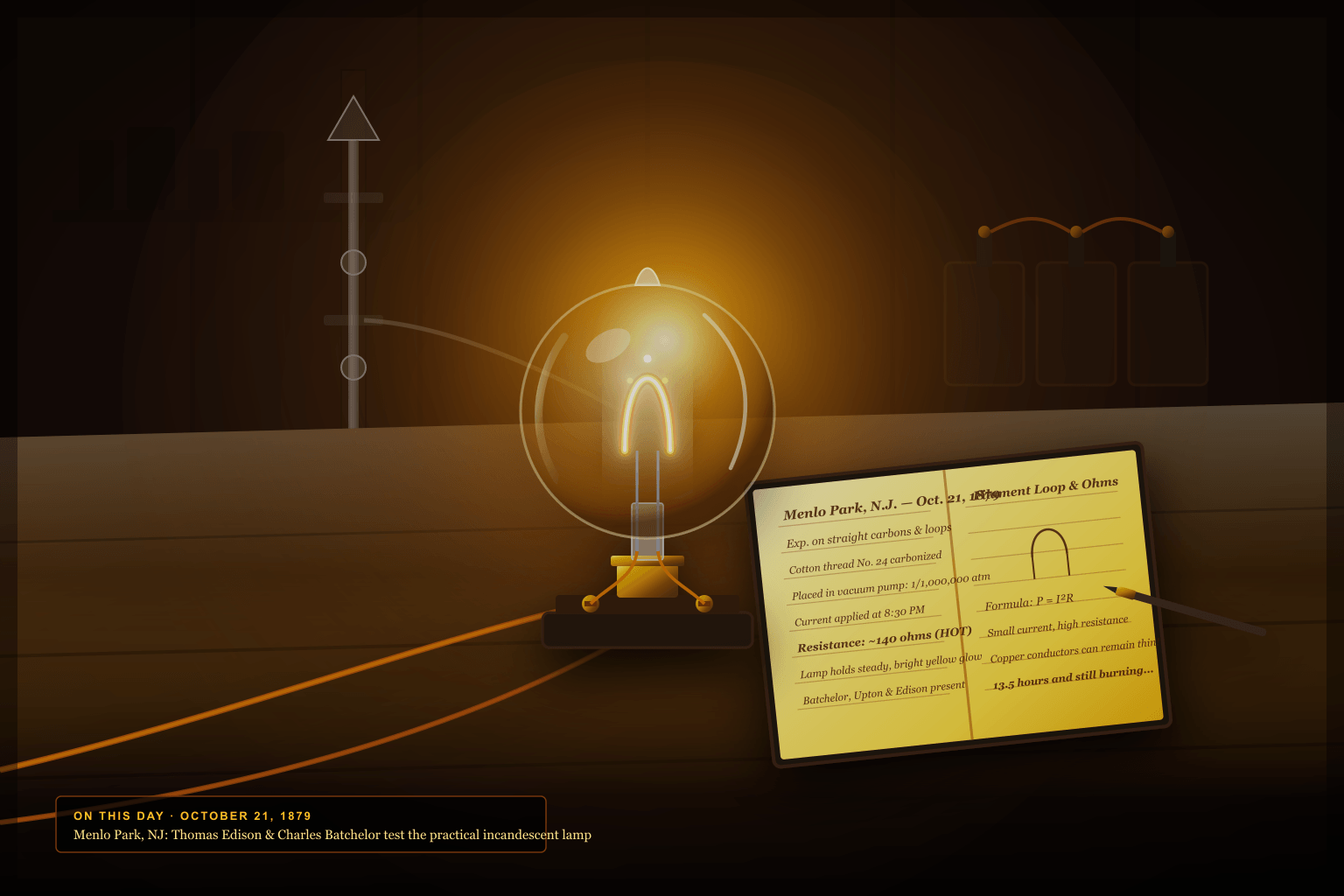
The Night the Cotton Thread Banished the Dark: How Thomas Edison's 1879 Menlo Park Breakthrough Created the Practical Incandescent Bulb
On October 21, 1879, in a dimly lit wooden laboratory in Menlo Park, New Jersey, Thomas Alva Edison and laboratory assistant Charles Batchelor connected electrical current to a fragile horseshoe filament of carbonized cotton sewing thread. Sealed inside a hand-blown glass bulb evacuated to one-millionth of an atmosphere by a Sprengel mercury pump, the delicate carbon loop began to glow with a steady, brilliant incandescent radiance that defied the dark. As the lamp burned through the night and into the following afternoon for over 13.5 continuous hours, the Menlo Park team did not merely invent a light bulb—they solved the elusive 'subdivision of electric light' and laid the engineering foundation for the centralized electric power grid that illuminates the modern world.
Read the source-led story →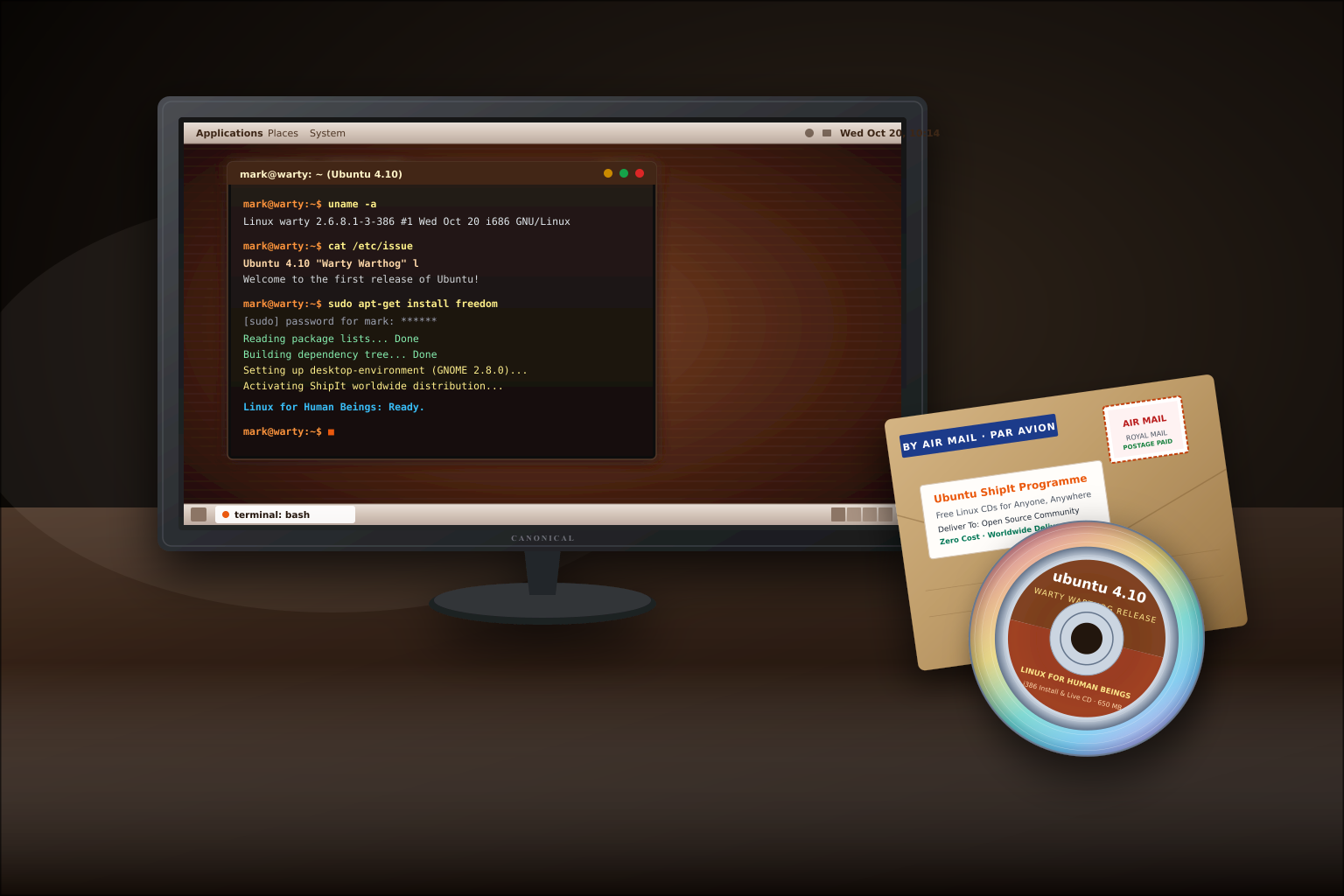
Linux for Human Beings: How the 2004 Launch of Ubuntu 4.10 Warty Warthog Democratized the Open-Source Desktop
On October 20, 2004, South African entrepreneur Mark Shuttleworth and a dedicated cadre of Debian developers unveiled Ubuntu 4.10, codenamed 'Warty Warthog.' By pairing Debian's technical foundation with a single-CD installer, polished GNOME desktop, strict six-month release cadence, and the audacious ShipIt program that mailed millions of free installation discs across the globe, Ubuntu dismantled the barriers to open-source computing and proved that Linux was truly ready for everyday human beings.
Read the source-led story →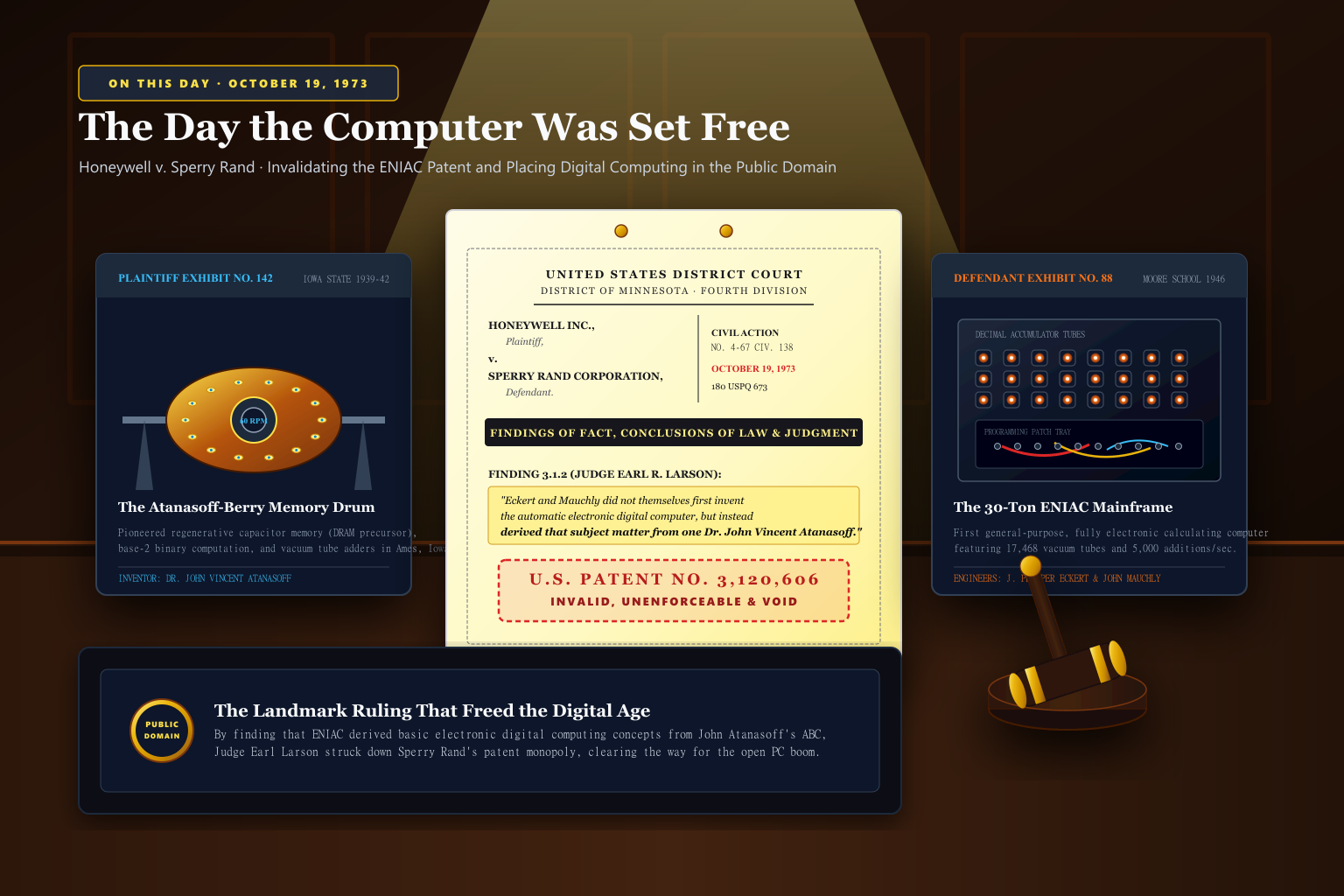
The Day the Computer Was Set Free: How the 1973 ENIAC Patent Ruling Put Digital Computing in the Public Domain
On October 19, 1973, federal judge Earl Larson struck down Sperry Rand's monopoly patent on the electronic digital computer. By ruling that the ENIAC inventors had derived their foundational ideas from physicist John Vincent Atanasoff, the decision dismantled a looming corporate tax on computing and placed digital computer architecture into the public domain on the eve of the personal computer revolution.
Read the source-led story →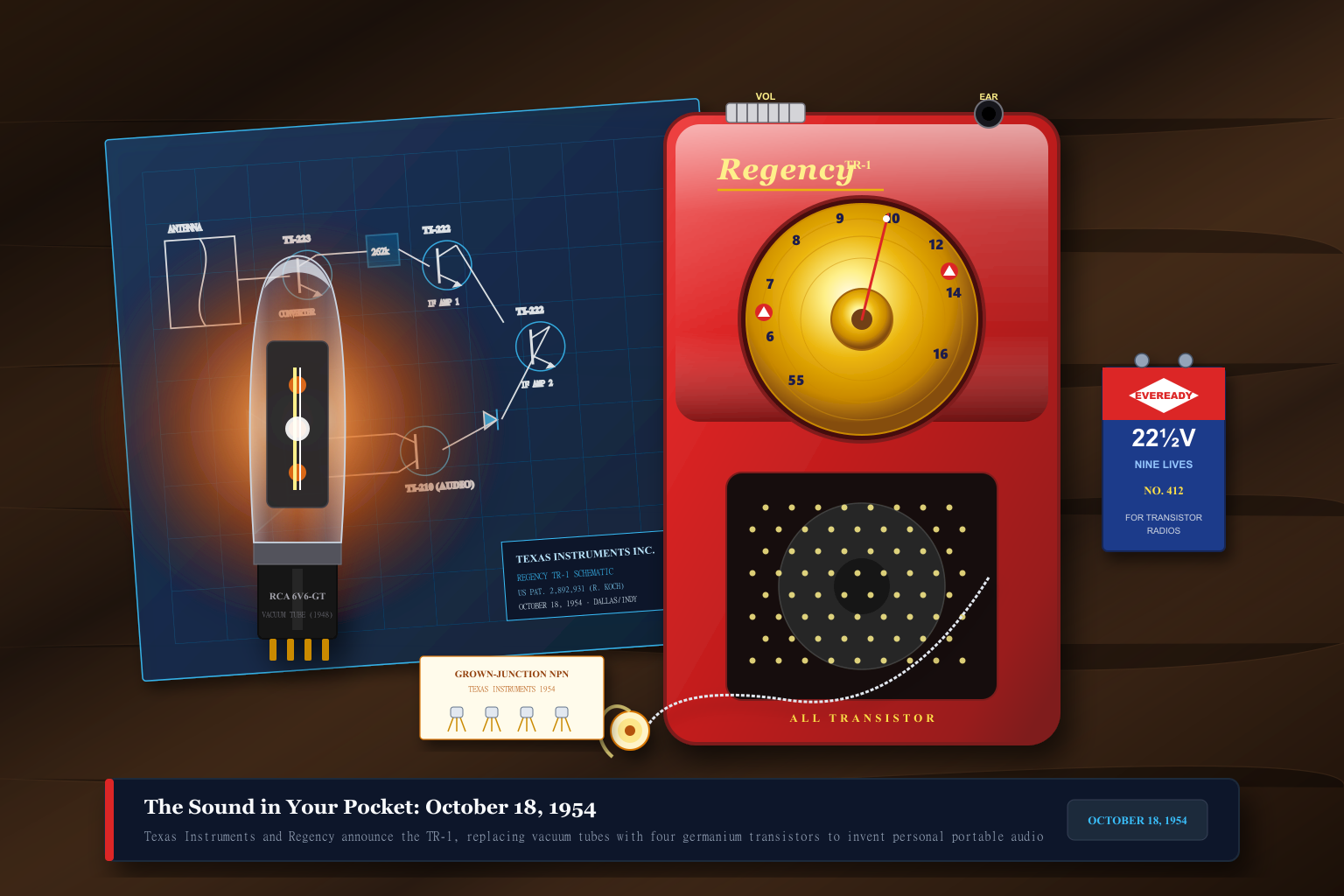
The Sound in Your Pocket: How the 1954 Regency TR-1 Transistor Radio Launched Modern Consumer Electronics
On October 18, 1954, Texas Instruments and I.D.E.A. unveiled the Regency TR-1 in Indianapolis and New York. By squeezing four tiny germanium transistors into an 11-ounce handheld chassis, engineers collapsed living-room-sized vacuum tube consoles into a pocket-sized gadget, sparking the personal electronics boom that shaped the modern world.
Read the source-led story →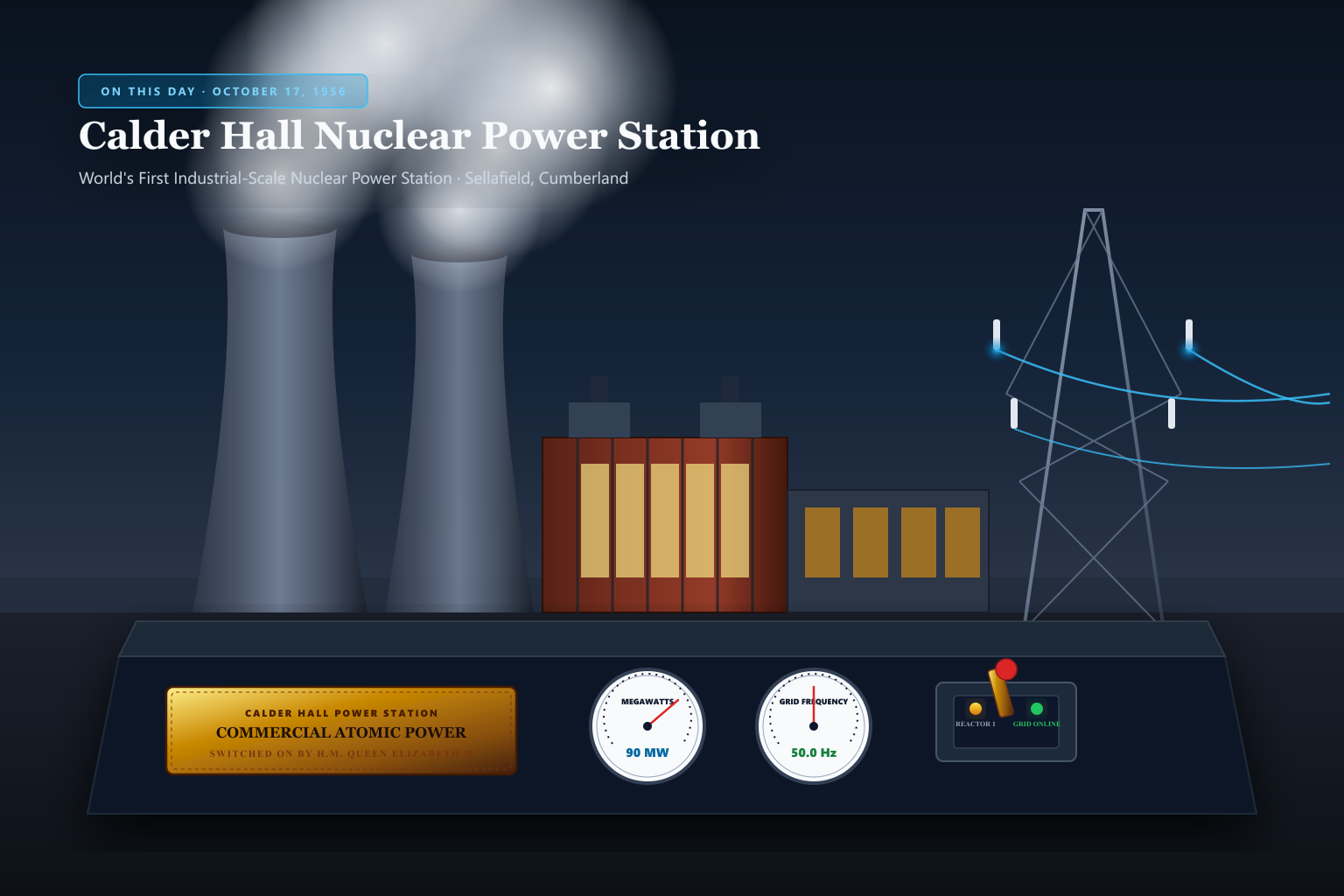
Harnessing the Atom for Peace: How Calder Hall Became the World's First Commercial Nuclear Power Station
On October 17, 1956, Queen Elizabeth II pushed a modest lever inside the brick control room at Sellafield, Cumberland, officially connecting Calder Hall Power Station to the British National Grid. As dials jumped and 90 megawatts of atomic electricity surged into homes and factories, humanity crossed a monumental threshold: the terrifying destructive energy of the atom had finally been harnessed to generate commercial electricity on an industrial scale.
Read the source-led story →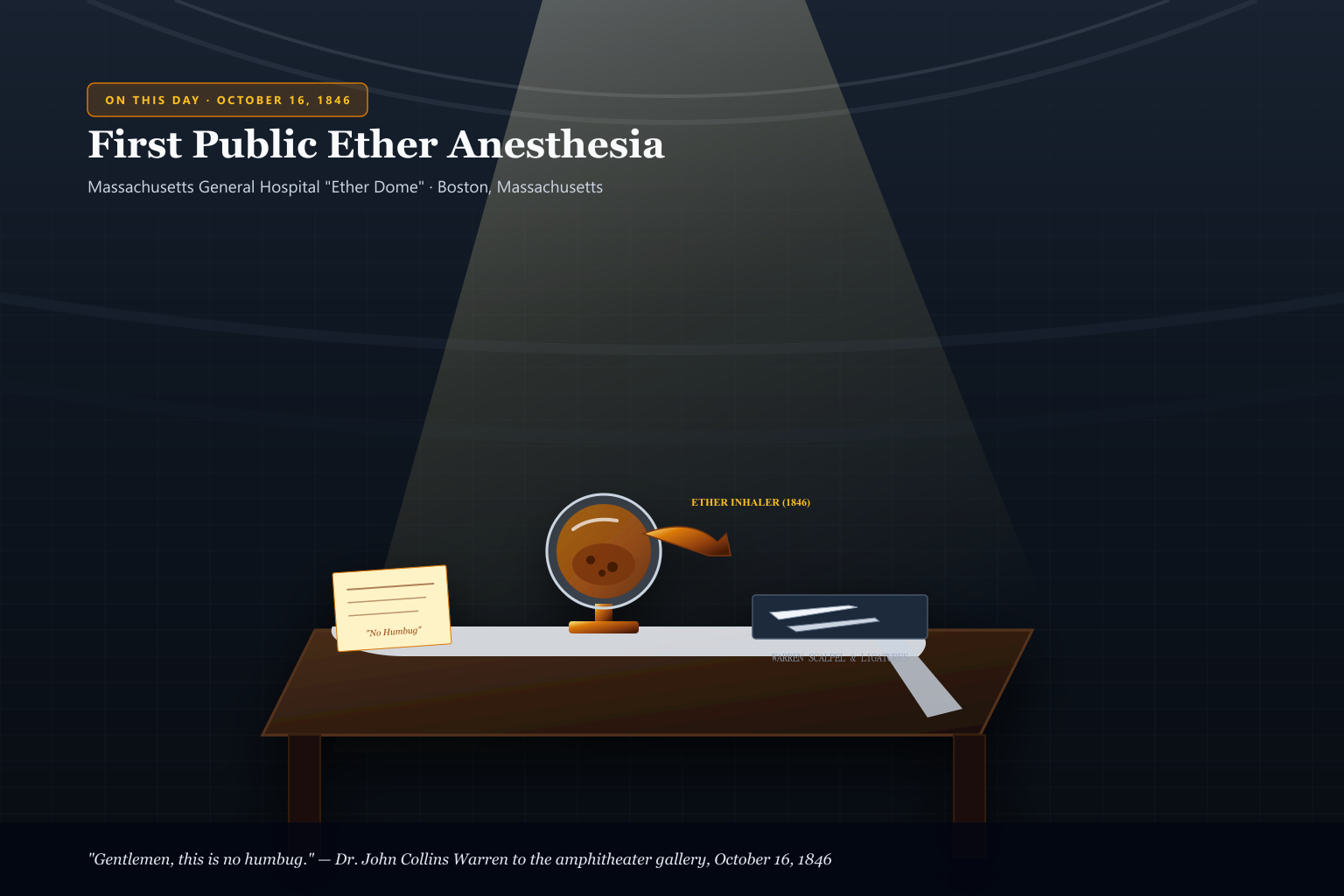
Gentlemen, This Is No Humbug: The 1846 Boston Ether Demonstration That Banished Surgical Pain
Before October 16, 1846, surgical speed was the only painkiller and operations were horrifying endurance ordeals. At Massachusetts General Hospital's Ether Dome, a Boston dentist and a skeptical chief surgeon successfully administered vaporized diethyl ether to Edward Abbott—banishing surgical agony and proving to a stunned medical world that painless healing was truly possible.
Read the source-led story →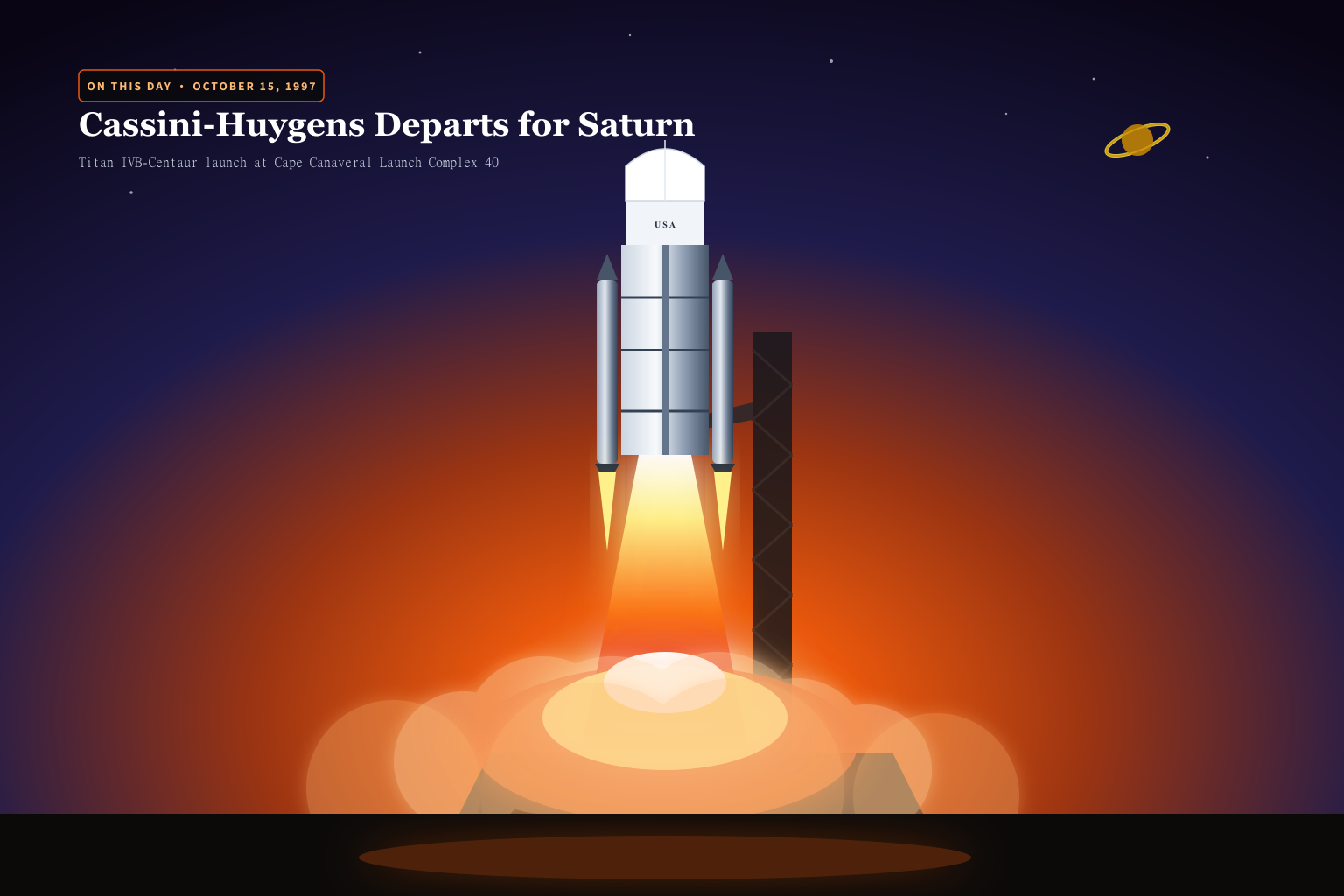
72 Pounds of Plutonium to Saturn: How the Cassini-Huygens Launch Overcame Nuclear Outcry
On October 15, 1997, atop the roaring twin solid boosters of a Titan IVB-Centaur rocket at Cape Canaveral, the six-ton Cassini-Huygens spacecraft thundered into the Florida pre-dawn sky. Carrying 72.3 pounds of plutonium-238 to survive the frigid darkness of the outer solar system, the mission faced down intense global anti-nuclear demonstrations, survived legal injunctions, and embarked on a seven-year, 2.2-billion-mile gravity-assist voyage that fundamentally transformed humanity's understanding of Saturn, its majestic rings, and its ocean moons.
Read the source-led story →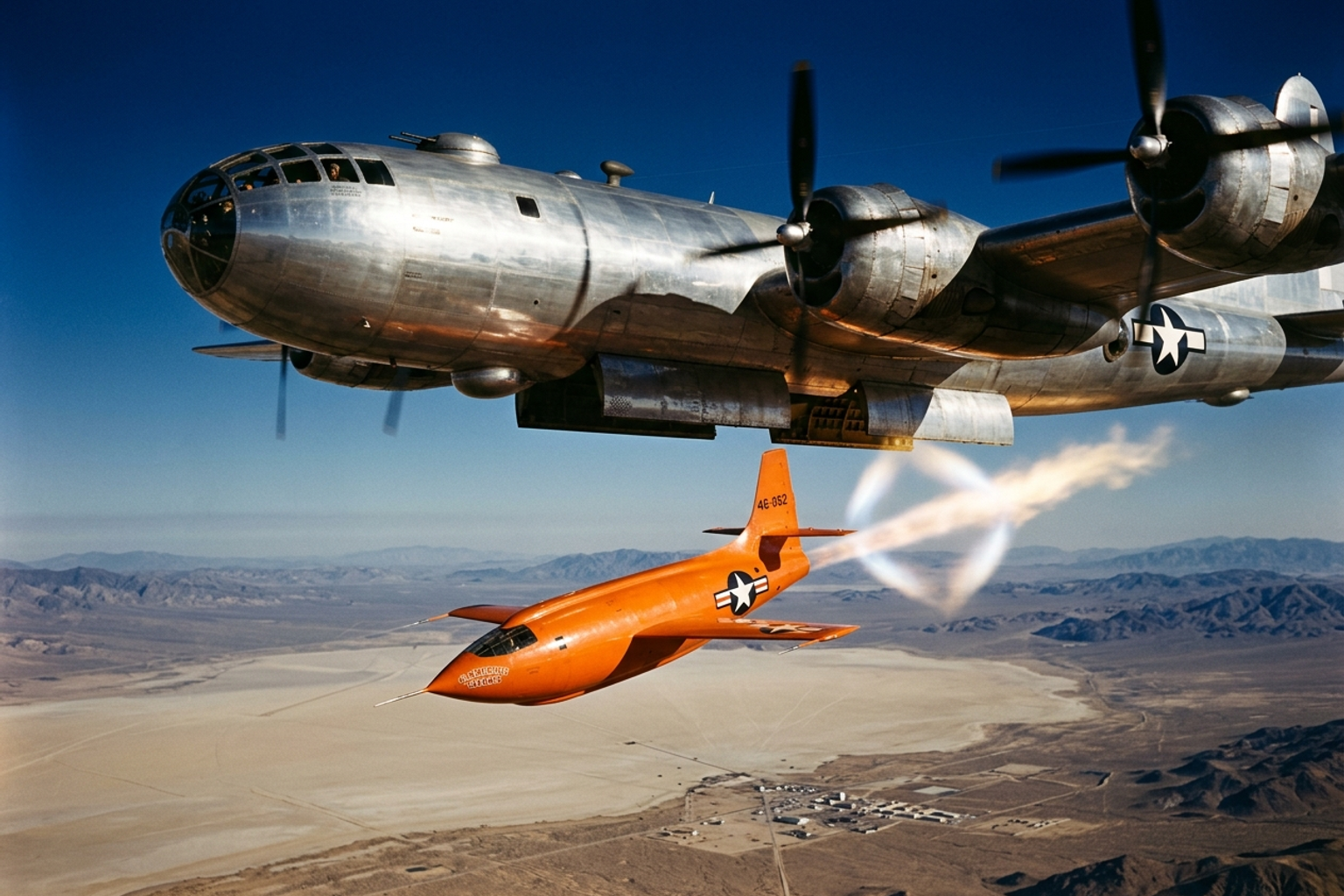
Mach 1 in the High Desert: How Chuck Yeager Broke the Sound Barrier with Two Broken Ribs
On October 14, 1947, strapped into the cramped cockpit of the rocket-powered Bell X-1 Glamorous Glennis with two taped-up broken ribs and a makeshift broomstick lever, 24-year-old Captain Chuck Yeager was dropped from a B-29 at 20,000 feet over California's Mojave Desert. Accelerating under four rocket chambers to Mach 1.06 at 43,000 feet, Yeager shattered the mythical 'sound barrier' and proved that human flight could survive transonic compressibility.
Read the source-led story →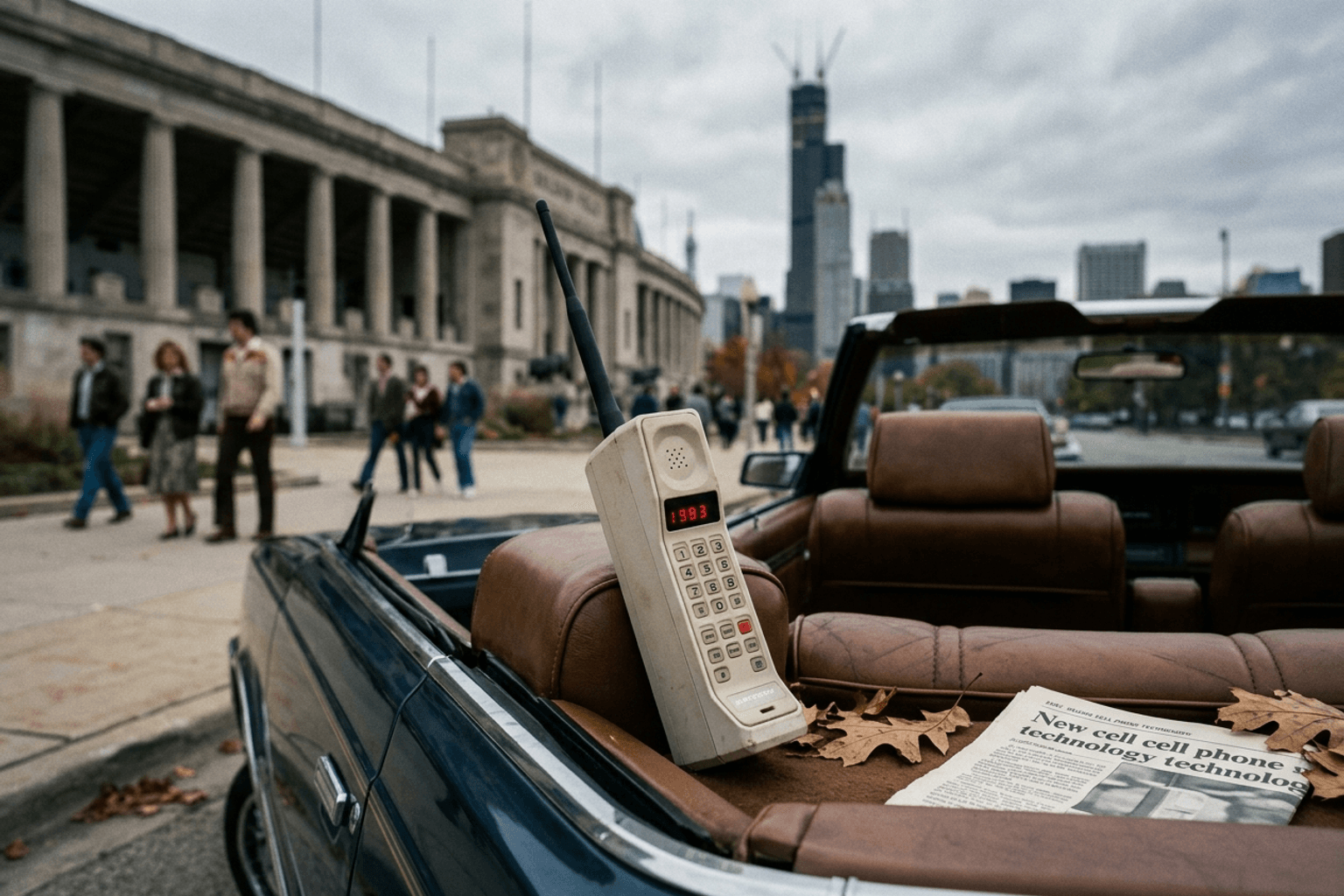
The $3,995 Brick: How the First Commercial Cell Phone Call Rewrote Telecommunications
On October 13, 1983, seated in a Chrysler convertible outside Chicago's Soldier Field, Ameritech Mobile Communications president Bob Barnett dialed the telephone inventor's descendant in Germany using a 28-ounce Motorola DynaTAC 8000X. Priced at $3,995 with 30 minutes of battery life, the handheld 'brick' and Ameritech's first 1G cellular network ended a century of physical wireline tethering.
Read the source-led story →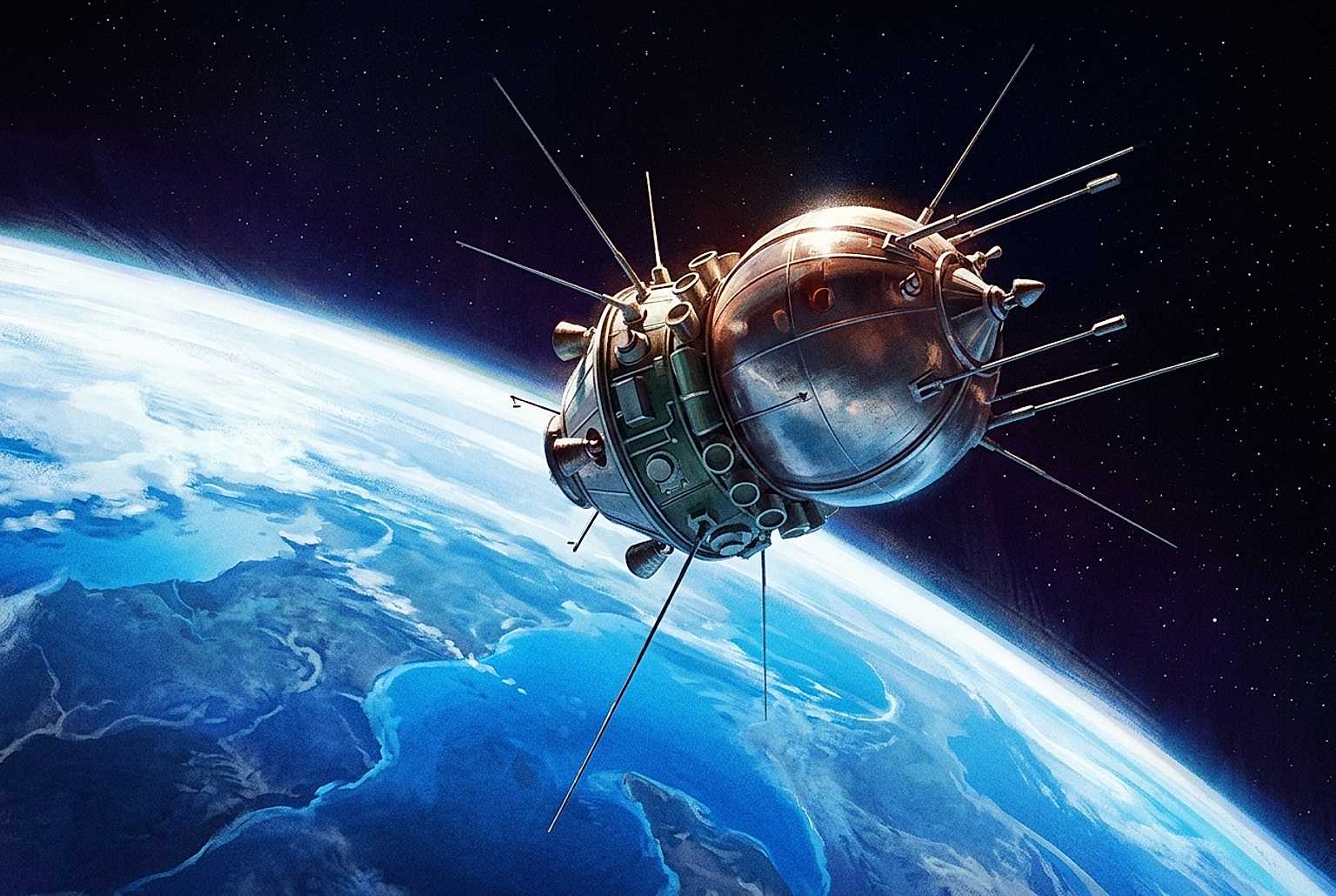
Three Men, Zero Spacesuits: How the Voskhod 1 Gamble Stunned the World
On October 12, 1964, the Soviet Union launched Voskhod 1 from Baikonur Cosmodrome, achieving humanity's first multi-person spaceflight. To beat NASA's upcoming two-man Project Gemini, Chief Designer Sergei Korolev stripped a single-seat Vostok capsule of its heavy ejection seat, squeezed three men into a 2.3-meter sphere without spacesuits, and flew the mission with zero launch escape system. The audacious 24-hour orbital mission stunned the Western world, even as Soviet Premier Nikita Khrushchev was being ousted from power back in Moscow.
Read the source-led story →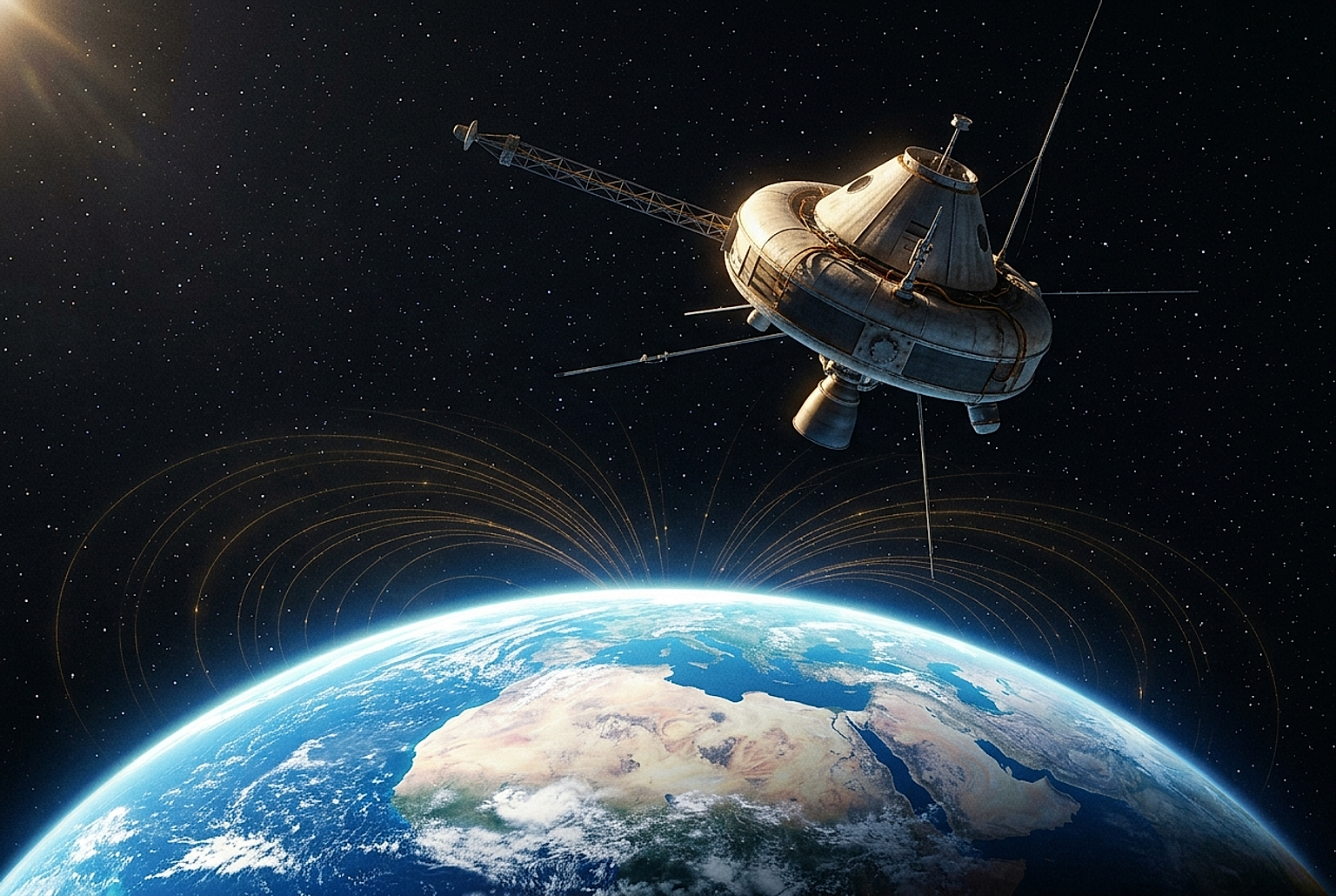
Missed the Moon, Founded an Agency: How Pioneer 1 Launched NASA into Deep Space
On October 11, 1958—just ten days after opening its doors—NASA launched its very first spacecraft atop a Thor-Able rocket at Cape Canaveral. Intended to orbit the Moon, Pioneer 1 suffered a minor booster guidance error that left it short of escape velocity. Yet instead of a catastrophe, its 43-hour, 70,700-mile ballistic journey returned the first deep-space radiation mapping of the Van Allen belts, discovered hydromagnetic oscillations in Earth's magnetosphere, and proved that a fledgling civilian agency could navigate the cosmos.
Read the source-led story →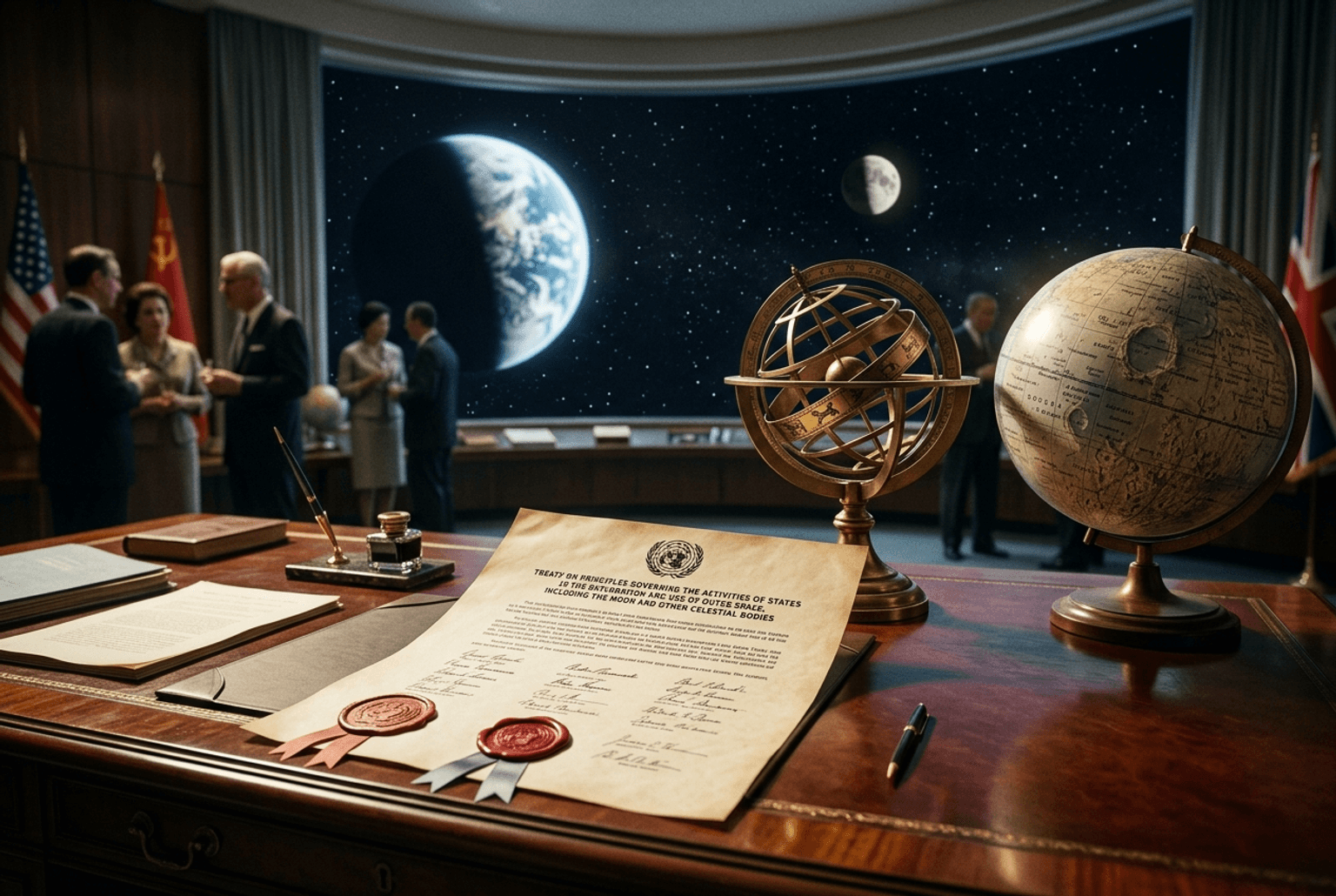
Why Nobody Owns the Moon: How the 1967 Outer Space Treaty Kept the Cold War Out of the Cosmos
On October 10, 1967, the foundational constitution of international space law officially took effect. Negotiated at the height of the Apollo race and the Cold War, the Outer Space Treaty barred weapons of mass destruction from orbit, established celestial bodies as the province of all mankind, and permanently prevented Earth's superpowers from carving up the Moon into sovereign real estate.
Read the source-led story →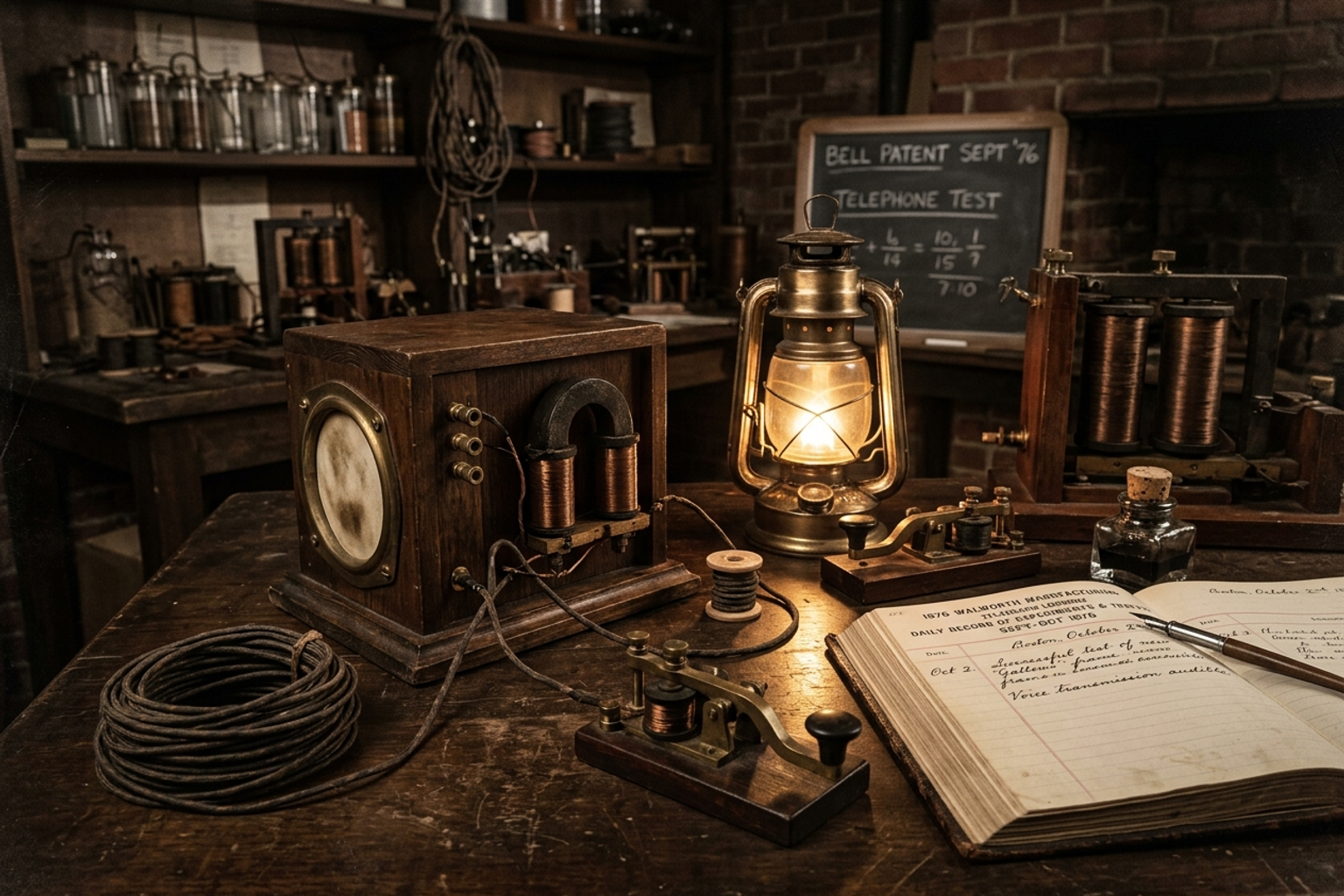
The Call That Conquered Distance: How Bell and Watson Conducted the First Two-Way Outdoor Telephone Conversation
On October 9, 1876, Alexander Graham Bell and his assistant Thomas A. Watson stepped out of their laboratory and onto the roof of telecommunications history. Connecting two early wooden box telephones to a borrowed two-mile telegraph wire of the Walworth Manufacturing Company between Boston and Cambridgeport, they overcame stubborn circuit resistance to conduct the world's first sustained, two-way outdoor conversation—proving that human speech could conquer open geographical distance.
Read the source-led story →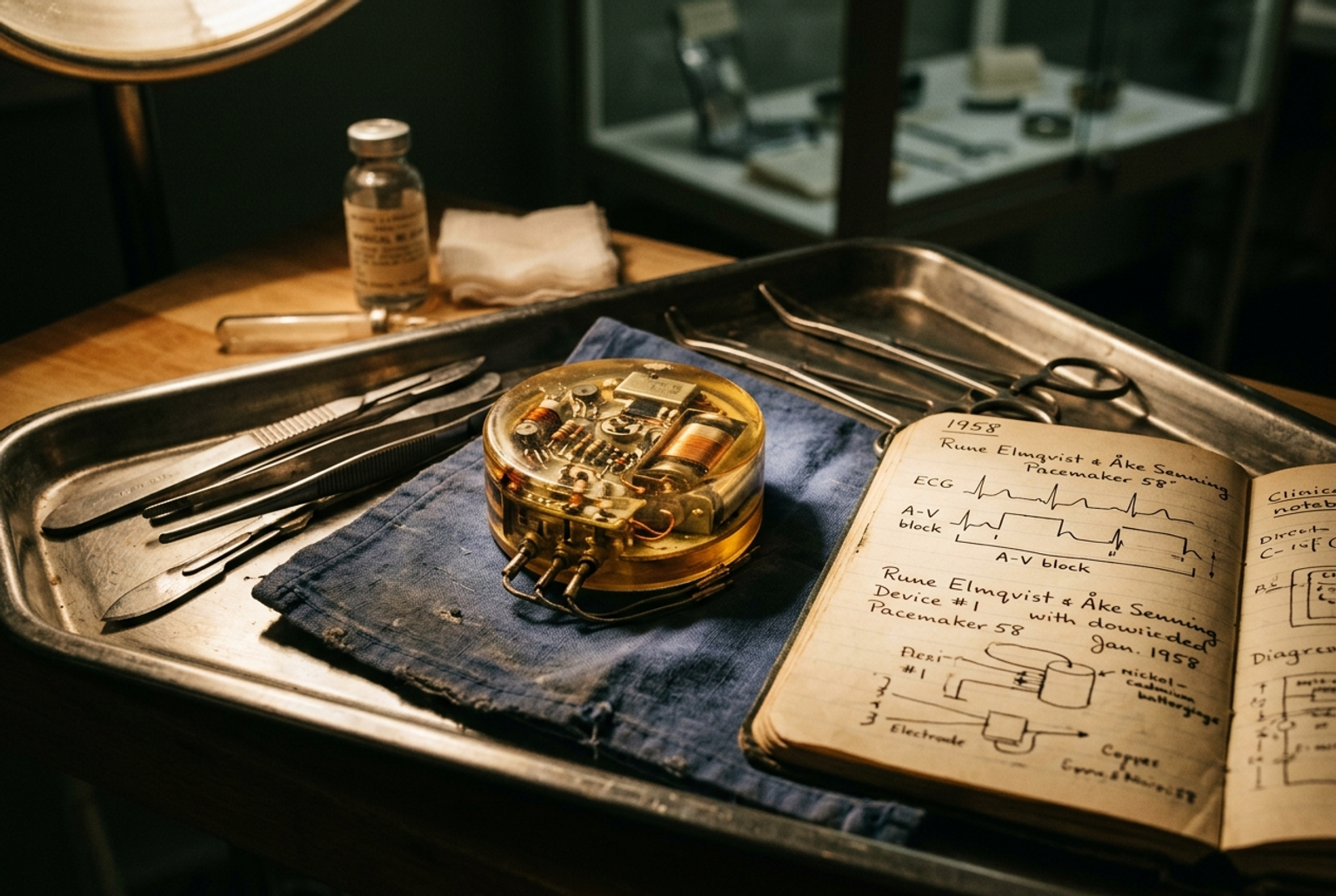
A Heartbeat on Two Transistors: How Rune Elmqvist and Åke Senning Implanted the World's First Cardiac Pacemaker
On October 8, 1958, at Stockholm's Karolinska Hospital, cardiac surgeon Åke Senning made medical history by implanting a miniature, battery-powered pulse generator designed by engineer Rune Elmqvist into 43-year-old Arne Larsson. Encased in hand-poured epoxy resin within a simple plastic cup, the crude device failed after just three hours—yet it ignited the modern bioelectronics revolution, kept Larsson alive for another 43 years across 26 replacement devices, and proved that human organs could be sustained from within.
Read the source-led story →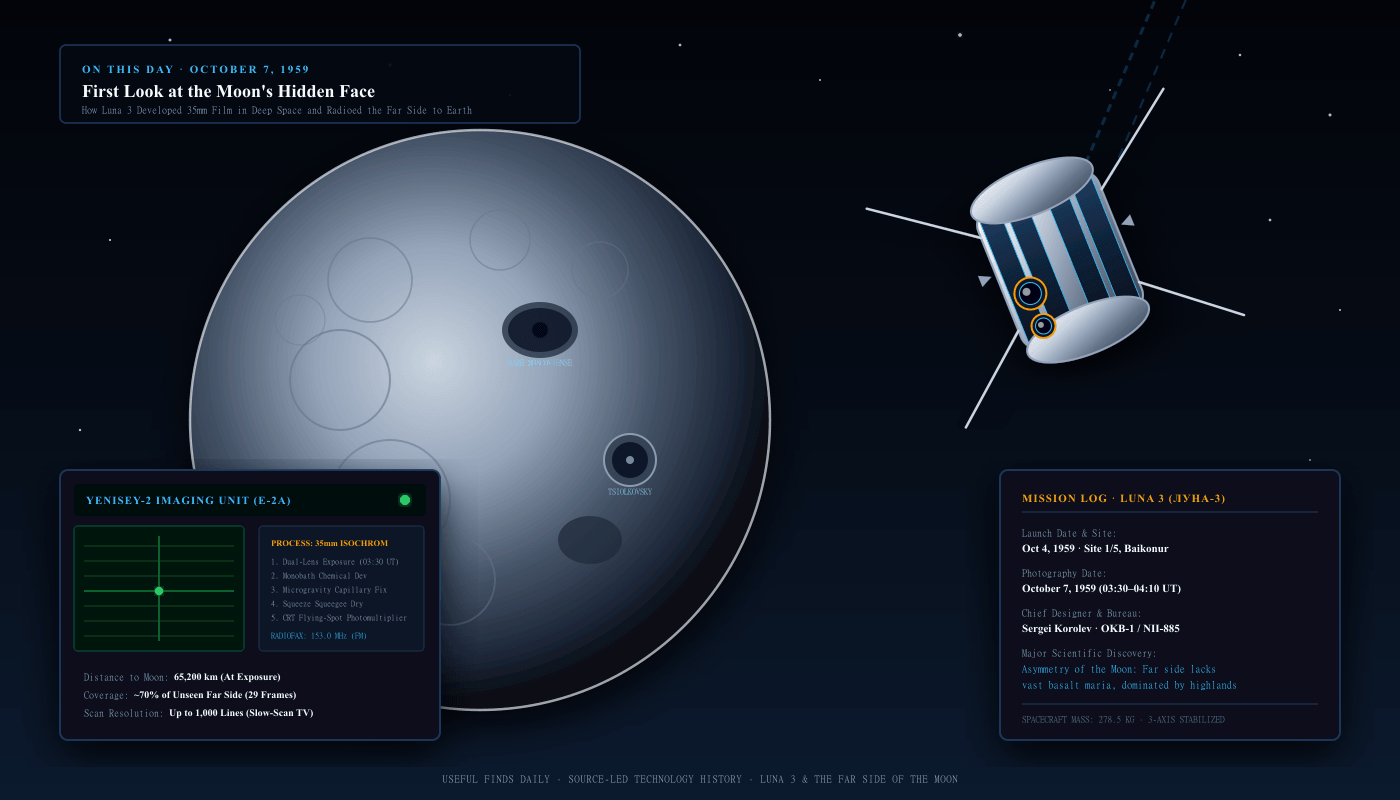
First Look at the Moon's Hidden Face: How Luna 3 Developed 35mm Film in Deep Space and Radioed the Far Side to Earth
On October 7, 1959, Soviet probe Luna 3 performed one of the most audacious automated engineering feats in aerospace history. Flying past the Moon's unseen hemisphere, the 278-kilogram spacecraft locked onto lunar sunlight, exposed radiation-resistant 35mm film, developed and dried the negatives in a miniaturized onboard chemical lab, and transmitted the first radiofacsimile scan of the lunar far side across 400,000 kilometers of deep space.
Read the source-led story →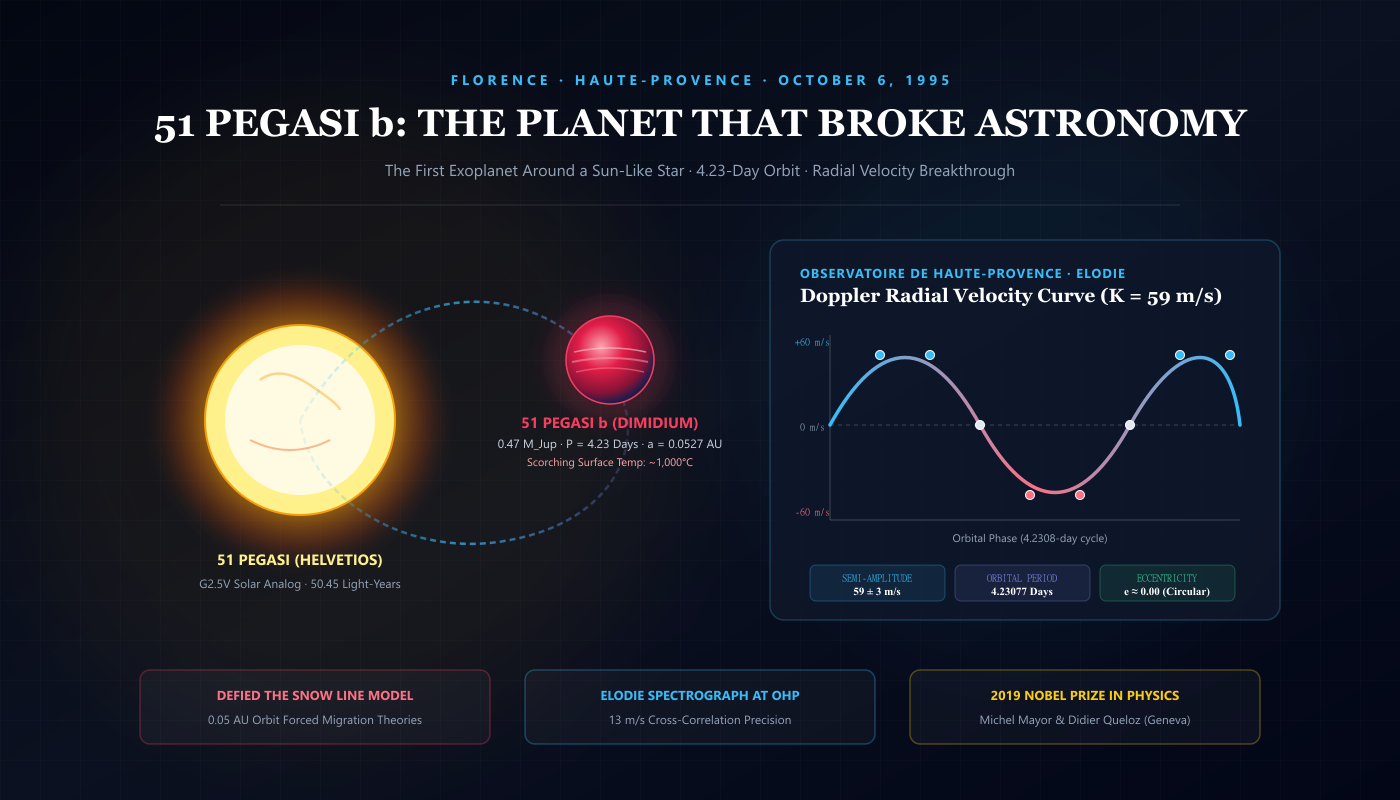
The Planet That Broke Astronomy: How the Discovery of 51 Pegasi b Rewrote Planetary Science and Launched the Exoplanet Era
On October 6, 1995, Swiss astronomers Michel Mayor and Didier Queloz announced the detection of 51 Pegasi b at a stellar astrophysics conference in Florence. Orbiting its Sun-like host star in just 4.23 days at scorching proximity, this unexpected 'hot Jupiter' defied prevailing planetary formation models, forced a revolution in orbital migration physics, and opened humanity's window onto thousands of alien worlds.
Read the source-led story →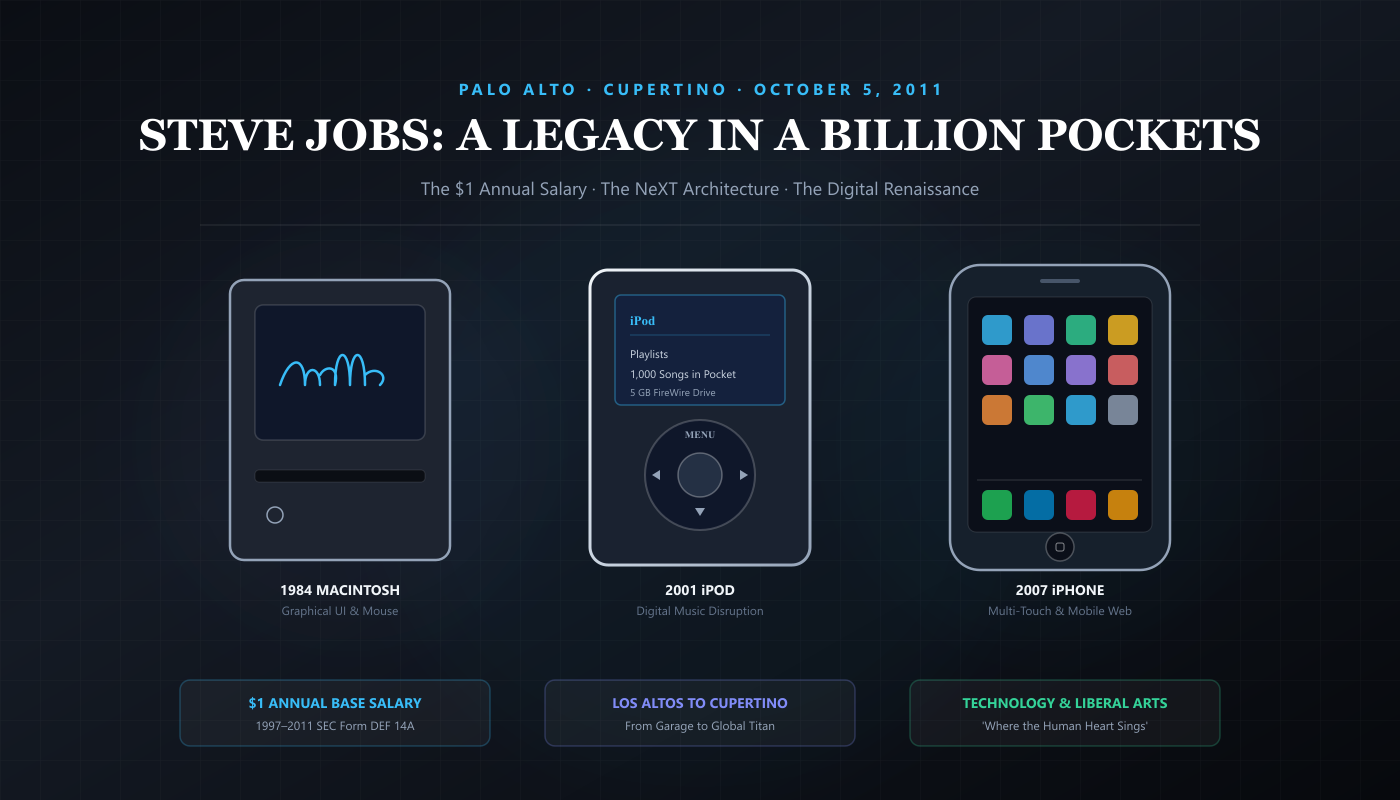
$1 a Year, a Jet, and a Legacy: How Steve Jobs Put a Computer in a Billion Pockets and Redefined Modern Technology
On October 5, 2011, Apple announced the passing of Steve Jobs at age 56. Taking an official salary of just $1 a year after his 1997 return, the exacting visionary fused calligraphy, Unix architecture, and minimalist industrial design to turn personal computing from a hobbyist niche into a pocket-sized extension of human thought. Here is the verified history behind his transformative legacy.
Read the source-led story →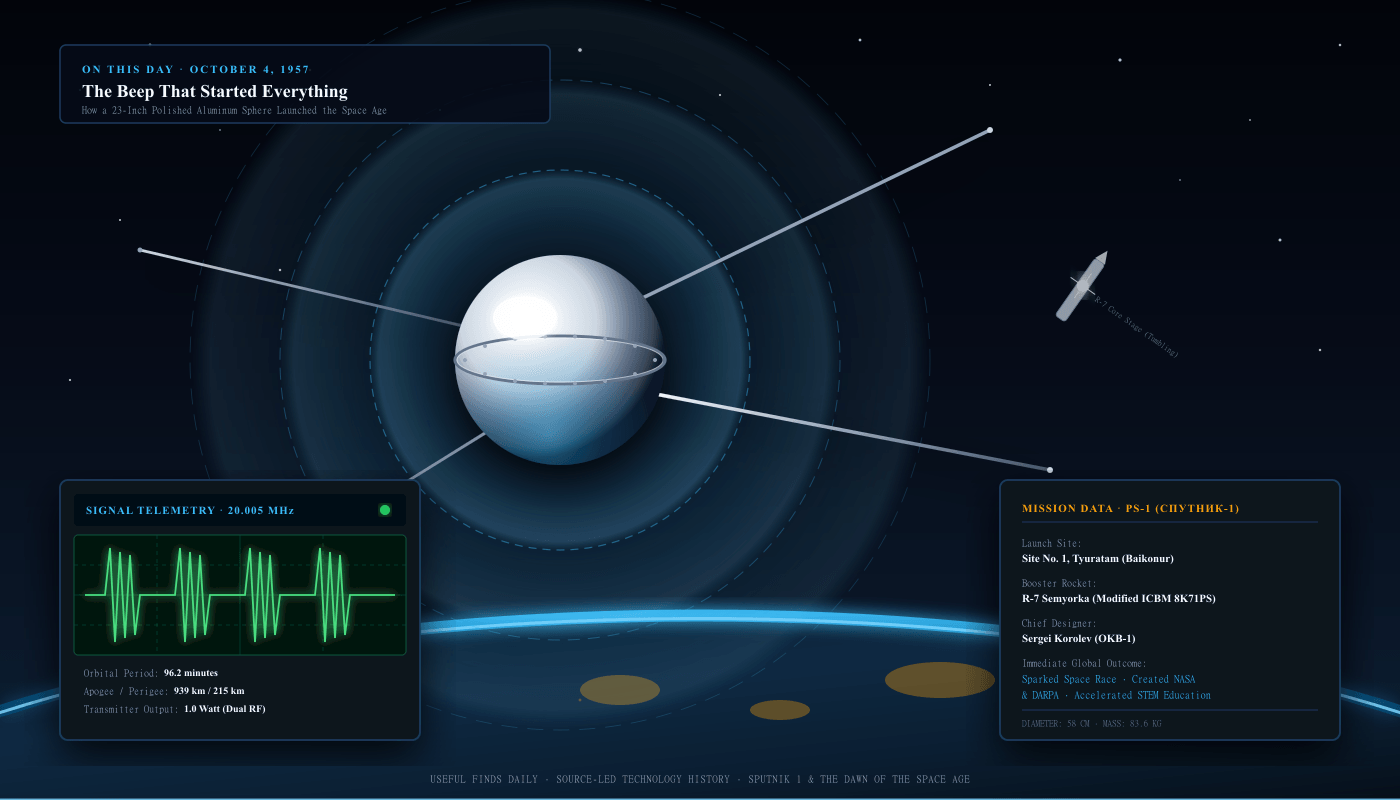
The Beep That Started Everything: How a 23-Inch Polished Aluminum Sphere Launched the Space Age and Created NASA
Before October 4, 1957, outer space belonged to science fiction. When an 83.6-kilogram polished aluminum sphere began transmitting its rhythmic 20-megahertz pulse from orbit, it triggered a geopolitical shockwave, created NASA and DARPA, and ignited the modern technological race. Here is the verified engineering history behind Sergei Korolev's minimalist masterpiece and the myths that still surround it.
Read the source-led story →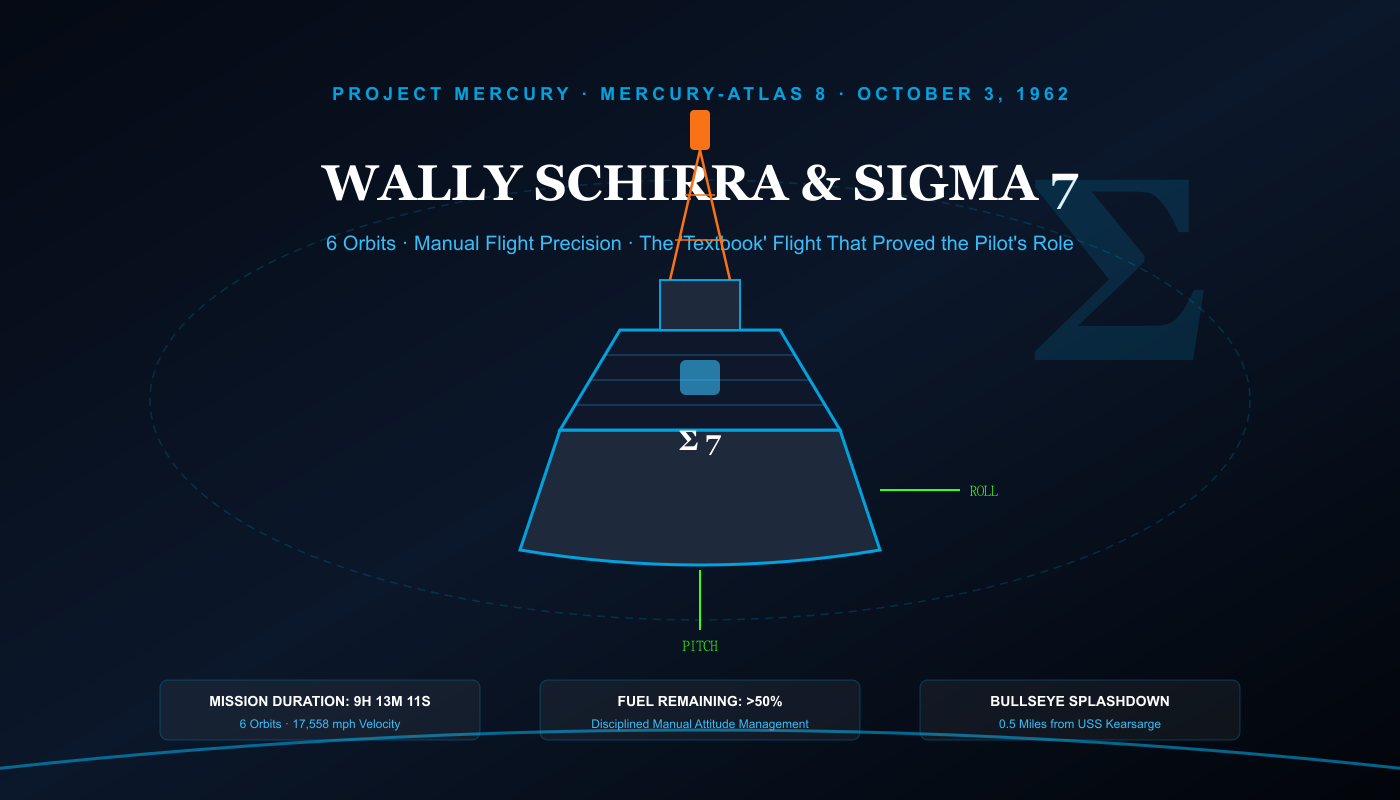
Sigma 7 and the Textbook Flight: How Wally Schirra Proved Humans Were Pilots, Not 'Spam in a Can'
Early critics dismissed Project Mercury astronauts as passive biological specimens—'spam in a can' carried along by automated systems. On October 3, 1962, naval aviator Wally Schirra took Mercury capsule No. 16 into orbit for six precision laps around the Earth, conserving fuel, troubleshooting spacesuit overheating, and executing the most flawless splashdown in early space history.
Read the source-led story →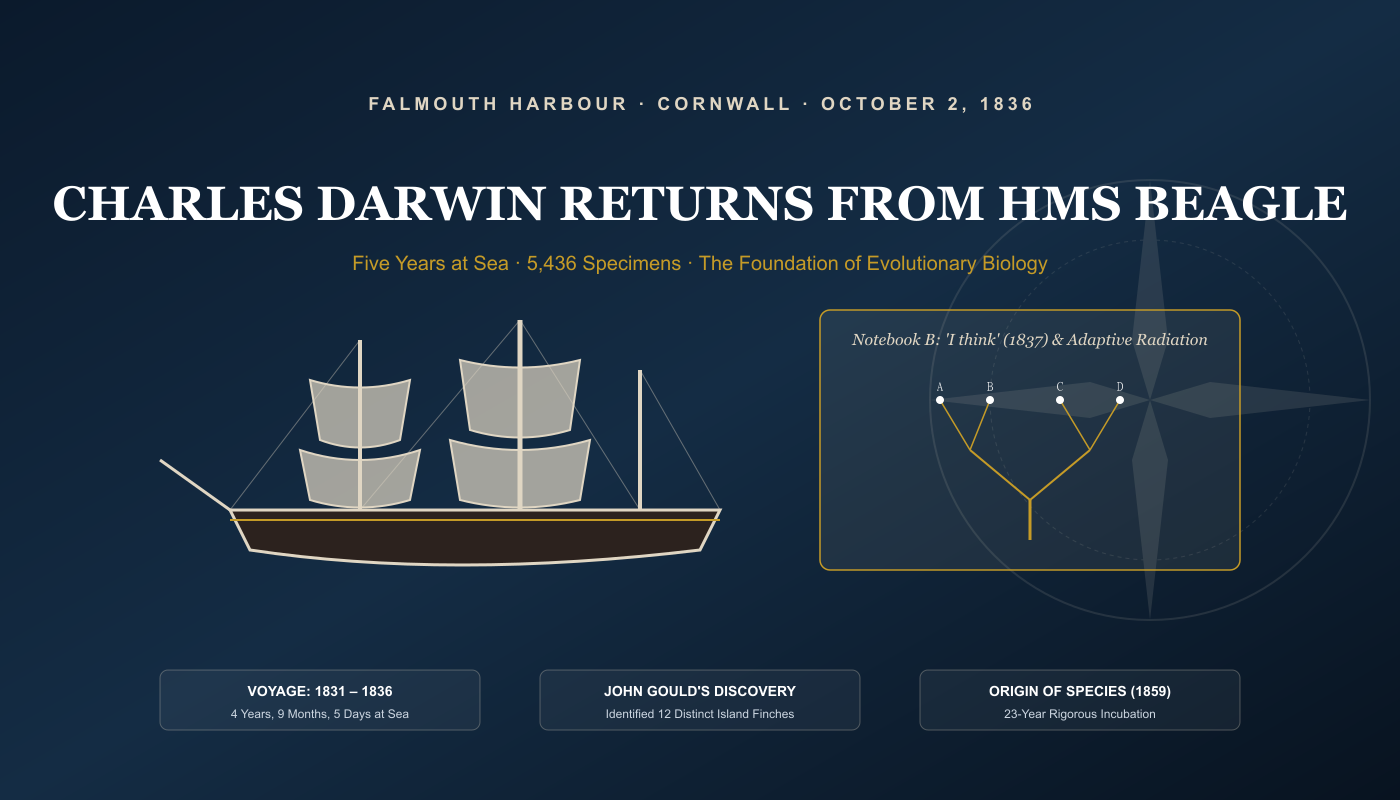
Five Years That Rewrote Biology: How Charles Darwin's Return from HMS Beagle Transformed Natural Science
When 22-year-old Charles Darwin boarded HMS Beagle in December 1831, his father feared he was embarking on a pointless diversion. When the ship anchored in Falmouth on October 2, 1836, Darwin carried 1,529 species in spirits, 3,907 dried specimens, and 770 pages of geological notes that would systematically dismantle the doctrine of static species and rewrite the foundations of biology.
Read the source-led story →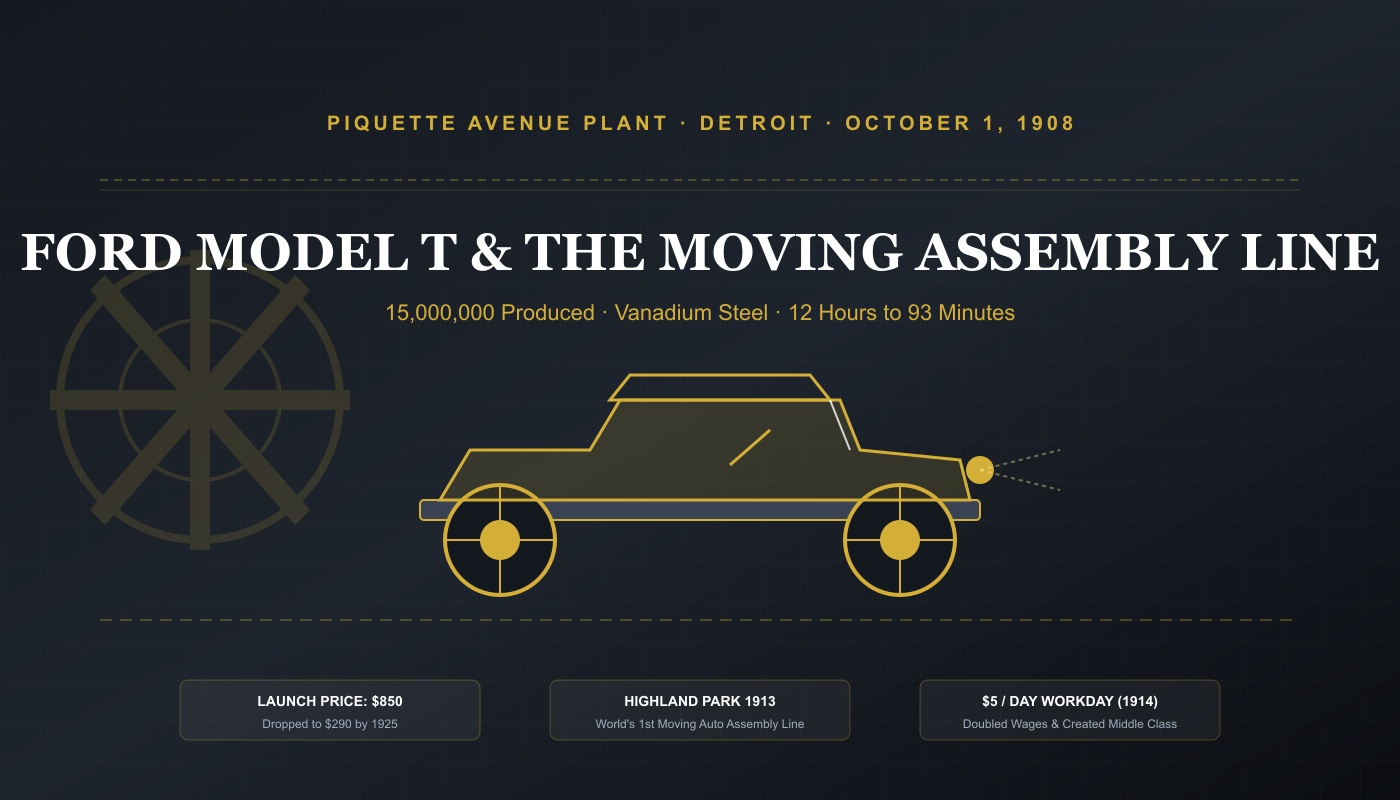
The Car That Put the World on Wheels: How Henry Ford's Model T and Moving Assembly Line Democratized Modern Transport
Before October 1, 1908, automobiles were bespoke luxury toys reserved for the wealthy elite. By engineering a rugged, standardized vehicle and perfecting the moving assembly line, Henry Ford transformed personal transportation, reduced build times from 12 hours to 93 minutes, and created the modern industrial middle class.
Read the source-led story →RESEARCHED ARCHIVE COLLECTIONS
Completed Monthly Chronicles
ARPANET, Emoticons, Transatlantic cables, Ramac 305, and GPS origins.
Browse all September stories →The Mother of All Demos, Netscape IPO, Web public announcement, and IBM 5150.
Browse all August stories →Apollo 11 landing, Sony Walkman release, Lunar Rover, and Amiga 1000.
Browse all July stories →HOW THIS SERIES WORKS
Every entry starts with a verifiable historical claim. If the primary record disagrees with the calendar, the disagreement becomes part of the story. Shopping links are included only when they genuinely help the reader continue the subject.