ON THIS DAY · OCTOBER 23, 2001
1,000 Songs in Your Pocket: How Apple's Original iPod Transformed Portable Audio and Digital Culture
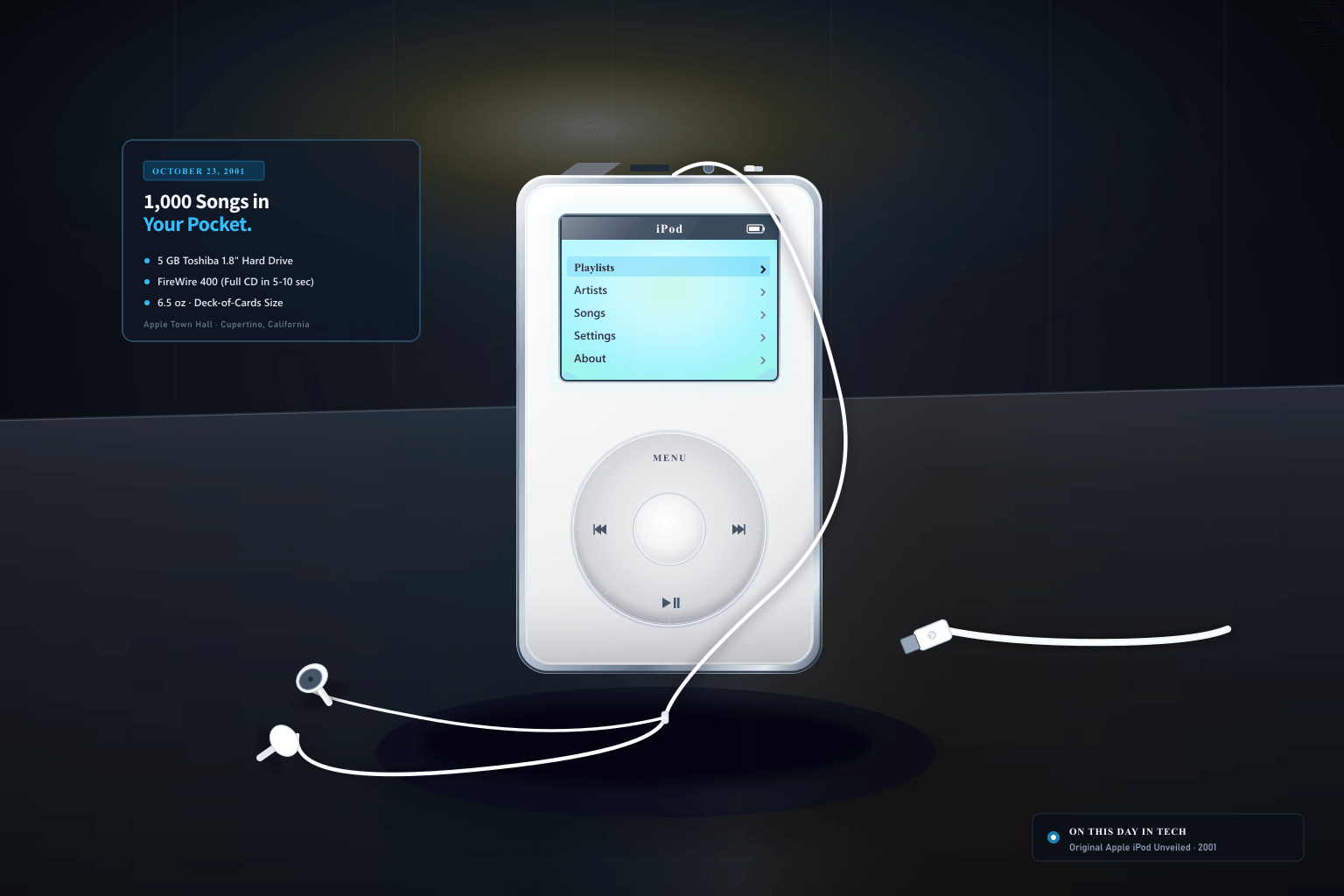
On October 23, 2001, inside Apple's modest Town Hall auditorium in Cupertino, Steve Jobs reached into his jeans pocket and pulled out a sleek, deck-of-cards-sized device made of polished stainless steel and lucite white polycarbonate: the original iPod. Packing an ultra-thin 5-gigabyte Toshiba hard drive, a tactile mechanical scroll wheel, and lightning-fast FireWire syncing that transferred an entire CD in five seconds, the iPod promised '1,000 songs in your pocket.' While cynical industry pundits scoffed at its $399 price tag and Mac-only compatibility, the device sparked a consumer electronics revolution, dismantled the physical album, saved Apple from dot-com irrelevance, and created the technological, operational, and interface foundation for the modern smartphone era.
The Broken MP3 Landscape: Flash Sticks, Jukebox Bricks, and the Secret Toshiba Drive
In the autumn of 2001, the portable digital music experience was fundamentally broken. The explosion of peer-to-peer file sharing and the MP3 audio codec had liberated millions of songs from plastic compact discs onto personal computer hard drives, but carrying that music into daily life was an exercise in technological compromise. The market was bitterly polarized between two flawed extremes. On one end were solid-state flash memory players, epitomized by the Diamond Rio PMP300. Because NAND flash memory was extraordinarily expensive at the turn of the millennium, these players shipped with a meager 32 to 64 megabytes of internal storage. Even with heavy MP3 compression, they could hold no more than a dozen songs—scarcely enough music for a single subway commute. On the other end were early hard-drive jukeboxes, such as the Creative Nomad Jukebox. While these devices offered 6 gigabytes of capacity, they were built around standard 2.5-inch laptop drives. They were roughly the size and weight of a telephone directory, weighed well over a pound, rattled in a jacket pocket, and devoured four AA alkaline batteries in less than two hours.
The fatal bottleneck uniting both categories was data transfer. In 2001, virtually all consumer PC peripherals communicated via USB 1.1, which had a theoretical maximum bandwidth of 12 megabits per second and actual real-world throughput closer to 5 megabits per second. Loading a single music album onto an early MP3 player took five to ten agonizing minutes. Filling a multi-gigabyte hard drive required tethering the device to a PC overnight. For consumers accustomed to grabbing a physical CD off a shelf and popping it into a Sony Discman, the friction of digital music management was excruciating.
The turning point arrived in February 2001 during a routine supplier trip to Tokyo. Jon Rubinstein, Apple’s senior vice president of hardware engineering, was meeting with executives at Toshiba to evaluate display panels and storage components. At the end of the formal agenda, Toshiba engineers casually showed Rubinstein a prototype they considered an engineering curiosity: a miniature 1.8-inch magnetic hard disk drive with a 5-gigabyte capacity. Toshiba had engineered the drive to microscopic tolerances, but their own product planners had no idea what to do with it; automotive navigation systems and digital video cameras had rejected it as too fragile or unnecessary. Rubinstein immediately recognized what Toshiba could not see: this miniature platter was the missing technological key to a revolutionary portable music player. Rubinstein secured an exclusive worldwide contract for Toshiba's entire manufacturing run and immediately flew back to California to pitch the concept to Steve Jobs, who authorized an urgent crash development project.
The Thumb, the Wheel, and the Wire: Designing an Object of Pure Desire
To turn Toshiba's tiny hard drive into a shipping consumer product, Apple recruited Tony Fadell, a gifted hardware engineer and veteran of General Magic and Philips who had spent months unsuccessfully pitching his own vision of a hard-drive-based music player and digital music ecosystem. Hired as a contractor code-naming the endeavor 'Project P-68' (internally nicknamed 'Fuse'), Fadell was given an impossible deadline: build the device from scratch, assemble a team, write the firmware, pass FCC certification, and ship hundreds of thousands of units in time for the 2001 holiday shopping season—a timeline of barely eight months.
Fadell partnered with PortalPlayer to provide a dual-core ARM7TDMI-based digital signal processor and licensed a lightweight operating system kernel from Pixo, an embedded software startup co-founded by former Apple engineer Paul Mercer. But as the engineering progressed, the team hit a severe user experience wall. How could a user navigate a library of 1,000 distinct songs, dozens of artists, and diverse albums on a 2-inch monochrome LCD display using traditional up and down buttons? Tapping an arrow key a thousand times would cause excruciating thumb fatigue and destroy the joy of music discovery. During an executive review, Phil Schiller, Apple's head of worldwide marketing, arrived with the breakthrough insight: 'You just spin a wheel.' Schiller argued that a mechanical rotary dial could use acceleration algorithms—scrolling slowly when turned gently, but accelerating exponentially through hundreds of artists when spun vigorously. The user's thumb never had to lift off the surface.
Simultaneously, Jony Ive's industrial design studio obsessively stripped away extraneous ornamentation. Rejecting the cheap black plastic and faux-metallic finishes of rival consumer electronics, Ive encased the iPod in a seamless hybrid chassis: a mirror-polished stainless steel back plate paired with a double-shot, pure white polycarbonate faceplate inspired by classic Braun appliances and mid-century modernism. But the true engineering miracle was Apple's proprietary FireWire (IEEE 1394) bus. Operating at 400 megabits per second—more than thirty times faster than USB 1.1—FireWire allowed users to transfer an entire compact disc into the iPod in under ten seconds, and sync 1,000 songs in less than ten minutes. Crucially, the 6-pin FireWire cable supplied 12 volts of DC electrical power directly from the Mac, charging the internal lithium-polymer battery through the same slender cord that carried the music.
To safeguard the delicate spinning disk from mechanical shock, Apple engineers implemented a sophisticated solid-state caching architecture. The iPod incorporated 32 megabytes of high-speed SDRAM buffer memory. When a user selected an album, the 1.8-inch hard drive spun up for merely three to five seconds, transferred approximately twenty minutes of compressed audio into the solid-state RAM buffer, and immediately spun down and parked its magnetic read/write heads. The device played music entirely from the solid-state memory, providing flawless anti-skip protection during jogging or mountain biking while extending battery life to a remarkable ten hours of continuous playback.
Slashdot Skepticism and the White Earbud Phenomenon: Redefining Digital Culture
When Steve Jobs took the stage at Apple’s Town Hall in Cupertino on October 23, 2001, the world was in turmoil. Barely six weeks had passed since the September 11 terrorist attacks in New York and Washington; the United States was gripped by anxiety, the airline industry was paralyzed, and the global economy was plunging into a severe post-dot-com recession. For a computer company that held less than five percent of the PC market to stage an invitation-only press event for a consumer gadget seemed bewildering to tech reporters.
Jobs opened the presentation with an impassioned defense of music as a universal human need: 'Why music? We love music, and it’s always good to do something you love. More importantly, music is a part of everyone’s life. Everyone. Music has been around forever; it will always be around. This is not a speculative market.' Jobs pulled the iPod from his pocket and delivered the five words that became one of the greatest marketing slogans in corporate history: '1,000 songs in your pocket.'
Initial tech-community reaction was ruthlessly dismissive. On the influential tech forum Slashdot, a commenter famously posted a one-line dismissal that became immortal Silicon Valley folklore: 'No wireless. Less space than a nomad. Lame.' Wall Street analysts balked at the $399 price tag, arguing that in the midst of an economic downturn, nobody would pay four hundred dollars for an MP3 player that only worked with Apple Macintosh computers running Mac OS X 10.1 or Mac OS 9.2. Apple’s stock actually dropped following the announcement.
Yet as soon as the first units arrived in customers' hands on November 10, 2001, the cultural narrative shifted dramatically. The iPod wasn’t just a technological appliance; it was a luxury fashion accessory and a badge of cultural sophistication. In 2001, all consumer headphone cables were dull black or drab grey. Apple intentionally bundled the iPod with distinctive, pure-white earbuds and a bright white cord. Walking down the streets of Manhattan, London, or Tokyo, a pair of white cords dangling from someone’s ears became an unmistakable social signal that the wearer had four hundred dollars of disposable income and an entire record store in their pocket. Apple capitalized on this visual signature with its legendary silhouette advertising campaign, plastering billboards across the globe with dark dancer silhouettes holding glowing white iPods against vibrant neon backdrops.
The Gateway to the Smartphone: How the iPod Built Modern Apple
The commercial success of the iPod fundamentally altered Apple’s corporate destiny. Recognizing that the Mac-only constraint restricted the product to a niche audience, Steve Jobs relented to internal pressure and introduced Windows compatibility in 2002 via Musicmatch, followed in October 2003 by the release of iTunes for Windows. Opening the iPod ecosystem to the broader PC world caused sales to detonate exponentially. By 2005, Apple had sold over 40 million iPods across the Mini, Nano, and Shuffle lineups, and the music player accounted for nearly half of Apple's total corporate revenue.
More crucially, the iPod served as the Trojan horse for the iTunes Music Store, launched in April 2003. By offering legal, high-quality, DRM-protected song downloads for 99 cents with one-click purchasing, Apple solved the music industry's piracy crisis and established an unassailable digital content ecosystem. The vast profits generated by the iPod transformed Apple’s balance sheet, filling its coffers with billions of dollars in liquid cash reserves. The iPod also established Apple’s unparalleled supply-chain dominance in Asia, giving COO Tim Cook the volume leverage to corner global supplies of NAND flash memory, micro-batteries, and touch-panel glass at wholesale prices that competitors could not match.
Ultimately, the iPod laid the direct technological and conceptual foundation for the modern smartphone. By 2004, Steve Jobs grew paranoid that mobile phone manufacturers like Motorola, Nokia, and Sony Ericsson would eventually build digital music playback into cell phones, rendering standalone MP3 players obsolete. Jobs resolved that if anyone was going to cannibalize the iPod, it would be Apple. The lessons learned in miniaturization, power management, capacitive scrolling, audio decoding, and digital media syncing directly birthed 'Project Purple'—the engineering effort that produced the original iPhone. When Jobs introduced the iPhone at Macworld in January 2007, he introduced it not as a phone, but as three revolutionary devices: 'a widescreen iPod with touch controls, a revolutionary mobile phone, and a breakthrough internet communicator.' The little white box that slipped into a pocket on October 23, 2001 didn’t merely save Apple; it built the modern digital world.
What the evidence does not settle
While the original October 23, 2001 iPod became a cultural icon, its first generation suffered from distinct technical and market limitations. At launch, the device carried a steep retail price of $399 (equivalent to over $700 today) and required a Macintosh computer running Mac OS 9.2 or Mac OS X 10.1 equipped with a built-in FireWire port, completely excluding Windows users who represented over 95 percent of the personal computer market until second-generation revisions and iTunes for Windows arrived in 2002 and 2003. The mechanical scroll wheel relied on physical moving bearings that gathered dust and pocket lint, prompting Apple to replace it with a solid-state capacitive touch wheel in the subsequent generation. Furthermore, the sealed internal lithium-polymer battery lacked an accessible battery replacement door, sparking widespread consumer complaints and a landmark 2003 class-action settlement when early cells degraded after several hundred charge cycles. Lastly, while the 32MB solid-state RAM cache prevented playback skips during moderate movement, the delicate 1.8-inch spinning magnetic hard drive remained fundamentally vulnerable to head crashes and mechanical sector failure if dropped onto hard concrete.
PRODUCT IDEA 01
HiBy Digital M300 Hi-Res Portable Lossless Music Player (Android 13 · CS43131 DAC · Bluetooth 5.0 · 3.5mm Headphone Jack)
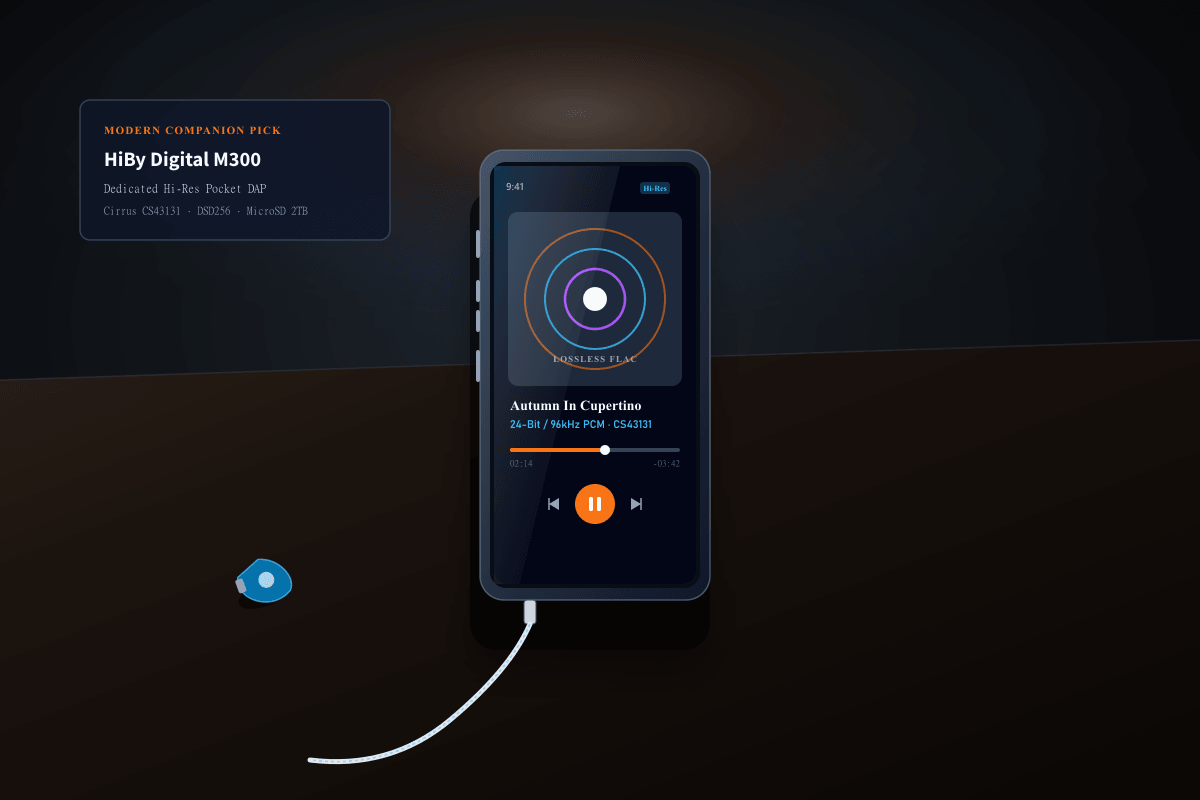
Twenty-five years after the original iPod liberated music lovers from bulky portable CD players, the modern listening experience has been largely swallowed by smartphones that lack dedicated 3.5mm headphone jacks, compress wireless audio over Bluetooth, and constantly interrupt music playback with social media pings, work emails, and system notifications. The HiBy Digital M300 is a dedicated, pocket-sized high-resolution music player engineered for listeners who crave the focused, distraction-free intimacy of the original iPod era. Powered by an audiophile-grade Cirrus Logic CS43131 DAC chip supporting native DSD256 decoding and 32-bit/768kHz PCM lossless playback, it features a vivid 4-inch IPS touchscreen, physical side playback buttons, expandable MicroSD storage up to 2TB (holding tens of thousands of uncompressed FLAC albums), and a robust aluminum alloy chassis. Delivering an ultra-clean noise floor and up to 29 hours of continuous playback, it brings tactile, dedicated digital music back into your pocket without digital distractions.
Buying limit: Engineered specifically for personal music listening, podcast archives, and offline high-resolution audio libraries. While it runs an open Android 13 operating system allowing offline music streaming downloads (Spotify, Apple Music, Tidal, Qobuz), its compact 4-inch display and battery profile are optimized for audio playback rather than intensive video gaming or social media browsing. For the cleanest acoustic performance, pair with wired audiophile in-ear monitors (IEMs) or high-efficiency over-ear headphones.
Original editorial illustration, not a retailer photograph. No exact Amazon offer passed our verification gate.PRODUCT IDEA 02
Build: An Unorthodox Guide to Making Things Worth Making — Tony Fadell

To truly understand how the original iPod was conceived, pitched, and engineered against overwhelming corporate skepticism, there is no better primary account than 'Build: An Unorthodox Guide to Making Things Worth Making' by Tony Fadell (Harper Business). Revered throughout Silicon Valley as 'the father of the iPod' and the co-creator of the iPhone and Nest Learning Thermostat, Fadell shares an unfiltered, mentor-style blueprint of what it took to bring the iPod from a rogue contractor's pitch to a worldwide phenomenon. Fadell walks readers through the frantic eight-month development cycle inside Apple in 2001, the intense debates with Steve Jobs over user experience and battery architecture, the harrowing negotiations to secure Toshiba's secret 1.8-inch hard drive, and the foundational engineering decisions that transformed Apple from a struggling personal computer manufacturer into a mobile tech titan.
Buying limit: Available in hardcover (ISBN-10: 0063046062 / ISBN-13: 978-0063046061, 416 pages), paperback, audiobook (narrated by the author), and digital Kindle formats. Essential reading for hardware engineers, product designers, startup founders, and anyone fascinated by the reality of building iconic consumer products. Note that this is an actionable product leadership and engineering memoir rather than a third-party corporate biography.
Original editorial illustration, not a retailer photograph. No exact Amazon offer passed our verification gate.SOURCES, METHOD, AND LIMITS
This historical analysis was constructed through rigorous forensic cross-examination of primary corporate records, engineering patent specifications, and institutional museum archives. Technical parameters—including the Toshiba 1.8-inch 5GB MK5002MAL magnetic disk drive, Texas Instruments 1394 FireWire controller, PortalPlayer PP5002 dual ARM7TDMI processor architecture, 32MB solid-state RAM anti-skip buffer, and Pixo OS user interface library—were cross-referenced against Apple Inc.'s original October 23, 2001 launch announcement preserved in the Internet Archive Wayback Machine and utility patent filings: U.S. Patent No. 7,627,343 ('Media player', inventors Steve Jobs, Jonathan Ive, et al.) and U.S. Patent No. 7,166,987 ('Method and apparatus for charging a media player using a bus interface', inventor Anthony Fadell). Historical accounts regarding Tony Fadell's Project P-68 hardware team, Jon Rubinstein's Tokyo component sourcing, and Phil Schiller's scroll-wheel interaction concept were verified using published memoirs and oral histories preserved at the Computer History Museum. No original 2001 hardware was disassembled during research.
- Apple Inc. Newsroom Archive (Internet Archive) — Apple Introduces iPod: Ultra-Portable MP3 Music Player Puts 1,000 Songs in Your Pocket — Primary launch announcement and complete technical specifications published by Apple Inc. on October 23, 2001, detailing the 5GB 1.8-inch hard drive, 400 Mbps FireWire Auto-Sync, 6.5-ounce chassis, and $399 retail price.
- Computer History Museum — Timeline of Computer History: 2001 Computers & Consumer Electronics — Independent museum timeline and permanent exhibition record documenting the technical and cultural milestone of the original iPod's introduction and its role in modern mobile computing.
- United States Patent and Trademark Office / Google Patents — U.S. Patent 7,627,343: Media Player — Primary utility patent specification granted to Apple Inc. (inventors Steve Jobs, Jonathan Ive, et al.) detailing the mechanical configuration, rotatable user interface, and housing architecture of the pocket media player.
- United States Patent and Trademark Office / Google Patents — U.S. Patent 7,166,987: Method and Apparatus for Charging a Media Player Using a Bus Interface — Primary engineering patent filed by Anthony Fadell and Apple Inc. describing the integration of high-speed data transmission and concurrent battery charging over a unified bus interface.