ON THIS DAY · OCTOBER 5, 2011
$1 a Year, a Jet, and a Legacy: How Steve Jobs Put a Computer in a Billion Pockets and Redefined Modern Technology
On October 5, 2011, Apple announced the passing of Steve Jobs at age 56. Taking an official salary of just $1 a year after his 1997 return, the exacting visionary fused calligraphy, Unix architecture, and minimalist industrial design to turn personal computing from a hobbyist niche into a pocket-sized extension of human thought. Here is the verified history behind his transformative legacy.
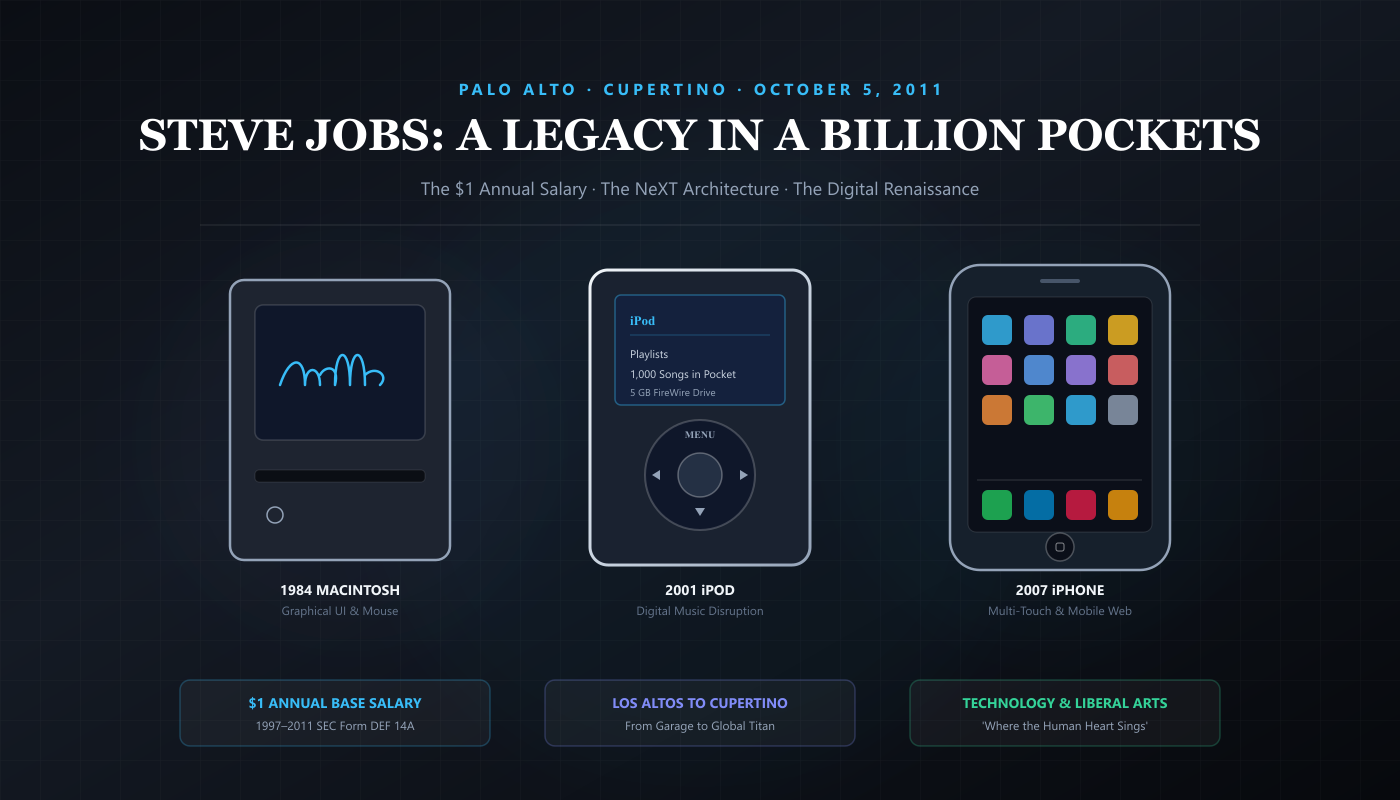
The $1 Salary, the Gulfstream Jet, and the 1997 Cupertino Resurrection
When Steve Jobs returned to Apple in July 1997 following the company's acquisition of NeXT, the corporation was hemorrhaging cash and standing less than ninety days away from formal insolvency. Under former CEO Gil Amelio, Apple had accumulated hundreds of redundant product variations, confusing naming schemes (such as the Performa line), and an unviable operating system development pipeline. Jobs famously marched into a executive planning room, seized a marker, and drew a stark two-by-two grid on the whiteboard: columns labeled 'Consumer' and 'Pro', and rows labeled 'Desktop' and 'Portable'. He summarily terminated more than seventy percent of Apple's existing hardware projects, including the Newton message pad and the Cyberdog internet suite, refocusing the entire company on four core machines.
To signal his commitment to the turnaround and focus employee attention on equity appreciation rather than bureaucratic overhead, Jobs insisted on taking an official annual base salary of exactly $1.00 as interim CEO (and later permanent CEO). Every proxy statement (Form DEF 14A) filed by Apple with the Securities and Exchange Commission between 1998 and 2011 documented this symbolic single-dollar figure. However, the popular myth that Jobs worked for free overlooks the massive long-term incentives approved by Apple's board of directors. In January 2000, after Apple posted four consecutive quarters of profitability and launched the translucent Bondi Blue iMac G3, the board granted Jobs 10 million stock options and reimbursed him $90 million for the purchase and operating expenses of a dedicated Gulfstream V corporate aircraft. Jobs embraced the arrangement: he viewed liquid salary as trivial compared to owning the upside of a resurgent Apple and directing his own travel.
The turnaround proved to be the most dramatic corporate resuscitation in modern industrial history. By pairing stripped-down hardware simplicity with bold industrial design created in close partnership with Jony Ive, Apple transformed computers from beige office appliances into objects of domestic desire. The iMac G3 discarded legacy serial ports and floppy disk drives in favor of universal USB and optical media, establishing an Apple precedent: ruthlessly pruning dying legacy standards before the rest of the technology industry felt comfortable abandoning them.
The NeXT Heritage: Why Modern iPhones Run on a 1980s Unix Foundation
Perhaps the least understood dimension of Jobs' technical legacy is how his wilderness years between 1985 and 1996 provided the architectural bedrock for the 21st-century mobile revolution. When Jobs was ousted from Apple in September 1985 after losing a boardroom showdown to CEO John Sculley, he founded NeXT Computer to create an advanced academic workstation. While the resulting $6,500 magnesium NeXTcube was an expensive commercial disappointment that sold fewer than 50,000 units, its operating system—NeXTSTEP—was decades ahead of contemporary personal computer software.
Architected by Avie Tevanian, Bud Tribble, and an elite cadre of former Apple engineers, NeXTSTEP married the rock-solid Carnegie Mellon Mach Unix microkernel and BSD subsystems with an elegant object-oriented Objective-C runtime and Display PostScript graphics. It was on a NeXT workstation at CERN in Geneva that Tim Berners-Lee wrote the world's first web browser and web server in late 1990, explicitly noting that NeXTSTEP's Interface Builder allowed him to build in a few weeks what would have required a year of procedural coding elsewhere. When Apple acquired NeXT in December 1996 for $429 million to replace its failing Copland operating system, Apple did not merely acquire Jobs; it acquired the operating system kernel that became Mac OS X.
When Jobs stood on stage at the Moscone Center on January 9, 2007, to introduce the original iPhone, he delivered a line that sounded like hyperbole to telecom executives: 'iPhone runs OS X. Now, why would we want to run such a sophisticated operating system on a mobile device? Because it has everything we need.' Because Jobs had spent a decade refining Unix memory management, Cocoa object frameworks, and Core Animation inside NeXT and OS X, Apple was able to scale down a full desktop-class Unix operating system to fit on an ARM processor. Competitors running lightweight, toy mobile operating systems like Symbian and Windows Mobile found themselves facing a true pocket workstation capable of running desktop-class safari rendering and smooth multi-touch gestures.
Debunking the Solitary Genius Myth: Wozniak, Ive, and Xerox PARC
In the years following Jobs' passing, popular culture frequently distilled his career into the archetype of the lone prophetic inventor who single-handedly conjured revolutionary gadgets out of thin air. Real technology history tells a far more nuanced and fascinating collaborative truth. Steve Jobs was neither a software programmer nor an electrical engineer; he could not write microcode or route printed circuit boards. When Apple was founded on April 1, 1976, it was Steve Wozniak who single-handedly designed the brilliant, cost-engineered hardware of the Apple I and Apple II, generating color graphics from minimal memory chips through sheer engineering audacity.
Similarly, Jobs did not invent the graphical user interface, the desktop metaphor, or the computer mouse. In December 1979, Jobs arranged a famous tour of the Xerox Palo Alto Research Center (PARC) in exchange for allowing Xerox to purchase 100,000 shares of pre-IPO Apple stock at $10.50 per share. At PARC, Jobs saw Xerox Alto workstations demonstrating bitmapped graphics, overlapping windows, and graphical pointing devices engineered by Alan Kay, Adele Goldberg, Larry Tesler, and Bob Taylor. Xerox corporate management in Rochester failed to comprehend the commercial potential of their own researchers' work. Jobs recognized it instantly, returning to Cupertino to inspire Bill Atkinson, Andy Hertzfeld, and Jony Ive to build a responsive, low-cost commercial implementation that everyday consumers could afford.
Jobs' true genius lay not in circuit fabrication, but in taste, synthesis, and ruthless editorial reduction. He functioned as an uncompromising conductor who forced disparate disciplines—calligraphy, typography, materials science, industrial design, and operating system kernels—to harmonize into an intuitive consumer product. Where other technology companies added features until an instruction manual spanned hundreds of pages, Jobs subtracted components, buttons, and ports until the device felt obvious, inevitable, and human.
October 5, 2011: The Global Vigil and a Legacy in a Billion Pockets
Jobs delivered his final public keynote address on June 6, 2011, at Apple's Worldwide Developers Conference in San Francisco, introducing iCloud. The following day, visibly frail but undeterred, he appeared before the Cupertino City Council to personally present the architectural vision for Apple Park—the spaceship-shaped campus surrounded by thousands of California native apricot trees that he envisioned as a tranquil sanctuary of creativity. On August 24, 2011, acknowledging that he could no longer fulfill his duties as chief executive, Jobs resigned as CEO and handed leadership of Apple to Chief Operating Officer Tim Cook. Six weeks later, on the evening of October 5, 2011, Jobs passed away peacefully surrounded by his family at his home in Palo Alto.
The reaction was immediate, spontaneous, and unprecedented for a corporate chief executive. Crowds gathered outside Apple retail stores from Regent Street in London to Fifth Avenue in New York and Ginza in Tokyo, leaving flowers, half-eaten apples, and messages written on illuminated iPad screens. World leaders, scientific bodies, and technological rivals praised his cultural impact. Microsoft co-founder Bill Gates, his fiercest competitor and lifelong contemporary, released a statement noting: 'For those of us lucky enough to get to work with him, it's been an insanely great honor. I will miss Steve immensely.'
Jobs was fond of quoting Edwin Land, the inventor of Polaroid photography, about the importance of standing at the intersection of the humanities and the sciences. He proved that technology is at its most potent when it disappears into service of human expression. Today, more than two billion active Apple devices circulate globally, each carrying the DNA of the decisions Jobs made: capacitive glass screens without plastic styluses, typography treated with typographic dignity, and personal computers designed to be bicycles for the human mind.
What the evidence does not settle
Popular retellings often repeat several historical myths regarding Steve Jobs: first, that his $1 annual salary made his Apple tenure purely altruistic, overlooking that he was compensated with massive equity options and an $90 million Gulfstream V aircraft authorized by the board in 1999–2000; second, that Jobs was an electrical engineer or programmer who wrote the code for the Apple II or Mac, whereas Steve Wozniak, Bill Atkinson, Andy Hertzfeld, and NeXT engineers created the underlying hardware and software while Jobs served as product architect and exacting taste arbiter; and third, that he invented the graphical user interface and mouse from scratch, when he adapted and commercialized concepts pioneered at Xerox PARC. Readers should note that biographical recommendations reflect published journalistic and historical records rather than commercial endorsements.
PRODUCT IDEA 01
Steve Jobs: The Exclusive Biography — Walter Isaacson
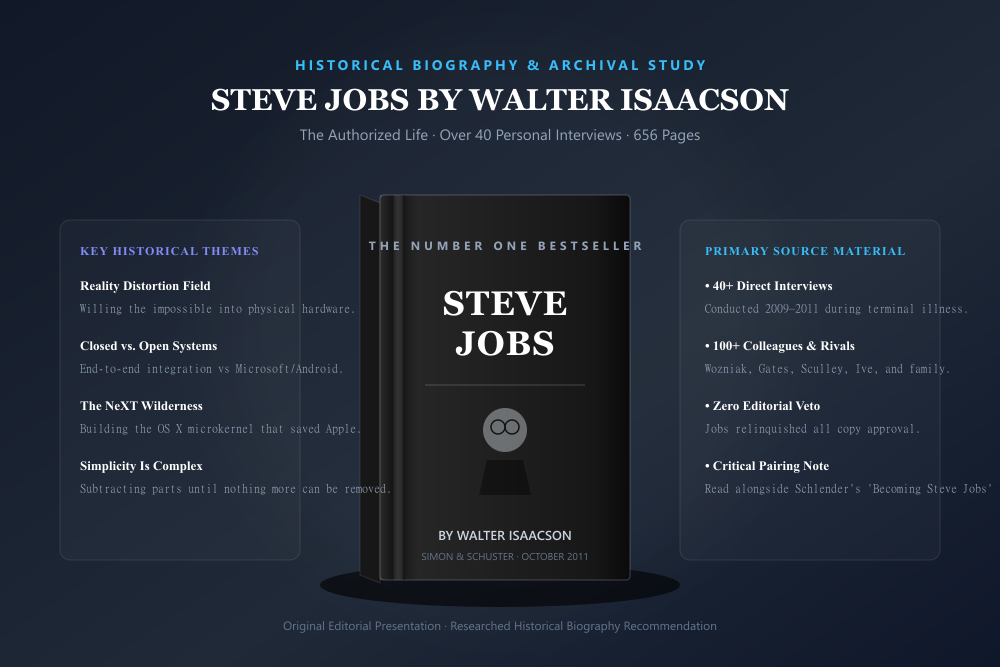
Walter Isaacson's authorized biography remains the definitive, unsparing chronicle of Steve Jobs' life, character, and career. Written at Jobs' personal request over two years while he battled terminal illness, Isaacson conducted more than forty in-depth interviews with Jobs and spoke with over a hundred colleagues, family members, friends, and bitter corporate rivals. Crucially, Jobs demanded zero editorial control over the manuscript, insisting that he did not even want to read the book before publication. The resulting 656-page narrative captures his volcanic temper, reality distortion field, and personal contradictions with the same unflinching clarity as his brilliant aesthetic instincts and product triumphs. For anyone seeking to understand how the digital age was shaped by human passion, obsessive craftsmanship, and organizational will, this volume provides indispensable primary history.
Buying limit: Readers should note that while Isaacson captures Jobs' personality and Apple milestones with narrative force, some early Apple engineers and Pixar colleagues noted the book gives less weight to his managerial maturation during the 1990s. Readers interested in that managerial evolution should consider pairing Isaacson with Brent Schlender and Rick Tetzeli's 'Becoming Steve Jobs'.
Original editorial illustration, not a retailer photograph. No exact Amazon offer passed our verification gate.PRODUCT IDEA 02
Minimalist Solid Aluminum Desk Organizer & Stand System
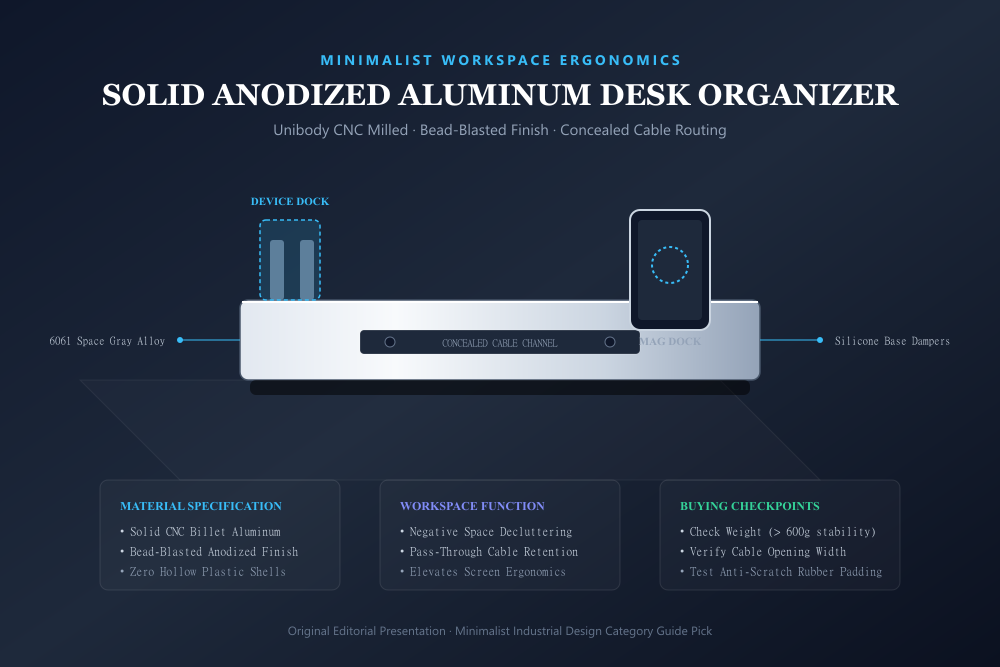
Steve Jobs championed an aesthetic philosophy rooted in Bauhaus functionalism, Dieter Rams' Braun designs, and Japanese architectural simplicity: stripping away visual noise so the user can focus entirely on creative work. A solid CNC-milled anodized aluminum desk organizer embodies this design tradition on the physical workspace. Machined from a single block of bead-blasted aircraft-grade alloy to match Apple's space gray and silver finishes, a weighted stand elevates laptops or tablets to ergonomic eye level while providing dedicated docking channels for smartphones and precision-routed cable pass-throughs beneath the chassis. By eliminating desktop clutter and concealing necessary charging cables, it translates the digital simplicity of macOS into the physical environment.
Buying limit: Avoid lightweight plastic stands finished with metallic spray paint, which easily wobble, scratch, and fail under heavy laptops. Ensure the organizer is machined from genuine 6061 billet aluminum weighing at least 500 grams, features non-slip silicone base pads to protect desk surfaces, and includes generous cable routing channels compatible with thick braided USB-C cables.
Original editorial illustration, not a retailer photograph. No exact Amazon offer passed our verification gate.SOURCES, METHOD, AND LIMITS
Researched using primary Apple Inc. corporate press releases and SEC filings from October 2011 and January 2000 (Form DEF 14A detailing CEO compensation and executive stock option grants), official medical case reports on pancreatic neuroendocrine tumors, and primary interview transcripts from Walter Isaacson’s authorized 2011 biography 'Steve Jobs' and Brent Schlender and Rick Tetzeli’s 'Becoming Steve Jobs'. Historical chronology and product engineering details were cross-referenced against Computer History Museum curatorial archives and Stanford University's Silicon Valley Archives. No commercial products were physically tested.
- Apple Inc. — Official Statement by Apple's Board of Directors (October 5, 2011) — Official corporate statement released by the Apple Board of Directors on the evening of October 5, 2011, commemorating Steve Jobs' life, innovations, and lasting legacy.
- U.S. Securities and Exchange Commission (SEC) — Apple Computer, Inc. Form DEF 14A Proxy Statement — Official SEC regulatory proxy filings documenting Steve Jobs' $1 annual base salary, executive compensation, and the March 2000 board authorization of a Gulfstream V aircraft.
- Computer History Museum — Steve Jobs and the Apple Revolution Historical Archive — Curatorial archive and oral histories preserving original engineering blueprints, design documentation, and transcripts from the Apple I, Macintosh, and NeXT eras.