ON THIS DAY · OCTOBER 18, 1954
The Sound in Your Pocket: How the 1954 Regency TR-1 Transistor Radio Launched Modern Consumer Electronics
On October 18, 1954, Texas Instruments and I.D.E.A. unveiled the Regency TR-1 in Indianapolis and New York. By squeezing four tiny germanium transistors into an 11-ounce handheld chassis, engineers collapsed living-room-sized vacuum tube consoles into a pocket-sized gadget, sparking the personal electronics boom that shaped the modern world.
The Vacuum Tube Bottleneck and Patrick Haggerty's Audacious Bet
In the early 1950s, listening to broadcast radio was an inherently domestic, collective experience anchored to heavy furniture. Household radios were substantial wooden consoles or bulky tabletop cabinets built around glowing vacuum tubes. These glass thermionic valves required fragile filaments that took thirty seconds to warm up, consumed significant electric power, generated intense heat, and demanded heavy power transformers or bulky high-voltage battery packs. Even the so-called 'portable' tube radios of the late 1940s were formidable contraptions: disguised as heavy luggage or lunchboxes, they weighed upwards of ten pounds and depleted multiple large dry cells within a dozen hours of playtime.
When Bell Telephone Laboratories publicly unveiled the point-contact transistor in June 1948, scientists recognized its immense theoretical promise. John Bardeen, Walter Brattain, and William Shockley had demonstrated that a solid crystal of semiconductor material could amplify electrical signals without a vacuum or a heated filament. Yet for six years, transistors remained expensive laboratory curiosities and specialized military components. Major consumer electronics conglomerates—including RCA, Philco, Emerson, and Zenith—dismissed the idea of solid-state consumer radios. They argued that vacuum tubes were already refined, pennies to manufacture, and that no consumer would pay a steep premium for unproven crystal amplifiers that produced tinny sound.
Patrick E. Haggerty, the visionary executive vice president of Texas Instruments in Dallas, saw a completely different future. In 1952, TI purchased a $25,000 patent license from Western Electric to manufacture transistors. Haggerty hired physical chemist Gordon Teal away from Bell Labs, tasking him with perfecting mass-production methods for single-crystal germanium and silicon semiconductors. By early 1954, Teal's team succeeded in fabricating reliable NPN grown-junction germanium transistors. However, Haggerty faced a classic chicken-and-egg economic dilemma: because transistors were made in small batches, they cost $10 to $15 each; until demand climbed into the hundreds of thousands, production costs could not fall. Haggerty concluded that only an irresistible, pocket-sized mass-market consumer device could create the volume needed to drive prices down toward $1 per transistor.
Haggerty approached America's established radio manufacturers with a complete prototype design and an offer to supply the transistors. Every single established firm turned him down. RCA and Zenith refused to cannibalize their lucrative vacuum tube supply chains, while others viewed the miniature project as an impossible commercial gamble. Refusing to yield, Haggerty sought out an agile, independent manufacturer hungry for innovation: Industrial Development Engineering Associates (I.D.E.A.), a small electronics firm in Indianapolis, Indiana, led by Edward C. Tudor. Tudor agreed to design and package the radio under I.D.E.A.'s Regency consumer division, while Texas Instruments committed to delivering the four-transistor component sets. On October 18, 1954, the two companies held a joint press conference in New York and Indianapolis to introduce the Regency TR-1.
Richard Koch's Engineering Feat: Squeezing Four Transistors into 11 Ounces
Texas Instruments' initial laboratory breadboard had required eight transistors and a complex cascade of inter-stage transformers to produce sufficient audio gain. Selling an eight-transistor radio would have pushed the retail price far above $100—an unthinkable sum for a novelty device in 1954. The daunting responsibility of making the radio commercially viable fell upon Regency's 34-year-old chief engineer, Richard C. Koch. Working relentlessly in Indianapolis over the summer of 1954, Koch re-engineered the superheterodyne circuit from the ground up, filing a seminal patent (US Patent 2,892,931) that cut the required transistor count by half.
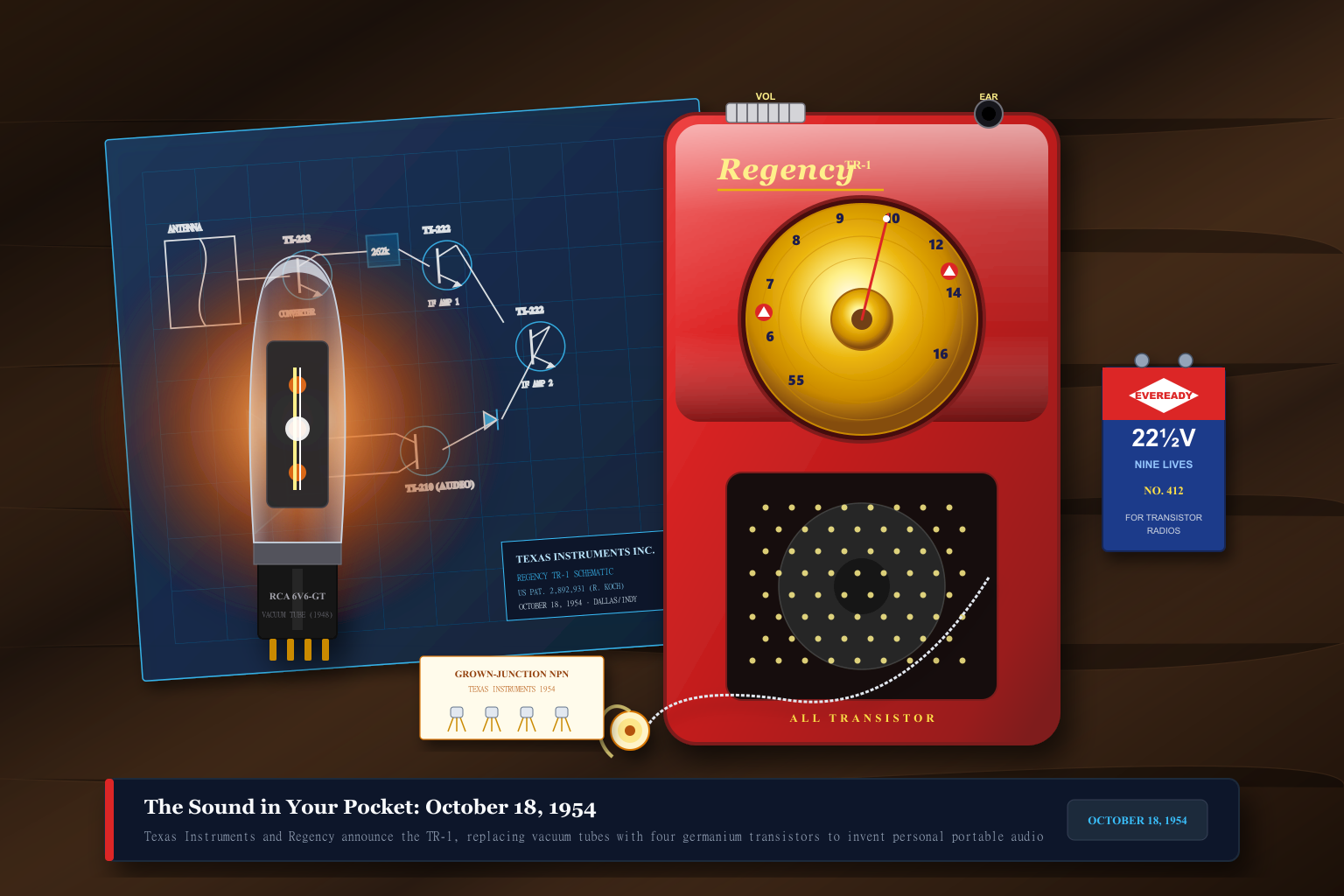
Koch's breakthrough was combining the radio frequency (RF) local oscillator and mixer functions into a single germanium transistor (the TI223). The incoming radio frequency from the internal ferrite core antenna was mixed with the local oscillator frequency right at the transistor emitter, converting the high-frequency broadcast signal down to an intermediate frequency (IF) of 262 kilocycles per second. Two subsequent Texas Instruments grown-junction germanium transistors (TI222) served as tuned intermediate-frequency amplifiers. A miniature germanium diode detected the audio envelope, and a fourth transistor (TI210) acted as the audio output amplifier, directly driving a tiny 2.7-inch permanent-magnet dynamic speaker manufactured by Jensen.
To achieve a pocketable profile measuring just 3 inches wide, 5 inches high, and 1.25 inches thick, Koch and Regency's manufacturing team abandoned point-to-point hand wiring. Instead, they adopted one of the earliest commercial printed circuit boards (PCBs), etching copper traces onto phenolic resin laminate. Miniature subminiature electrolytic capacitors and tiny custom IF transformers—developed in partnership with Chicago Telephone Supply and Centralab—were packed onto the board like puzzle pieces. The entire assembly, complete with a single 22.5-volt carbon-zinc battery (Eveready 412 or Burgess U15) that delivered more than twenty hours of continuous listening, weighed just 11 ounces.
The external industrial design was entrusted to the Chicago firm Painter, Teague & Petertil. Crafted from sleek thermoplastic, the TR-1 featured a recessed circular tuning dial adorned with a gold-finished aluminum disc and tiny red triangles at 640 kHz and 1240 kHz. These triangular CD markings stood for CONELRAD (Control of Electromagnetic Radiation)—the mandatory Cold War civil defense frequencies designated for emergency public broadcasts in the event of an enemy nuclear attack. Available at launch in Mandarin Red, Bone White, Cloud Gray, and Jet Black, the TR-1 looked like a piece of modern sculpture that begged to be picked up, held, and carried.
The Birth of Personal Audio and the Teenager Economy
When the Regency TR-1 arrived in select department stores—such as Liberty Music Shops in New York and Bullock's in Los Angeles—on November 1, 1954, it was priced at $49.95 (equivalent to approximately $560 in 2026 currency). Despite retail reviews noting that its tiny 2.7-inch speaker sounded thin and distorted at high volume compared to a heavy living room console, the public snapped up every unit Regency could manufacture. Over the course of its production run, approximately 150,000 Regency TR-1 radios were sold, proving beyond any shadow of a doubt that consumers valued portability and personal freedom over acoustic perfection.
The TR-1 arrived at a seismic cultural inflection point. In 1954, rock and roll was bursting into mainstream American consciousness. For the first time, American teenagers had disposable income from postwar allowances and part-time jobs, but their musical tastes clashed directly with their parents' preference for big band swing and orchestral pop. Before the transistor radio, listening to rhythm and blues, Bill Haley & His Comets, or early Elvis Presley meant competing for the living room console or retreating to the family automobile. The Regency TR-1 decoupled listening from the family hearth.
Equipped with an optional miniature earphone, the TR-1 allowed a teenager to slip a radio into a jacket pocket, walk down the street, ride a bicycle, or listen under the bedcovers late at night without adult interference. Sports fans carried the TR-1 to baseball games to hear play-by-play commentary from the bleachers; commuters checked stock reports on trains; beachgoers brought music directly onto the sand. The TR-1 transformed audio from a shared civic or household activity into an intimate, private soundtrack of individual life. It was the direct cultural ancestor of the boombox, the Sony Walkman, the Apple iPod, and today's smartphone audio streaming.
The Global Aftershock: From Indianapolis to Tokyo and Silicon Valley
While Regency earned immense prestige and Texas Instruments proved the viability of its germanium fabrication lines, the TR-1's greatest legacy was the global competitive earthquake it triggered. Across the Pacific, in the rubble of postwar Tokyo, a small struggling engineering company named Tokyo Tsushin Kogyo (Tokyo Telecommunications Engineering Corporation), founded by Masaru Ibuka and Akio Morita, had also obtained a transistor license from Western Electric in 1953. When news reached Tokyo in late October 1954 that an obscure American firm in Indiana had beaten the world's electronics giants to release a working transistor radio, Ibuka and Morita experienced a jolt of urgency.
Recognizing that the Americans had proven the consumer market, Ibuka and his engineering team redoubled their efforts. In August 1955, they released the TR-55 under their brand-new export brand name: Sony. While the TR-55 was still slightly too large for standard shirt pockets, Sony followed in 1957 with the TR-63—an ultra-compact radio that famously used tailor-made slightly oversized shirts on sales executives to demonstrate that it was genuinely 'pocketable.' Japanese manufacturers perfected high-yield alloy-junction transistors, integrated miniature ferrite antennas, and established dominant global supply chains that turned transistor radios into a universal household staple.
For Texas Instruments, the gamble paid off spectacularly. Having proven that semiconductor manufacturing could achieve massive commercial scale, TI used its surging cash flow and technical momentum to lead the next semiconductor revolutions. In September 1958, TI research engineer Jack Kilby built the world's first working integrated circuit on a sliver of germanium, uniting transistors, resistors, and capacitors on a single semiconductor chip. The humble four-transistor radio announced on October 18, 1954, did not merely introduce a new gadget; it established the economic foundation for Silicon Valley and the digital world we inhabit today.
What the evidence does not settle
While the Regency TR-1 was a watershed engineering triumph, historical evaluation reveals real technical limitations. The early germanium transistors (manufactured through grown-junction techniques) exhibited significant thermal instability; leaving a TR-1 on a hot car dashboard in summer could cause thermal runaway and circuit failure. The miniature Jensen 2.7-inch speaker suffered from severe low-frequency rolloff, providing virtually no bass response below 300 Hz and noticeable harmonic distortion above moderate volume. Furthermore, the 22.5-volt carbon-zinc battery (Burgess U15) was expensive to replace and less widely stocked than standard flashlight cells. Within three years, Japanese competitors including Sony out-engineered the TR-1 by utilizing more sensitive superheterodyne topologies, 9-volt standard batteries, and lower-cost alloy-junction transistors that delivered superior audio sensitivity at half the retail price.
PRODUCT IDEA 01
Sangean SR-35 / Compact Analog DSP Pocket AM/FM Handheld Radio Receiver
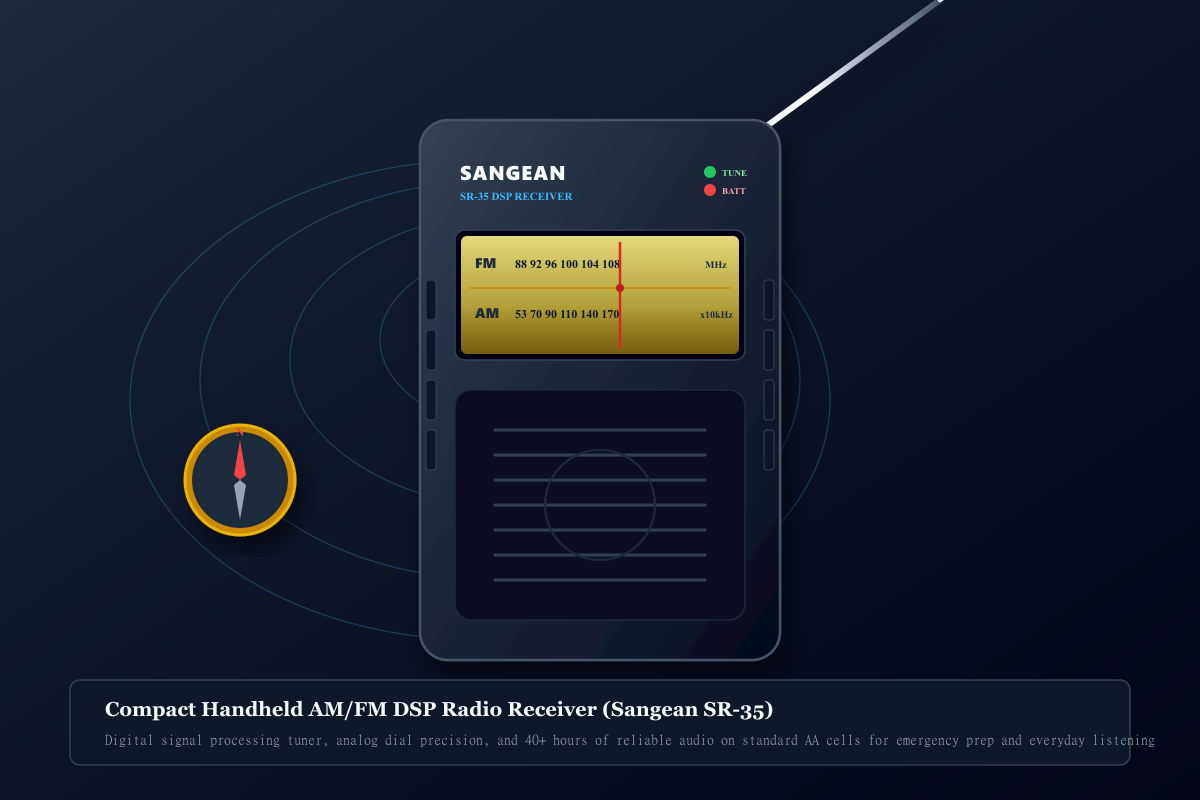
Seventy years after the Regency TR-1 proved the magic of pocket audio, high-sensitivity compact portable radios remain indispensable tools for outdoor adventurers, storm prep, ballgames, and everyday radio enthusiasts. Modern pocket receivers like the Sangean SR-35 combine the tactile charm of a smooth analog tuning wheel with modern digital signal processing (DSP) tuner ICs that deliver razor-sharp selectivity, low noise floors, and exceptional station pulling power across AM (520-1710 kHz) and FM (87.5-108 MHz). Equipped with an internal ferrite AM bar antenna, a swiveling telescopic FM antenna, a front-facing dynamic loudspeaker, and a dedicated 3.5mm stereo headphone jack, it operates for over 40 hours on just two standard AA batteries—delivering emergency news and music when cellular networks and Wi-Fi fail.
Buying limit: Prioritize pocket receivers built with DSP tuner chipsets (such as Silicon Labs DSP architecture) rather than unshielded basic analog circuits prone to drift. Look for models powered by ubiquitous AA or AAA batteries with battery life indicators and built-in wrist lanyards for emergency travel kits. Avoid novelty micro-radios with flimsy fixed wire antennas.
Original editorial illustration, not a retailer photograph. No exact Amazon offer passed our verification gate.PRODUCT IDEA 02
Crystal Fire: The Birth of the Information Age — Michael Riordan & Lillian Hoddeson

For readers intrigued by the high-stakes human drama, corporate gambles, and laboratory breakthroughs behind the semiconductor revolution, 'Crystal Fire' (W. W. Norton & Company) by physicists and historians Michael Riordan and Lillian Hoddeson is universally regarded as the definitive chronicle. Drawing upon declassified laboratory logbooks and extensive personal interviews with John Bardeen, Walter Brattain, William Shockley, Gordon Teal, and Patrick Haggerty, the authors trace the path from the first crude point-contact crystal at Bell Labs to Texas Instruments' audacious commercialization of the Regency TR-1 and the invention of the microchip. Written with exceptional narrative verve and technical clarity, it illuminates how a handful of physicists and ambitious risk-takers dismantled the vacuum tube empire and laid the foundations of modern digital civilization.
Buying limit: Available in trade paperback, library hardcover, and digital e-book editions (ISBN 978-0393318517). For personal collections and engineering libraries, seek the unabridged trade paperback edition featuring comprehensive archival photographic plates, transistor patent diagrams, and extensive scholarly reference notes.
Original editorial illustration, not a retailer photograph. No exact Amazon offer passed our verification gate.SOURCES, METHOD, AND LIMITS
This dossier was synthesized through rigorous cross-examination of primary historical documentation, including the original United States Patent 2,892,931 ('Transistor Radio') issued to Richard C. Koch, archival records preserved in the Smithsonian Institution National Museum of American History (Division of Work and Industry, Object ID: 1986.0827.01), first-hand retrospective engineering papers published by the IEEE History Center / Engineering and Technology History Wiki (ETHW), and semiconductor historical archives at the Computer History Museum. Electrical parameters (262 kHz intermediate frequency, 22.5V power supply, Jensen speaker dimensions, and CONELRAD frequency markers) were verified against original 1954 Regency service schematics and Texas Instruments transistor specification bulletins. No vintage germanium semiconductors were physically disassembled or powered during research.
- Smithsonian Institution National Museum of American History — Regency TR-1 Transistor Radio, 1954 (Object ID: 1986.0827.01) — Primary institutional museum record documenting the accession, dimensions, thermoplastic construction, Jensen dynamic loudspeaker, and commercial provenance of the 1954 Regency TR-1 transistor radio.
- IEEE History Center / Engineering and Technology History Wiki — First-Hand: The Regency TR-1 Family (Archival Engineering Record) — Authoritative primary historical engineering memoir written by early Regency engineers documenting the partnership between Texas Instruments and I.D.E.A., circuit optimization by Richard C. Koch, and the October 18, 1954 announcement.
- Computer History Museum — 1954: Commercial Transistor Radios are Introduced (The Silicon Engine) — Comprehensive semiconductor history retrospective documenting Patrick Haggerty's corporate strategy at Texas Instruments, Gordon Teal's grown-junction NPN transistors, and the market disruption caused by the Regency TR-1.