ON THIS DAY · OCTOBER 13, 1983
The $3,995 Brick: How the First Commercial Cell Phone Call Rewrote Telecommunications
On October 13, 1983, seated in a Chrysler convertible outside Chicago's Soldier Field, Ameritech Mobile Communications president Bob Barnett dialed the telephone inventor's descendant in Germany using a 28-ounce Motorola DynaTAC 8000X. Priced at $3,995 with 30 minutes of battery life, the handheld 'brick' and Ameritech's first 1G cellular network ended a century of physical wireline tethering.
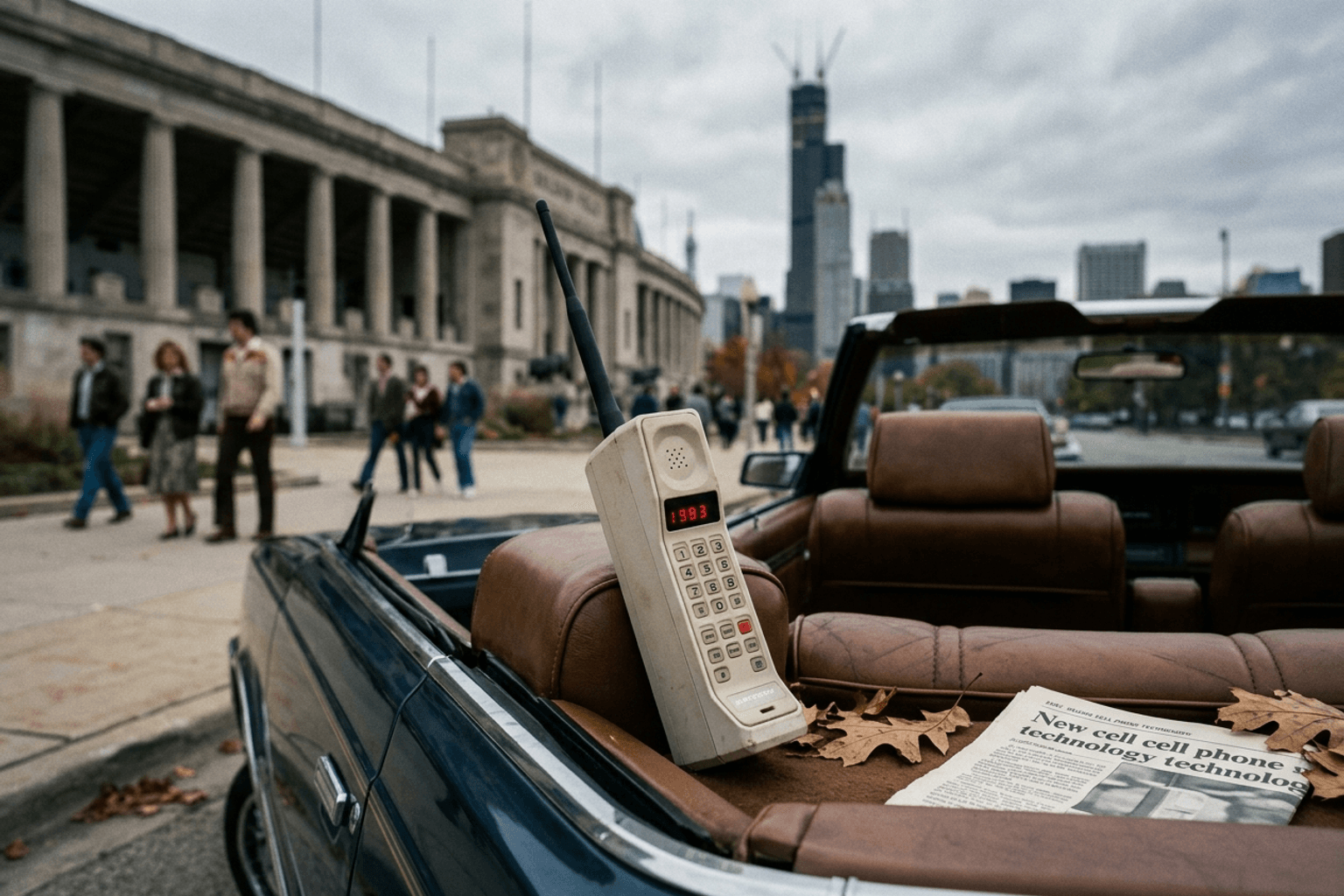
The Soldier Field Transmission: Inside the First Commercial Cellular Call
On the crisp autumn morning of October 13, 1983, a small assembly of corporate executives, city officials, and journalists gathered in the blustery parking lot outside Soldier Field on Chicago's South Lakefront. Parked on the asphalt was a convertible Chrysler sedan. Sitting in the driver's seat was Bob Barnett, the president of Ameritech Mobile Communications—the newly incorporated cellular subsidiary of Ameritech, one of the seven Regional Bell Operating Companies being carved out of AT&T's impending antitrust breakup. Resting in Barnett's hand was an imposing, cream-colored rectangular slab of molded plastic bristling with a black rubberized whip antenna and a vertical red LED numeric display: the Motorola DynaTAC 8000X.
With cameras clicking, Barnett pressed the keypad buttons to place a transatlantic long-distance telephone call. The radio signals from the handheld transmitter traveled through the Chicago air to one of seventeen regional cell towers, routed across the public switched telephone network, bounced across undersea cables, and rang an office phone in Germany. Answering the line was Alexander Graham Bell Grosvenor, the great-grandson of Alexander Graham Bell and nephew of National Geographic's legendary editors. The connection was clear, immediate, and historic. For the first time in human history, an ordinary paying commercial subscriber had initiated a phone call from a truly portable, untethered personal radio handset rather than a fixed copper wall jack or an eighty-pound mobile rig bolted permanently into an automobile trunk.
The symbolism of calling Bell's direct descendant was deliberate and profound. Just 107 years earlier, on October 9, 1876, Alexander Graham Bell had conducted the world's first two-way long-distance telephone conversation across two miles of telegraph wire between Boston and Cambridgeport. Now, Barnett's call proved that human speech could travel through thin air without a physical wire anywhere in the caller's vicinity. The moment marked the official opening of commercial cellular service in the United States, ending decades of radio congestion and ushering in what Ameritech boldly proclaimed as 'the dawn of the wireless era.'
The Ten-Year Regulatory Siege: From Martin Cooper's 1973 Prototype to FCC Approval
While Bob Barnett made the first commercial call in October 1983, the underlying technology had been demonstrated a full decade earlier. On April 3, 1973, Motorola vice president and general manager Martin Cooper had famously stepped onto the sidewalk of Sixth Avenue in Midtown Manhattan and made the first experimental handheld cell phone call to his chief rival, Joel Engel, head of Bell Labs' mobile research department. Yet between that dramatic street corner demonstration in 1973 and the commercial launch in 1983 lay a grueling ten-year regulatory and legal siege before the Federal Communications Commission (FCC).
The primary battlefield was not merely engineering, but spectrum policy and market monopoly. AT&T had spent decades lobbying the FCC for exclusive control of the 800 MHz radio spectrum, arguing that only a nationwide monopoly utility could coordinate the complex switching and frequency reuse required for mobile telephony. Furthermore, AT&T envisioned mobile phones strictly as 'car phones'—heavy transceivers permanently installed beneath automobile dashboards or in luggage compartments, powered by vehicle batteries. Motorola, then a comparatively modest maker of two-way land-mobile radios, pushed back aggressively under the leadership of Cooper and CEO John F. Mitchell, insisting that human beings are fundamentally mobile and that telephones should belong to individuals, not vehicles.
For nearly a decade, the FCC deliberated over spectrum allocation, antitrust safeguards, and technical standards. Motorola poured more than $100 million into developing cellular base stations and miniaturized handset electronics without any guarantee that the FCC would certify the hardware or grant commercial operating licenses. The deadlock finally broke in the early 1980s as the Department of Justice finalized the breakup of the Bell System (agreed in 1982 and effective January 1, 1984). The FCC established a competitive framework mandating two cellular operating licenses in every metropolitan market—one for the local wireline telephone company and one for a non-wireline competitor. In March 1983, the FCC officially approved Ameritech's commercial construction permit for Chicago, and in September 1983, it granted type acceptance for the Motorola DynaTAC 8000X, paving the way for the October 13 opening.
Engineering the DynaTAC 8000X: Why the $3,995 'Brick' Had 30 Minutes of Talk Time
By modern smartphone standards, the Motorola DynaTAC 8000X was a monstrous physical oddity, quickly earning the universal moniker 'The Brick.' The handset measured 10 inches in vertical height (13 inches when including the flexible rubber duck antenna), 1.5 inches in width, and 3.5 inches in depth. It tipped the scales at 28 ounces (1.75 pounds or 790 grams)—roughly four times the weight of an Apple iPhone 15 Pro. The casing was molded from high-impact ABS plastic, featuring a recessed earpiece, an internal electret microphone, and a keypad of twenty-one buttons: twelve standard numeric telephone keys alongside nine function keys for volume, clearing, and memory recall.
The severe ergonomic compromises of the DynaTAC were dictated by the brutal state of 1983 battery and semiconductor physics. The phone contained thirty distinct circuit boards stacked tightly together, housing hundreds of discrete analog and digital components, including a custom microprocessor and a frequency synthesizer capable of tuning across 666 duplex voice channels. Transmitting a 0.6-watt radio signal strong enough to penetrate office buildings and reach distant cell towers required tremendous electrical current. The internal power source consisted of a heavy pack of rechargeable nickel-cadmium (NiCd) cells. At maximum transmit power, this battery pack provided only thirty to thirty-five minutes of continuous talk time before dying completely.
Recharging the device was an exercise in patience. The standard desktop trickle charger took ten continuous hours to replenish the nickel-cadmium pack. Motorola offered an optional one-hour fast charger, but the intense heat generated during rapid charging frequently degraded the battery pack's lifespan and raised safety concerns. Yet despite these limitations, the DynaTAC 8000X was an astounding industrial triumph: it was the first completely self-contained, fully portable, full-duplex commercial cellular transceiver ever certified for civilian use. When Motorola put the handset on sale alongside Ameritech's network launch, it carried an eye-watering retail price tag of $3,995—equivalent to over $11,000 in contemporary inflation-adjusted purchasing power.
The Cellular Revolution: Hexagonal Frequency Reuse and the Death of the Landline Tether
To appreciate why the October 13, 1983 launch caused such a seismic transformation, one must examine the wretched state of mobile telecommunications that preceded it. Since 1946, cities had relied on legacy Improved Mobile Telephone Service (IMTS)—a system that utilized a single, massive high-power radio antenna mounted on a central skyscraper or mountain. Because everyone in the metropolitan area shared the exact same handful of frequencies (often only 12 to 24 channels for an entire city like New York or Chicago), mobile phone networks suffered catastrophic congestion. Only two dozen people could place calls simultaneously across a multi-million-person metropolis. Waitlists for car phone service stretched past three years, and placing a call routinely required waiting thirty minutes for an open radio channel.
The genius of the Advanced Mobile Phone System (AMPS) deployed in Chicago lay in cellular architecture, an idea first conceptualized mathematically by Bell Labs engineers D.H. Ring and W.R. Young in 1947. Instead of one giant transmitter shouting across an entire city, the urban landscape was divided into a honeycomb grid of small, low-power coverage areas called 'cells.' Because the transmission power of both the base station and the DynaTAC handset was strictly limited, the exact same radio frequencies could be reused simultaneously in non-adjacent cells without interfering with one another. When Bob Barnett drove his convertible across Chicago, high-speed automated computer switches measured the signal strength and seamlessly 'handed off' his call from one cell tower to the next in a fraction of a second, without dropping the audio conversation.
Ameritech's Chicago network launched with seventeen cell sites covering 2,500 square miles, instantly multiplying the city's mobile calling capacity by orders of magnitude. The financial barrier to entry was formidable: subscribers paid $50 a month for base service ($150 today), plus 40 cents per minute during peak business hours and 24 cents per minute off-peak. Yet demand shattered every industry forecast. Marketing consultants had famously told AT&T in 1980 that total nationwide cell phone users would never exceed 900,000 by the year 2000. Within weeks of the Soldier Field call, Ameritech had thousands of wealthy corporate executives, real estate developers, and physicians on an eager backlog. By 1984, cellular networks were expanding to Washington, D.C., Baltimore, and New York. The $3,995 brick proved that the world was ravenous for mobile connectivity, permanently breaking humanity's physical bond to the wall.
What the evidence does not settle
Popular retellings of early cellular history often conflate two distinct milestones: Martin Cooper's April 3, 1973 prototype demonstration on Sixth Avenue in New York City (which was a one-off experimental engineering test operating under a temporary FCC experimental permit) and Bob Barnett's October 13, 1983 call from Soldier Field in Chicago (which was the genuine launch of commercial cellular service available to paying subscribers). Additionally, historical accounts frequently describe the call recipient Alexander Graham Bell Grosvenor as Bell's grandson or nephew, whereas genealogical records confirm he was Bell's great-grandson via daughter Elsie May Bell and National Geographic president Gilbert Hovey Grosvenor. Furthermore, while the Motorola DynaTAC 8000X received commercial FCC certification in September 1983, consumer deliveries rolled out incrementally into early 1984 due to manufacturing ramp-up constraints. Readers seeking original hardware artifacts should note that vintage 1G analog AMPS handsets cannot transmit on modern digital cellular networks following the FCC's 2008 sunset of analog cellular spectrum mandates.
PRODUCT IDEA 01
Cutting the Cord: The Cell Phone Has Transformed Humanity — Martin Cooper

To understand the grueling decade-long struggle between Motorola and the Bell System that culminated in the October 13, 1983 commercial launch, Martin Cooper's firsthand memoir 'Cutting the Cord' offers essential historical testimony. Written by the visionary engineer who led the DynaTAC project, the book chronicles how a relatively small mobile-radio manufacturer in Schaumburg, Illinois took on AT&T—then the world's largest corporation—to champion the radical concept of personal, portable wireless communication. Cooper recounts the fierce patent rivalries, the technical breakthroughs required to build a 28-ounce handheld transceiver in an era of rack-mounted electronics, and the political battles before the FCC to prevent AT&T from monopolizing cellular airwaves. It remains the definitive insider narrative of how the modern mobile landscape was forged.
Buying limit: Published by RosettaBooks (ISBN 978-1948122818 in hardcover and ebook). Available through independent bookstores, university libraries, and digital book retailers. When purchasing for research collections or personal history archives, seek the unabridged hardcover edition containing Cooper's original engineering sketches, Motorola internal design memorandums, and historical photographs of the team that built the DynaTAC prototype.
Original editorial illustration, not a retailer photograph. No exact Amazon offer passed our verification gate.PRODUCT IDEA 02
Motorola DynaTAC Cellular Radiotelephone Handset Patent Blueprint Fine-Art Print (US Patent 3,906,166)
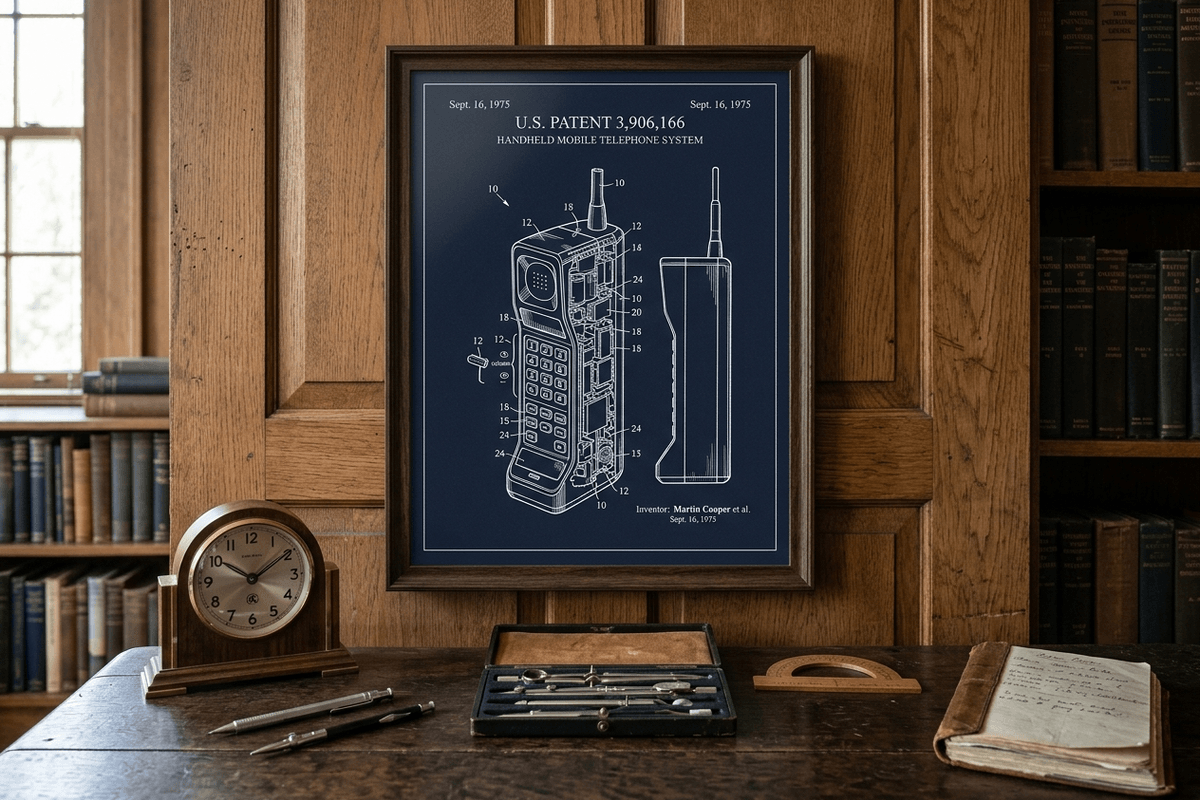
For engineers, telecommunications professionals, and industrial design enthusiasts, a museum-grade archival fine-art print reproducing Martin Cooper and Richard W. Dronsuth's original 1975 U.S. Patent (US Patent 3,906,166 for 'Radio Telephone System') captures the technical ingenuity of the DynaTAC's internal architecture. Printed on heavy 230gsm matte archival fine-art paper with acid-free pigment inks, the technical blueprint renders the exploded mechanical views of the phone's RF transceiver shield, the integrated helical whip antenna mount, the custom keypad matrix, and the modular nickel-cadmium battery housing. Framed in dark walnut or brushed aluminum, it serves as a sophisticated tribute to the physical artifact that severed the wireline cord and permanently altered human communication.
Buying limit: Select archival giclée prints created from high-resolution vector scans of the official United States Patent and Trademark Office (USPTO) patent filings rather than low-resolution digital copies. Ensure the print uses 100% cotton rag acid-free archival stock to prevent yellowing or ink degradation under ambient light. Standard framing dimensions (18x24 inches or 24x36 inches) allow straightforward mounting with UV-filtering acrylic or museum glass.
Original editorial illustration, not a retailer photograph. No exact Amazon offer passed our verification gate.SOURCES, METHOD, AND LIMITS
Researched using primary institutional archives from the Smithsonian National Museum of American History (Object Catalog nmah_1191361, Motorola DynaTAC Cellular Telephone collection), the Engineering and Technology History Wiki (ETHW Oral History: Martin Cooper and First-Hand: The Birth of the Cellular Phone), and the Federal Communications Commission (FCC historical cellular spectrum allocation and licensing dockets). Technical specifications regarding the Advanced Mobile Phone System (AMPS) 800 MHz frequency band, 30 kHz channel spacing, cell-site handoff algorithms, and DynaTAC nickel-cadmium battery chemistry were verified against Bell System Technical Journal archives and Motorola historical technical bulletins. No operational vintage cellular transceivers were activated on live radio frequencies.
- Smithsonian National Museum of American History — Motorola Dynatac Cellular Telephone Archive — Curatorial museum catalog record (Object ID 2003.0095.046) documenting the physical design, 2.5-pound weight, nickel-cadmium battery pack, and historical lineage of Motorola's DynaTAC handheld cellular phone.
- Engineering and Technology History Wiki (ETHW) — Oral History: Martin Cooper and the Birth of Cellular — Authoritative IEEE institutional oral history interview with Martin Cooper detailing the engineering development, FCC regulatory battles, and commercial rollout of the DynaTAC handheld phone and cellular network.
- Federal Communications Commission — Historical Cellular Services and Spectrum Docket — Official FCC regulatory overview detailing the history, commercial spectrum allocation in the 800 MHz band, and service rules for the first-generation cellular radio telecommunications service.