ON THIS DAY · OCTOBER 9, 1876
The Call That Conquered Distance: How Bell and Watson Conducted the First Two-Way Outdoor Telephone Conversation
On October 9, 1876, Alexander Graham Bell and his assistant Thomas A. Watson stepped out of their laboratory and onto the roof of telecommunications history. Connecting two early wooden box telephones to a borrowed two-mile telegraph wire of the Walworth Manufacturing Company between Boston and Cambridgeport, they overcame stubborn circuit resistance to conduct the world's first sustained, two-way outdoor conversation—proving that human speech could conquer open geographical distance.
Beyond the Parlour Curiosity: Why March 10, 1876 Failed to Convince the Commercial World
In modern folklore, the telephone was born in a single theatrical flash on March 10, 1876, when 29-year-old Alexander Graham Bell shouted into an experimental transmitter at 5 Exeter Place in Boston: 'Mr. Watson, come here, I want to see you!' Yet to nineteenth-century electrical engineers and commercial financiers, that famous laboratory demonstration was profoundly unimpressive. Bell's March transmission relied on a liquid variable-resistance transmitter—a fragile cup of diluted sulfuric acid with a vibrating platinum wire—that was volatile, caustic, and chemically incapable of sustained commercial operation. Crucially, the March experiment spanned only a few yards between two adjacent rooms inside a quiet private boarding house. Skeptics routinely dismissed the device as an acoustic parlour toy or an elaborate parlour trick, arguing that while sound might travel across a few paces of copper wire in a silent cellar, the delicate harmonic modulations of human speech could never survive the electrical hostility of real-world telegraph infrastructure.
That skepticism was reinforced by the dominant communications titan of the Gilded Age: the Western Union Telegraph Company. Governed by telegraphic orthodoxy, Western Union's leadership and chief consulting electrician, Thomas Edison, believed the future of telecommunications lay strictly in multiplexed Morse telegraphy—squeezing four or eight rapid dot-and-dash telegraph messages simultaneously onto a single iron wire. When Bell's primary financial patron, Gardiner Greene Hubbard, offered to sell Bell's telephone patents to Western Union president William Orton in the late summer of 1876 for $100,000, Orton scoffed at the proposal, famously asking: 'What use could this company make of an electrical toy?' To Orton and Wall Street, human voice transmission seemed commercially trivial and technically unscalable. If Bell wanted the world to take telephony seriously, he had to prove that the human voice could travel through wind, rain, and miles of existing outdoor iron telegraph wire, and return an articulate answer in real time.
The Walworth Iron Line: Repurposing a Two-Mile Factory Telegraph Wire
To mount a definitive real-world demonstration, Bell and his ingenious 22-year-old machinist-partner, Thomas A. Watson, needed access to a live outdoor line. Constructing their own private pole route across Boston was financially impossible for the cash-strapped inventors. Fortune intervened through the Walworth Manufacturing Company, a prominent steam-fitting and industrial valve manufacturer. Walworth maintained a private overland telegraph wire spanning roughly two miles between its downtown executive office at 69 Kilby Street in Boston and its sprawling manufacturing foundry in Cambridgeport, Massachusetts. By securing permission to connect their experimental apparatus to this line after business hours on Monday evening, October 9, 1876, Bell and Watson gained their first authentic proving ground.
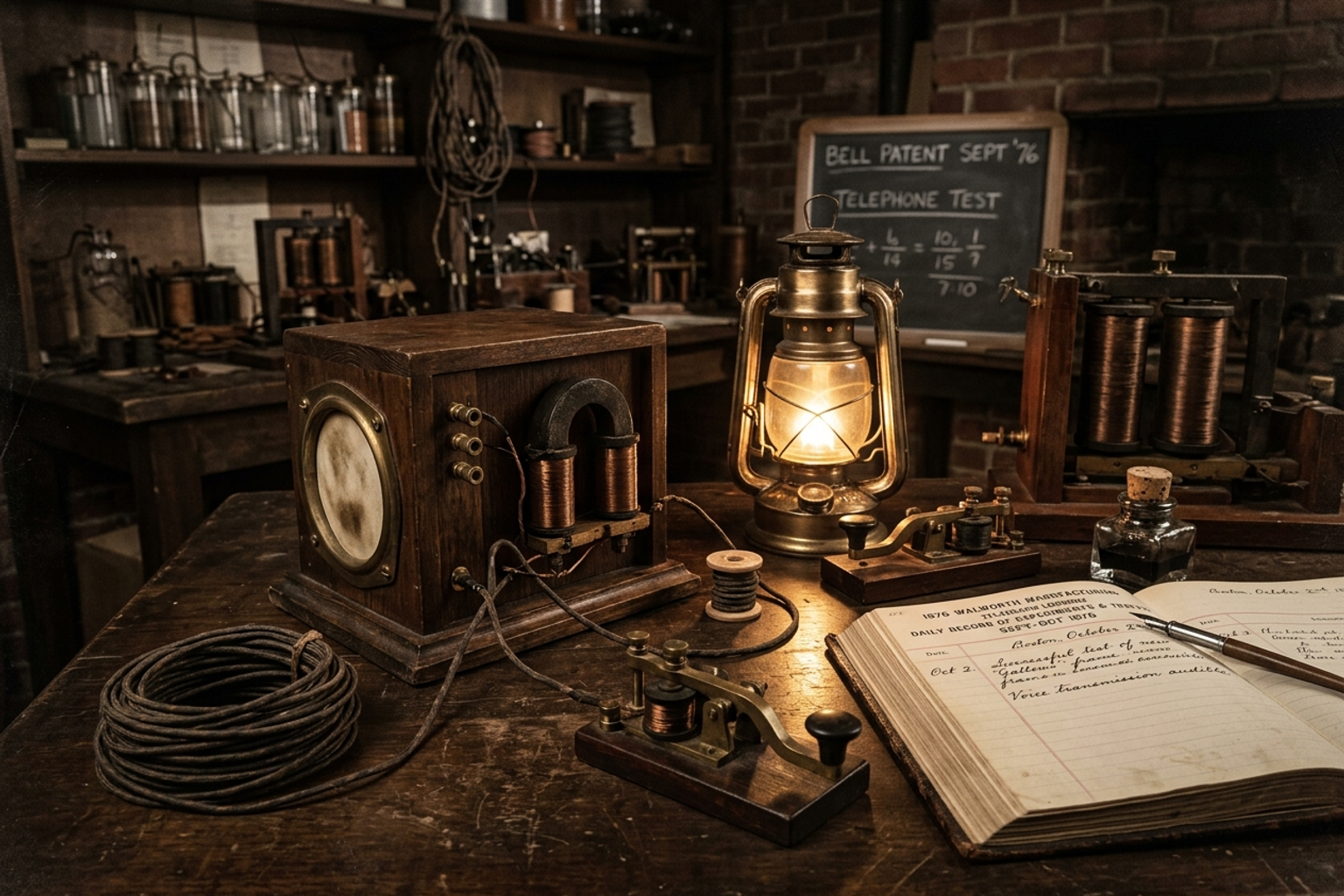
The technological setup was an exacting trial of nineteenth-century physics. At each end of the line, the inventors installed their newly refined 'box telephones'—rectangular wooden housings enclosing a parchment diaphragm glued to a lightweight sheet-iron armature, positioned mere fractions of a millimeter in front of the pole pieces of an adjustable horseshoe electromagnet. Unlike modern handsets that segregate the microphone from the earpiece, Bell's 1876 electromagnetic box instruments functioned reversibly: speaking into the membrane vibrated the iron armature, generating microscopic undulating currents via electromagnetic induction in the coil; conversely, incoming electrical waves modulated the magnet's attraction, vibrating the membrane to recreate speech into the listener's ear. Before commencing, Bell and Watson modified the line's electrical foundation: they disconnected the telegraph company's standard battery bank of nine Daniell wet cells and substituted a battery of ten high-capacity carbon elements, seeking a cleaner electrical bias that would not swamp the subtle micro-currents of vocal articulation.
'Not a Murmur Came Through': Watson's Relay Bypass and the Midnight Dialogue
As darkness fell over Massachusetts Bay on October 9, Watson stationed himself in the cold Cambridgeport factory office while Bell took up his post at 69 Kilby Street in Boston. To initiate contact, Bell tapped out a prearranged Morse telegraph signal on the wire's sounder. Hearing the click in Cambridgeport, Watson signaled back, disconnected the Morse sounder, coupled his box telephone to the line, and pressed his ear anxiously against the aperture. The result was horrifying silence. As Watson later recounted in his landmark memoir, 'The Birth and Babyhood of the Telephone': 'Not a murmur came through! Could it be that, although the thing worked all right in the house, it wouldn't work under practical line conditions?' For several tense minutes, the entire future of the telephone hung in the balance.
Watson's practical machinist instincts saved the experiment. Methodically tracing the factory wiring in the dim lamplight, he realized that although he had switched out his own Morse sounder, an auxiliary telegraph relay possessing a high-resistance electromagnet coil remained connected in series with the circuit at the factory terminal. This heavy electromagnetic coil acted as a massive inductive choke, strangling the faint, high-frequency undulations of Bell's voice currents before they could reach the telephone diaphragm. Grabbing a scrap length of copper wire, Watson hastily lashed a shunt across the relay's binding posts, cutting the obstructive coil entirely out of the circuit. He thrust the telephone back to his ear. Instantly, clear and vibrant as if standing in the same room, Alexander Graham Bell's voice resonated through the diaphragm: 'Mr. Watson, do you understand what I say?'
Overwhelmed with relief, Watson shouted back through his transmitter: 'Yes, I understand you perfectly!' What followed was the world's first sustained, two-way telephonic dialogue across open distance. For more than three continuous hours, Bell and Watson conversed through the autumn night. Conscious that skeptics would claim they were merely anticipating familiar conversational scripts, they subjected the connection to rigorous acoustic trials. They read long excerpts from local newspapers, traded technical queries, recited poetry, lowered their voices to normal conversational levels, and finally whispered across the two miles of iron line. Every inflection, cadence, and whisper carried through the wire with startling fidelity, proving that electromagnetic telephony was not a delicate laboratory fluke, but a rugged transmission medium.
Parallel Columns and the Midnight War Dance: Proving Practical Telephony to Skeptics
Knowing that commercial credibility demanded unassailable proof, both men kept synchronized written logs throughout the three-hour test, transcribing verbatim every word spoken and every word received. When the marathon call concluded around midnight, Watson boarded the last horse-drawn streetcar from Cambridge back across the Charles River to Boston. Arriving at the Exeter Place laboratory in the early morning hours, he found the attic empty; Bell had rushed directly to the offices of the Boston Daily Advertiser with their handwritten logbooks. Ten days later, on October 19, 1876, the newspaper published their complete records arranged in side-by-side 'parallel columns'—demonstrating word-for-word that complex sentences uttered in Boston had been faithfully received and recorded in Cambridgeport.
When Bell finally returned to the Exeter Place attic that night, the two young men erupted into an ecstatic, unrestrained celebration. Locking hands, they executed what Watson described as an exuberant 'jubilation and war dance', whooping and stomping on the wooden floorboards until their exhausted landlady pounded furiously on the ceiling below, threatening immediate eviction if the noisy inventors did not cease their midnight commotion. Yet no landlord could dampen their triumph. The October 9, 1876 experiment settled the fundamental engineering question of the age: speech could traverse outdoor iron wires without losing articulation. Within months, Bell and Watson pushed transmission from two miles to five, then sixteen miles over telegraph lines between Boston and Salem, paving the way for the incorporation of the Bell Telephone Company in July 1877 and sparking the global telecommunications grid that connects humanity today.
What the evidence does not settle
While popular histories often celebrate March 10, 1876 ('Mr. Watson, come here') as the birth of the telephone, that initial transmission utilized an acid-filled liquid transmitter over a short wire inside a single boarding house, which was chemically unstable and impractical for commercial use. The October 9, 1876 Walworth line test proved electromagnetic transmission over outdoor wires, but early iron telegraph circuits suffered severe signal attenuation, lacked amplification, and were heavily vulnerable to electromagnetic induction and crosstalk from adjacent Morse lines. The two-way communication required alternating speaking and listening through the same membrane or cumbersome two-instrument handling, as modern carbon-granule transmitters (Edison/Blake) and automatic switchboards were not perfected until late 1877 and 1878. Mentioned historical monographs and vintage design reproductions are independent editorial assessments and carry no commercial sponsorship.
PRODUCT IDEA 01
The Telephone Gambit: Chasing Alexander Graham Bell's Secret — Seth Shulman
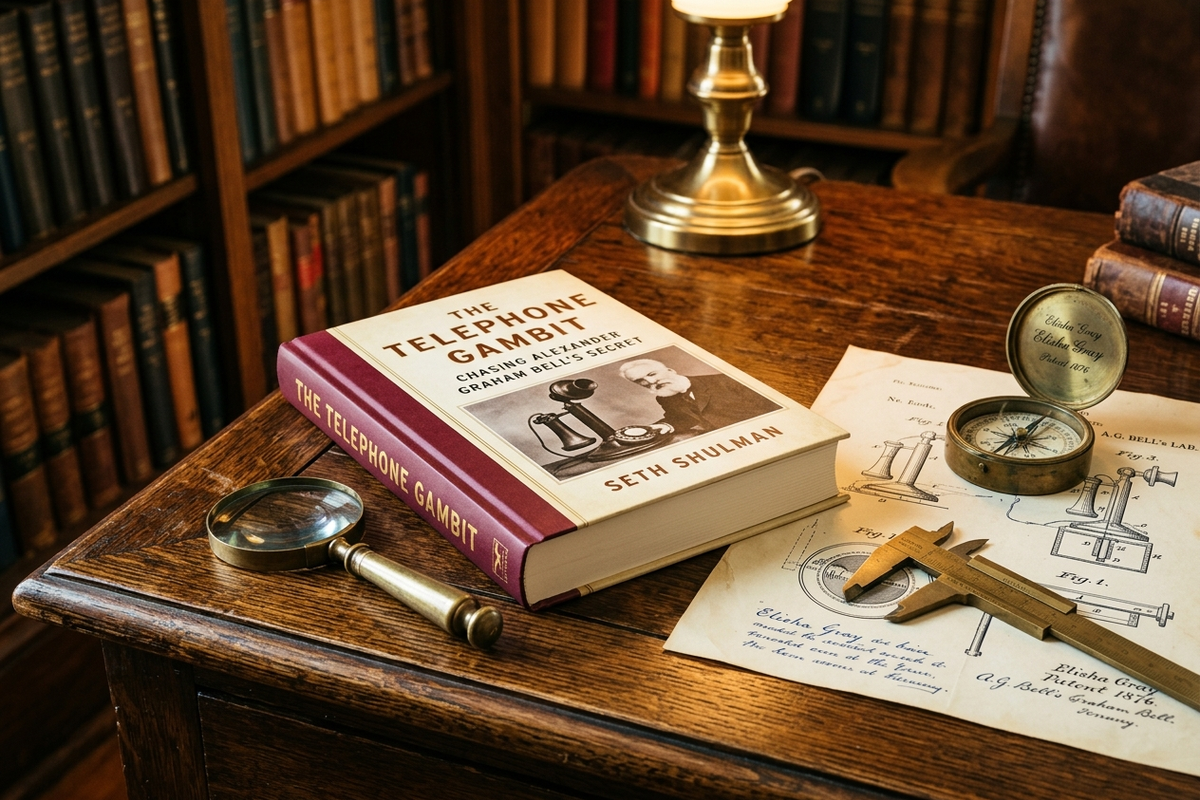
In 'The Telephone Gambit', investigative journalist Seth Shulman explores the intense intellectual drama and fierce patent battles surrounding Alexander Graham Bell's seminal telecommunications breakthroughs. Drawing upon newly accessible archival materials—including Bell's personal laboratory notebooks preserved at the Library of Congress and the competing patent caveat submitted on the exact same morning by Elisha Gray—Shulman unpacks the tense weeks leading up to and following the October 1876 Walworth line tests. He examines how Bell and his financial backers scrambled to defend the legitimacy of their patents against Western Union and rival claimants, illuminating the fragile boundary between independent invention, technical serendipity, and aggressive patent prosecution. It offers essential reading for anyone captivated by the messy, high-stakes human reality behind world-changing inventions.
Buying limit: Published by W. W. Norton & Company (ISBN 978-0393333145 in paperback, 978-0393062069 in hardcover). Available in paperback, hardcover, and digital Kindle formats from major booksellers. When purchasing for research or personal libraries, select the trade paperback edition which contains the complete illustrated plate section reproducing Bell's notebook sketches alongside Gray's caveat drawings and full bibliographic source citations.
Original editorial illustration, not a retailer photograph. No exact Amazon offer passed our verification gate.PRODUCT IDEA 02
Classic Solid-Brass Antique Candlestick Desk Telephone Replica (Heavyweight Working Model)
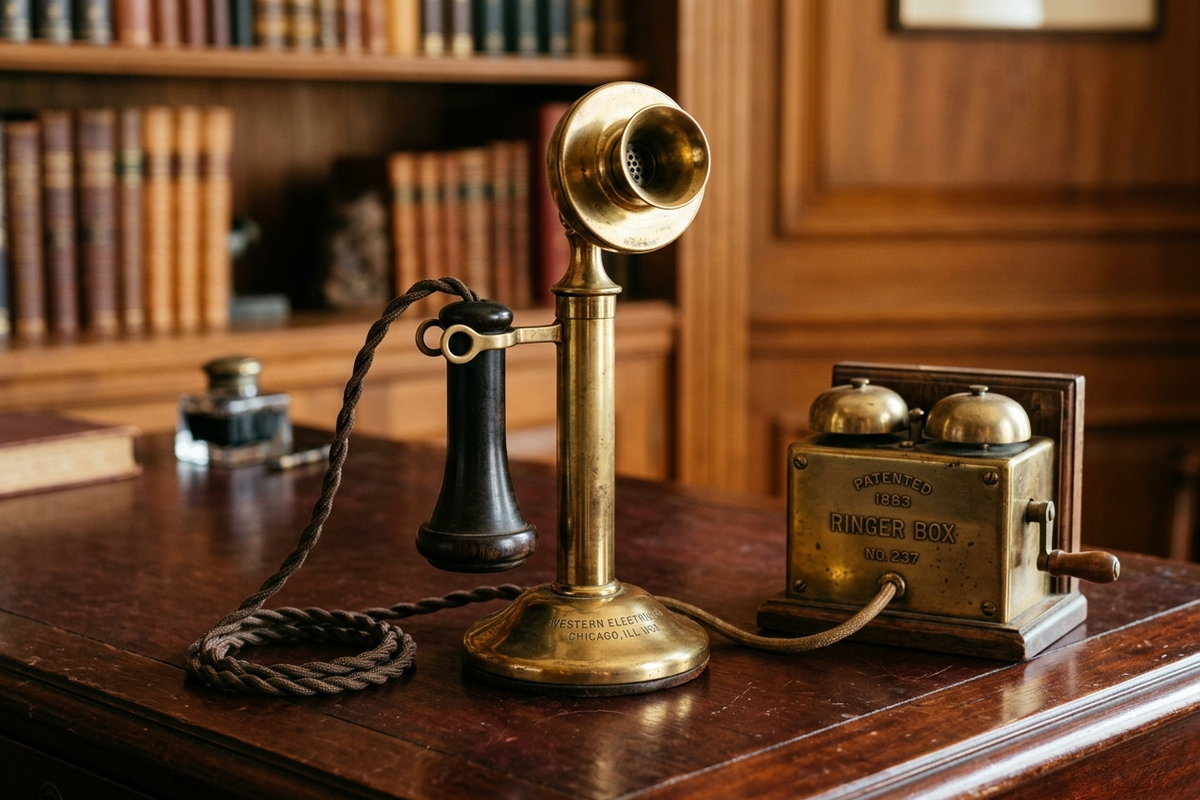
The awkward two-mile trial on October 9, 1876—where Bell and Watson had to alternate speaking and listening through rudimentary wooden boxes—directly spurred the ergonomic evolution of telephone design. By the 1890s, the telecommunications industry converged on the iconic 'candlestick' (upright) form factor: an upright brass stem holding a stationary mouthpiece transmitter, coupled with a handheld receiver hanging on an off-hook switchhook cradle. High-grade authentic reproductions crafted from heavy solid brass with braided cloth cords, operational rotary dials or push-button pulse converters, and mechanical bell ringers capture the tactile weight and acoustic charm of early telecommunications history, serving as a functional work of industrial art for modern study or office desks.
Buying limit: Avoid lightweight plastic or electroplated zinc novelties that imitate the vintage silhouette without substance. Look for authentic reproductions weighing at least four to five pounds, cast in genuine solid brass or lacquered bronze, featuring authentic cloth-jacketed wiring and a physical mechanical chime or dual-gong ringer box. Ensure the unit incorporates a standard modular RJ11 jack and FCC-approved tone-pulse circuitry compatible with modern landlines or analog telephone adapters (ATAs) if active home calling is desired.
Original editorial illustration, not a retailer photograph. No exact Amazon offer passed our verification gate.SOURCES, METHOD, AND LIMITS
Researched using primary archival documentation from the Library of Congress (Alexander Graham Bell Family Papers, including Bell's November 2, 1911 address to the Telephone Pioneers of America), Thomas A. Watson's published autobiographical monograph ('The Birth and Babyhood of the Telephone', 1913, Project Gutenberg EBook #18721), contemporary press records from the Boston Daily Advertiser (October 19, 1876 parallel-column transcript publication), and Fred De Land's historical analysis in The Popular Science Monthly (Volume 69, December 1906: 'Notes on the Development of Telephone Service II'). Technical parameters of the Walworth Manufacturing Company circuit—including the replacement of nine Daniell wet cells with ten carbon battery elements, line resistance characteristics, and the shunt bypass of the Morse relay—were corroborated against nineteenth-century telegraphic engineering literature. No vintage acoustic hardware was physically energized for this historical reconstruction.
- Library of Congress — Alexander Graham Bell Family Papers: Address to the Telephone Pioneers of America (1911) — Primary address delivered by Alexander Graham Bell on November 2, 1911, recounting the technical details, battery modifications, and transcript logs of the October 9, 1876 Walworth Manufacturing line experiment.
- Project Gutenberg — The Birth and Babyhood of the Telephone by Thomas A. Watson (EBook #18721) — Primary memoir by Bell's associate Thomas A. Watson detailing the Cambridgeport setup, the initial signal failure, cutting out the high-resistance telegraph relay, and the Exeter Place celebration.
- Wikisource / Popular Science Monthly — Notes on the Development of Telephone Service II by Fred De Land (1906) — Authoritative engineering history documenting the Walworth Manufacturing Company telegraph circuit, the substitution of ten carbon elements for nine Daniell cells, and the Boston Daily Advertiser publication.