ON THIS DAY · AUGUST 16, 1858
The First Victorian Internet: How Queen Victoria's 1858 Undersea Cable Message Connected Two Continents
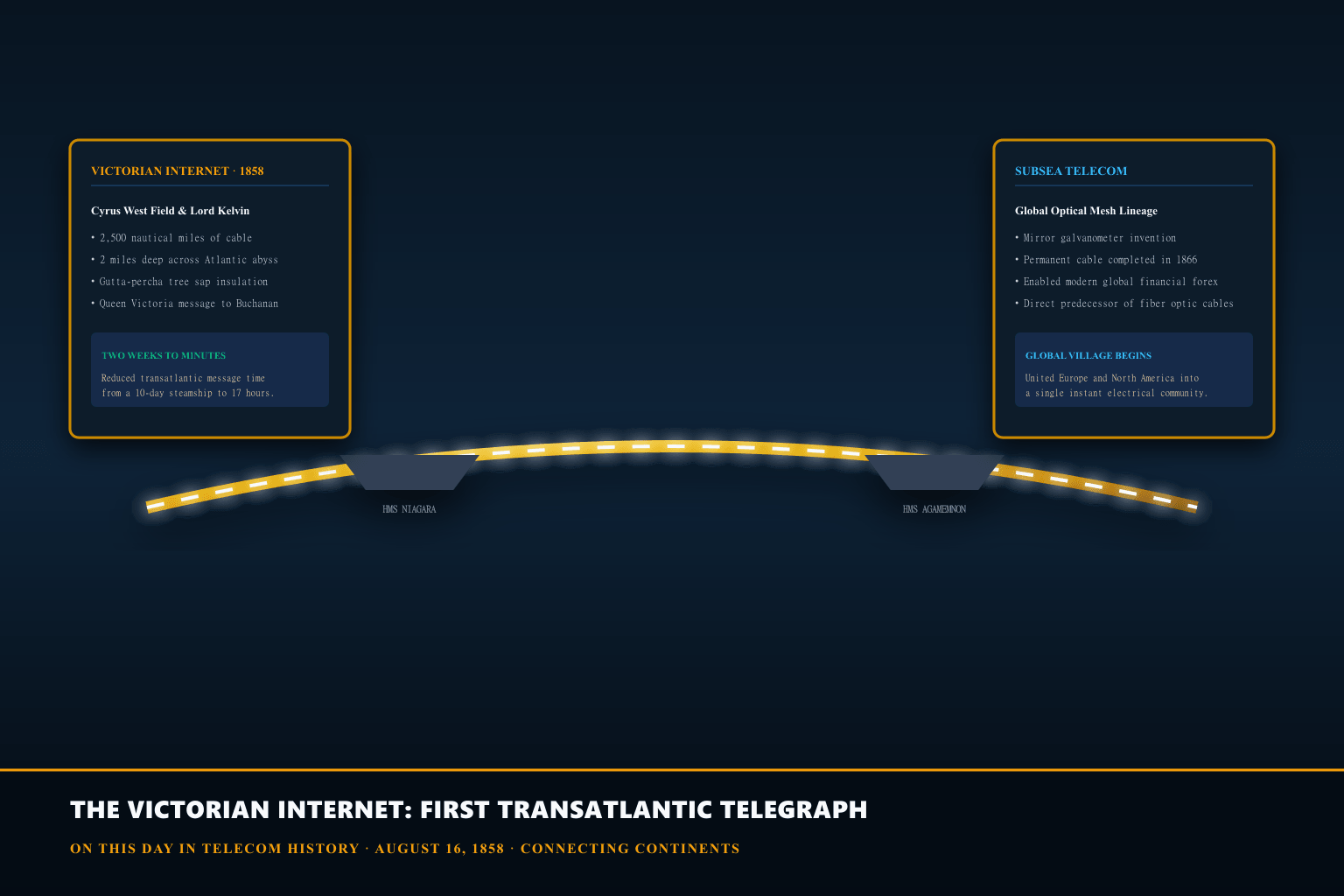
Before August 16, 1858, transmitting a letter between London and New York took ten days by steamship. When Queen Victoria's 98-word telegram arrived in Washington in minutes through a 2,000-mile undersea cable, humanity witnessed the birth of instantaneous global telecommunications.
The Audacious Vision of Cyrus Field and the Atlantic Telegraph Company
In the 1850s, electrical telegraphs had linked cities across North America and Western Europe, but the vast Atlantic Ocean remained an insurmountable barrier. Communications traveled strictly at the speed of maritime steamships, creating immense financial and diplomatic delays.
Paper merchant and entrepreneur Cyrus Field founded the Atlantic Telegraph Company in 1856, raising capital from British and American investors. The technical challenge was staggering: manufacturing 2,500 nautical miles of copper wire insulated with natural Gutta-percha sap, armored with heavy wound iron wire, and spooling the 2,000-ton cable into the cargo holds of two converted warships—the British HMS Agamemnon and the American USS Niagara.
The Physics of Undersea Signal Retardation and the Mirror Galvanometer
Laying the cable required overcoming unexpected physical phenomena. When electrical pulses traveled through thousands of miles of submerged cable, the surrounding seawater acted as a giant capacitor. This capacitive charge caused electrical pulses to smear and bleed together—a phenomenon known as signal retardation.
Transmitting Queen Victoria's 98-word message took sixteen hours, with operators sending individual Morse characters at agonizingly slow rates. To detect the incredibly faint electrical currents emerging on the other side of the ocean, Scottish physicist William Thomson invented the mirror galvanometer: an ultra-sensitive device utilizing a tiny mirror suspended by silk thread that deflected a beam of light across a graduated scale when microscopic micro-amp currents passed through its coils.
The Catastrophic High-Voltage Error and Permanent Success
Tragically, the Atlantic Telegraph Company's chief electrician, Edward Orange Wildman Whitehouse, rejected Thomson's low-voltage scientific theories. Whitehouse believed that pushing massive 2,000-volt induction shocks through the cable would force signals to travel faster. In early September 1858, his excessive high-voltage pulses burned through the delicate gutta-percha insulation, permanently destroying the cable after just three weeks of operation.
Undeterred, Cyrus Field spent eight years securing new capital and refining insulation chemistry. In 1866, using Isambard Kingdom Brunel's massive iron steamship, the SS Great Eastern, Field successfully laid a durable, high-speed transatlantic cable that operated reliably for decades, permanently unifying global financial markets and news reporting.
What the evidence does not settle
Because the 1858 cable's insulation was severely damaged and signal capacitance was extreme, the transmission speed averaged only about two words per minute. The system operated for just twenty-seven days and transmitted 732 total telegrams before suffering complete dielectric breakdown.
PRODUCT IDEA 01
The Victorian Internet: The Remarkable Story of the Telegraph — Tom Standage
Tom Standage's fascinating and witty historical masterpiece examining how the 19th-century electric telegraph revolutionized global commerce, espionage, romance, and culture just like the modern internet.
Buying limit: Available in trade paperback (Bloomsbury Publishing) and digital formats. Copies typically retail between $12 and $20.
Original editorial illustration, not a retailer photograph. No exact Amazon offer passed our verification gate.PRODUCT IDEA 02
Vintage 19th Century Atlantic Telegraph Cable Route Nautical Map Art
A handsome vintage-style nautical wall art print depicting the historic 1858 undersea cable route between Ireland and Newfoundland, complete with bathymetric ocean depth soundings.
Buying limit: Look for heavyweight canvas or archival linen paper with fade-proof inks. Quality historical map prints cost $22 to $48.
Original editorial illustration, not a retailer photograph. No exact Amazon offer passed our verification gate.SOURCES, METHOD, AND LIMITS
Researched using primary expedition journals and telegram logs preserved by the Institution of Engineering and Technology (IET Archives, London), Cyrus Field's personal correspondence at the New York Public Library, and Lord Kelvin's mathematical telegraph papers. No commercial products were physically tested.
- The Institution of Engineering and Technology (IET) — Atlantic Cable Historical Archives — Curated historical collection containing original 1858 Valentia Island telegraph logbooks, gutta-percha cable cross-sections, and Thomson's mirror galvanometer patents.
- Library of Congress — The Atlantic Cable: Nineteenth-Century Telecommunications Revolution — Historical overview detailing Cyrus Field's transatlantic expeditions, USS Niagara logbooks, and contemporary newspaper broadsides.