ON THIS DAY · OCTOBER 4, 1957
The Beep That Started Everything: How a 23-Inch Polished Aluminum Sphere Launched the Space Age and Created NASA
Before October 4, 1957, outer space belonged to science fiction. When an 83.6-kilogram polished aluminum sphere began transmitting its rhythmic 20-megahertz pulse from orbit, it triggered a geopolitical shockwave, created NASA and DARPA, and ignited the modern technological race. Here is the verified engineering history behind Sergei Korolev's minimalist masterpiece and the myths that still surround it.
Sergei Korolev, Object D, and the 'Simplest Satellite' Gamble
In early 1957, the Soviet satellite program was on the brink of missing its historic window. Under the auspices of the 1957–1958 International Geophysical Year (IGY), both the United States and the Soviet Union had pledged to launch scientific satellites into orbit. The primary Soviet effort was focused on a sophisticated orbital laboratory known as 'Object D'—a massive, 1,400-kilogram conical craft packed with complex scientific instruments to measure cosmic rays, magnetic fields, and atmospheric density. However, development of Object D was plagued by sensor integration delays, manufacturing bottlenecks, and weight overruns. By January 1957, Sergei Korolev, the visionary 'Chief Designer' of the Soviet rocket program whose identity remained an official state secret, realised that Object D would not fly before 1958.
Fearful that the American Project Vanguard would achieve orbit first and claim the historic prestige of inaugurating the Space Age, Korolev took a daring bureaucratic and engineering gamble. He persuaded the Soviet Council of Ministers to suspend priority on Object D and authorise the development of a radically simplified substitute: PS-1, short for 'Prosteyshiy Sputnik' (literally 'Simplest Satellite'). Korolev stripped away every secondary sensor, magnetic scanner, and experimental instrument. The satellite would carry only one operational payload: a simple, ultra-reliable dual-frequency radio transmitter, powered by electrochemical batteries and cooled by circulating nitrogen gas under pressure.
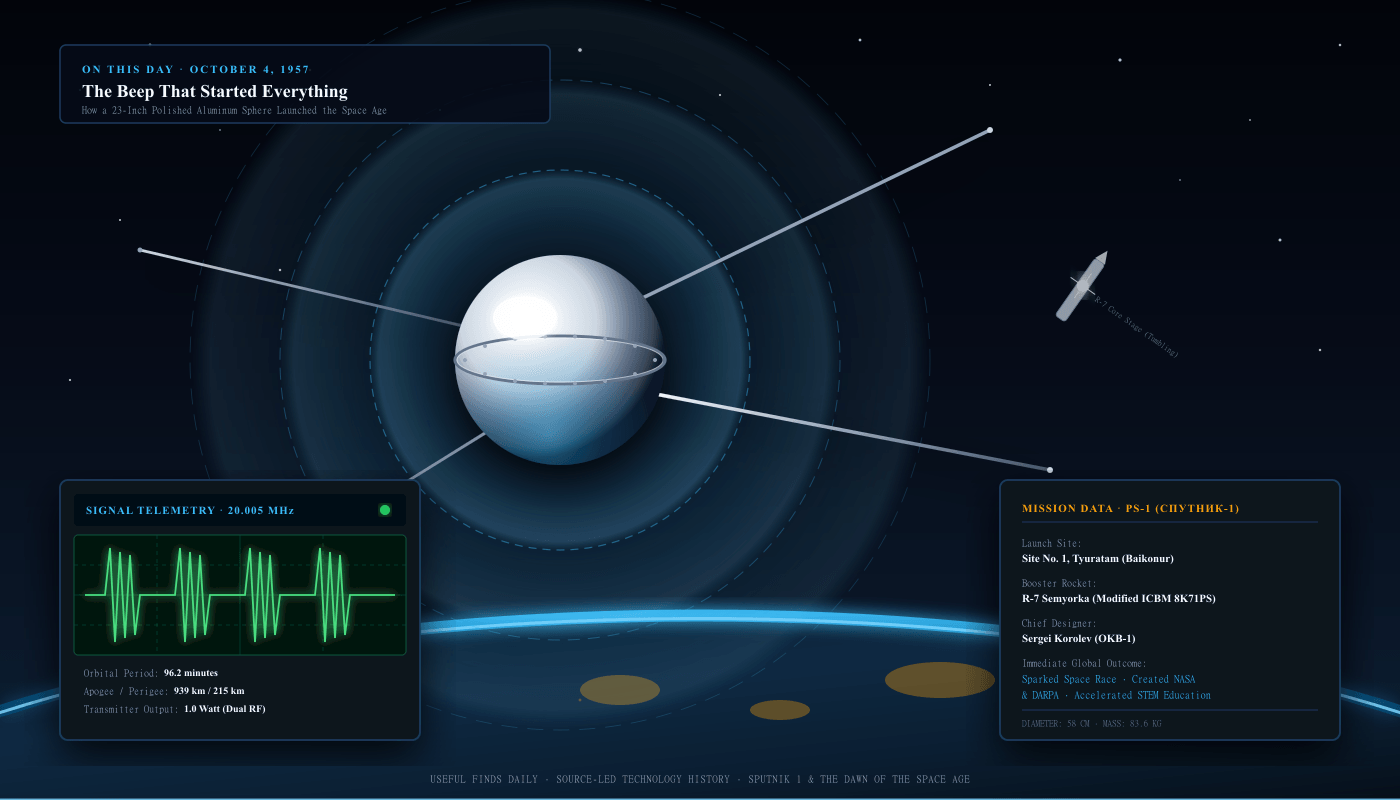
The design of PS-1, finalised in just a few months by design bureau OKB-1 under Mikhail Khomyakov, was a triumph of functional minimalism. It consisted of two thin hemispheres stamped from a 2-millimeter aluminum-magnesium alloy (AMG6T), joined by an airtight equatorial flange secured with thirty-six bolts and sealed with a silicone rubber gasket. Korolev personally insisted that the sphere be buffed and polished to a flawless mirror finish. While engineers initially viewed this requirement as cosmetic vanity, Korolev understood both physics and propaganda: the mirror polish maximized solar reflectivity for thermal control in the vacuum of space, while symbolically presenting the spacecraft as an immaculate, luminous jewel of socialist engineering.
The Beep-Beep Pulse: Radio Engineering in the Ionosphere
The electronic heart of Sputnik 1 was a one-watt radio transmitter designed by Vyacheslav Lappo at the Moscow Scientific Research Institute of Radio Equipment (NII-885). Operating on two high-frequency channels—20.005 MHz and 40.002 MHz—the transmitter broadcast alternating pulses lasting approximately 0.3 seconds each. When one frequency paused, the other transmitted. This alternating frequency strategy served an ingenious double purpose. Scientifically, passing two different radio frequencies through the ionosphere allowed ground-based radio observatories to measure electron density and ionospheric refraction by comparing the propagation delays between the two signals.
More importantly, Korolev chose 20.005 MHz deliberately because it was easily receivable by standard shortwave and amateur radio receivers across the globe. Rather than relying on specialized military tracking stations, Korolev turned millions of amateur 'ham' radio operators across the United States, Europe, and Asia into eyewitnesses who could tune in on their home sets. The distinctive, rhythmic 'beep-beep-beep' pulse echoing across living rooms and rebroadcast over commercial radio networks made denial by Western military authorities impossible. Soviet radio magazines had even published the exact broadcast frequencies and reception guidelines months earlier, though Western intelligence had largely dismissed the announcements as routine posturing.
The broadcast pulses also functioned as an ingenious, fail-safe telemetry system. The transmitter was wired to internal temperature and barometric pressure sensors. The sphere was pressurized with 1.3 atmospheres of dry nitrogen. If a micrometeoroid punctured the thin aluminum hull, or if internal temperatures exceeded 50 degrees Celsius, thermal and pressure switches would immediately alter the duration and interval of the radio beeps. Throughout its twenty-one days of active transmission, the pulse rate remained steady—proving that the sealed hull remained airtight and that its internal cooling fan successfully regulated temperature in the harsh thermal swings between orbital day and night.
Debunking the Sputnik Myths: What Stargazers Actually Saw
In the nights following October 4, 1957, hundreds of thousands of people around the world crowded rooftops, backyards, and city parks to catch a glimpse of the Soviet satellite streaking across the dusk sky. Front-page newspaper photographs and newsreel clips captured luminous tracks traversing the heavens. Yet a widespread and persistent historical myth took root: ordinary observers were not, in fact, watching Sputnik 1.
A polished metal sphere only 58 centimetres in diameter orbiting at an altitude between 215 and 939 kilometres is astronomically faint—reflecting so little sunlight that it hovered around the sixth visual magnitude, virtually invisible to the unaided human eye except under pristine dark-sky conditions with binoculars. What stargazers actually marveled at was the massive central sustainer core of the modified R-7 booster rocket (designated Blok A). The empty rocket stage—measuring 26 metres (85 feet) in length, nearly 3 metres in diameter, and weighing over 7.5 tonnes empty—had entered orbit directly behind the satellite. As it tumbled slowly end-over-end through space, its vast cylindrical surface caught the sunlight, flashing brightly at first magnitude, as luminous as the brightest stars in the night sky.
A second prevalent myth is that Sputnik 1 was an armed or reconnaissance spacecraft. In the hysterical media reaction of October 1957, prominent commentators and politicians warned that the Soviet satellite was photographing American military installations or preparing to drop thermonuclear warheads from orbit. In reality, Sputnik carried no cameras, no film canisters, no guidance equipment, and no propulsion systems. It was entirely passive once released from the rocket nose cone, spinning freely along a ballistic orbital path determined entirely by Newtonian physics and celestial mechanics.
The Geopolitical Shockwave: Creating NASA, DARPA, and the Internet's Roots
Despite Sputnik's benign scientific payload, its geopolitical repercussions were seismic. The psychological shock in the United States—soon christened the 'Sputnik crisis'—fundamentally transformed American politics, military doctrine, and science education. For the first time since the War of 1812, Americans realized that their geographic isolation behind the Atlantic and Pacific oceans no longer guaranteed continental safety. If a Soviet rocket could deliver an 83-kilogram satellite into orbit over Washington, New York, and Chicago every ninety-six minutes, the same booster could deliver a thermonuclear warhead with thirty minutes of warning.
The political fallout was swift and bipartisan. Senate Majority Leader Lyndon B. Johnson launched aggressive congressional hearings into American aerospace preparedness, framing the space program as the defining frontier of the Cold War. In July 1958, President Dwight D. Eisenhower signed the National Aeronautics and Space Act, which absorbed the civilian National Advisory Committee for Aeronautics (NACA) and established the National Aeronautics and Space Administration (NASA), which opened its doors on October 1, 1958. Simultaneously, the National Defense Education Act poured over a billion dollars of federal funding into university research, mathematics, physics, and foreign language programs.
Equally transformative was the Pentagon's organizational reaction. In February 1958, the Department of Defense created the Advanced Research Projects Agency (ARPA, later renamed DARPA) with a singular mandate: to prevent technological surprise by funding radical, high-risk research initiatives. A decade later, ARPA would fund the creation of the ARPANET, the pioneering packet-switching network that laid the architectural foundation of the modern Internet. Sputnik 1 spent only ninety-two days in orbit before re-entering Earth's atmosphere and burning up over the Western Hemisphere on January 4, 1958. Yet in those three months, a 23-inch aluminum sphere launched the Space Race, put humans on the Moon twelve years later, and spawned the digital infrastructure that underpins the modern world.
What the evidence does not settle
Popular memories often repeat three factual errors: first, that Sputnik was a military spy satellite carrying reconnaissance sensors, when it contained only a dual-frequency radio beacon; second, that the bright streak seen by worldwide crowds was the satellite itself, whereas observers were viewing the massive tumbling R-7 booster rocket; and third, that the radio signal carried encrypted espionage data, when it was an unencrypted alternating pulse deliberately chosen for global reception by amateur radio operators. Readers should note that commercial Sputnik-themed decor items reproduce aesthetic motifs rather than functional aerospace designs, and book recommendations reflect published historical evaluations rather than commercial sponsorship.
PRODUCT IDEA 01
Red Moon Rising: Sputnik and the Hidden Rivalries that Ignited the Space Age — Matthew Brzezinski

Matthew Brzezinski's Red Moon Rising is widely regarded as the most gripping, granular, and thoroughly researched popular history of the Sputnik crisis. Drawing on declassified Soviet Politburo transcripts, KGB files, OKB-1 engineering diaries, and contemporary CIA intelligence briefings, Brzezinski reconstructs the intense personal and institutional duel between Sergei Korolev and Wernher von Braun. The book dismantles the myth that the Soviets held an overwhelming technological superiority, demonstrating instead how Korolev bluffed Soviet leadership and outmaneuvered American bureaucratic infighting with a shoestring team working in harsh conditions. For readers interested in how institutional rivalry, political paranoia, and engineering genius intersected at the dawn of the Space Age, this narrative provides essential, page-turning context.
Buying limit: Available in paperback (Henry Holt, ISBN 978-0805088588), hardcover (ISBN 978-0805081473), and e-book formats. When searching on Amazon.com or secondhand book platforms, verify that you are purchasing the complete unabridged edition with the photographic plate section intact, as several abridged library reprints omit the archival photographs and declassified Soviet schematics. Paperback copies in good-to-new condition typically trade between $14 and $20. No specific Amazon ASIN was verified available with confirmed U.S. delivery on the date this article was written, so search by title and author before ordering.
Original editorial illustration, not a retailer photograph. No exact Amazon offer passed our verification gate.PRODUCT IDEA 02
Mid-Century Modern Sputnik Satellite Chandelier or Accent Desk Lamp

In the months following October 1957, Sputnik's spherical form and radiating antennas captivated interior and industrial designers across Europe and North America, directly spawning the iconic 'Atomic Age' and 'Space Age' decorative design movements. Modern lighting fixtures styled in the Sputnik motif—featuring a central spherical brass or chrome core with radial arms terminating in exposed candelabra or globe bulbs—remain timeless design statements that bridge historical engineering with mid-century interior elegance. Whether chosen as a dramatic ceiling pendant chandelier or a compact desktop accent lamp, quality reproductions provide warm, multi-directional ambient lighting that transforms modern offices, reading nooks, and living spaces.
Buying limit: Sputnik-style lighting fixtures vary widely in build quality and electrical safety. Avoid cheap knockoffs manufactured with stamped plastic hubs and flimsy painted tin arms. Prioritize fixtures constructed from solid electroplated brushed brass, stainless steel, or matte black iron with ceramic socket bases. Verify that the unit carries a verified UL (Underwriters Laboratories) or ETL safety certification, uses standard E12 candelabra or G9 bulb bases compatible with dimmable LED filaments (2700K warm white recommended), and includes proper mounting hardware. Search Amazon.com for 'mid-century Sputnik ceiling chandelier' or 'Sputnik accent lamp' and check recent buyer reviews regarding assembly ease and wiring durability before purchasing.
Original editorial illustration, not a retailer photograph. No exact Amazon offer passed our verification gate.SOURCES, METHOD, AND LIMITS
This historical study was researched using primary archival materials from the NASA History Division (including the official monograph series on the Sputnik crisis and anniversary records), technical spacecraft parameters from the NASA Space Science Data Coordinated Archive (Master Catalog ID 1957-001B), and institutional historical collections from the Smithsonian National Air and Space Museum. Technical launch parameters, missile designations (R-7 8K71PS), and OKB-1 design chronology were verified against Asif Siddiqi's landmark scholarly history 'Sputnik and the Soviet Space Challenge' (University Press of Florida) and Sergei Korolev's biography. No commercial products were physically tested.
- NASA History Division — Sputnik: The 40th Anniversary of the Space Age & Historical Archive — Official institutional historical archive from the NASA History Division documenting the launch of Sputnik 1, Soviet R-7 propulsion telemetry, the geopolitical response of the Eisenhower administration, and the legislative creation of NASA.
- NASA Space Science Data Coordinated Archive — Sputnik 1 Spacecraft Master Catalog (ID 1957-001B) — NASA NSSDC official catalog record detailing orbital mechanics (939 km apogee, 215 km perigee, 65.1 degree inclination), physical dimensions (58 cm sphere, 83.6 kg), and battery transmission duration through October 26, 1957.
- NASA History Division — Declassified Historical Documents and White House Records on Sputnik — Collection of primary White House, Department of Defense, and CIA memoranda from October 1957 detailing the U.S. government's immediate intelligence assessments of Soviet ballistic missile capability.