ON THIS DAY · SEPTEMBER 11, 1958
The Monolithic Idea: How Jack Kilby’s 1958 Hand-Soldered Wafer Sparked the Microchip Revolution
Before September 11, 1958, electronics were strangled by the "tyranny of numbers"—the physical impossibility of hand-soldering millions of individual wires between components. When Jack Kilby built a working oscillator entirely within a single sliver of germanium, he inaugurated the modern semiconductor age.
The "Tyranny of Numbers" Crisis in 1950s Computing
In the late 1950s, the electronics industry collided with a fundamental physical limitation known as the "tyranny of numbers." Complex military and industrial computing circuits required tens of thousands of discrete vacuum tubes, transistors, resistors, and capacitors.
Each discrete component had to be individually manufactured, tested, and manually hand-soldered to copper circuit boards with separate wire leads. With hundreds of thousands of individual solder joints, the statistical probability of a solder failure approached 100%, causing massive computer mainframes to fail every few hours.
The Solitary Summer at Texas Instruments: The Monolithic Idea
Jack Kilby joined Texas Instruments in Dallas in May 1958. Because he had not yet accrued vacation time, Kilby was left virtually alone in the Central Research Laboratory during July when the rest of the engineering staff took their mandatory two-week mass summer vacation.
Left to his own thoughts, Kilby had a radical epiphany: since semiconductors like germanium and silicon could act as transistors, they could also be doped with chemical impurities to function as resistors, while p-n junctions could serve as capacitors. Kilby realized that an entire circuit could be carved directly out of a single monolithic semiconductor crystal.
September 11, 1958: The Oscillator Sings
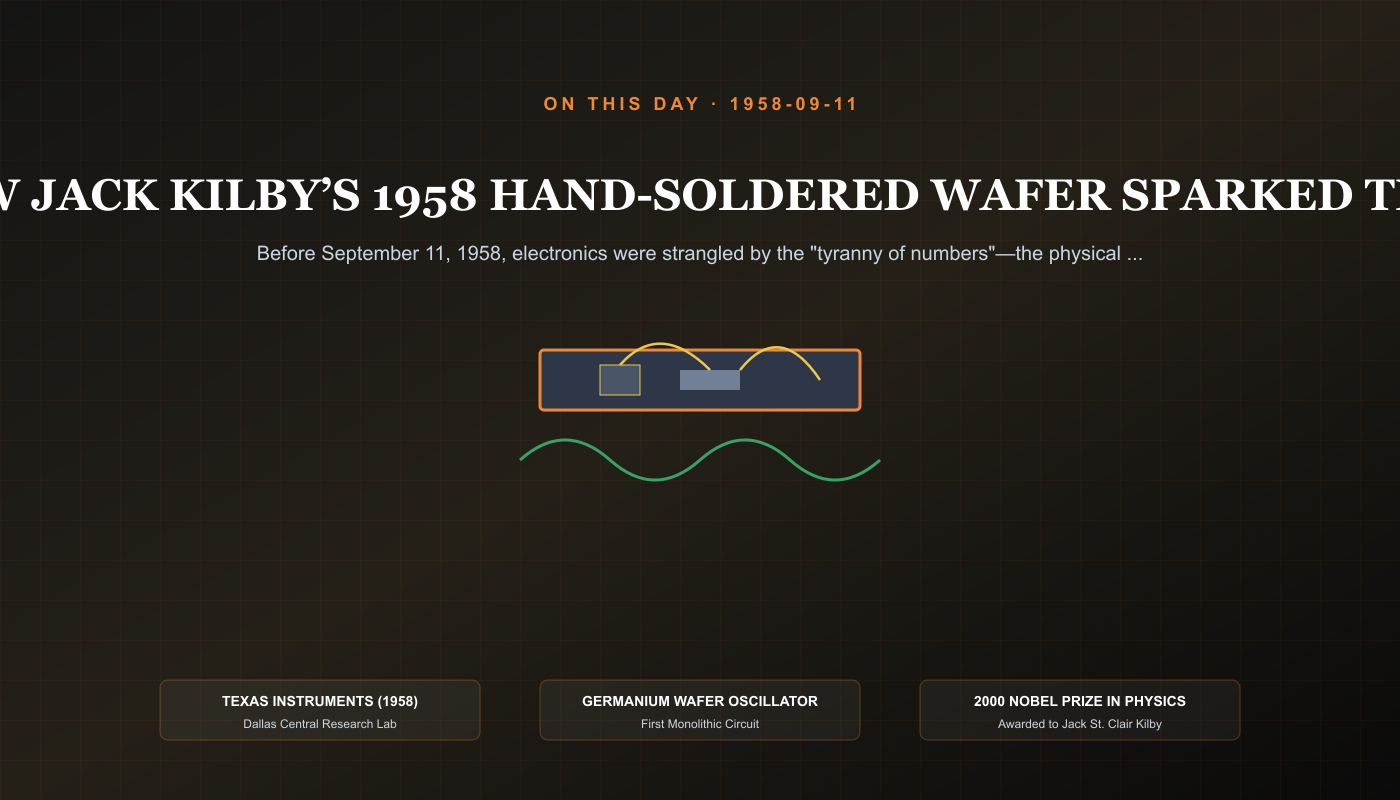
When management returned, lab director Willis Adcock was intrigued but skeptical. Kilby hand-fabricated a prototype on a sliver of germanium measuring half an inch long, etching a transistor and three resistors onto the bar and soldering gold connecting wires under a microscope.
On September 11, 1958, with Adcock looking on, Kilby connected the power supply and hooked the output to an oscilloscope. Instantly, a green sine wave danced across the screen at 1.3 MHz. The device was oscillating entirely on its own power from a single chip. Kilby was awarded U.S. Patent 3,138,743 and received the 2000 Nobel Prize in Physics for his foundational breakthrough.
What the evidence does not settle
Jack Kilby’s 1958 prototype used hand-soldered flying gold wire leads; six months later in 1959, Robert Noyce at Fairchild Semiconductor independently invented the planar silicon integrated circuit using evaporated aluminum lines, which made commercial mass fabrication possible. Both men are recognized as co-inventors of the microchip.
PRODUCT IDEA 01
The Chip: How Two Americans Invented the Microchip — T.R. Reid

T.R. Reid’s acclaimed chronicle of the parallel, brilliant breakthroughs of Jack Kilby at Texas Instruments and Robert Noyce at Fairchild Semiconductor that birthed the Silicon Valley revolution.
Buying limit: Available in trade paperback (Random House, ISBN 978-0375758287). Paperback copies typically trade between $14 and $20.
Original editorial illustration, not a retailer photograph. No exact Amazon offer passed our verification gate.PRODUCT IDEA 02
Raspberry Pi Pico 2 Microcontroller Development Board with RP2350

A high-performance dual-core ARM/RISC-V development board featuring silicon microchip architecture that descends directly from Kilby’s 1958 integrated circuit breakthrough.
Buying limit: Look for authentic Raspberry Pi Foundation packaging with pre-soldered header pins. Retail boards range from $8 to $15.
Original editorial illustration, not a retailer photograph. No exact Amazon offer passed our verification gate.SOURCES, METHOD, AND LIMITS
Researched using Jack Kilby’s 2000 Nobel Prize Lecture ("Turning Potential into Realities: The Invention of the Integrated Circuit"), primary Texas Instruments archival engineering records, and T.R. Reid’s history The Chip: How Two Americans Invented the Microchip. No commercial products were physically tested.
- The Nobel Foundation — Jack S. Kilby Nobel Lecture in Physics 2000 — Primary Nobel Prize address by Jack Kilby recounting the 1958 summer at Texas Instruments, the tyranny of numbers, and early microchip commercialization.
- IEEE History Center / ETHW — Milestone: Invention of the First Integrated Circuit, 1958 — Official IEEE electrical milestone documentation evaluating Kilby’s germanium phase-shift oscillator prototype and patent priority records.