ON THIS DAY · SEPTEMBER 9, 1947
The Moth in Relay 70: How Grace Hopper’s Harvard Team Recorded the World’s First Computer Bug
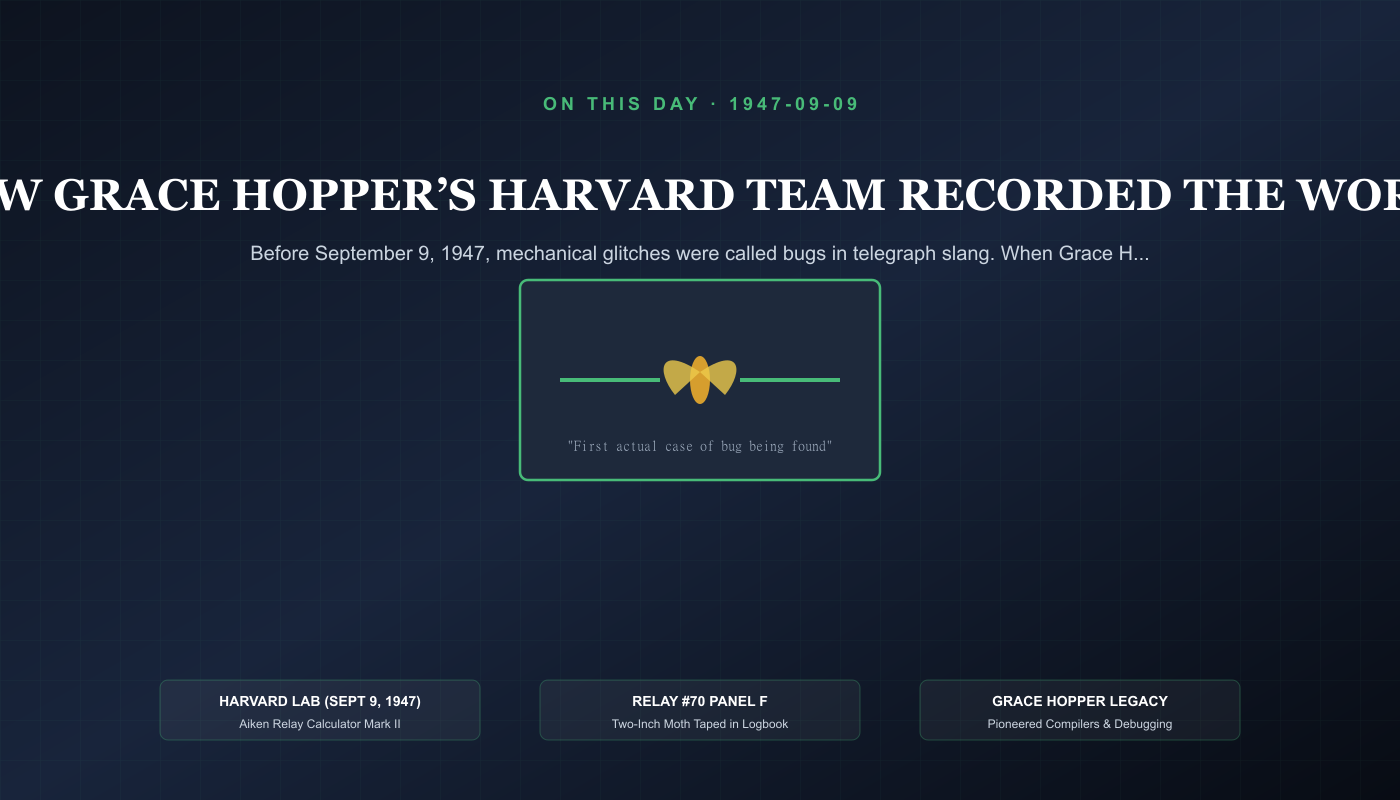
Before September 9, 1947, mechanical glitches were called bugs in telegraph slang. When Grace Hopper’s engineering team at Harvard taped an actual two-inch moth into their Mark II logbook with the notation "First actual case of bug being found," they gave computing its most enduring metaphor.
Electromechanical Computing in the Dahlgren Heat
In the late summer of 1947, the Harvard Mark II Aiken Relay Calculator was undergoing extensive test runs for the U.S. Navy Bureau of Ordnance. Unlike modern solid-state microprocessors, the Mark II was a colossal electromechanical calculating engine weighing twenty-five tons, containing 13,000 electromagnetic relays, miles of open copper wiring, and occupying a non-air-conditioned laboratory hall.
On a warm September afternoon, with windows open to cool the vacuum tubes and humming relay banks, the computer unexpectedly halted during a mathematical ballistics routine. The system indicated an open circuit failure in Panel F, halting all numerical calculations.
3:45 PM: Tweezers, Scotch Tape, and the Famous Logbook
Technicians traced the circuit fault to Relay #70. Using flashlights, operator Bill Burke inspected the copper leaf contacts and discovered a deceased two-inch moth beaten to death by the high-voltage relay blades, insulating the contact points and preventing current flow.
Burke extracted the moth with tweezers and taped the insect directly onto page 92 of the official daily logbook with transparent cellophane tape. Beneath the specimen, he carefully noted: "1545 Relay #70 Panel F (moth) in relay. First actual case of bug being found." The original logbook page, with the brittle moth still preserved, is permanently archived in the Smithsonian National Museum of American History.
Grace Hopper and the Discipline of Software Debugging
While the term "bug" had been used in 19th-century telegraph engineering slang (even Thomas Edison used it in letters), pioneering programmer and naval officer Grace Murray Hopper popularized the term across the computing discipline.
Hopper, who went on to create the world’s first compiler (the A-0 System) and co-design COBOL, frequently recounted the moth incident to military officials and industry conferences. As computing evolved from hardware relay glitches into complex logical software syntax errors, "debugging" became the formal terminology for isolating and fixing defects in software architecture.
What the evidence does not settle
Popular folklore often claims Grace Hopper personally caught the moth; official laboratory records show operator Bill Burke removed the insect while Hopper was supervising operations. Readers should note that modern software bugs stem from logical code errors rather than biological insects obstructing mechanical contacts.
PRODUCT IDEA 01
Grace Hopper and the Invention of the Information Age — Kurt W. Beyer

Kurt W. Beyer’s authoritative academic biography examines Grace Hopper’s pivotal leadership at Harvard, the development of machine-independent programming languages, and the birth of modern software engineering.
Buying limit: Available in hardcover and trade paperback (MIT Press, ISBN 978-0262517263). Paperback copies typically trade between $18 and $26.
Original editorial illustration, not a retailer photograph. No exact Amazon offer passed our verification gate.PRODUCT IDEA 02
Professional Electronics Anti-Static ESD Tweezers & Precision Repair Toolkit

A 9-piece precision anti-static carbon-fiber/stainless steel tweezers kit essential for micro-soldering, SMD board rework, and delicate hardware inspection.
Buying limit: Look for matte black ESD-safe coatings, non-magnetic stainless steel, and fine curved tip options. Quality precision tweezer sets range from $12 to $25.
Original editorial illustration, not a retailer photograph. No exact Amazon offer passed our verification gate.SOURCES, METHOD, AND LIMITS
Researched using primary archives from the Smithsonian National Museum of American History (Division of Information Technology and Communications, Record NMAH-AC0385), Naval History and Heritage Command records on Rear Admiral Grace Hopper, and Kurt W. Beyer’s scholarly biography Grace Hopper and the Invention of the Information Age. No commercial products were physically tested.
- Smithsonian National Museum of American History — The "First Computer Bug" Logbook — Primary physical artifact record containing high-resolution scans of page 92 of the Harvard Mark II logbook with the taped moth from September 9, 1947.
- Naval History and Heritage Command — Rear Admiral Grace Murray Hopper Biographical Archive — Official naval historical records documenting Hopper’s programming work on Mark I, Mark II, compiler architecture, and early software engineering standardization.