ON THIS DAY · OCTOBER 22, 1938
10-22-38 Astoria: How Chester Carlson's Makeshift Lab Invented Xerography and the Plain-Paper Copy
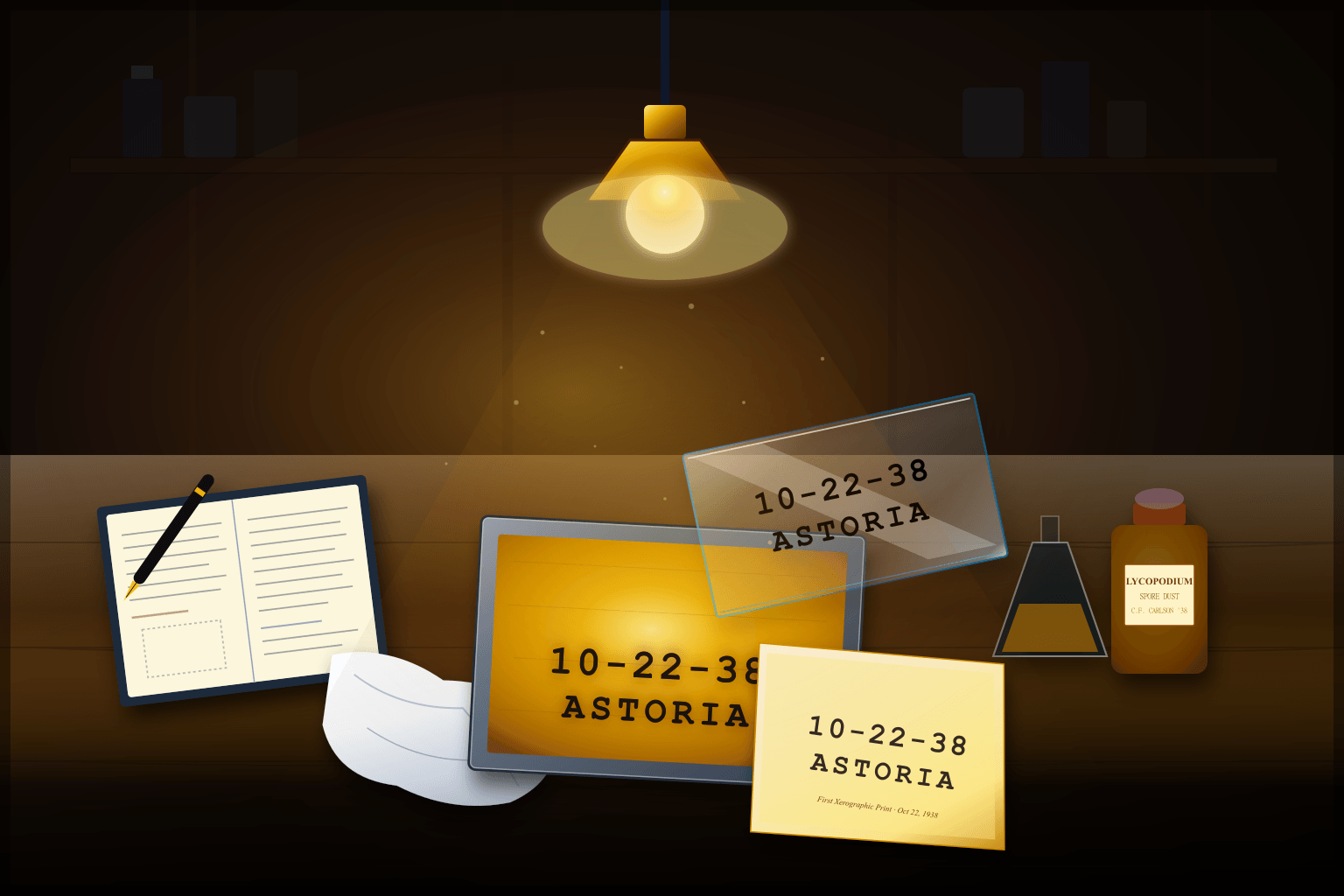
On October 22, 1938, in a rented second-floor apartment above a tavern in Astoria, Queens, an impoverished, arthritic patent attorney named Chester Carlson and Austrian refugee physicist Otto Kornei pressed an ink-inscribed glass microscope slide against a sulfur-coated zinc plate rubbed with a cotton handkerchief. Exposing the plate to an incandescent floodlamp, dusting it with clubmoss spores, and pressing it against a sheet of waxed paper over a gas flame, they created a faint brown smear bearing the immortal inscription: '10-22-38 ASTORIA'. It was the world's first successful electrophotographic copy—an unheralded experiment in 'dry writing' that defied twenty years of corporate skepticism, created the Xerox Corporation, and permanently liberated human knowledge from the tyranny of carbon paper.
The Tyranny of Carbon Paper: A Crippled Attorney's Quiet Obsession
In the late 1930s, the modern American office was held hostage by an excruciating, century-old mechanical bottleneck: carbon paper. Duplicating a legal contract, patent application, or engineering memorandum required a typist to sandwich flimsy sheets of waxy, soot-coated carbon paper between blank stationery inside a heavy manual typewriter. Striking a key forced ink through the layers, but the process was agonizingly unforgiving. A single typographic mistake on the fifth carbon copy required laboriously erasing errors across all preceding sheets with an abrasive pencil eraser, frequently tearing the delicate onionskin paper. For documents featuring intricate technical diagrams, mathematical formulas, or handwritten signatures, carbon paper was completely useless. The only commercial alternatives were Photostat machines—cavernous darkroom cameras that used wet chemical developers, cost up to twenty-five cents per page, and required hours of chemical immersion and drying—or gelatin-based hectographs and alcohol mimeographs that demanded messy, toxic purple stencils.
Among the countless office workers who suffered through this bureaucratic drudgery was Chester Floyd Carlson. Born in Seattle in 1906, Carlson had experienced a childhood of crushing poverty. By the time he was fourteen, both of his parents were crippled by tuberculosis and spinal arthritis, leaving young Chester as the sole breadwinner. Working as a janitor and print-shop apprentice, he somehow managed to earn a physics degree from the California Institute of Technology in 1930. Arriving in New York City during the depths of the Great Depression, Carlson was hired by P.R. Mallory & Co., an electronics manufacturer in midtown Manhattan, where he rose to manage the firm's patent department while attending law school at night. At Mallory, Carlson spent entire days manually writing, retyping, and cross-checking patent claims. To compound his agony, Carlson suffered from debilitating spinal arthritis and severe myopia, making the physical strain of manual transcription and carbon-copying an unbearable physical torment.
Recognizing that existing chemical photography was fundamentally unsuited for rapid office copying—because wet silver-halide processes required expensive coated papers, chemical baths, darkrooms, and prolonged drying times—Carlson resolved to find a physical rather than a chemical solution. He spent evenings and weekends immersed in the reading rooms of the New York Public Library, scouring obscure physics journals and foreign monographs. He became fascinated by photoelectric phenomena and the research of Hungarian physicist Paul Selényi, who had demonstrated that electrostatic charges could be guided across an insulating surface to record images. Carlson arrived at a daring conceptual hypothesis: if a photoconductive material—a substance that acts as an electrical insulator in the dark but conducts electricity when exposed to light—were coated onto a metal plate, given a static electrostatic charge, and exposed to an optical image, light would drain the charge away from white areas while dark letters would preserve their static attraction. By dusting the plate with oppositely charged pigmented powder, an invisible electrostatic latent image could be made visible and instantly fused to ordinary dry paper without a single drop of liquid chemical.
Sulfur, Silk, and Spores: The Astoria Breakthrough of October 22, 1938
Turning electrostatic theory into physical reality required experimental facilities that Carlson could not afford. Fearing that toxic vapors and sulfur fumes would incinerate his modest Jackson Heights apartment, Carlson rented the second floor of a small frame house at 32-05 31st Street in Astoria, Queens, owned by his mother-in-law. The space sat directly above a bustling neighborhood bar and beauty parlor, whose patrons routinely complained about the pungent sulfur smells wafting down through the floorboards. Knowing his arthritic hands could not manage delicate experimental manipulations alone, Carlson placed a classified advertisement in the German-language daily newspaper 'New Yorker Staats-Zeitung'. He hired Otto Kornei, an unemployed Austrian refugee physicist with expertise in metallurgy who had fled Nazi persecution in Europe, offering him ten dollars a week plus a share in any future patent royalties.
Throughout the autumn of 1938, Carlson and Kornei experimented with various metal bases and photoconductive coatings. In the late 1930s, the few known photoconductors were crude and temperamental; they settled on elementary sulfur, which melted into a crystalline, vitreous yellow layer when heated onto a small rectangular zinc plate. The breakthrough arrived on Saturday, October 22, 1938. Inside the darkened Astoria room, Kornei took a zinc plate coated with yellow sulfur and rubbed its surface vigorously with a clean cotton handkerchief to deposit a uniform negative static charge through triboelectric friction. Kornei then took a clean glass microscope slide and, using an ordinary steel dip pen dipped in black India ink, meticulously hand-lettered the date and location across the glass: '10-22-38 ASTORIA'.
Kornei laid the ink-inscribed glass slide directly over the charged sulfur plate. Turning on a bright incandescent floodlamp, he exposed the sandwich to light for approximately three seconds. Light streaming through the clear glass struck the sulfur, exciting electrons and allowing the electrostatic charge to bleed off into the grounded zinc plate below. But directly beneath the opaque black letters '10-22-38 ASTORIA', the sulfur remained in darkness, stubbornly retaining its electrostatic charge. Moving the plate back into the darkroom, Kornei dusted the surface with lycopodium powder—the microscopic, powdery yellow spores of clubmoss plants, traditionally used by pharmacists to coat pills. The spores clung tenaciously to the invisible electrostatic letters. Kornei then pressed a sheet of kitchen wax paper against the dusted sulfur, transferred the spores onto the wax, and held the paper over a flame to melt the wax and permanently fuse the powder. When Carlson and Kornei examined the cooled wax paper under the light, the inscription stood out with sharp, indelible clarity: '10-22-38 ASTORIA'. The world's first photocopy had been born.
The Twenty-Year Wilderness: Corporate Rejection and the Battelle Gamble
Carlson was ecstatic, believing that his modest Astoria print would immediately attract the titans of American industry. In reality, October 22, 1938 inaugurated a grueling twenty-year corporate odyssey that would test Carlson's sanity and financial endurance. On September 8, 1938, Carlson had filed his preliminary patent application, culminating in U.S. Patent No. 2,221,776 for 'Electron Photography' and U.S. Patent No. 2,297,691 for 'Electrophotography'. Between 1939 and 1944, Carlson personally demonstrated his crude sulfur plate and spore-dusting apparatus to more than twenty of the largest corporations in the United States, including IBM, RCA, General Electric, Eastman Kodak, and Remington Rand. Every single corporate board turned him away. Executives dismissed the process as dirty, messy, and laughably uncompetitive against established carbon paper, which cost mere pennies per box.
The most legendary rejection came from Thomas J. Watson's IBM. After inspecting Carlson's apparatus, IBM commissioned a comprehensive market research study from the prestigious consulting firm Arthur D. Little. The analysts concluded with clinical certainty that there was no meaningful commercial demand for an office copier, asserting that even if a machine could be engineered to work reliably, total national demand across the entire United States would never exceed a few thousand units—a market far too trivial to justify the tooling costs. Kornei, disillusioned by the endless stream of corporate dismissals and needing steady income to survive in America, amicably resigned to accept an engineering position at the Brush Development Company in Cleveland, forfeiting his future patent share in exchange for a modest severance payment (though Carlson later voluntarily gave Kornei a substantial financial gift worth hundreds of thousands of dollars after the invention succeeded).
The turning point arrived in 1944 when Carlson visited the Battelle Memorial Institute, a non-profit industrial research foundation in Columbus, Ohio. An insightful Battelle engineer named Russell Dayton recognized the revolutionary physics buried beneath Carlson's crude sulfur apparatus. Battelle signed a royalty-sharing development agreement with Carlson, investing thousands of laboratory hours into refining the materials science. Battelle researchers made the critical discovery that replacing sulfur with amorphous selenium—a metalloid with vast photoconductive sensitivity across the visible spectrum—allowed the plate to be exposed in fractions of a second rather than minutes. In 1947, Joseph C. Wilson, the visionary young president of the Haloid Company—a struggling photographic paper manufacturer in Rochester, New York that lived precariously in the shadow of giant Eastman Kodak—learned of Battelle's research. Wilson boldly risked Haloid's remaining capital to license Carlson's patents. Realizing that 'electrophotography' was too cumbersome for commerce, Haloid consulted an Ohio State University classical scholar, who suggested combining the Greek words 'xeros' (dry) and 'graphos' (writing). In 1948, Haloid officially trademarked the word 'Xerox'.
The Xerox 914 and the Digital Age: From Plain-Paper Copiers to Laser Printing
On September 16, 1959—nearly twenty-one years after the Astoria experiment—Haloid Xerox held a press conference at the Sherry-Netherland Hotel in New York City to unveil the culmination of Carlson's dream: the Xerox 914. Weighing 648 pounds and roughly the size of two washing machines, the 914 was the world's first fully automatic, plain-paper commercial office copier. An operator simply placed an original document face down on a glass platen, pushed a button, and watched as a spinning selenium drum was charged by high-voltage corona wires, exposed via synchronized moving mirrors, dusted with fine thermoplastic black toner, transferred to plain paper, and heat-fused in six seconds. It required no wet chemicals, no masters, no stencils, and no specialized coated paper. It made six copies per minute on whatever paper the office already had in its supply closet.
The Xerox 914 unleashed an unprecedented information revolution. Haloid Xerox pioneered an innovative leasing model: instead of selling the prohibitively expensive $29,500 machine outright, they leased it for ninety-five dollars a month, including two thousand free copies, charging a nickel for each additional copy. Office workers began copying everything—memos, recipes, children's drawings, newspaper clippings, and financial spreadsheets. By 1965, Haloid Xerox had renamed itself Xerox Corporation, and annual revenues skyrocketed past $500 million, making Xerox one of the fastest-growing corporations in American history. The photocopier fundamentally decentralized corporate power, giving mid-level employees the ability to duplicate and circulate documents without executive gatekeepers. In 1969, military analyst Daniel Ellsberg spent weeks after hours operating a commercial Xerox copier to duplicate 7,000 top-secret pages that became known as the Pentagon Papers, demonstrating how Carlson's dry copier could alter political history.
The technological lineage of Carlson's October 22 breakthrough did not end with the photocopier. In 1971, at Xerox's newly established Palo Alto Research Center (PARC), optical engineer Gary Starkweather modified a xerographic selenium drum to be imaged not by incandescent reflected light, but by a computer-controlled, modulated helium-neon laser beam sweeping across a spinning polygonal mirror. Starkweather's invention—the laser printer—became the operational engine of personal computing, desk-top publishing, and modern digital commerce. Chester Carlson became extraordinarily wealthy, receiving tens of millions of dollars in Xerox royalties. Yet Carlson never owned a yacht, never lived in a mansion, and shunned personal publicity. Remembering the agonizing poverty of his youth, Carlson quietly and anonymously gave away over $100 million—more than eighty percent of his fortune—to universities, the NAACP Legal Defense Fund, peace foundations, and Buddhist monasteries before suffering a fatal heart attack in Manhattan in September 1968, leaving behind an invention that quietly reshaped the architecture of human communication.
What the evidence does not settle
While Chester Carlson's October 22, 1938 Astoria experiment proved the viability of electrophotography, early xerographic processes suffered severe technical and commercial constraints. Early sulfur-coated plates possessed very low light sensitivity, requiring high-intensity floodlamp exposures of several seconds and degrading rapidly under repeated friction. Transferring organic lycopodium spores produced fragile images that required manual open-flame heating to fuse, creating significant fire hazards. The commercial breakthrough required replacing sulfur with hazardous amorphous selenium drums, which had to be handled with extreme care to avoid toxic vapor emissions during manufacturing. High-voltage corona wires (corotrons) used to charge the drums generated sharp ozone odors that mandated activated-carbon ventilation filters in office environments. Furthermore, early automatic paper feeders frequently jammed against hot fusing rollers—prompting the Xerox 914 to famously ship with a built-in fire extinguisher (humorously dubbed the 'Scorchatron' by technicians)—before heat-resistant silicone rollers and modern micro-toner formulations matured.
PRODUCT IDEA 01
Brother HL-L2460DW Wireless Compact Monochrome Laser Printer (Automatic Duplex · Up to 36 ppm · Wi-Fi & USB)

Nearly nine decades after Chester Carlson dusted moss spores across an electrically charged sulfur plate in Astoria, the core physics of electrophotography remains the undisputed backbone of professional document output. While consumer inkjet printers constantly plague home offices with clogged printheads, smeared water-soluble dyes, and ruinously expensive ink cartridges that evaporate when left idle, the Brother HL-L2460DW uses the exact electrostatic dry-toner principles perfected by Xerox. Inside its compact chassis, a semiconductor laser diode scans an organic photoconductor drum, attracting electrostatic micro-toner particles that are thermally fused onto plain paper at speeds up to 36 pages per minute. Featuring automatic two-sided duplex printing, a 250-sheet enclosed paper cassette, and dual-band wireless connectivity, it delivers crisp, razor-sharp 1200 dpi black text documents that never smudge, smear, or fade, providing years of maintenance-free reliability for home offices and small businesses.
Buying limit: Engineered strictly for high-yield monochrome document printing, legal filings, tax returns, shipping labels, and academic manuscripts. This unit does not produce color prints or photographic glossy images. If full-color charts or photo reproduction are mandatory, choose a color laser multifunction system instead. Replacement high-yield TN830XL toner cartridges yield up to 3,000 pages, reducing per-page running costs to pennies.
Original editorial illustration, not a retailer photograph. As an Amazon Associate, we earn from qualifying purchases.PRODUCT IDEA 02
Copies in Seconds: How a Lone Inventor and an Unknown Company Created the Biggest Communication Breakthrough Since Gutenberg — David Owen
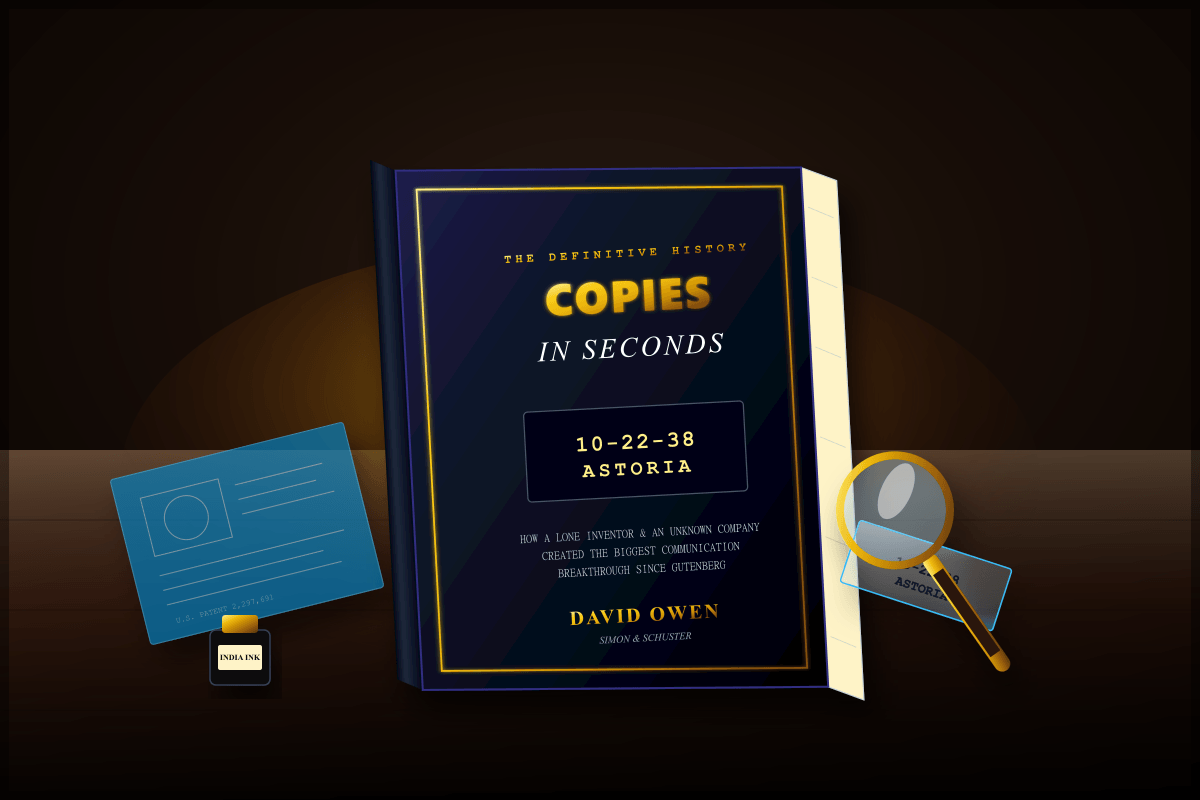
To understand how a solitary, arthritic patent attorney working above a Queens bar ignited one of the greatest technological and industrial revolutions in human history, one must read David Owen's acclaimed chronicle 'Copies in Seconds' (Simon & Schuster). Owen masterfully reconstructs Chester Carlson's arduous, twenty-year battle against corporate inertia, financial ruin, and technological skepticism. Drawing upon unpublished personal letters, laboratory logs, and corporate archives from Battelle and Haloid Xerox, Owen tracks the evolution of electrophotography from a faint smear of lycopodium spores on wax paper to the magnificent, world-changing engineering triumph of the Xerox 914. More than just a corporate history, Owen's book is a poignant human portrait of Carlson himself—a painfully shy, profoundly humble genius who endured two decades of humiliating rejections, became fabulously wealthy, and then quietly gave away his entire fortune without fanfare or self-aggrandizement.
Buying limit: Available in trade paperback (ISBN-10: 0743251180 / ISBN-13: 978-0743251181, 320 pages), hardcover, and digital formats. Essential reading for inventors, electrical engineers, historians of technology, and anyone fascinated by how radical ideas survive corporate gatekeepers. Note that this is a detailed narrative history with archival source citations rather than a technical engineering manual.
Original editorial illustration, not a retailer photograph. As an Amazon Associate, we earn from qualifying purchases.SOURCES, METHOD, AND LIMITS
This historical inquiry was constructed through rigorous forensic cross-examination of primary archival records, legal patent specifications, and institutional histories. Technical parameters of the October 22, 1938 experiment—including zinc substrate preparation, molten sulfur coating procedures, handkerchief static triboelectric charging, India ink microscope slide masking, and lycopodium clavatum spore powder adhesion—were cross-referenced against Chester F. Carlson's original patent filings: U.S. Patent No. 2,221,776 ('Electron Photography', filed September 8, 1938; granted November 19, 1940) and U.S. Patent No. 2,297,691 ('Electrophotography', filed October 6, 1939; granted October 6, 1942). Historical narratives regarding Otto Kornei's experimental logs, corporate rejection by IBM and Arthur D. Little, the Battelle Memorial Institute research agreements, and Haloid Xerox 914 development were verified using the Chester Carlson papers and artifacts preserved at the Smithsonian National Museum of American History, the IEEE History Center's Milestones program, and David Owen's definitive archival biography 'Copies in Seconds'. No experimental hardware or laboratory chemicals were operated during research.
- Smithsonian National Museum of American History — Chester Carlson's Electrophotography Equipment (1938) — Primary historical artifacts and institutional records preserving Chester Carlson's original 1938 zinc sulfur plates, glass slides, and Astoria electrophotographic laboratory equipment.
- United States Patent and Trademark Office / Google Patents — U.S. Patent 2,297,691: Electrophotography — Primary legal patent specification filed by Chester F. Carlson detailing the electrophotographic method using electrostatic charge, photoconductive layers, and powder transfer.
- IEEE History Center / Engineering and Technology History Wiki (ETHW) — Milestones: Invention of Xerography, 1938 — Peer-reviewed technical history documenting the IEEE Milestone dedication recognizing Carlson's October 22, 1938 proof-of-concept in Astoria, Queens.
- American Physical Society (APS News) — October 22, 1938: Chester Carlson Invents the Photocopier — Scholarly physics society retrospective analyzing Carlson's application of photoconductive physics, Selényi's electrostatic papers, and the engineering of the Xerox 914.