ON THIS DAY · OCTOBER 21, 1879
The Night the Cotton Thread Banished the Dark: How Thomas Edison's 1879 Menlo Park Breakthrough Created the Practical Incandescent Bulb
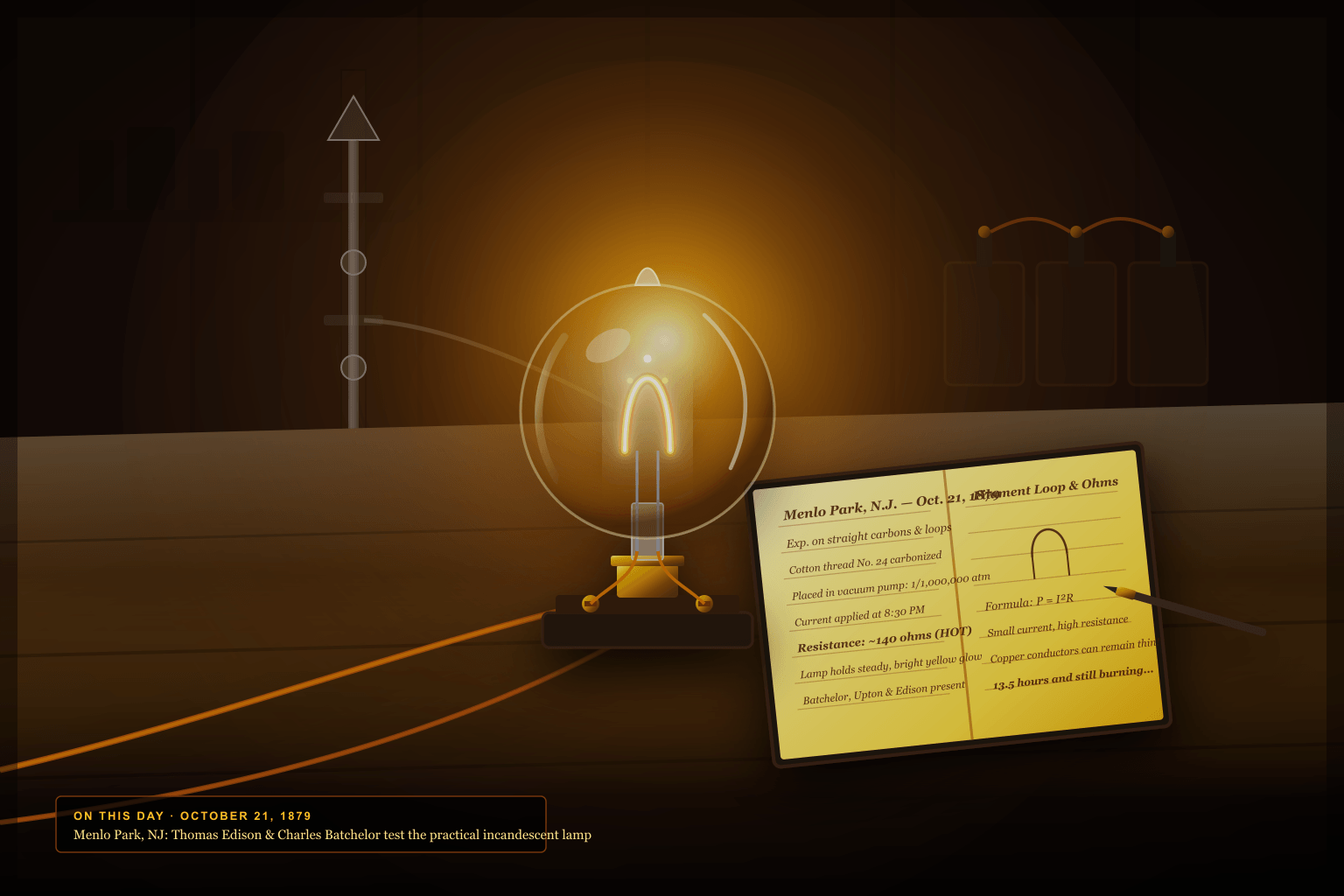
On October 21, 1879, in a dimly lit wooden laboratory in Menlo Park, New Jersey, Thomas Alva Edison and laboratory assistant Charles Batchelor connected electrical current to a fragile horseshoe filament of carbonized cotton sewing thread. Sealed inside a hand-blown glass bulb evacuated to one-millionth of an atmosphere by a Sprengel mercury pump, the delicate carbon loop began to glow with a steady, brilliant incandescent radiance that defied the dark. As the lamp burned through the night and into the following afternoon for over 13.5 continuous hours, the Menlo Park team did not merely invent a light bulb—they solved the elusive 'subdivision of electric light' and laid the engineering foundation for the centralized electric power grid that illuminates the modern world.
The Fallacy of the Arc Lamp: Cracking the 'Subdivision of Electric Light'
A persistent popular myth asserts that Thomas Alva Edison invented the electric light bulb from whole cloth in 1879. In historical reality, inventors had been coaxing electricity into emitting light for nearly eight decades before Edison turned his attention to illumination. As early as 1802, English chemist Humphry Davy demonstrated that an electric current passing through a thin strip of platinum caused it to glow incandescently, and by 1808 he had unveiled the dazzling carbon arc lamp before the Royal Institution in London. In the intervening decades, more than twenty inventors—including Warren de la Rue, William Grove, Frederick de Moleyns, and Joseph Swan in Great Britain—constructed experimental incandescent bulbs. Yet by the late 1870s, electric lighting remained virtually unusable inside ordinary human dwellings. Commercial electric lighting was restricted almost exclusively to blinding, flickering carbon arc lamps mounted atop towering outdoor street standards or illuminating cavernous railway stations. Arc lamps produced thousands of candlepower of glaring, harsh light, hissed loudly, generated choking fumes, consumed carbon rods that required constant manual replacement, and presented severe fire hazards.
The fundamental hurdle that stymied the greatest scientific minds of Victorian Europe was known as the 'subdivision of the electric light.' Eminent physicists, including Silvanus Thompson in England and members of the British Parliamentary Committee on Lighting, declared on mathematical grounds that subdividing an electrical current into hundreds of small, independent household lamps was a physical and economic impossibility. In existing low-resistance lamps connected in series, if one bulb burned out, the entire circuit failed—like a broken strand of primitive holiday lights. Furthermore, existing low-resistance filaments (measuring only a few ohms) demanded massive electrical currents to generate incandescence. According to Joule's first law of heating, the thermal energy lost in transmission wires increases with the square of the current (P = I²R). To deliver enough current to hundreds of low-resistance lamps without incinerating the transmission lines, municipal distribution networks would have required solid copper cables as thick as a man's arm—an infrastructure expense so staggering it would bankrupt any utility company on Earth.
Edison approached the problem not merely as an isolated physical puzzle, but as an integrated commercial system designed to replace the reigning municipal monopoly: illuminating gas. In late 1878, Edison hired Francis Robbins Upton, a brilliant twenty-six-year-old mathematician and physicist trained at Bowdoin, Princeton, and Hermann von Helmholtz's prestigious laboratory in Berlin. Guided by Upton's rigorous mathematical modeling, Edison arrived at a counterintuitive conceptual breakthrough that eluded his contemporaries: rather than seeking a low-resistance conductor that could withstand brute electrical currents, the ideal domestic lamp required an extraordinarily high electrical resistance—exceeding 100 ohms. By raising the lamp's internal resistance, Ohm's law (I = V/R) dictated that the required operating current would drop dramatically. Because transmission wire heating depended on the square of that current, a high-resistance lamp operating at approximately 100 volts could be powered through economical, slender copper distribution wires arranged in a parallel circuit, allowing every household lamp to be turned on or off independently without affecting the others.
Cotton Thread No. 24 and the Mercury Fall Pump: The Menlo Park Crucible
Having determined the mathematical necessity of a high-resistance filament, Edison's Menlo Park laboratory embarked on an exhausting materials sprint throughout late 1878 and 1879. The team initially focused their experiments on rare refractory metals, predominantly platinum and platinum-iridium alloys, which possessed high melting points and did not readily oxidize. Edison designed intricate mechanical lamp bases featuring expanding thermostatic cut-off levers to short-circuit the lamp before the platinum wire reached its melting point. Yet platinum was prohibitively expensive, difficult to draw into uniform microscopic wire, and prone to occluding ambient air bubbles within its crystalline matrix, causing the metal to pit, crack, and vaporize after modest hours of operation. Recognizing that platinum was an economic dead end for mass adoption, Edison made the pivotal decision in the late summer of 1879 to return to an earlier, discarded material: pure carbon.
Carbon had long been recognized as an ideal incandescent radiator because it possessed an astronomical sublimation point (over 3,600 degrees Celsius) and high natural resistivity. The fatal challenge of carbon was that it oxidized instantaneously when heated in the presence of even trace amounts of atmospheric oxygen, burning to ash within seconds. To keep a carbon filament intact at white heat, Edison required an evacuation technology capable of creating an unprecedentedly hard vacuum. Fortunately, German chemist Hermann Sprengel had invented the mercury drop vacuum pump in 1865. The apparatus operated by releasing a continuous stream of heavy liquid mercury droplets down a vertical glass capillary tube; as each droplet fell past a side-arm connected to the bulb, it trapped microscopic parcels of air between successive mercury pistons and dragged them out through the bottom barometric seal. Assisted by master glassblower Ludwig Boehm, Menlo Park technicians evacuated glass globes down to less than one-millionth of an atmosphere—a vacuum quality orders of magnitude superior to standard mechanical piston pumps.
With the vacuum apparatus perfected, the search narrowed to finding a carbonaceous organic fiber that could be carbonized without disintegrating into fragile dust. Edison's principal laboratory assistant, English machinist Charles Batchelor—whose nimble fingers and extraordinary mechanical deftness complemented Edison's relentless conceptual drive—took a spool of ordinary Clark's 'O.N.T.' No. 24 six-cord white cotton sewing thread. Batchelor meticulously bent a small length of thread into a horseshoe loop, placed it inside an airtight earthenware crucible packed with powdered graphite to prevent any contact with air, and baked the crucible in a high-temperature coal muffle furnace for hours. As volatile hydrocarbons were driven off, the cotton fibers were transformed into a fragile, flexible, semi-metallic filament of pure carbon. Batchelor and Boehm carefully clamped the carbon loop onto delicate platinum lead-in wires fused through a glass stem, inserted the assembly into a hand-blown spherical glass bulb, and sealed the glass with a blowpipe. While the bulb was attached to the humming Sprengel mercury pump, Edison passed a weak electric current through the filament, gradually heating it to expel trapped 'occluded gases' from the carbon pores before melting the top glass exhaust tube shut.
The Thirteen-Hour Vigil: The Breakthrough Night of October 21–22, 1879
On the evening of Tuesday, October 21, 1879, experimental lamp number 9 was ready for trial at the Menlo Park laboratory. As dusk settled over the quiet New Jersey countryside, Thomas Edison, Charles Batchelor, Francis Upton, and chief machinist John Kruesi gathered around the test bench on the second floor of the main laboratory building. At approximately 8:30 PM, electrical leads from Edison's newly constructed bi-polar DC dynamos (affectionately nicknamed 'Long-waisted Mary Anns' due to their towering vertical field magnets) were connected to the lamp terminals. Batchelor carefully closed the circuit. The hair-thin carbonized cotton thread began to glow: first a dull cherry red, then an intense golden-orange, and finally settling into a clear, tranquil, incandescing yellow light that illuminated the faces of the weary researchers.
In earlier trials with paper and metal wires, experimental lamps had routinely flickered, sputtered, or snapped within minutes. But as the laboratory clock ticked past midnight into the early morning hours of October 22, the cotton filament burned on with unyielding constancy. Upton meticulously measured the electrical characteristics: the lamp drew approximately 0.75 amperes of current while operating at a hot electrical resistance of roughly 140 ohms, emitting roughly 16 candlepower of illumination—directly matching the light output of a standard municipal gas jet. The Menlo Park team maintained an anxious, breathless vigil throughout the night, speaking in hushed tones as they watched the glowing filament. Outside, the autumn darkness gave way to dawn, yet the glass globe remained crystal clear, free of the black soot deposits that had ruined earlier experiments.
The test continued uninterrupted through the morning and past midday on October 22. When the clock crossed 13 hours and 30 minutes of continuous operation, Edison and his associates realized they had achieved what the scientific establishment had deemed impossible: a reliable, durable, high-resistance incandescent lamp. Curious to test the ultimate physical limits of the carbonized cotton structure, Edison gradually dialed up the dynamo voltage, increasing the current to push the lamp to greater brilliance. The filament burned with blinding radiance until, after 14 hours and 58 minutes of continuous stress, the carbon loop finally fractured and went dark. Charles Batchelor famously sat down at his laboratory desk and opened his logbook (Catalog 1304), writing the immortal entry that began: 'We made some very interesting experiments on straight carbons made from cotton thread...' Less than two weeks later, on November 4, 1879, Edison executed U.S. Patent Application No. 223,898 for an 'Electric-Lamp,' which was formally granted by the U.S. Patent Office on January 27, 1880.
From Menlo Park to Pearl Street: The Birth of the Central Grid
The dramatic success of the cotton thread experiment on October 21 was the technological tipping point, but Edison understood with characteristic pragmatism that a light bulb in isolation was commercially useless. To persuade a skeptical public to abandon familiar gas lamps, Edison had to invent an entire supporting universe of electrical hardware that did not yet exist. In 1880, recognizing that carbonized sewing thread was too fragile for rugged transport, Edison dispatched scouts across the globe—including William H. Moore to Japan—to find superior carbon sources. They discovered that Japanese bamboo (Madake), when carbonized, possessed uniform vascular fibers that extended bulb operating lifespans to over 1,200 continuous hours. Meanwhile, Menlo Park engineers designed the screw-threaded lamp base and matching socket (the universal E26 socket still in use today across North America), key-turn wall switches, safety fuses made of low-melting-point lead-tin alloy, underground junction boxes, and an electrochemical copper-voltameter meter to accurately bill consumers for kilowatt-hours consumed.
On New Year's Eve, December 31, 1879, Edison staged his legendary public demonstration, stringing dozens of incandescent lamps across the Menlo Park complex and lighting the railway station. More than three thousand people boarded special Pennsylvania Railroad trains from New York and Philadelphia to witness what the New York Herald heralded as 'The Great Inventor's Triumph in Electric Light.' The climactic realization of Edison's vision arrived on the afternoon of September 4, 1882, when Edison pulled the master switch at the Pearl Street Generating Station at 257 Pearl Street in lower Manhattan. Powered by six colossal 27-ton 'Jumbo' steam-driven dynamos, Pearl Street delivered 110-volt direct-current power through eighteen miles of underground copper conduits, illuminating 400 incandescent lamps across Wall Street, the offices of J.P. Morgan, and the editorial floor of The New York Times.
The night of October 21, 1879 fundamentally altered the trajectory of human civilization. Before Edison's practical incandescent lamp, human activity had been ruthlessly circumscribed by the setting of the sun, bounded by the dim, flickering, and oxygen-depleting flame of candles, whale oil lamps, and toxic gas burners. By proving that a microscopic filament of baked cotton thread could reliably harness electrical resistance to generate clean, silent, flameless light, Edison, Batchelor, and Upton inaugurated the electrical age. The incandescent lamp extended productive working hours, transformed urban nightscapes, made domestic spaces safer and healthier, and created the foundational consumer demand that spurred the electrification of the globe.
What the evidence does not settle
While Thomas Edison's October 21, 1879 breakthrough demonstrated the first practical incandescent lamp, early carbon filament lamps faced distinct technical limitations. Early carbonized thread and paper filaments were exceedingly fragile, requiring careful upright handling during transport to prevent mechanical breakage. Operating in a vacuum, the carbon filament underwent gradual thermal evaporation at high temperatures, causing carbon atoms to deposit onto the interior glass envelope over hundreds of operating hours—a darkening phenomenon that degraded luminous output and led Edison to discover the 'Edison effect' (thermionic electron emission), which later became the operational basis for radio vacuum tubes. Furthermore, early carbon lamps were energetically inefficient by modern standards, converting less than 2% of electrical energy into visible light (roughly 1.5 to 3 lumens per watt, compared to 80 to 100 lumens per watt for modern LED filaments), and their reliance on 110-volt direct current (DC) limited Pearl Street-style distribution networks to a geographic radius of approximately one mile before the development of alternating current (AC) transformers by Nikola Tesla and George Westinghouse enabled regional electrification.
PRODUCT IDEA 01
Ascher Vintage LED Edison Bulbs (ST58 Style · 6W / 60W Equivalent · 2700K Warm White · E26 Base · 4-Pack)
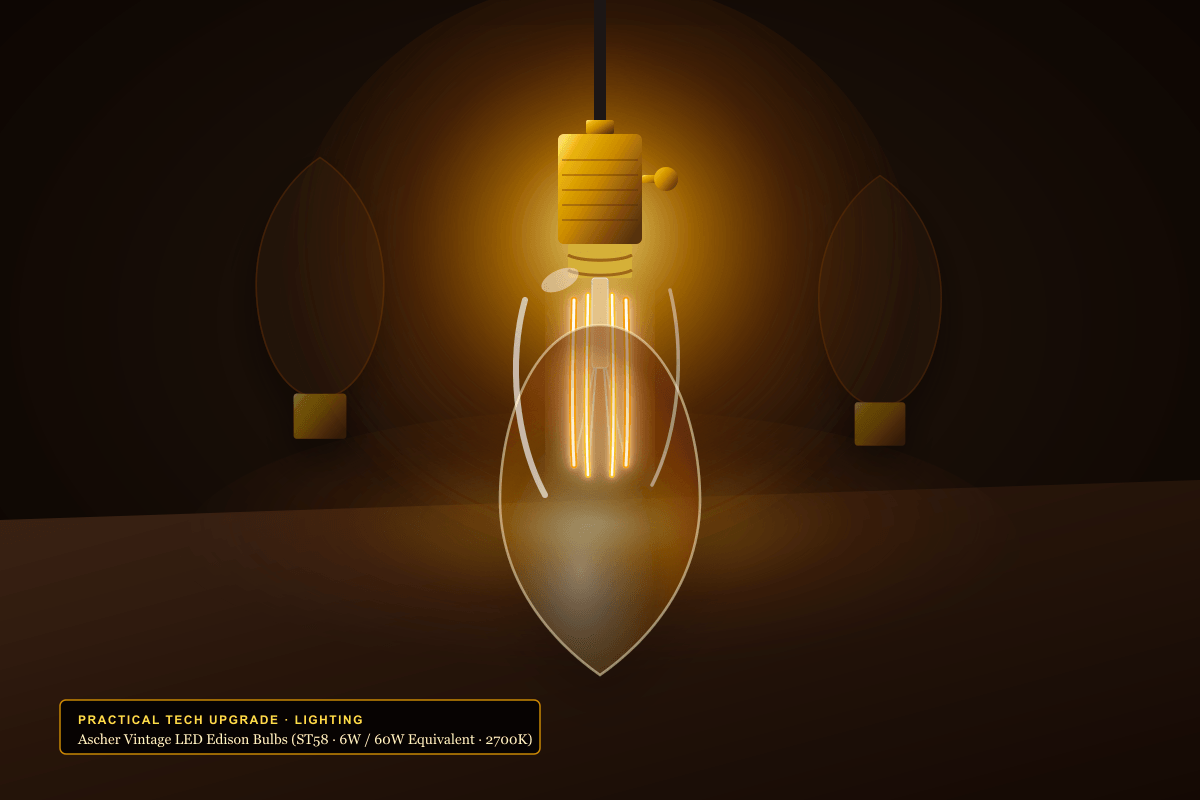
Nearly a century and a half after Thomas Edison watched a carbonized cotton thread glow at Menlo Park, the distinctive aesthetic of the antique incandescent bulb remains an enduring design icon. Modern solid-state lighting has completely resolved the severe energetic inefficiencies and fragile lifespans of original carbon lamps through LED filament technology. The Ascher Vintage LED Edison Bulb (ST58 teardrop style) encapsulates high-density linear micro-LED strips inside clear-amber tinted glass, replicating the warm, romantic 2700K color temperature and visible filament architecture of early 20th-century lamps while consuming just 6 watts of electrical power—delivering the equivalent illumination of a traditional 60-watt incandescent bulb. Designed with a standard E26 medium screw base derived directly from Edison's 1880 base specification, it produces 700 lumens with a high color rendering index (CRI 80+), operates completely cool to the touch, and lasts for over 20,000 hours without the carbon evaporation, thermal hazard, or rapid lumen degradation of antique incandescent filaments.
Buying limit: Best suited for exposed-bulb fixtures, dining room chandeliers, clear-glass pendants, desk lamps, and ambient hospitality lighting where warm 2700K aesthetic warmth is desired. Note that this specific model is non-dimmable; if circuit dimming is required, verify compatible triac-dimmable LED variants. For precision task lighting, drafting, or electronics repair benches where neutral daylight color accuracy is necessary, choose 4000K-5000K high-CRI fixtures instead.
Original editorial illustration, not a retailer photograph. As an Amazon Associate, we earn from qualifying purchases.PRODUCT IDEA 02
Empires of Light: Edison, Tesla, Westinghouse, and the Race to Electrify the World — Jill Jonnes
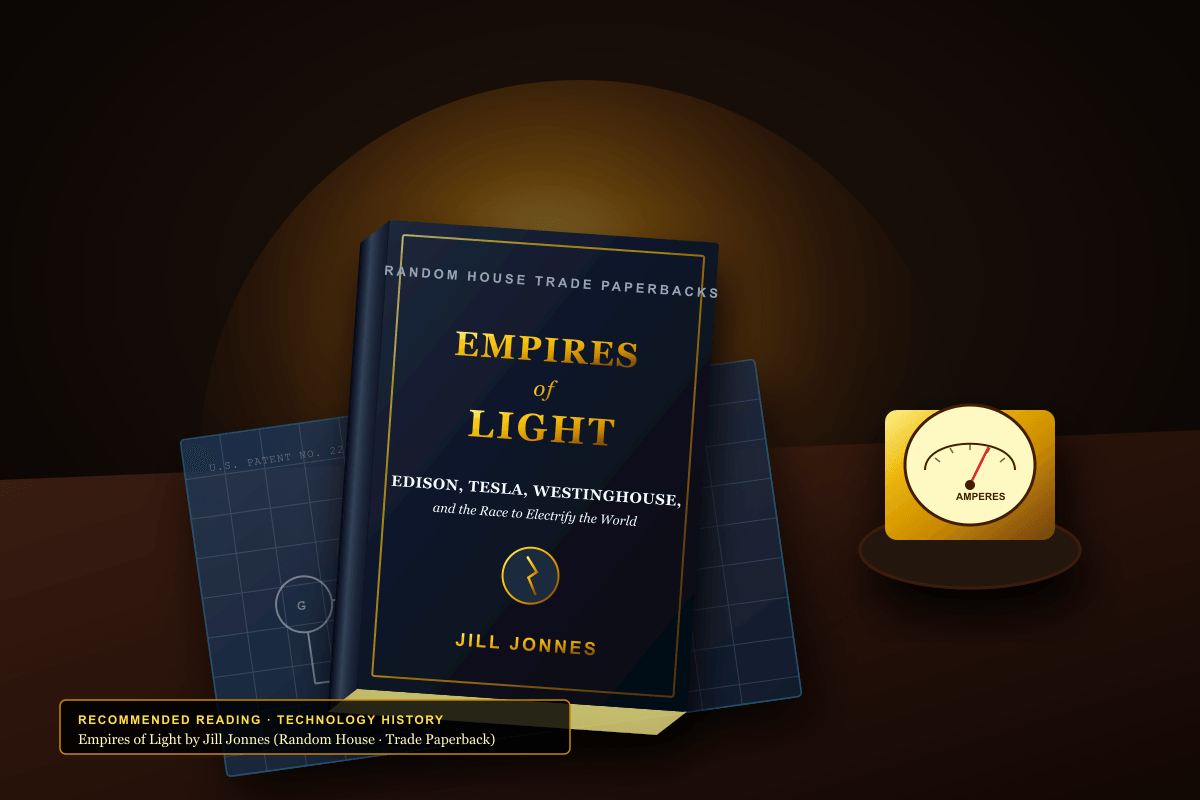
To understand the profound commercial, technological, and social upheaval unleashed by Edison's incandescent light bulb, one must examine the fierce industrial war that erupted immediately in its wake. In 'Empires of Light: Edison, Tesla, Westinghouse, and the Race to Electrify the World' (Random House Trade Paperbacks), acclaimed historian Jill Jonnes delivers the definitive, page-turning narrative of the epic late-nineteenth-century 'War of the Currents.' Jonnes masterfully tracks the collision between three extraordinary titans: Thomas Edison, the stubborn pragmatic wizard defending his direct-current (DC) empire; Nikola Tesla, the visionary Serbian immigrant whose alternating-current (AC) polyphase induction motor unlocked the physics of long-distance power; and George Westinghouse, the daring industrialist who risked his fortune to champion AC across the continent. Drawing upon declassified corporate archives, personal correspondence, and technical court records, Jonnes captures the fierce patent battles, high-stakes political intrigue, and technical genius that culminated in the 1893 Chicago World's Fair and the harnessing of Niagara Falls.
Buying limit: Available in trade paperback (ISBN-10: 0375758844 / ISBN-13: 978-0375758843), hardcover, and digital formats. Highly recommended for electrical engineers, historians of science, and general readers seeking a rigorous, deeply researched chronicle of how the modern electric grid was forged. Note that this is a dense 464-page investigative history with scholarly source annotations rather than a light pictorial overview.
Original editorial illustration, not a retailer photograph. As an Amazon Associate, we earn from qualifying purchases.SOURCES, METHOD, AND LIMITS
This historical analysis was developed through forensic cross-examination of primary institutional records, beginning with the laboratory notebooks of Charles Batchelor (Cat. 1304) and laboratory accounts preserved in the Thomas A. Edison Papers Project at Rutgers University. Technical specifications—including No. 24 six-cord cotton sewing thread, operating resistance of approximately 140 ohms hot, operating current of 0.75 amperes, Hermann Sprengel mercury pump vacuum levels of one-millionth of an atmosphere, and Ludwig Boehm glass-sealing procedures—were cross-referenced against Edison's original patent specification for U.S. Patent No. 223,898 ('Electric-Lamp', filed November 4, 1879, granted January 27, 1880) held by the National Archives and Records Administration. Historical context surrounding the 'subdivision of electric light', Francis Upton's mathematical models, and the 1882 Pearl Street Station launch was verified through archival holdings at the Smithsonian National Museum of American History's 'Lighting A Revolution' collection and the IEEE History Center. No laboratory experiments or antique hardware operations were simulated during research.
- The Thomas A. Edison Papers Project — Rutgers University (Charles Batchelor Notebooks Cat. 1304) — Primary historical laboratory logbooks recorded by Edison's chief assistant Charles Batchelor documenting the October 21-22, 1879 cotton thread filament experiments and electrical resistance measurements at Menlo Park.
- National Archives & Records Administration — Thomas Edison's Patent Application for the Incandescent Light Bulb (U.S. Patent 223,898) — Official primary legal patent documentation filed on November 4, 1879, detailing the high-resistance carbon filament construction, vacuum glass envelope, and platinum lead wire seal.
- Smithsonian National Museum of American History — Lighting A Revolution: The Electric Light System — Institutional museum exhibition and archival documentation examining Edison's systemic approach to commercial electrification, generator development, and Menlo Park laboratory operations.
- Engineering and Technology History Wiki (ETHW) / IEEE History Center — Milestones: Edison Electric Light System, 1879 — Peer-reviewed technical history documenting the IEEE historical milestone recognition of the Menlo Park incandescent lamp breakthrough and the parallel electrical distribution network.