ON THIS DAY · OCTOBER 17, 1956
Harnessing the Atom for Peace: How Calder Hall Became the World's First Commercial Nuclear Power Station
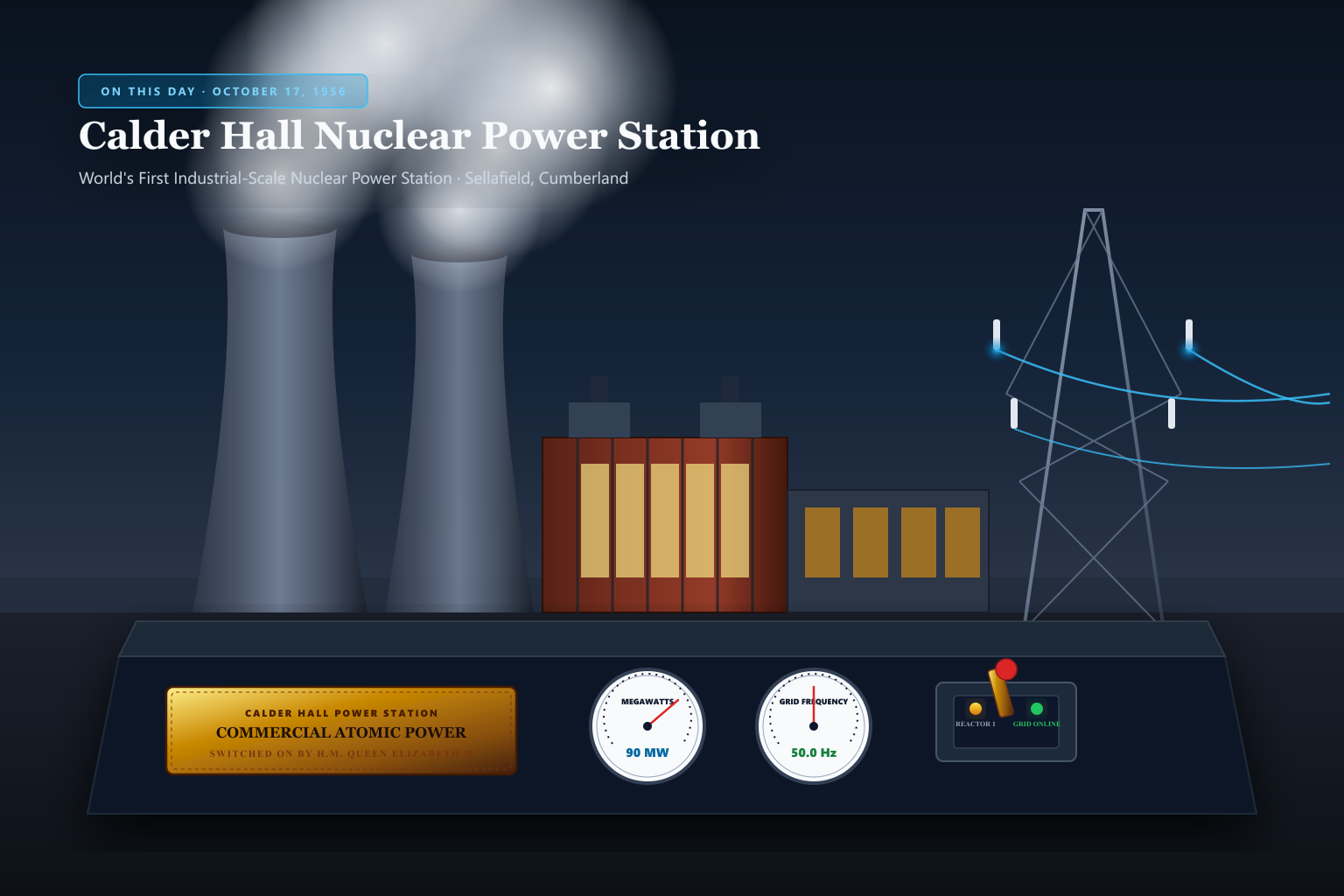
On October 17, 1956, Queen Elizabeth II pushed a modest lever inside the brick control room at Sellafield, Cumberland, officially connecting Calder Hall Power Station to the British National Grid. As dials jumped and 90 megawatts of atomic electricity surged into homes and factories, humanity crossed a monumental threshold: the terrifying destructive energy of the atom had finally been harnessed to generate commercial electricity on an industrial scale.
The Postwar Energy Crisis and the Race for Atomic Kilowatts
In the grim aftermath of the Second World War, Great Britain found itself grappling with severe economic exhaustion and a crippling fossil-fuel shortage. The bitter winter of 1947 had paralyzed British coal transportation, freezing locomotive tracks, shuttering industrial factories, and leaving millions of households without heat or electric light. With Britain's deep coal reserves becoming increasingly dangerous and costly to extract, government planners recognized that the nation's postwar industrial revival required a radical, abundant new primary energy source. Simultaneously, geopolitical tensions across the Middle East—culminating in the 1956 Suez Crisis—exposed the severe vulnerability of imported oil supplies, accelerating the British government's determination to master domestic nuclear fission.
Under the visionary leadership of Sir Christopher Hinton, managing director of the newly established United Kingdom Atomic Energy Authority (UKAEA) Industrial Group at Risley, British engineers embarked on an audacious crash development program. In 1953, construction commenced on a desolate coastal plot adjacent to the existing Windscale plutonium piles on the River Calder in Cumberland (now Cumbria). The engineering challenge was staggering: Hinton's team had only thirty-six months to transform theoretical nuclear physics into a rugged, multi-megawatt commercial generating station capable of continuous, safe baseline operation. Construction workers poured tens of thousands of tons of concrete and assembled colossal two-inch-thick steel pressure vessels entirely on site, racing against American and Soviet competitors to achieve the first civilian power breakthrough.
On the crisp autumn midday of Wednesday, October 17, 1956, an international audience of senior diplomats, Commonwealth representatives, and over two hundred journalists gathered in the marquee outside Calder Hall's Number One Reactor. At 12:16 PM, 30-year-old Queen Elizabeth II delivered a poignant address broadcast across the Commonwealth: 'This new power, which has proved itself to be such a terrifying weapon of destruction, is at last being harnessed for the common good of our community.' Stepping to a ceremonial console fitted with polished brass instruments and a chrome lever, Her Majesty threw the switch. Within seconds, high-voltage circuit breakers closed in the 132-kilovolt outdoor substation, heavy analog needles on the control room's megawatt meters swung sharply clockwise, and atomic electricity surged through transmission pylons into homes across northern England.
The public reception was euphoric. British national newspapers proclaimed 'Atomic Power in Every Home' and heralded the dawn of a utopian 'Second Industrial Revolution' where energy would be abundant, smokeless, and cheap. British engineers were celebrated as pioneers who had tamed the primordial fire of the universe, proving to a war-weary world that the atom could light cities rather than vaporize them.
The Magnox Blueprint: Natural Uranium, Graphite, and Pressurized Gas
The technical triumph of Calder Hall rested upon the 'Magnox' reactor architecture—an engineering concept dictated by Britain's postwar technological constraints and geopolitical isolation. Unlike the United States, which possessed vast gaseous diffusion enrichment facilities at Oak Ridge and Hanford that allowed American designers to build compact light-water reactors fueled by enriched uranium, postwar Britain lacked industrial enrichment capacity. Hinton and his chief design engineer, R.V. Moore, were compelled to design a reactor that could achieve self-sustaining criticality using abundant, un-enriched natural uranium metal.
To achieve a sustained chain reaction with natural uranium, the core required a moderator that absorbed virtually no thermal neutrons. The UKAEA selected ultra-pure nuclear-grade graphite, machining 1,200 tons of interlocking carbon blocks into a towering cylindrical core pierced by 1,696 vertical fuel channels. Inside each channel hung fuel rods made of solid natural uranium metal encased within finned protective sheaths of 'Magnox'—a proprietary magnesium-aluminum alloy (magnesium non-oxidizing) specifically developed to resist corrosion, transfer heat rapidly, and avoid parasitic neutron capture.
Cooling the colossal graphite core presented another monumental design choice. While light water would have absorbed too many neutrons and heavy water was exorbitantly scarce, the British team chose pressurized carbon dioxide (CO2) gas. Circulating under 100 pounds per square inch of pressure, the dense carbon dioxide was blown through the reactor core at high velocity, reaching temperatures of roughly 336 degrees Celsius before exiting into four towering external Babcock & Wilcox heat exchangers. Inside these 80-foot boilers, the hot gas converted feedwater into superheated steam at two distinct pressures (high pressure at 200 psi and low pressure at 53 psi), which was ducted into the turbine hall to spin four C.A. Parsons turbo-alternators generating 23 megawatts each.
The entire primary circuit was enclosed within a cylindrical welded steel pressure vessel 37 feet in diameter and 70 feet tall, shielded by seven feet of reinforced barytes concrete to protect operating crews from lethal gamma and neutron fluxes. Heat rejection was managed by two majestic 300-foot natural draught hyperbolic concrete cooling towers, whose billowing plumes of pure condensed water vapor became the enduring visual signature of Britain's nuclear age.
The Dual-Purpose Reality: Commercial Power and Cold War Plutonium
While the 1956 opening of Calder Hall was celebrated globally as a purely benevolent civilian milestone for 'Atoms for Peace,' declassified Cabinet papers and UKAEA records reveal a far more calculated Cold War reality. Calder Hall was never conceived solely as a municipal power station; it was an urgent dual-purpose military installation commissioned directly by the British Ministry of Supply under Project PIPPA (Pressurised Pile Producing Power and Plutonium).
Following the United States' passage of the McMahon Act in 1946, which abruptly severed wartime atomic cooperation and locked Britain out of American weapons laboratories, Prime Minister Clement Attlee's secret Cabinet committee had resolved that Britain must develop its own independent nuclear and thermonuclear deterrent. Manufacturing atomic weapons required vast stockpiles of weapons-grade plutonium-239. However, the original Windscale air-cooled piles were inherently inefficient and discharged all their fission heat directly into the atmosphere through tall exhaust stacks. Calder Hall was engineered to solve this defense bottleneck: by enclosing the reactor in a pressurized gas loop, the UKAEA could harvest plutonium for atomic bombs while simultaneously selling the waste steam as high-value electricity to the Central Electricity Authority (CEA).
This dual mandate directly shaped Calder Hall's daily operations. To produce weapons-grade plutonium suitable for atomic warheads, natural uranium fuel elements could only remain inside the reactor for short irradiation periods—typically a few hundred megawatt-days per ton—before unwanted plutonium-240 built up and degraded the material's explosive purity. Consequently, Calder Hall was equipped with sophisticated on-load refueling machines that could extract irradiated fuel rods and replace them with fresh uranium cartridges without shutting down the reactor or interrupting the station's electrical output to the National Grid. Commercial electricity sales effectively subsidized Britain's thermonuclear weapons program, enabling the nation to conduct its historic Operation Grapple hydrogen bomb tests in 1957.
Debunking the myth of a purely civilian birth does not diminish Calder Hall's technological genius; rather, it underscores the pragmatic engineering compromises of the early atomic era. By successfully bridging military defense imperatives with civilian electrical infrastructure, British engineers established the foundational operational protocols, thermal cycling tolerances, and grid synchronization techniques that governed commercial nuclear power plants worldwide for the next half-century.
Forty-Seven Years on the Grid: The Calder Legacy and Modern Decommissioning
Originally engineered with an expected operational lifespan of just twenty years, Calder Hall demonstrated extraordinary durability and mechanical reliability. By 1959, all four reactors at Calder Hall A and B were operational, accompanied by four sister reactors at Chapelcross in Dumfriesshire, Scotland, providing Britain with an unshakeable baseload of civilian nuclear power. Over the ensuing decades, the station's operating parameters were progressively refined: gas operating pressures were optimized, fuel cladding geometries were upgraded, and the plant's total thermal output climbed from an initial 180 megawatts per reactor to over 270 megawatts.
Calder Hall outlasted the Cold War, the rise and fall of the Central Electricity Generating Board, and the privatization of the British electricity supply industry. When Reactor Number One was finally permanently shut down on March 31, 2003, Calder Hall had completed forty-six years and five months of continuous operation—making it the longest-operating commercial nuclear power plant in human history up to that time. Over its lifespan, the station generated more than 14 billion kilowatt-hours of clean electricity, avoiding tens of millions of tons of atmospheric carbon emissions.
In September 2007, the station's historic cooling towers were safely brought down in a controlled demolition, marking a new chapter in the science of nuclear decommissioning. Today, Sellafield stands as a global center of excellence for fuel cooling, nuclear waste stewardship, and precision reactor defueling. The operational lessons forged at Calder Hall—from graphite core management and gas-phase corrosion chemistry to passive emergency heat dissipation—remain deeply embedded in the design of next-generation High-Temperature Gas-Cooled Reactors (HTGRs) and advanced modular civilian nuclear energy systems worldwide.
What the evidence does not settle
Archival UKAEA and UK National Archives records demonstrate that while Calder Hall was undeniably the first station to feed industrial-scale electricity into a national civilian grid, it cannot be evaluated as a purely commercial enterprise in modern free-market economic terms. The station's capital construction costs and operating cycles were heavily subsidized by the British Ministry of Supply to manufacture weapons-grade plutonium-239 for the United Kingdom's Cold War thermonuclear weapons program. Furthermore, modern readers should not confuse Calder Hall's historic 1956 milestone with the arrival of modern light-water commercial reactor economics; the early Magnox design possessed relatively modest thermal efficiency (roughly 19 percent) and generated significant quantities of spent fuel that required complex chemical reprocessing and long-term radiological management.
PRODUCT IDEA 01
Precision Handheld Digital Nuclear Radiation Detector / Geiger Counter (GM Tube Dosimeter)

For science educators, mineral collectors, antique glassware hobbyists, and homeowners curious about environmental physics, modern digital Geiger counters offer portable, laboratory-grade detection of ionizing radiation. Equipped with sensitive, energy-compensated Geiger-Müller (GM) tubes, instruments like the GQ Electronics GMC series or FNIRSI radiation monitors detect beta particles, gamma rays, and X-rays in real time. They display radiation dosage rates in microsieverts per hour (µSv/h) and counts per minute (CPM), complete with audible clickers, visual LED alert flashes, and customizable dose-rate threshold alarms. Whether testing vintage vaseline glassware, granite countertops, or educational mineral specimens, these compact instruments demystify nuclear physics into tangible, readable data.
Buying limit: Prioritize models featuring calibrated Geiger-Müller tubes with glass or metal envelopes capable of detecting both Beta and Gamma radiation, rather than basic electromagnetic field (EMF) meters that do not measure ionizing radiation. Look for rechargeable lithium batteries, data-logging internal memory, and USB export capabilities. Avoid uncalibrated novelty meters lacking specified measurement ranges.
Original editorial illustration, not a retailer photograph. No exact Amazon offer passed our verification gate.PRODUCT IDEA 02
Atomic Awakening: A New Look at the History and Future of Nuclear Power — James Mahaffey

For readers fascinated by the monumental engineering feats of the mid-20th century, Dr. James Mahaffey's 'Atomic Awakening' (Pegasus Books) stands as one of the most authoritative, engaging, and technically rigorous chronicles of nuclear energy ever written. A former senior research scientist at the Georgia Tech Research Institute who directed nuclear reactor operations, Mahaffey blends insider engineering mastery with thrilling historical storytelling. The book traces the nuclear journey from early radium discoveries through the intense Cold War race to build Calder Hall, the evolution of commercial pressurized water reactors, and the modern future of clean atomic baseload power. Filled with archival anecdotes, reactor core mechanics, and geopolitical intrigue, it is an indispensable volume for any technology history library.
Buying limit: Available in handsome hardcover, trade paperback, and digital e-book formats (ISBN 978-1605982038). For serious home libraries and collectors, look for the unabridged hardcover edition featuring archival photographic inserts, reactor schematics, and detailed bibliographic reference notes. Unabridged audio editions are also well narrated.
Original editorial illustration, not a retailer photograph. No exact Amazon offer passed our verification gate.SOURCES, METHOD, AND LIMITS
This dossier was produced through rigorous cross-examination of primary historical documentation, including the United Kingdom Atomic Energy Authority (UKAEA) operational reports preserved in the UK National Archives (Series AB 16 and AB 9), contemporaneous transcripts of Queen Elizabeth II's October 17, 1956 opening address, and technical retrospectives published by the British Nuclear Energy Conference and the IEEE History Center. Technical specifications for Calder Hall's Magnox reactors, carbon dioxide coolant pressures, and turbo-alternator electrical outputs were verified against original UKAEA engineering schematics and Sellafield historical archives. No commercial hardware or radioactive materials were physically handled during this historical research.
- The National Archives (UK) — United Kingdom Atomic Energy Authority: Calder Hall Works, Reports and Memoranda (Series AB 16 / AB 9) — Primary operational records, construction blueprints, and engineering committee memoranda documenting the design, commissioning, and grid synchronization of Calder Hall's Magnox reactors from 1953 to 1956.
- UK Department for Energy Security and Net Zero / Sellafield Ltd — 60 Years of Nuclear Power at Calder Hall (Historical Record) — Official British government historical retrospect detailing the ceremony of October 17, 1956, Queen Elizabeth II's official address, and the 47-year operational record of the Sellafield Magnox reactors.
- IEEE History Center / Engineering and Technology History Wiki — Milestones: Calder Hall Nuclear Power Station, 1956 — Institutional engineering milestone record documenting the technical specifications, electrical alternator parameters, and historical precedence of Calder Hall as the world's first industrial-scale nuclear station.