ON THIS DAY · OCTOBER 19, 1973
The Day the Computer Was Set Free: How the 1973 ENIAC Patent Ruling Put Digital Computing in the Public Domain
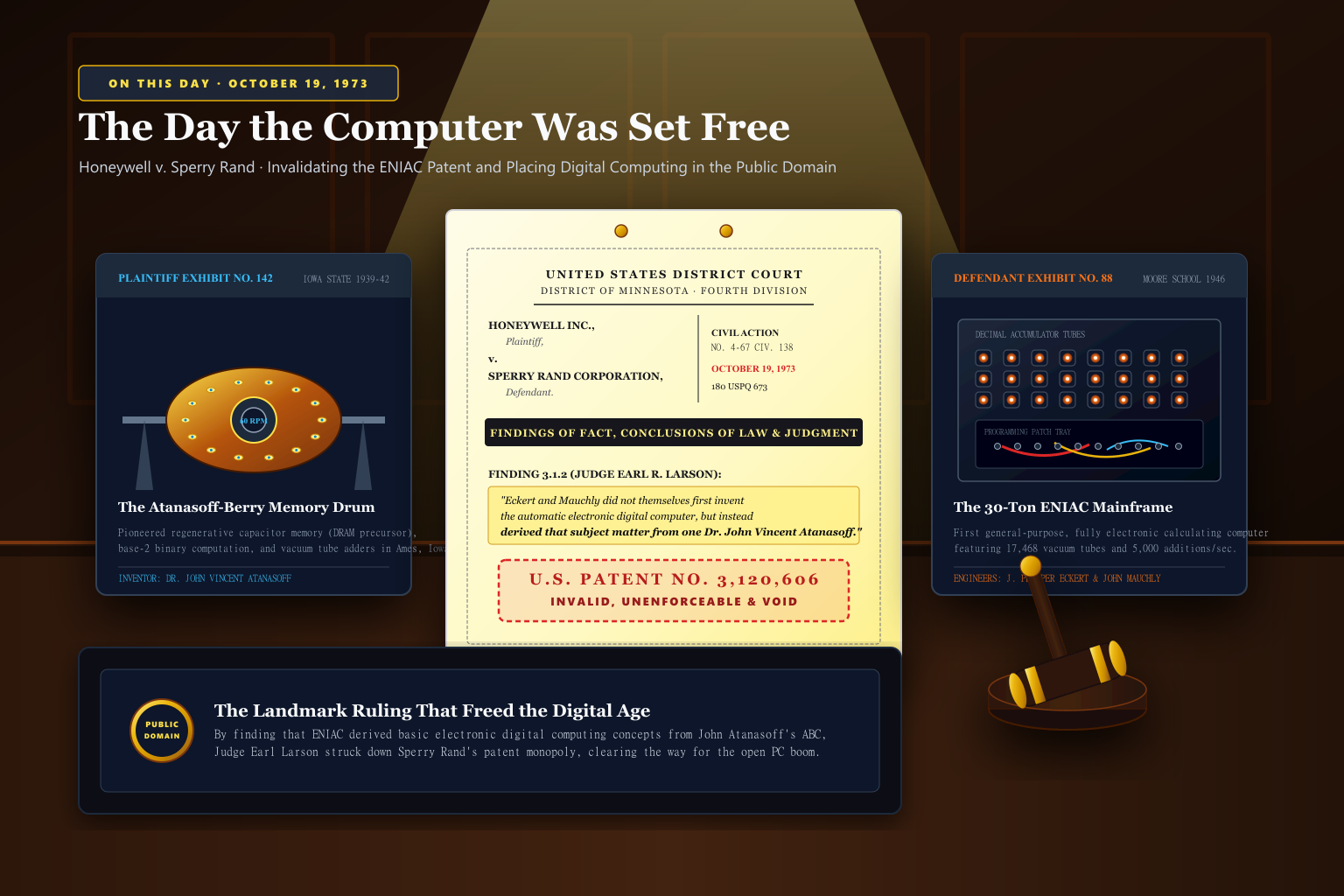
On October 19, 1973, federal judge Earl Larson struck down Sperry Rand's monopoly patent on the electronic digital computer. By ruling that the ENIAC inventors had derived their foundational ideas from physicist John Vincent Atanasoff, the decision dismantled a looming corporate tax on computing and placed digital computer architecture into the public domain on the eve of the personal computer revolution.
The Corporate Stranglehold: Sperry Rand and the 1.5% Royalty Tax on Computing
In the mid-1960s, the burgeoning American computer industry faced an existential legal threat. In 1950, struggling to finance their commercial computer business, ENIAC pioneers J. Presper Eckert and John Mauchly sold their startup, the Eckert-Mauchly Computer Corporation, to typewriter giant Remington Rand (which subsequently merged into Sperry Rand). Along with the company came their pending patent application for the Electronic Numerical Integrator and Computer (ENIAC). That application, originally filed in June 1947, had languished in the United States Patent Office for nearly seventeen years amid bureaucratic delays, internal priority disputes, and procedural wrangling. Finally, on February 4, 1964, the patent was issued as U.S. Patent No. 3,120,606. Sperry Rand believed it had been handed the holy grail of technological intellectual property: an unassailable legal monopoly over the automatic electronic digital computer.
Armed with Patent 3,120,606, Sperry Rand immediately moved to monetize its windfall. In 1956, Sperry Rand and IBM had quietly executed a secret cross-licensing pact, sharing technological patents and agreeing that IBM would pay a discounted royalty. With that precedent established, Sperry Rand turned its sights on the rest of the industry—the emerging competitors known collectively as 'the BUNCH' (Burroughs, UNIVAC/Sperry, NCR, Control Data, and Honeywell). Sperry Rand demanded a standard 1.5% royalty on all gross revenues generated from the manufacture and sale of any electronic data processing system. In an industry doubling in revenue every few years, a permanent 1.5% gross tax would have siphoned tens of millions of dollars annually into Sperry Rand's coffers, suffocating independent innovation, raising hardware costs, and giving Sperry Rand an insurmountable competitive advantage.
While several competitors weighed settlement, Honeywell executives and their legal counsel took a stand. Examining the convoluted history of the ENIAC patent prosecution, Honeywell's patent attorneys noticed glaring procedural anomalies, extensive prior art that had never been disclosed to the patent examiner, and rumors of an obscure Iowa college professor who claimed to have demonstrated an electronic digital computing device years before the ENIAC was constructed. On May 26, 1967, Honeywell filed a sweeping antitrust and patent-invalidation lawsuit against Sperry Rand in federal court in Minneapolis, Minnesota. Sperry Rand swiftly countersued for patent infringement, claiming over $200 million in damages. The stage was set for the trial of the century in computing history.
The Forgotten Basement in Ames: Dr. John Atanasoff and the ABC Machine
The central figure in Honeywell's defense was Dr. John Vincent Atanasoff, a brilliant Bulgarian-American theoretical physicist and mathematician at Iowa State College (now Iowa State University) in Ames. In the late 1930s, Atanasoff was bogged down by the grueling mathematical labor of solving complex systems of simultaneous linear algebraic equations needed for his quantum mechanics calculations. The available mechanical calculating machines—such as the Monroe desk calculators and Vannevar Bush's mechanical differential analyzer—were agonizingly slow, prone to mechanical gear backlash, and mathematically limited.
During a freezing winter night in 1937, frustrated after hours of fruitless work, Atanasoff got into his car and drove eastward into Illinois. Stopping at a roadside tavern for a drink of bourbon, his mind cleared, and four revolutionary concepts crystallized: First, the machine would use electronic switching elements (vacuum tubes) rather than mechanical gears or telephone relays to achieve unprecedented computational speed. Second, it would operate on base-two binary arithmetic rather than cumbersome decimal notation, mapping seamlessly to the on-off states of vacuum tubes. Third, it would utilize regenerative capacitor memory, storing electrical charges on rotating drums that were refreshed every cycle to prevent charge decay (the direct conceptual forerunner of dynamic random-access memory, or DRAM). Fourth, computation would proceed through direct electronic logic circuits performing serial binary addition and subtraction.
Between 1939 and 1942, with a modest $650 research grant and the invaluable assistance of a gifted graduate student named Clifford Berry, Atanasoff constructed the prototype Atanasoff-Berry Computer (ABC) in the basement of the Iowa State Physics Building. Containing over 300 vacuum tubes and two rotating memory drums studded with paper capacitors, the ABC successfully demonstrated the ability to eliminate variables from pairs of linear equations. In December 1940, Atanasoff attended an American Association for the Advancement of Science lecture in Philadelphia, where he met Dr. John W. Mauchly, then a physics professor at Ursinus College. Intrigued by Atanasoff's claims of electronic computation, Mauchly accepted an invitation to visit Ames.
From June 14 to June 18, 1941, Mauchly stayed as a houseguest in Atanasoff's home. Atanasoff gave Mauchly complete access to his laboratory in the basement, demonstrated the ABC calculating machine, and allowed Mauchly to read his unpublished 35-page technical manuscript titled 'Computing Machines for the Solution of Large Systems of Linear Algebraic Equations.' Mauchly took extensive notes and discussed electronic calculation late into the night. When World War II intensified, Atanasoff left Iowa State for defense research at the Naval Ordnance Laboratory, trusting Iowa State's patent attorneys to file a patent application for the ABC. Through institutional neglect and bureaucratic oversight, Iowa State never filed the paperwork. Atanasoff believed his foundational work was lost to history.
135 Days in Minneapolis: The Evidence That Dismantled the ENIAC Monopoly
When trial commenced on June 1, 1971, before U.S. District Judge Earl R. Larson in Minneapolis, Honeywell's legal team presented a meticulously documented forensic timeline. The trial was monumental in scale: it spanned 135 trial days over nine months, produced over 50,000 pages of trial transcripts, examined 77 witnesses, and introduced 25,686 physical exhibits. Atanasoff took the stand for days, presenting original 1939 schematics, laboratory purchase orders, and his detailed contemporaneous letters to Mauchly.
Honeywell's attorneys uncovered critical correspondence that proved decisive. In a letter dated September 30, 1941, written shortly after his visit to Ames, Mauchly had written to Atanasoff asking whether he would mind if the Moore School built an electronic calculator along the same lines as the ABC, asking: 'Would the way in which you are planning to build it have any bearing on our design?' When deposed, Mauchly attempted to minimize Atanasoff's influence, claiming he had gained little from the visit and that the ABC was an unworkable novelty. However, trial testimony from computer pioneers—including ENIAC co-designer Dr. Arthur W. Burks—corroborated that Mauchly had returned from Ames brimming with enthusiasm for electronic digital techniques, vacuum tube flip-flops, and binary logic.
Equally devastating to Sperry Rand was Honeywell's proof of the statutory public use bar under Section 102(b) of the Patent Act. Under federal patent law, an inventor cannot receive a valid patent if the invention was in public use or on sale more than one year prior to filing the patent application. Honeywell proved that the ENIAC had been officially dedicated and publicly demonstrated for the U.S. Army Ordnance Corps and international press at the University of Pennsylvania on February 15, 1946—fully sixteen months before Eckert and Mauchly filed their patent application on June 26, 1947. Furthermore, the ENIAC had been actively running top-secret thermonuclear weapon calculations for Los Alamos mathematician Edward Teller in late 1945. Under the strict rules of patent law, these public and practical operations were fatal to the patent's validity.
Buried by Watergate, Vindicated by History: The Legacy of October 19, 1973
On Friday, October 19, 1973, Judge Earl R. Larson delivered his sweeping 248-page findings of fact, conclusions of law, and order for judgment in Honeywell Inc. v. Sperry Rand Corp. (No. 4-67 Civ. 138). His decision was unequivocal: U.S. Patent 3,120,606 was declared completely invalid, unenforceable, and void. In the most famous finding of the ruling, Finding 3.1.2, Judge Larson wrote: 'Eckert and Mauchly did not themselves first invent the automatic electronic digital computer, but instead derived that subject matter from one Dr. John Vincent Atanasoff.'
Under ordinary circumstances, a federal ruling declaring that the basic patent on the electronic digital computer had been invalidated and that computing belonged to the public would have been splashed across front pages worldwide. Yet on October 20, 1973—the very next evening—President Richard Nixon ordered the firing of Watergate Special Prosecutor Archibald Cox. In what became known as the 'Saturday Night Massacre,' Attorney General Elliot Richardson and Deputy Attorney General William Ruckelshaus resigned in protest. The United States plunged into its greatest constitutional crisis in modern history. The historic Minneapolis courtroom verdict that had set the digital computer free was buried in the back pages of daily newspapers or omitted altogether.
Despite its muted public reception, the long-term impact of October 19, 1973, was profound. By striking down Sperry Rand's monopoly claim, Judge Larson effectively placed the fundamental architecture of the electronic digital computer into the public domain. Sperry Rand chose not to appeal. Two years later, in 1975, the MITS Altair 8800 ignited the microcomputer hobbyist movement; in 1976, Steve Jobs and Steve Wozniak built the Apple I; and in 1981, IBM introduced the Personal Computer. None of these revolutionary systems were forced to pay tribute to Sperry Rand or navigate prohibitive patent injunctions. The quiet decision issued on October 19, 1973, removed the tollbooth from the digital revolution and ensured that the computing age would belong to the entire world.
What the evidence does not settle
While Judge Larson's ruling legally placed electronic digital computing in the public domain and recognized Atanasoff's prior work, historical nuance is essential. John Atanasoff and Clifford Berry's ABC machine was a special-purpose, non-programmable electronic calculator built to solve systems of linear algebraic equations; it never operated reliably as a full system, largely due to electrostatic errors in its novel spark-punch card reader. Conversely, J. Presper Eckert and John Mauchly's ENIAC at the University of Pennsylvania was a monumental, general-purpose computing machine containing 17,468 vacuum tubes capable of 5,000 additions per second and conditional branching. Historians of technology widely agree that Eckert's masterly engineering and Mauchly's architectural vision created the first functional, large-scale general-purpose electronic computer in world history. Judge Larson's decision did not diminish the ENIAC's staggering technological execution; rather, it penalized Sperry Rand's overreaching attempt to claim exclusive intellectual ownership of the entire concept of the electronic computer itself.
PRODUCT IDEA 01
Elenco XK-550 / Digital Logic Trainer & Breadboard Architecture Lab

To understand the fundamental binary logic, bistable flip-flops, adders, and counters contested in the 1973 ENIAC trial, there is no substitute for physical circuit breadboarding. High-grade educational trainers like the Elenco XK-550 provide an integrated platform featuring multiple regulated DC power supplies (5V, ±12V), a variable-frequency clock pulse generator, debounced logic data switches, logic status LEDs, and two 7-segment digital displays mounted alongside dual high-density solderless breadboards. Whether building John Atanasoff's binary adders or experimenting with TTL digital logic gates (7400 NAND, 7402 NOR, 7474 D flip-flops), it bridges abstract Boolean algebra and working computer hardware.
Buying limit: Verify robust short-circuit protection on the internal DC power supplies and look for heavy-gauge nickel-silver spring contacts within the tie-point breadboards to ensure reliable jumper pin retention over years of testing. Avoid toy snap-together electronics sets that hide the underlying IC pinouts and electrical characteristics.
Original editorial illustration, not a retailer photograph. No exact Amazon offer passed our verification gate.PRODUCT IDEA 02
The Innovators: How a Group of Hackers, Geniuses, and Geeks Created the Digital Revolution — Walter Isaacson
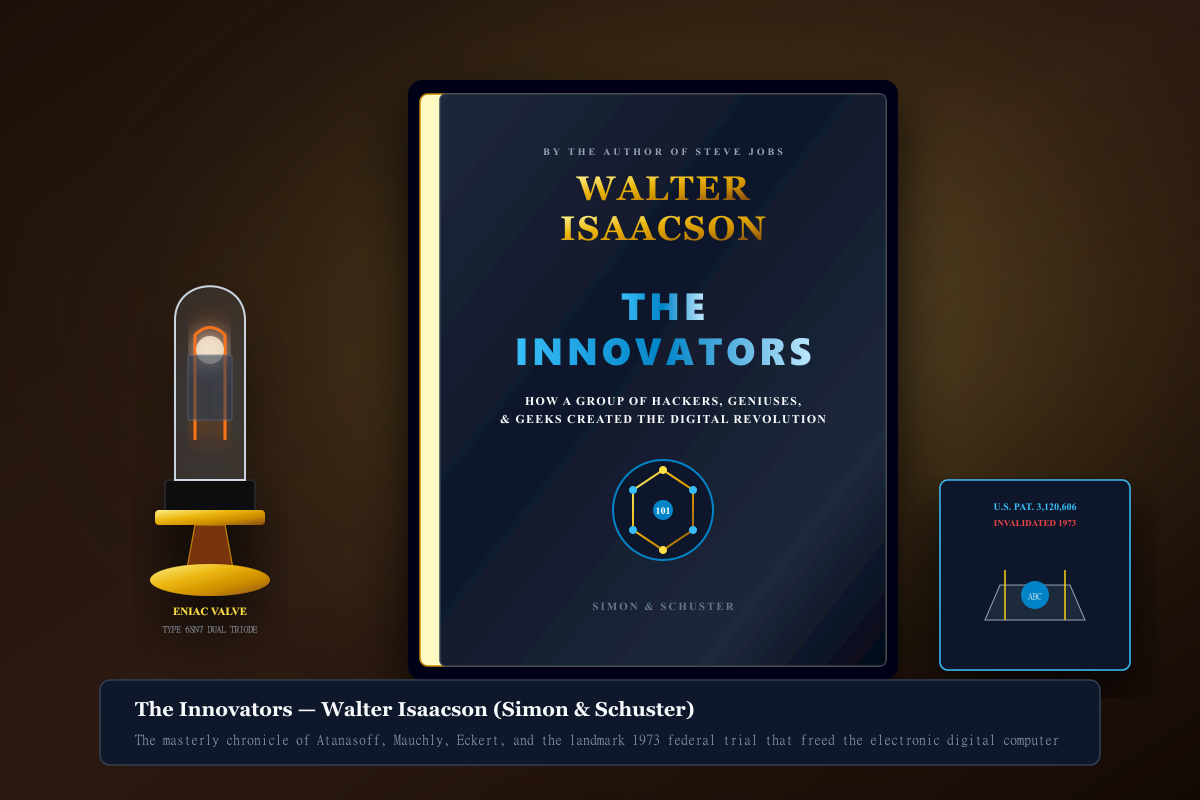
In 'The Innovators' (Simon & Schuster), biographer Walter Isaacson offers a masterclass in technology history, dedicating an essential chapter to the dramatic clash between John Vincent Atanasoff, John Mauchly, and J. Presper Eckert. Through meticulous analysis of trial testimony, private correspondence, and laboratory logs, Isaacson unpacks how collaborative innovation actually works—and how the bitter 1973 Honeywell v. Sperry Rand trial exposed the fraught boundary between solitary academic insight and industrial-scale engineering execution. Written with gripping biographical pacing and rigorous factual grounding, it remains one of the finest accounts of how digital computing transitioned from wartime secrecy into the open foundation of the modern world.
Buying limit: Available in hardcover, trade paperback, audio, and digital e-book formats (ISBN 978-1476708706). For student research, personal libraries, and engineering reference, choose the unabridged trade paperback or hardcover edition containing the complete archival notes, photo inserts, and scholarly index.
Original editorial illustration, not a retailer photograph. No exact Amazon offer passed our verification gate.SOURCES, METHOD, AND LIMITS
This historical analysis was developed through thorough examination of primary legal and institutional records, including the published findings of fact and conclusions of law in Honeywell Inc. v. Sperry Rand Corp., 180 U.S.P.Q. 673 (D. Minn. 1973), trial transcript depositories maintained at the Charles Babbage Institute at the University of Minnesota, the John Vincent Atanasoff Papers (MS 101) in the Special Collections and University Archives at Iowa State University, and the technical archives of the Computer History Museum. Electrical architecture details—such as the ABC's 300 vacuum tubes, 60-cycle rotating capacitor drum memory, and ENIAC's 10-digit decimal ring-counter accumulators and plugboard programming—were cross-verified against original Moore School of Electrical Engineering progress reports and technical bulletins. No computing hardware was operated during research.
- Charles Babbage Institute, University of Minnesota — Honeywell Inc. v. Sperry Rand Corp. Records (180 USPQ 673) — Primary institutional depository containing the complete trial transcripts, depositions, trial exhibits, and Judge Earl R. Larson's October 19, 1973 findings of fact and conclusions of law.
- Iowa State University Special Collections — John Vincent Atanasoff Papers, 1928-1995 (MS 101) — Official institutional collection preserving Dr. Atanasoff's original 1939-1941 ABC manuscripts, schematics, correspondence with John Mauchly, and contemporaneous patent notes.
- Computer History Museum — The Birth of the Computer: ENIAC and the Legal Battles — Authoritative historical retrospective examining the engineering differences between the ABC and ENIAC, the 1971-1973 Honeywell litigation, and the court's invalidation of the ENIAC patent.