ON THIS DAY · OCTOBER 11, 1958
Missed the Moon, Founded an Agency: How Pioneer 1 Launched NASA into Deep Space
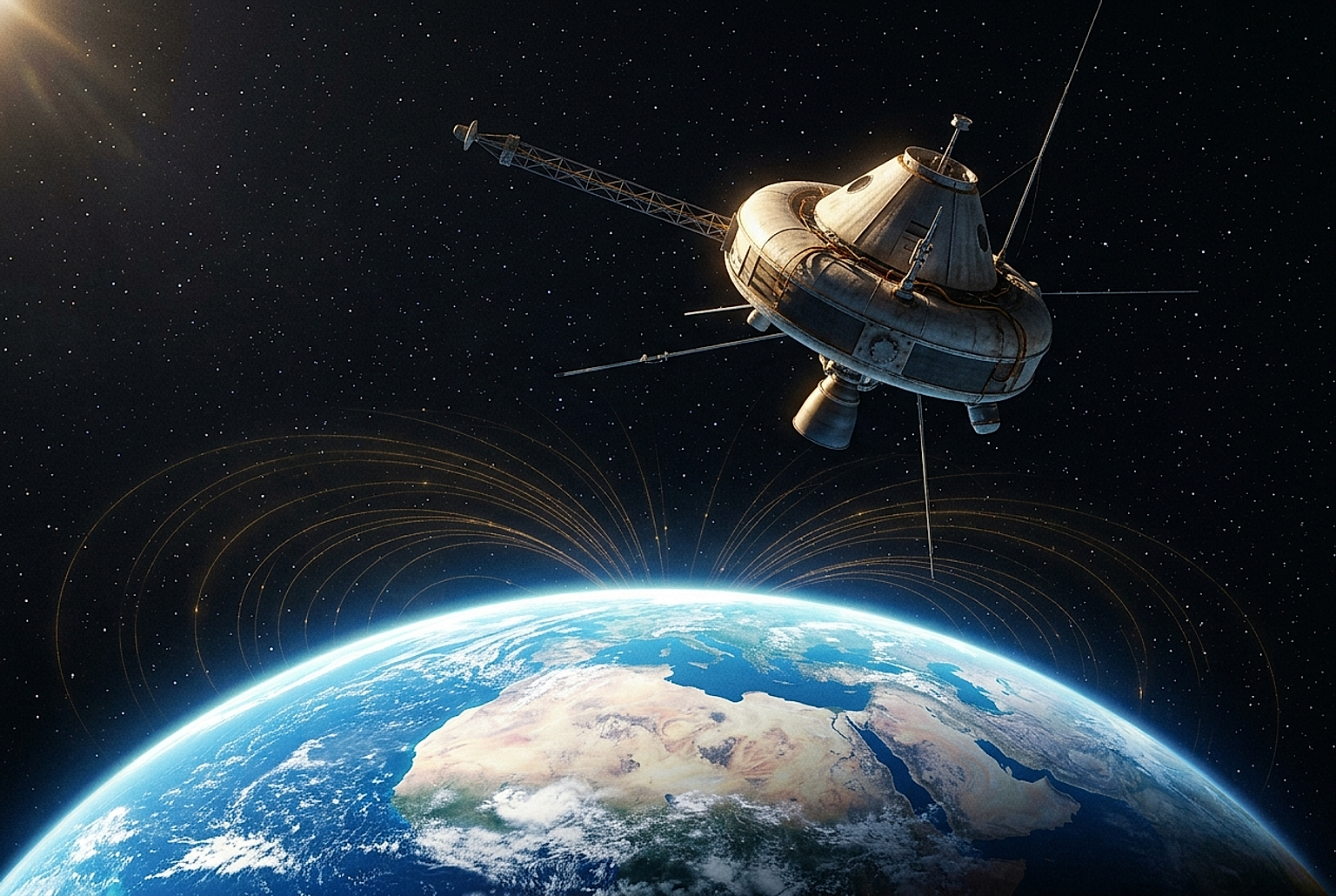
On October 11, 1958—just ten days after opening its doors—NASA launched its very first spacecraft atop a Thor-Able rocket at Cape Canaveral. Intended to orbit the Moon, Pioneer 1 suffered a minor booster guidance error that left it short of escape velocity. Yet instead of a catastrophe, its 43-hour, 70,700-mile ballistic journey returned the first deep-space radiation mapping of the Van Allen belts, discovered hydromagnetic oscillations in Earth's magnetosphere, and proved that a fledgling civilian agency could navigate the cosmos.
Ten Days After Day One: How a Fledgling Civilian Agency Inherited the Moon Race
In the frantic autumn of 1958, the American space effort was wrestling with an existential crisis of national prestige and administrative fragmentation. Exactly one year earlier, the Soviet Union had launched Sputnik 1, followed swiftly by Sputnik 2 carrying the dog Laika into orbit. The American public response swung between humiliation and panic, compounded when the U.S. Navy's Vanguard TV-3 booster erupted into flames on its launch pad in December 1957. Although Wernher von Braun's Army Ballistic Missile Agency and the Jet Propulsion Laboratory restored a measure of confidence by lofting Explorer 1 into orbit in January 1958, the American space agenda remained a turbulent turf war divided between the Army, Navy, and Air Force.
President Dwight D. Eisenhower was determined to keep space exploration firmly in civilian hands rather than allowing it to become a permanent military branch. On July 29, 1958, Eisenhower signed Public Law 85-568, the National Aeronautics and Space Act, establishing the National Aeronautics and Space Administration. When NASA officially opened its doors for business on October 1, 1958, under its first administrator, Case Institute president T. Keith Glennan, it absorbed roughly 8,000 employees from the 43-year-old National Advisory Committee for Aeronautics (NACA). But Glennan did not have months or years to construct an orderly pipeline of planetary missions. The Cold War space race was accelerating, and NASA immediately inherited the Air Force's ongoing lunar probe effort, codenamed Project Able. Just ten calendar days after NASA's official founding, the agency found itself on the launch pad at Cape Canaveral, preparing to fly its inaugural mission directly to the Moon.
The 3.5-Degree Pitch Error: Anatomy of the Thor-Able Booster Anomaly
At 08:42:13 UTC (03:42:13 local time) on October 11, 1958, the three-stage Thor-Able I rocket roared off Launch Complex 17A at the Atlantic Missile Range. The launch vehicle was an audacious composite: a modified Douglas Thor intermediate-range ballistic missile (IRBM #130) serving as the liquid-oxygen and kerosene first stage, topped by an Aerojet AJ10-42 liquid-propellant second stage derived from Vanguard, and an Allegany Ballistics Laboratory Altair X-248 solid-propellant third stage. Stacked within the fiberglass nose fairing sat Pioneer 1—an 84-pound (38.2 kg) biconical cylinder developed by TRW Space Technology Laboratories (STL), bristling with dipole antennas and carrying a Thiokol solid-propellant retro-rocket motor intended to fire at lunar arrival.
The initial staging appeared flawless, but inside the guidance electronics, a subtle hardware discrepancy had already sealed the spacecraft's trajectory. An accelerometer aboard the Thor booster had drifted out of calibration, feeding inaccurate velocity data to the pitch-control servos. As a consequence of this guidance error, the rocket tilted slightly too steeply, climbing at an angle 3.5 degrees higher than the programmed flight profile (approximately 35 degrees above the horizontal rather than 31.5 degrees). Furthermore, the second stage shut down ten seconds prematurely. Although the Altair third stage ignited and burned cleanly, the cumulative velocity at final burnout reached 34,400 feet per second (10,485 meters per second)—approximately 800 feet per second shy of the 35,200 feet per second (10,730 meters per second) required for translunar escape velocity. Pioneer 1 was traveling fast enough to escape the immediate vicinity of Earth, but not fast enough to overcome Earth's gravitational anchor and reach the Moon.
Seventy Thousand Miles into the Void: The Scientific Triumph of a Falling Probe
To general observers and sensationalist headlines, missing the Moon might have looked like an outright failure. But to astrophysicists and aerospace engineers, Pioneer 1 became an unprecedented goldmine of deep-space science. Instead of plunging into the Atlantic Ocean, the spacecraft soared higher into the cosmos than any human-made machine had ever ventured. For forty-three continuous hours, tracking stations at Manchester's Jodrell Bank in England, Singapore, and Hawaii followed the spacecraft as it coasted outward to a record-breaking apogee of 70,700 miles (113,854 kilometers)—more than seventeen Earth radii away and nearly thirty times higher than any existing artificial satellite.
Throughout its long elliptical ascent, Pioneer 1's scientific payload performed brilliantly. An ion chamber designed by the University of Minnesota and TRW mapped radiation across thousands of miles of cislunar space, providing crucial confirmation of James Van Allen's newly discovered radiation belts. Crucially, Pioneer 1 proved that the radiation intensity did not increase indefinitely; after peaking in the inner and outer belts, the radiation counts began tapering off at higher altitudes, proving that the hazard had finite boundaries. Meanwhile, STL's search-coil magnetometer observed hydromagnetic oscillations in deep space and recorded the compression of Earth's magnetic field on the sunward side, offering humanity's first empirical glimpse of the interaction between the solar wind and the magnetosphere. Additionally, a piezoelectric microphone registered eleven micrometeorite impacts over the flight, confirming that deep space was relatively sparse rather than dangerously choked with debris.
The Deep Space Blueprint: What Pioneer 1 Taught NASA About Flying into the Unknown
As Pioneer 1 reached the crest of its trajectory on October 12 and began its long gravitational fall back toward Earth, ground controllers attempted a desperate salvage maneuver. They sent radio commands to ignite the onboard Thiokol TX-8-6 retro-rocket, hoping to boost the spacecraft's perigee and circularize its orbit into a permanent high-Earth satellite. But here, the harsh reality of deep space taught another brutal engineering lesson: because the spacecraft had traveled at an unexpected attitude, its thermal balance was compromised. Internal temperatures had plummeted to near freezing (approximately 2°C to 3°C), chilling the chemical batteries below the threshold needed to deliver sufficient electrical current to fire the ignition squib. The motor remained silent.
On October 13, 1958, at 03:46 UTC, Pioneer 1 plunged into the upper atmosphere over the South Pacific Ocean and disintegrated. Yet the mission left an indelible legacy. It established the baseline operational protocols for global deep-space tracking that would evolve into NASA's Deep Space Network. It established a standard of American transparency—conducting open press briefings and releasing scientific telemetry worldwide—that contrasted sharply with Soviet secrecy. Most importantly, Pioneer 1 proved that NASA was capable of orchestrating complex interplanetary missions. Just ten days into its institutional life, the agency had reached into the cosmos, turned an apparent navigational shortfall into a masterclass in space physics, and proved that humanity's journey to the Moon had truly begun.
What the evidence does not settle
Popular retellings of the Pioneer 1 mission frequently perpetuate three historical misconceptions: first, that the spacecraft was a catastrophic launch failure that crashed immediately into the ocean, ignoring its record-setting 70,700-mile flight and groundbreaking 43-hour scientific return; second, that Pioneer 1 was secretly designed to detonate a nuclear warhead on the Moon (conflating the scientific probe with Project A119, a purely speculative military study that was never approved or flown); and third, that the retro-rocket failed due to an electrical short circuit, whereas primary telemetry proved that extreme thermal cooling incapacitated the low-temperature battery chemistry. Readers should note that hobby rocketry kits recreate general propulsion and staging mechanics rather than orbital guidance, and book recommendations reflect published aerospace historical evaluations without commercial sponsorship.
PRODUCT IDEA 01
Estes Tandem-X Flying Model Rocket Starter Set (Dual Rocket Launch System)
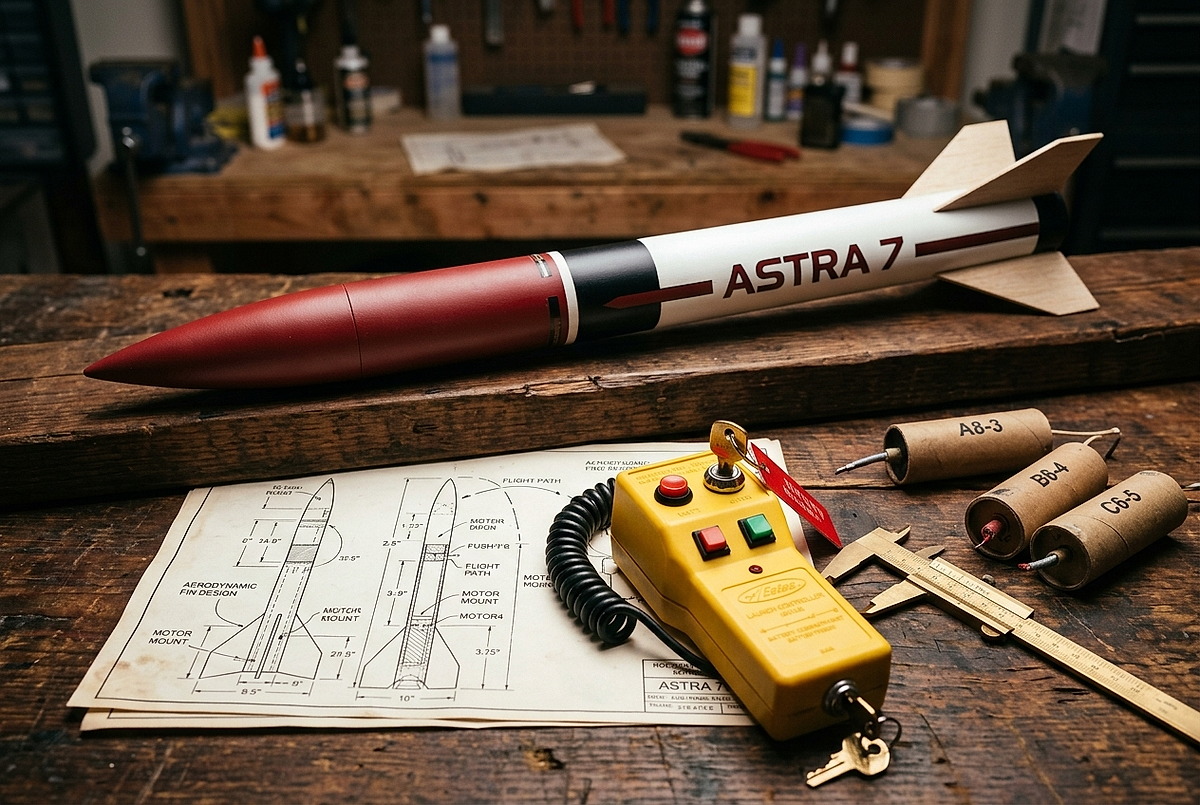
Hands-on model rocketry remains the most vivid educational introduction to the multi-stage propulsion physics and aerodynamic challenges that defined early space exploration like Pioneer 1's Thor-Able booster. The Estes Tandem-X starter system includes two distinct flight models: the E2X (Easy to Assemble) Amazon rocket measuring nearly three feet long, and the classic precision balsa-fin Crossfire ISX. Powered by standard Estes black powder model rocket motors (such as A8-3, B6-4, or C6-5), these lightweight models demonstrate primary principles of rocketry—thrust-to-weight ratio, center of pressure versus center of gravity, and staged parachute recovery—allowing amateur rocketeers and aerospace students to experience the practical physics of launch staging in an open field.
Buying limit: Look for complete launch starter sets that include the Electron Beam launch controller, safety interlock key, and adjustable Porta-Pad II launch base. Model rocket engines, recovery wadding, and 9V launch controller batteries are sold separately due to shipping regulations. Ensure launches comply strictly with the National Association of Rocketry (NAR) Safety Code, requiring a clear outdoor field of at least 200 to 500 feet, calm winds below 20 mph, and strict spectator standoff distances.
Original editorial illustration, not a retailer photograph. No exact Amazon offer passed our verification gate.PRODUCT IDEA 02
Deep Space Chronicle: A Chronology of Deep Space and Planetary Probes — Asif A. Siddiqi

For space historians and engineering enthusiasts seeking the definitive, unvarnished history of early robotic exploration, Dr. Asif A. Siddiqi's landmark monograph 'Deep Space Chronicle' (published by the NASA History Division as NASA SP-2002-4524 and republished in expanded volumes by the University Press of Florida) is the ultimate reference work. Siddiqi meticulously reconstructs every lunar and planetary mission from Pioneer 0 and Pioneer 1 in 1958 through the dawn of the 21st century. Utilizing declassified government records, manufacturer contractor reports from TRW and Douglas Aircraft, and Soviet archives, the book details the exact engineering failures, guidance discrepancies, launch vehicle configurations, and scientific discoveries of Pioneer 1's 43-hour flight, separating historical truth from Cold War myth.
Buying limit: Available in government monograph format (NASA SP-2002-4524) through official government bookstores, university research repositories, and expanded commercial trade paperback editions. When purchasing for institutional or personal aerospace libraries, ensure the edition includes the complete appendix tables of launch vehicle serial numbers, trajectory orbital elements, and primary scientific instrument contractor manifests.
Original editorial illustration, not a retailer photograph. No exact Amazon offer passed our verification gate.SOURCES, METHOD, AND LIMITS
Researched using primary mission documentation and technical flight reports from the NASA Science Solar System Exploration archives (Pioneer 1 / Able 2 Mission Record), the NASA Space Science Data Coordinated Archive (NSSDCA Spacecraft Master Catalog ID PION1), and the NASA History Division (monograph SP-2002-4524, 'Deep Space Chronicle: A Chronology of Deep Space and Planetary Probes 1958–2000' by Dr. Asif A. Siddiqi). Launch vehicle specifications, telemetry logs, and STL TRW contractor performance summaries were cross-checked against Douglas Aircraft Thor-Able I launch logs and the Smithsonian National Air and Space Museum collection dossier for artifact NASM_A19640665000. No historic aerospace artifacts were physically disassembled or operated.
- NASA Science Solar System Exploration — Pioneer 1 (Able 2) Mission Overview — Primary institutional mission record detailing the launch of Pioneer 1 on October 11, 1958, its Thor-Able booster profile, scientific payload, 70,700-mile apogee, and atmospheric re-entry on October 13, 1958.
- NASA Space Science Data Coordinated Archive (NSSDCA) — Pioneer 1 Master Catalog — Official NASA spacecraft catalog record documenting physical parameters (38.2 kg toroidal structure), search-coil magnetometer, ion chamber, micrometeorite detector, and 43 hours of cislunar telemetry.
- NASA History Division — Deep Space Chronicle: Pioneer 1 Flight and Telemetry Records — Official NASA history publication documenting the founding of NASA on October 1, 1958, the 3.5-degree Thor guidance pitch anomaly, and the Van Allen radiation belt mapping achievements of October 11–13, 1958.