ON THIS DAY · OCTOBER 10, 1967
Why Nobody Owns the Moon: How the 1967 Outer Space Treaty Kept the Cold War Out of the Cosmos
On October 10, 1967, the foundational constitution of international space law officially took effect. Negotiated at the height of the Apollo race and the Cold War, the Outer Space Treaty barred weapons of mass destruction from orbit, established celestial bodies as the province of all mankind, and permanently prevented Earth's superpowers from carving up the Moon into sovereign real estate.
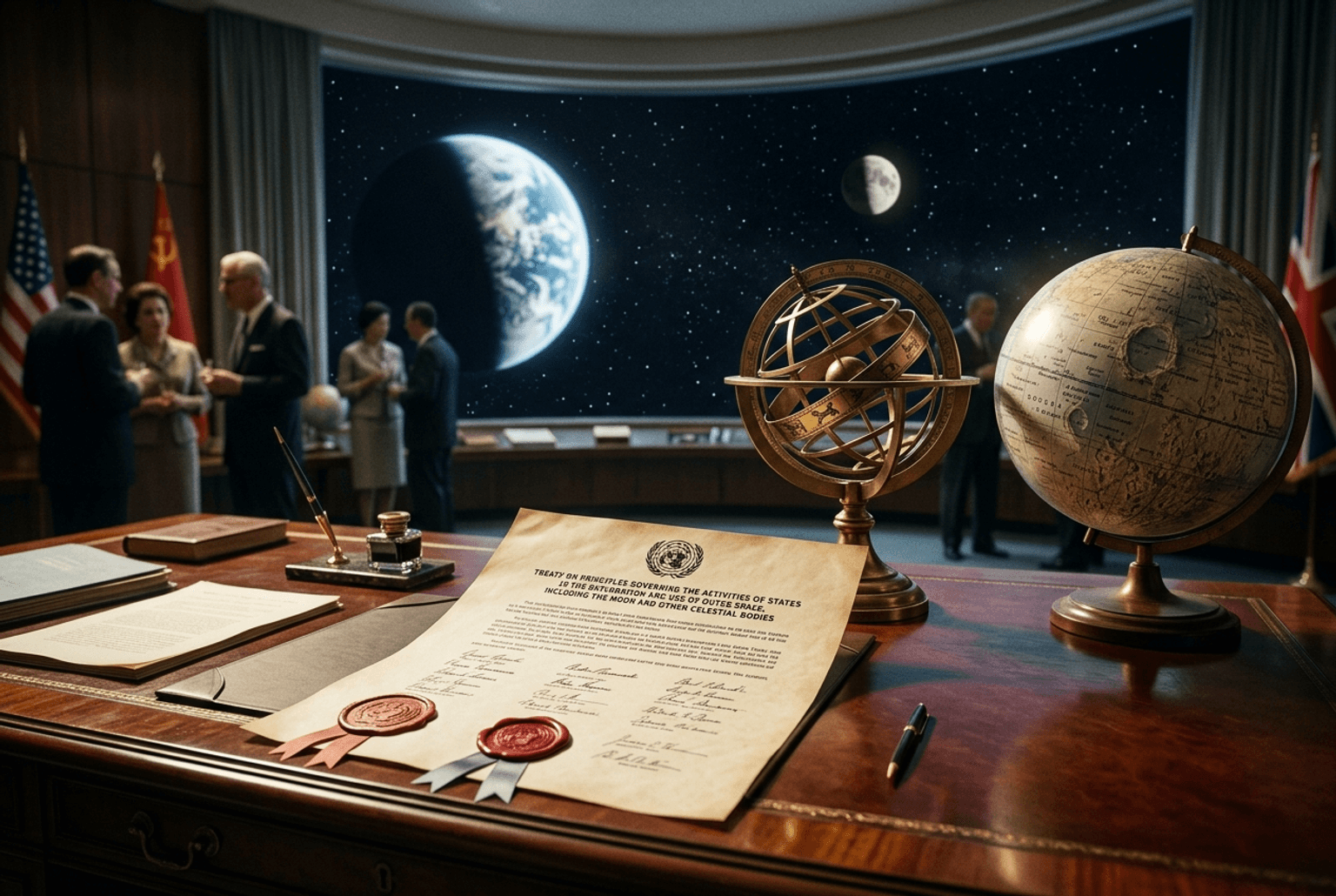
The Nightmare of Orbital Armageddon: Why Cold War Superpowers Needed Space Law
In the autumn of 1957, when Sergei Korolev's Sputnik 1 began transmitting its rhythmic radio pulse across the globe, the international scientific community celebrated a triumph of human intellect—but military strategists saw an existential crisis. The same rocket technology capable of launching a 23-inch aluminum sphere into orbit could loft thermonuclear warheads across continents in under thirty minutes. Over the following decade, the Cold War escalated into near-Earth space with alarming velocity. In July 1962, the United States detonated a 1.4-megaton nuclear warhead 250 miles above Johnston Atoll in Operation Starfish Prime, generating an artificial radiation belt that disabled multiple satellites and proved that orbital detonations could blind global communications. Simultaneously, Soviet design bureaus began developing Fractional Orbital Bombardment Systems (FOBS)—de-orbiting nuclear weapons that could loiter silently in low Earth orbit before striking targets without radar warning.
As both Washington and Moscow poured billions into robotic lunar probes and crewed lunar landing programs, an even more destabilizing prospect emerged: the weaponization of the Moon itself. Strategists on both sides drew up conceptual blueprints for lunar military fortifications, deep-crater missile silos, and nuclear listening posts. Under traditional terrestrial international law—the colonial 'Doctrine of Discovery' and terra nullius—nations had spent five centuries acquiring sovereign territory by arriving first, planting a national flag, and asserting physical dominion. If an Apollo crew or Soviet cosmonaut touched down on lunar soil and claimed the Moon as sovereign national territory, the lunar surface would inevitably become an armed front line of the Cold War. Both American President Lyndon B. Johnson and Soviet Premier Alexei Kosygin recognized that an unconstrained race for lunar real estate would trigger an unaffordable, unmanageable cosmic arms race that neither superpower could guarantee winning.
The Non-Appropriation Doctrine: Erasing the Colonial Doctrine of Discovery from the Moon
The diplomatic solution forged inside the United Nations Committee on the Peaceful Uses of Outer Space (COPUOS) was as legally revolutionary as the rocketry that prompted it. Formally embodied in United Nations General Assembly Resolution 2222 (XXI) on December 19, 1966, the resulting multilateral treaty overturned five hundred years of colonial property law in a single sentence. Article II of the Outer Space Treaty declared: 'Outer space, including the Moon and other celestial bodies, is not subject to national appropriation by claim of sovereignty, by means of use or occupation, or by any other means.' With nineteen decisive words, the international community rejected the concept of terra nullius in space, classifying the cosmos instead as res communis omnium—a common heritage immune to sovereign annexation.
This non-appropriation principle is the precise legal reason why Neil Armstrong and Buzz Aldrin planting the American flag at Tranquility Base on July 20, 1969 did not transform the Sea of Tranquility into the fifty-first American state. Anticipating potential international alarm, the United States Congress had explicitly included a statutory provision in the 1969 NASA Authorization Act affirming that the lunar flag deployment was a symbolic commemoration of historical achievement, not an assertion of national sovereignty. Article II also decisively dismantles recurring commercial myths regarding private lunar land sales. Periodically, novelty entrepreneurs—most notoriously Dennis Hope's 'Lunar Embassy' in the 1980s—have claimed to sell parcels of lunar real estate by arguing that Article II only restricts 'national' appropriation rather than private individuals. In international jurisprudence, this argument is completely baseless. Property rights cannot exist in a legal vacuum; a valid title deed requires a sovereign government with jurisdiction over the territory to recognize, record, and enforce that title. Because no sovereign state can claim jurisdiction over lunar soil, no state can grant private property rights to land on the Moon. Furthermore, Article VI of the treaty explicitly holds signatory governments internationally responsible for all space activities conducted by their non-governmental entities and private citizens.
The White House, the Kremlin, and UN Resolution 2222: How Diplomacy Succeeded in 1967
Achieving unanimous agreement on the treaty during the height of the Vietnam War and fierce Cold War espionage was a masterclass in pragmatic multilateral diplomacy. Leading the American delegation, U.S. Ambassador to the United Nations Arthur Goldberg worked closely with Soviet Ambassador Platon Morozov and Soviet Ambassador to the United States Anatoly Dobrynin to hammer out compromises on thorny military definitions. The United States insisted that civilian scientific personnel and military personnel conducting peaceful scientific research must have free access to all areas of celestial bodies (Article I). In return, the Soviet Union accepted strict provisions making launching states internationally liable for any physical damage caused by their space objects on Earth or in flight (Article VII).
On January 27, 1967, the treaty was formally opened for signature simultaneously in London, Moscow, and Washington, D.C.—the three designated depositary capitals. In the East Room of the White House, President Lyndon B. Johnson watched U.S. Ambassador Goldberg, Soviet Ambassador Dobrynin, and British Ambassador Sir Patrick Dean affix their signatures, hailing the moment as 'the first firm step toward keeping outer space free from the weapons of mass destruction.' The U.S. Senate ratified the treaty by a decisive vote of 88 to 0 on April 25, 1967, and President Johnson signed the ratification proclamation on May 24. Over the subsequent five months, instruments of ratification were gathered from dozens of nations across Europe, the Americas, Africa, and Asia. When the three depositary powers deposited their formal ratifications at the United States Department of State in Washington on October 10, 1967, the Outer Space Treaty formally crossed the threshold into binding international law.
Artemis, Megaconstellations, and the Frontier: What the 1967 Treaty Left Unfinished
Six decades after entering into force, the Outer Space Treaty remains the unchallenged magna carta of space exploration, with more than 115 ratifying nations and dozens of additional signatories. Its core prohibitions have held with remarkable resilience: no orbital nuclear warheads have ever been stationed in space, no sovereign military bases guard lunar crater rims, and Article V's humanitarian mandate designating astronauts as 'envoys of mankind' entitled to emergency rescue across national lines has fostered unbroken international cooperation in orbit. Furthermore, Article IX's requirement that states avoid 'harmful contamination' of celestial bodies established the foundational science of planetary protection—explaining why NASA deliberately crashed the Galileo probe into Jupiter in 2003 and the Cassini spacecraft into Saturn in 2017 to protect potential life on icy moons.
Yet the treaty's very success in freezing the geopolitical status quo in 1967 has created urgent legal friction in the commercial space age. The drafters of 1967 could scarcely imagine thousands of commercial satellites launched annually by private aerospace enterprises like SpaceX, nor the prospect of commercial asteroid mining. While Article II clearly forbids owning celestial land, it remains deliberately ambiguous regarding whether private or state actors may extract and own space resources—such as water ice from lunar polar craters or platinum-group metals from near-Earth asteroids. Under the 2015 U.S. Commercial Space Launch Competitiveness Act and the multilateral Artemis Accords launched in 2020, the United States and over forty partner nations maintain that harvesting resources does not constitute sovereign territorial appropriation, drawing an analogy to international maritime law where fishermen own the fish they harvest from international waters without claiming sovereignty over the ocean. Conversely, nations such as Russia and China argue that unilateral resource extraction frameworks undermine the treaty's mandate that space remain the shared province of all mankind. As humanity prepares to return crews to the Moon and establish permanent lunar bases, the 1967 Outer Space Treaty stands as an indispensable compass, proving that our highest legal ideals can withstand the vacuum of deep space.
What the evidence does not settle
While the Outer Space Treaty successfully banned nuclear weapons and weapons of mass destruction from orbit and demilitarized celestial bodies, it contains notable ambiguities and deliberate compromises reflecting its Cold War origins. Article IV does not prohibit conventional ground-to-space anti-satellite (ASAT) kinetic weapons, electronic warfare, directed-energy lasers, or dual-use military reconnaissance and positioning satellites. Furthermore, the 1967 pact did not anticipate commercial mega-constellations, orbital space debris mitigation standards, or private space tourism. The treaty's non-appropriation clause (Article II) forbids sovereign territorial claims on celestial surfaces, but contemporary international legal consensus remains divided regarding whether the commercial extraction and private ownership of mined space resources (such as lunar water ice or regolith under the 2015 U.S. Commercial Space Act and the Artemis Accords) complies fully with the 'province of all mankind' mandate. Mentioned historical monographs and lunar design objects are independent editorial reviews and carry no commercial sponsorship.
PRODUCT IDEA 01
The Moon Is a Harsh Mistress — Robert A. Heinlein (Classic Lunar Sovereignty Sci-Fi)

Published in 1966—on the very eve of the Outer Space Treaty negotiations—Robert A. Heinlein's Hugo Award-winning masterpiece 'The Moon Is a Harsh Mistress' remains the definitive literary exploration of lunar sovereignty, space resource economics, and planetary rebellion. Set in 2075, the novel chronicles the uprising of a self-sufficient lunar penal colony (the 'Loonies') against Earth's exploitative planetary authority, aided by HOLMES IV ('Mike'), a self-aware supercomputer. Heinlein presciently grapples with the core legal and economic tensions that the 1967 treaty sought to freeze: who controls lunar regolith and ice, how celestial outposts govern themselves, and whether sovereign laws drafted in Earth capitals can realistically hold sway across cislunar space. It is essential reading for anyone seeking to understand the philosophical debate between terrestrial treaty law and off-world frontier autonomy.
Buying limit: Published by Orb Books / Tor Publishing (ISBN-10: 0312863551, ISBN-13: 978-0312863555 in mass-market and trade paperback). Available widely in trade paperback, hardcover, and Kindle e-book formats across booksellers. When purchasing for personal or institutional science-fiction libraries, select the Orb trade paperback edition featuring Heinlein's original unabridged text, superior binding durability, and high-opacity acid-free paper that resists yellowing.
Original editorial illustration, not a retailer photograph. No exact Amazon offer passed our verification gate.PRODUCT IDEA 02
Precision 3D-Printed NASA Lunar Topography Globe Lamp (Touch Dimmable & Wooden Stand)

While Article II of the 1967 Outer Space Treaty decreed that no human being or government can own the Moon, you can place a faithful physical model of its surface on your workspace. High-fidelity 3D-printed lunar lamps utilize digital elevation model (DEM) telemetry gathered by NASA's Lunar Reconnaissance Orbiter (LRO) to accurately recreate the Moon's true geological relief in tactile PLA polymer. From the deep basalt plains of Mare Tranquillitatis to the sharp impact rims of Tycho and Copernicus, the lamp's internal dual-color LED module projects both warm 3000K amber glow and crisp 6000K lunar white light through variable wall thicknesses, highlighting authentic crater shadowing. Resting on a minimalist solid hardwood geometric stand, it serves as an inspiring tactile reminder of humanity's shared celestial commons for home offices and reading libraries.
Buying limit: Avoid cheap novelty spheres under 4 inches made with thin injection-molded plastic shells and low-resolution smoothed surfaces. Look for lamps with a diameter of at least 5.9 to 7.1 inches (15 to 18 cm) manufactured using genuine additive 3D printing with sub-0.2mm layer heights to preserve authentic crater relief. Prioritize models with a built-in rechargeable lithium-ion battery (minimum 500mAh for 6 to 8 hours of cordless operation), universal USB-C charging, and certified low-flicker dimmable touch or remote controls.
Original editorial illustration, not a retailer photograph. No exact Amazon offer passed our verification gate.SOURCES, METHOD, AND LIMITS
Researched using primary legal documents and treaty records from the United Nations Office for Outer Space Affairs (UNOOSA Treaty Status Record for General Assembly Resolution 2222 (XXI)), the United States Department of State (Treaties in Force: 18 U.S.T. 2410; TIAS 6347), and NASA History Division legal archives. Diplomatic correspondence and legislative debates were cross-referenced against the Foreign Relations of the United States (FRUS, 1964–1968, Volume XI, Arms Control and Volume XIV, Soviet Union) and the United States Senate Committee on Foreign Relations Executive Report on the Treaty on Outer Space (90th Congress, 1st Session, Executive D). Secondary legal analyses from the McGill Manual on International Law Applicable to Military Uses of Outer Space (MILAMOS) and scholarly literature on international space jurisprudence were consulted to assess property rights distinctions, private liability under Article VI, and space resource extraction. No physical space objects or classified aerospace systems were inspected.
- United Nations Office for Outer Space Affairs (UNOOSA) — Outer Space Treaty Text and Status Record — Primary multilateral treaty repository maintained by the United Nations documenting the full text, depositary history, and formal October 10, 1967 entry into force date of the Outer Space Treaty.
- United States Department of State — Treaty on Principles Governing the Activities of States in Outer Space — Primary diplomatic treaty archive of the U.S. Department of State detailing the signing in Washington, London, and Moscow, U.S. Senate ratification, and presidential proclamation of October 10, 1967.
- NASA Legal and Historical Archives — Treaty on Principles Governing the Exploration and Use of Outer Space — Official NASA archive providing the statutory framework, planetary protection guidelines under Article IX, and astronaut rescue obligations under Article V.