ON THIS DAY · OCTOBER 7, 1959
First Look at the Moon's Hidden Face: How Luna 3 Developed 35mm Film in Deep Space and Radioed the Far Side to Earth
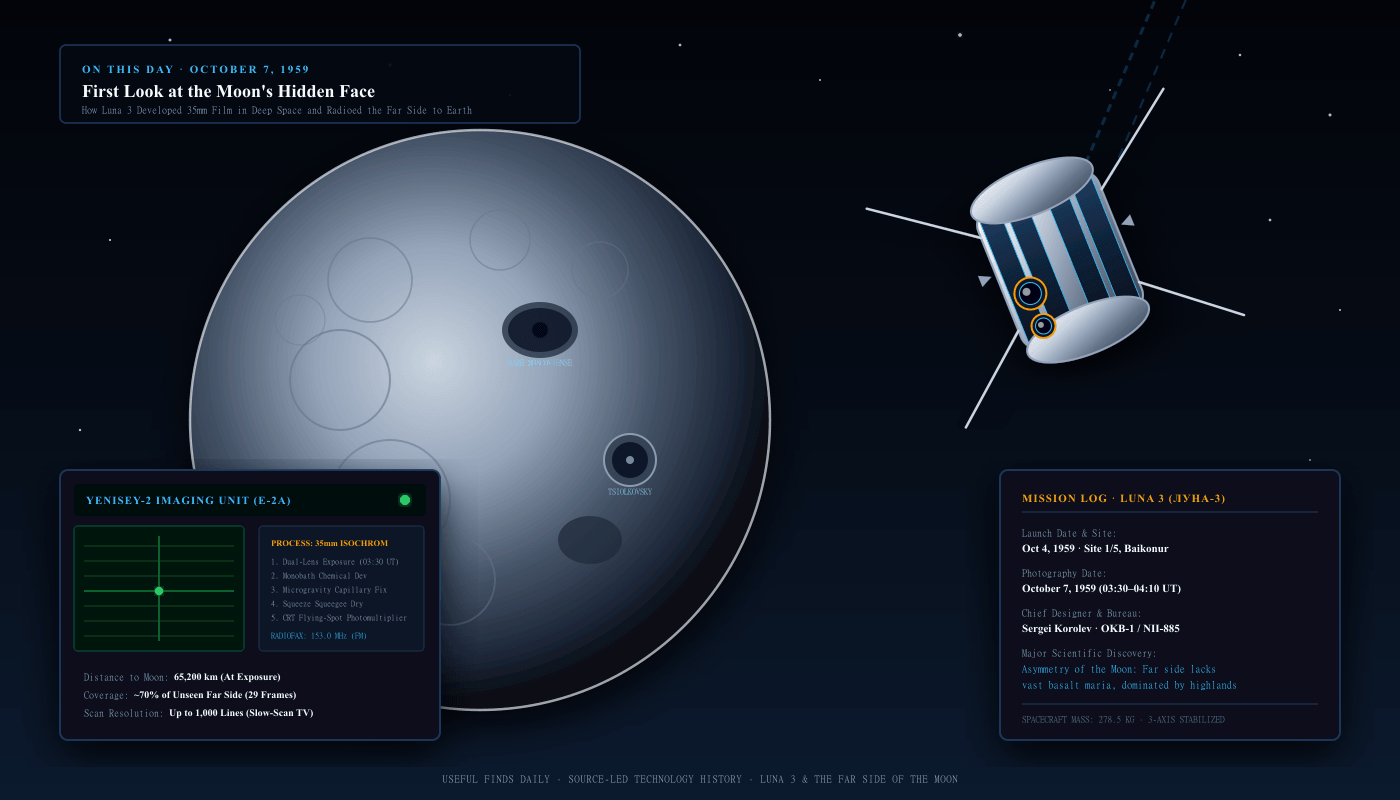
On October 7, 1959, Soviet probe Luna 3 performed one of the most audacious automated engineering feats in aerospace history. Flying past the Moon's unseen hemisphere, the 278-kilogram spacecraft locked onto lunar sunlight, exposed radiation-resistant 35mm film, developed and dried the negatives in a miniaturized onboard chemical lab, and transmitted the first radiofacsimile scan of the lunar far side across 400,000 kilometers of deep space.
The Dark Hemispheric Mystery: Why Humanity Had Never Seen 41 Percent of the Moon
For the entirety of recorded human history prior to October 1959, the hemisphere of the Moon facing away from Earth was one of the solar system's supreme enigmas. Because the Moon is gravitationally tidally locked to Earth—completing one rotation on its axis in precisely the same 27.3 days it takes to complete one orbit around our planet—the same hemisphere perpetually faces terrestrial observers. While subtle orbital wobbles known as optical and physical librations allow astronomers to glimpse roughly fifty-nine percent of the total lunar surface over time, forty-one percent remained utterly invisible behind a permanent celestial curtain.
In the early years of the Space Race, Western and Soviet planetary scientists widely assumed that the hidden hemisphere would mirror the familiar face: vast dark plains of solidified volcanic basalt (the lunar maria, or 'seas') interspersed with bright cratered highlands. Unlocking that unseen territory required more than simply launching a rocket past the Moon; it demanded a spacecraft capable of autonomous three-axis stabilization, optical celestial navigation, and an imaging system that could operate in the extreme thermal and radiation environment of cislunar space years before digital solid-state image sensors (CCDs) were invented.
Under the direction of Chief Designer Sergei Pavlovich Korolev at design bureau OKB-1 in Kaliningrad (now Korolev), Soviet engineers conceived the E-2A project. Launched from Site 1/5 at the Baikonur Cosmodrome on October 4, 1959—exactly two years to the day after Sputnik 1—Luna 3 was designed not to impact the surface like its predecessor Luna 2, but to loop around the Moon in an unprecedented circumlunar trajectory engineered by mathematician Vsevolod Egorov at the Steklov Institute of Mathematics. This trajectory utilized the Moon's gravitational field to bend the probe's flight path back toward Earth's Northern Hemisphere, ensuring that high-gain radio telemetry antennas in Crimea could receive the spacecraft's signals on its return leg.
The Yenisey-2 System: An Automated Chemistry Lab and CRT Scanner in Microgravity
Because electronic television cameras of the late 1950s lacked the resolution and radiation shielding required for deep-space photography, the All-Union Scientific Research Institute of Television (NII-19) in Leningrad, led by Igor Valik and Pyotr Bratslavets, engineered an astonishing mechanical marvel: the Yenisey-2 phototelevision apparatus. The system was built around an AFA-E1 dual-lens camera containing a 200mm f/5.6 wide-angle objective (for full-disk framing) and a 500mm f/9.5 telephoto objective (for detailed regional topography).
The core technical challenge lay in the film itself. Standard photographic emulsions would rapidly fog and degrade under cosmic rays and solar radiation. To solve this, Soviet engineers utilized special temperature- and radiation-resistant 35mm isochromatic film stock—historically sourced in part from recovered American Project Genetrix high-altitude reconnaissance balloons that had drifted over Soviet airspace in 1956. The film was loaded into a hermetically pressurized cassette inside the spacecraft's cylindrical hull.
On the morning of October 7, 1959, as Luna 3 passed behind the sunlit far side at a distance of 65,200 kilometers, the probe's optical orientation system (Chaika) fired cold-gas nitrogen thrusters to lock its rear sensors onto the Sun while pointing its camera lenses squarely at the illuminated lunar disk. Over the course of forty minutes (03:30 to 04:10 UT), the camera exposed twenty-nine frames. The exposed film immediately advanced into an automated miniaturized chemical processing chamber where a viscous monobath developer-fixer solution was applied, squeegeed, and dried under strictly controlled microgravity capillary action.
Radiofacsimile Transmission: Beaming the Hidden Moon Across 400,000 Kilometers
Once the 35mm film negatives were dried, they passed directly in front of a miniature cathode-ray tube (CRT) flying-spot scanner. The CRT projected an ultra-fine beam of light through the negative onto a sensitive photomultiplier tube on the opposite side. As the light beam rastered across the film grain, the photomultiplier converted variations in photographic optical density into continuous analog electrical signals, generating a slow-scan television facsimile signal with a vertical resolution of up to 1,000 lines per frame.
Transmitting this facsimile data across cislunar distances with Luna 3's modest 153.0 MHz radio transmitter required strategic patience. At lunar distance, radio noise and battery conservation restricted transmission rates to low bandwidths. As Luna 3 looped back toward Earth along its eccentric geocentric return orbit, reaching a perigee of roughly 40,000 kilometers on October 18, ground stations at the Soviet Deep Space Tracking Facility in Simeiz (Crimea) and Kamchatka commanded the high-resolution readout.
Seventeen frames were successfully reconstructed on Earth, recorded onto photographic paper and magnetic tape as lines of light traced out on terrestrial CRT receivers. Although the raw images were noisy, low-contrast, and stripped with telemetry interference, digital enhancement and manual photographic stacking revealed unmistakable, revolutionary geography: humanity was looking at the far side of the Moon for the first time.
The Lunar Asymmetry Shock and Enduring Spaceflight Legacy
The scientific revelation delivered by Luna 3 completely overturned prevailing lunar geological paradigms. The far side of the Moon was not a symmetric twin of the near side. Instead of expansive dark basaltic plains like Oceanus Procellarum or Mare Tranquillitatis, the far side was overwhelmingly dominated by rugged, heavily cratered anorthositic highlands. Only two significant dark basalt seas were detected: a small, dark circular basin that Soviet scientists promptly christened Mare Moscoviense (the Sea of Moscow) and a smaller feature named Mare Ingenii (the Sea of Cleverness).
The images also revealed a prominent dark-floored impact crater with a bright central peak, which was named Tsiolkovsky in honor of Russian rocket pioneer Konstantin Tsiolkovsky. In 1960, the Soviet Academy of Sciences published the first-ever Atlas of the Far Side of the Moon based on Luna 3's data, and the International Astronomical Union (IAU) officially adopted five hundred newly cataloged lunar features. This fundamental dichotomy—known to modern geophysicists as the Lunar Crustal Asymmetry—is now understood to stem from differences in crustal thickness, early tidal heating, and asymmetric concentrations of radioactive heat-producing elements (the KREEP terrane) on the near side.
Beyond lunar cartography, Luna 3 established critical foundational principles for all deep-space exploration: autonomous celestial orientation, circumlunar trajectory gravity assists, automated remote sensing, and deep-space facsimile telemetry. When NASA's Apollo 8 astronauts Frank Borman, Jim Lovell, and William Anders became the first humans to view the lunar far side with their own eyes on Christmas Eve 1968, they were navigating terrain whose first blurry, heroic contours had been drawn nine years earlier by a Russian 35mm film camera in the cold silence of deep space.
What the evidence does not settle
Popular retellings occasionally claim that Luna 3 broadcast live digital video from the Moon; in physical reality, the spacecraft carried no digital image sensors or live television video. It utilized physical 35mm chemical film that was chemically developed in an automated microgravity tank and subsequently scanned line-by-line via an analog cathode-ray tube flying-spot scanner. Furthermore, while Luna 3 exposed 29 frames covering roughly 70% of the far side, radio interference and orbital orientation limits meant only 17 frames yielded interpretable scientific data. Stargazers should also note that the lunar far side is not permanently dark; it experiences day and night cycles identical in length (approx. 14 Earth days each) to the near side. Historical book and cartographic globe recommendations reflect verified published scholarship rather than commercial sponsorship.
PRODUCT IDEA 01
Challenge to Apollo: The Soviet Union and the Space Race, 1945–1974 — Asif A. Siddiqi
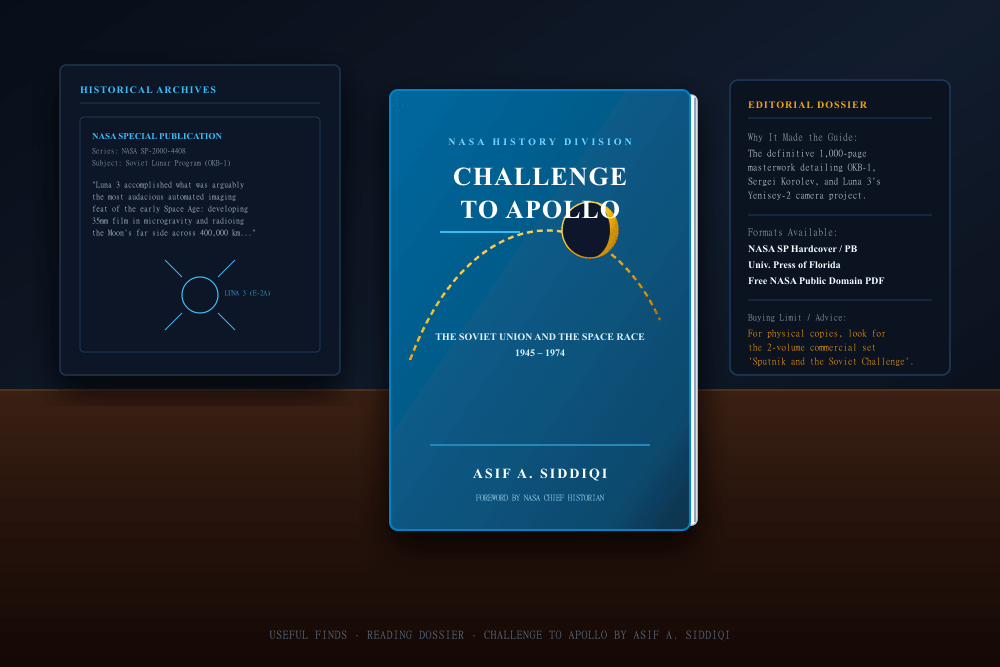
Asif A. Siddiqi's 'Challenge to Apollo', published by the NASA History Division (NASA SP-2000-4408) and later released commercially by the University Press of Florida, is widely celebrated as the definitive, monumental historical study of the Soviet space program. Drawing on previously top-secret Russian design bureau archives, declassified Politburo transcripts, and memoirs of OKB-1 engineers, Siddiqi provides an extraordinarily granular and thrilling account of how Sergei Korolev's team conceptualized and executed Luna 3. The narrative illuminates the immense technical audacity behind developing 35mm film in microgravity, navigating with cold-gas thrusters, and transmitting radiofacsimile scans across deep space with 1950s vacuum tube technology. For readers interested in the genuine engineering triumphs and bureaucratic struggles behind early space exploration, this volume represents the gold standard of space history scholarship.
Buying limit: The full original text is available as a free public domain PDF download via NASA's official history portal (NASA SP-2000-4408). Physical readers seeking a bound book can purchase the commercial two-volume revised edition published by the University Press of Florida under the titles 'Sputnik and the Soviet Space Challenge' (ISBN 978-0813026275) and 'The Soviet Space Race with Apollo' (ISBN 978-0813026282). When ordering physical editions from secondhand platforms or online bookshops, ensure you verify that you are acquiring the complete unabridged work with all photographic plates and OKB-1 schematics intact.
Original editorial illustration, not a retailer photograph. No exact Amazon offer passed our verification gate.PRODUCT IDEA 02
Topographic 3D Relief Lunar Desk Globe (6-Inch to 12-Inch Scale)
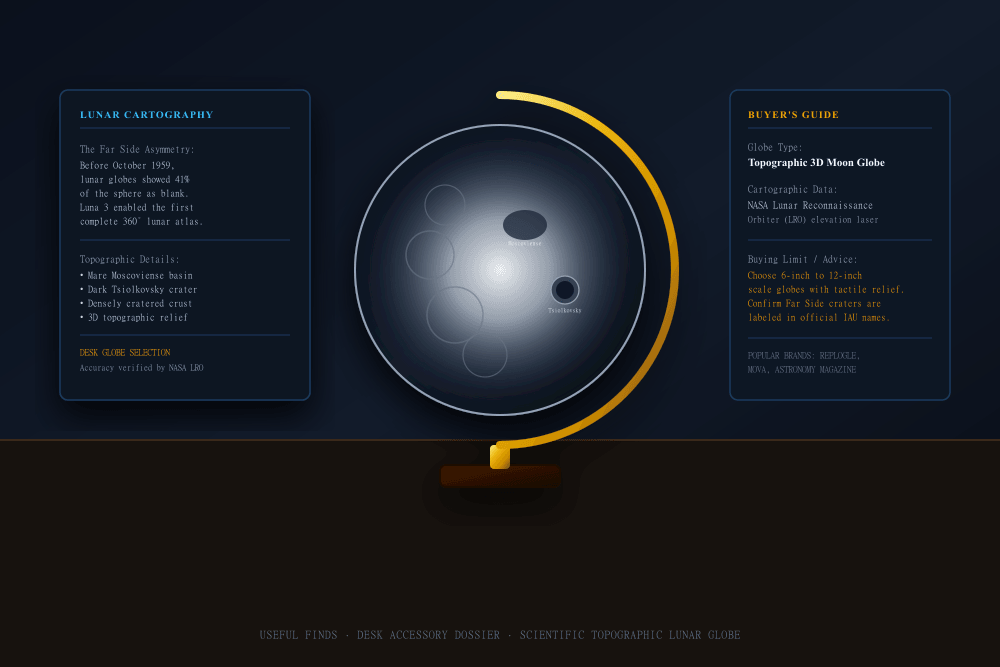
Prior to October 1959, every astronomical globe ever manufactured featured a blank gray void across more than forty percent of its surface. Luna 3's historic photographs enabled the first complete 360-degree lunar atlases and desk globes. Modern topographic lunar globes—based on millions of high-resolution laser altimetry data points captured by NASA's Lunar Reconnaissance Orbiter (LRO)—allow space enthusiasts, educators, and stargazers to physically hold and explore the remarkable geological dichotomy discovered by Luna 3. A quality tactile relief globe prominently highlights the cratered highland crust of the far side alongside iconic landmarks like Mare Moscoviense, Tsiolkovsky crater, and the vast South Pole–Aitken basin. Mounted on a weighted wooden or brushed brass meridian stand, it serves as an educational centerpiece that connects historical space exploration with modern lunar cartography.
Buying limit: Avoid cheap inflatable or smooth plastic globes that apply low-resolution printed stickers with unverified or inaccurate crater placements. Choose models crafted with tactile, molded 3D surface elevation relief and clear cartographic typography utilizing official International Astronomical Union (IAU) nomenclature. Ensure the globe distinctly delineates the boundary between the near and far hemispheres, and confirm that both Mare Moscoviense and Tsiolkovsky crater are labeled. When searching Amazon.com or specialty astronomy retailers, search terms such as 'topographic lunar relief globe', 'NASA LRO Moon desk globe', or 'Replogle Moon globe' provide the most accurate scientific options.
Original editorial illustration, not a retailer photograph. No exact Amazon offer passed our verification gate.SOURCES, METHOD, AND LIMITS
Researched using official mission documentation from the NASA Space Science Data Coordinated Archive (Luna 3 Master Catalog ID: 1959-008A), NASA History Division monograph SP-2000-4408 ('Challenge to Apollo: The Soviet Union and the Space Race, 1945–1974' by Asif A. Siddiqi), translated OKB-1 technical records on the Yenisey-2 phototelevision apparatus (NII-19 / Igor Valik & Pyotr Bratslavets), and archival records of the International Astronomical Union (IAU) 1960 lunar nomenclature committee. Orbital parameters (65,200 km photography distance, 153.0 MHz transmission frequency, 1,000-line CRT scan raster) were cross-referenced against Soviet Academy of Sciences 1960 'Atlas of the Far Side of the Moon'. No commercial optical instruments or consumer hardware were physically tested.
- NASA Space Science Data Coordinated Archive — Luna 3 Spacecraft Master Catalog (ID 1959-008A) — Official NASA NSSDC catalog record recording Luna 3 spacecraft mass (278.5 kg), launch parameters, Yenisey-2 dual-lens camera specifications, and October 7, 1959 far-side photography timeline.
- NASA Solar System Exploration — Luna 3 Mission Profile and In-Depth History — NASA Science mission dossier detailing the automated 35mm film processing chamber, CRT flying-spot radiofacsimile scanning system, and the first circumlunar gravity-assist trajectory.
- NASA History Division — Challenge to Apollo: The Soviet Union and the Space Race, 1945–1974 (NASA SP-2000-4408) — Definitive scholarly monograph by Asif A. Siddiqi detailing Sergei Korolev's OKB-1 design bureau, the Yenisey-2 development at NII-19, and the geopolitical impact of the first far-side lunar photographs.