ON THIS DAY · OCTOBER 6, 1995
The Planet That Broke Astronomy: How the Discovery of 51 Pegasi b Rewrote Planetary Science and Launched the Exoplanet Era
On October 6, 1995, Swiss astronomers Michel Mayor and Didier Queloz announced the detection of 51 Pegasi b at a stellar astrophysics conference in Florence. Orbiting its Sun-like host star in just 4.23 days at scorching proximity, this unexpected 'hot Jupiter' defied prevailing planetary formation models, forced a revolution in orbital migration physics, and opened humanity's window onto thousands of alien worlds.
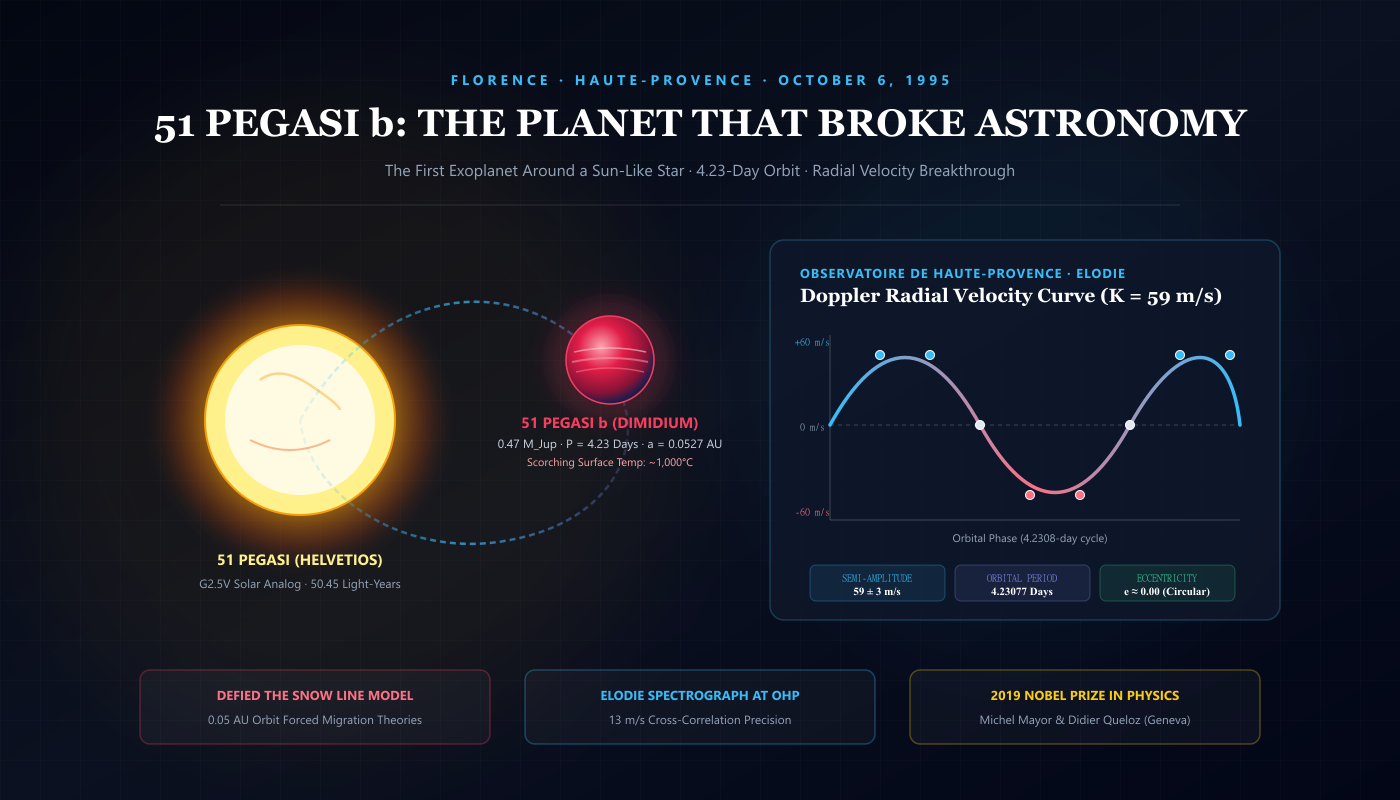
The Florence Bombshell: How a 4.2-Day Wobble Shocked the Stellar Astronomy Community
On the morning of Friday, October 6, 1995, several hundred astrophysicists packed into the auditorium of the Palazzo dei Congressi in Florence, Italy, for the final sessions of the Ninth Cambridge Workshop on Cool Stars, Stellar Systems, and the Sun. Most attendees anticipated routine discussions on stellar magnetic fields, chromospheric heating, and brown dwarf candidates. Instead, Swiss astronomer Michel Mayor of the Geneva Observatory took the rostrum and presented a result that instantly upended four centuries of observational astronomy: he and his 29-year-old doctoral student Didier Queloz had detected a Jupiter-mass companion orbiting the solar-type star 51 Pegasi, located fifty light-years away in the constellation Pegasus.
The auditorium fell into stunned disbelief not because an exoplanet had been found, but because of its absurd orbital period. The companion completed a full orbit around its parent star once every 4.2308 days. For decades, astronomers had searched for planetary companions modeled on our own solar system, expecting gas giants to orbit over cycles of twelve years (like Jupiter) or thirty years (like Saturn). A period of just four days implied that this gargantuan planet was skimming less than eight million kilometers (0.0527 astronomical units) above the star's nuclear furnace—seven times closer to its star than scorched Mercury is to our Sun.
Queloz had first spotted the sinusoidal radial velocity modulation eighteen months earlier in the spring of 1994, while analyzing calibration data from the newly commissioned ELODIE spectrograph at the Observatoire de Haute-Provence in southeastern France. Suspecting an instrumental defect or software glitch in his automated cross-correlation algorithms, Queloz remeasured the star repeatedly. When Mayor returned from a sabbatical in Hawaii, the two researchers spent months testing every conceivable alternative explanation—stellar surface oscillations, spots, non-radial pulsations, binary star contamination—before finally submitting their landmark manuscript to Nature in late August 1995. By the time Mayor delivered his Florence lecture, the secret had begun leaking through European astronomical circles, turning the October 6 presentation into an epochal turning point in modern science.
The Snow Line Paradigm: Why 51 Pegasi b Defied Planetary Formation Theory
To understand why 51 Pegasi b sent shockwaves through astrophysics, one must appreciate the ironclad orthodoxy of twentieth-century planetary formation theory. Developed from the core accretion paradigm of Viktor Safronov and George Wetherill, the standard nebular model dictated that giant planets could only form beyond the circumstellar 'snow line' (or frost line)—the boundary roughly 2.7 to 3.0 astronomical units from a young star where ambient temperatures drop below 150 Kelvin (-123°C), allowing volatile water ice to freeze out of the protoplanetary nebula.
According to this textbook model, only beyond the snow line could abundant solid ice grains agglomerate rapidly into a massive solid protoplanetary core of roughly ten Earth masses before the primordial gas disk dissipated. Once this threshold core was assembled, its runaway gravity would vacuum up surrounding hydrogen and helium gas to form a bloated giant like Jupiter. Inside the snow line, volatile gases and water were baked away by solar radiation; only refractory silicates and metals remained, producing small, rocky, terrestrial planets like Earth and Mars over tens of millions of years.
51 Pegasi b shredded this paradigm. With an estimated minimum mass of 0.47 Jupiter masses (roughly 150 Earth masses) baking at equilibrium temperatures exceeding 1,000°C (1,800°F), there was simply not enough solid matter inside 0.05 AU to have formed such a giant in situ. Theorists like Douglas Lin, Peter Bodenheimer, and Derek Richardson had to dust off long-marginalized hypotheses of orbital migration: a giant planet must assemble far out beyond the snow line, then spiral inward toward its host star over millions of years as gravitational torques and tidal friction with the viscous gas disk drain its orbital angular momentum. 51 Pegasi b thus created an entirely new taxonomic category—the 'hot Jupiter'—and forced humanity to confront the reality that our Solar System is far from the universal template of planetary architecture.
Doppler Precision and Skepticism: From Stellar Pulsations to Lick Observatory's Rush
The technological triumph behind the discovery was the ELODIE spectrograph, mounted on the 1.93-meter optical reflector at the Observatoire de Haute-Provence. Designed by André Baranne and built through a collaboration between the Geneva Observatory and Haute-Provence, ELODIE used dual optical fibers—one targeting the star and the second targeting a thorium-argon reference lamp—to project thousands of stellar absorption lines across a digital CCD detector. By applying numerical cross-correlation masks against a synthesized stellar spectrum, ELODIE compressed vast spectral datasets into a single velocity measurement with an unprecedented precision of 13 meters per second, a tenfold improvement over prior European instruments.
Despite ELODIE's precision, widespread skepticism greeted the Florence announcement. The stakes were monumental, and previous claimed exoplanet discoveries had collapsed under scrutiny. In 1991, British astronomer Andrew Lyne had announced a planet around pulsar PSR 1829-10 at an American Astronomical Society meeting, only to retract it months later when he realized his team had failed to account for Earth's orbital eccentricity. More seriously, prominent Canadian astronomer David Gray published a paper in Nature in early 1997 arguing that the 4.2-day velocity variations of 51 Pegasi were not caused by an orbiting planet at all, but by non-radial stellar surface pulsations or convective granulation cycles mimicking a Keplerian wobble.
The confirmation race fell to American astronomers Geoffrey Marcy and R. Paul Butler, who had spent eight grueling years monitoring solar-type stars using an iodine absorption cell at the University of California's Lick Observatory. Hearing rumors of Mayor's Florence announcement, Marcy and Butler immediately secured observing time on Lick's 3-meter Shane Telescope on Mount Hamilton. Over four consecutive nights in mid-October 1995, they took dozens of high-resolution spectra of 51 Pegasi, ran them through their custom Doppler analysis pipeline, and on October 12, 1995, confirmed the exact 4.23-day sinusoidal period and 59-meter-per-second velocity amplitude announced by the Swiss team. Subsequent high-resolution spectral line-bisector analyses systematically disproved Gray's pulsation hypothesis, leaving a planetary companion as the only physically viable explanation.
From Helvetios to 5,500 Worlds: The Enduring Legacy of the First Exoplanet
The validation of 51 Pegasi b triggered an unprecedented scientific gold rush. Armed with the knowledge that giant planets could inhabit scorching, tight orbits, Marcy and Butler reanalyzed their extensive Lick archives and within months detected 70 Virginis b (an eccentric giant) and 47 Ursae Majoris b (a Jupiter analog in a circular orbit). What had been a fringe discipline starved of telescope allocations transformed almost overnight into one of the most heavily funded frontiers of astrophysics.
Over the three decades that followed, detection methods diversified from ground-based radial velocity to spaceborne transit photometry. NASA's Kepler Space Telescope (launched in 2009) and Transiting Exoplanet Survey Satellite (TESS, launched in 2018) discovered that planets are ubiquitous throughout the Milky Way, statistically outnumbering the stars themselves. More remarkably, these surveys revealed that our galaxy is dominated by worlds absent from our own solar neighborhood: scorching lava planets, super-Earths, and gaseous mini-Neptunes. In 2015, during the International Astronomical Union's NameExoWorlds campaign, star 51 Pegasi was officially named Helvetios (in honor of the Swiss discoverers) and its planet designated Dimidium (Latin for 'half', referencing its mass of roughly half a Jupiter).
On October 8, 2019, the Royal Swedish Academy of Sciences awarded the Nobel Prize in Physics to Michel Mayor and Didier Queloz 'for the discovery of an exoplanet orbiting a solar-type star,' sharing the prize with cosmologist James Peebles. In its scientific citation, the Nobel Committee noted that Mayor and Queloz's 1995 discovery 'started a revolution in astronomy and our ideas about our place in the universe.' What began as an anomalous 4.2-day wobble on a modest French telescope on an autumn morning in 1995 has expanded into a catalog of more than 5,500 confirmed alien worlds, forever dismantling humanity's cosmic provincialism.
What the evidence does not settle
Popular accounts of 51 Pegasi b frequently conflate several distinct astronomical milestones: first, 51 Pegasi b was not the first extrasolar planet ever confirmed; in 1992, radio astronomers Aleksander Wolszczan and Dale Frail discovered planets orbiting pulsar PSR B1257+12, but those orbited a dead, rapidly spinning neutron star bathed in lethal radiation rather than a living, main-sequence Sun-like star. Second, 51 Pegasi b was not discovered by direct optical photography or imaging; it was inferred indirectly via the star's Doppler radial velocity wobble. Third, hot Jupiters were initially assumed to be the most common planets in the universe due to observational selection bias (massive planets in close orbits produce the strongest gravitational tugs and most frequent transits), whereas later Kepler statistics proved smaller sub-Neptunes and super-Earths are far more prevalent. Readers should note that biographical and optical book recommendations reflect published scientific literature rather than commercial endorsements.
PRODUCT IDEA 01
The Planet Factory: Exoplanets and the Search for a Second Earth — Elizabeth Tasker
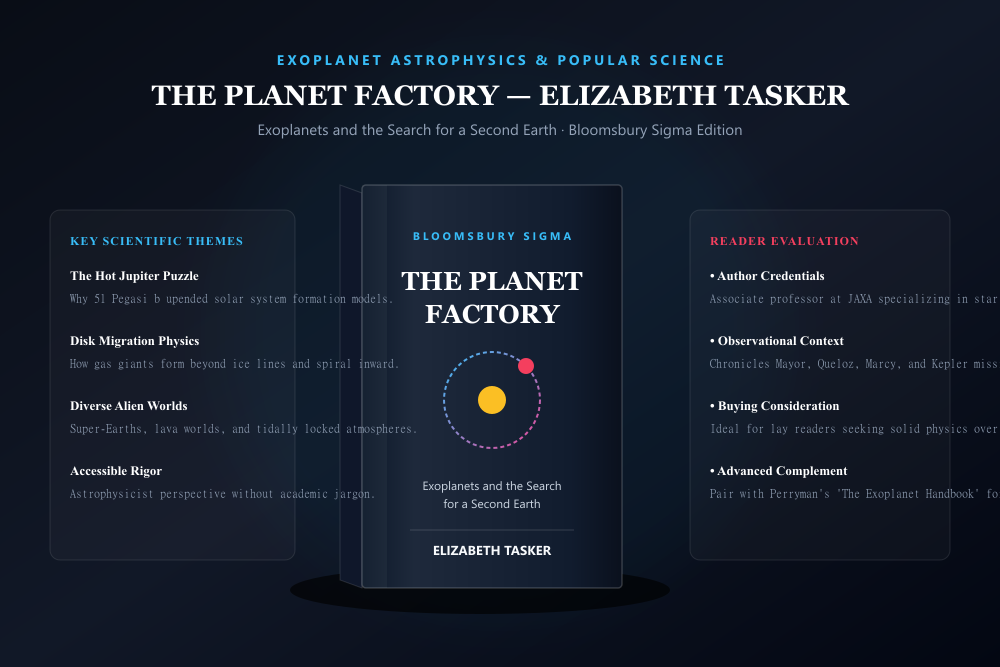
Elizabeth Tasker's 'The Planet Factory', published in Bloomsbury's popular science Sigma series, offers one of the most lucid, engaging, and scientifically rigorous explorations of exoplanetary physics available for general readers. An associate professor at the Japan Aerospace Exploration Agency (JAXA) who specializes in computational models of star and planet formation, Tasker demystifies how hot Jupiters like 51 Pegasi b shattered traditional nebular accretion theory and forced astrophysicists to embrace disk migration dynamics. Through vivid analogies grounded in thermodynamics and orbital mechanics, she chronicles the evolution of exoplanet detection from early radial velocity wobbles to Kepler transit light curves and atmospheric spectroscopy. Unlike sensationalist works that treat every rocky discovery as an immediate twin Earth, Tasker maintains honest scientific skepticism about habitability, detailing the complex atmospheric chemistry, tidal locking, and stellar flare hazards that make alien planets so radically different from our home world.
Buying limit: Readers seeking purely mathematical derivations or formal university astrophysics problem sets should note this book is written for engaged popular science readers rather than graduate students. For readers who require rigorous equations and formal orbital perturbation mathematics, Michael Perryman's textbook 'The Exoplanet Handbook' serves as the ideal technical companion.
Original editorial illustration, not a retailer photograph. No exact Amazon offer passed our verification gate.PRODUCT IDEA 02
Compact Parabolic Tabletop Reflector Telescope System (76mm–100mm)
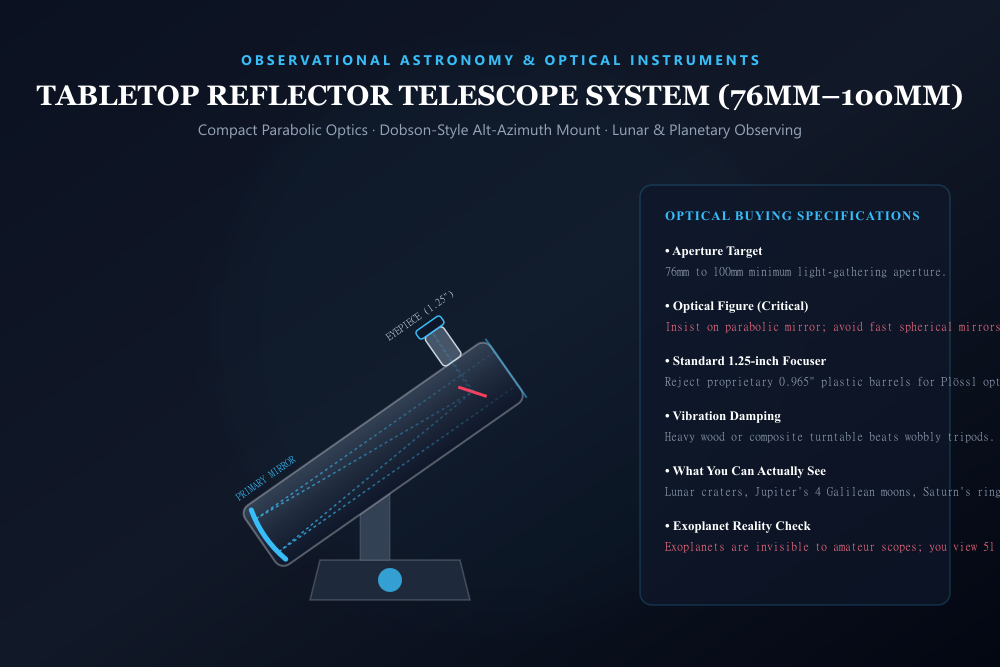
While detecting exoplanetary radial velocity wobbles requires multi-million-dollar echelle spectrographs, amateur stargazers can directly observe the bright host stars that anchor these historic discoveries—including 51 Pegasi itself, shining at magnitude 5.49 in the autumn northern sky. A compact tabletop Newtonian reflector telescope with an aperture between 76mm and 100mm provides an ideal, friction-free gateway into observational astronomy. Mounted on a smooth, weighted wooden Dobson-style alt-azimuth swivel base, these tabletop instruments eliminate the flimsy aluminum tripod legs and complicated equatorial counterweights that cause chronic vibration and frustration in cheap beginner kits. With a fast focal ratio and standard 1.25-inch focuser accommodating quality Plössl eyepieces, a tabletop reflector yields crisp, wide-field views of the lunar crater terminator, Jupiter's equatorial cloud belts and four Galilean moons, Saturn's rings, and open star clusters.
Buying limit: Avoid entry-level reflector telescopes that cut manufacturing costs with spherical primary mirrors at short focal lengths, which produce severe spherical aberration and blurry planetary images; insist on an optical assembly with a genuine paraboloidal primary mirror. Reject models with proprietary 0.965-inch plastic focusers, and remember an exoplanet itself cannot be visually seen through amateur optics—the telescope allows observing host star 51 Pegasi and our Solar System's gas giants.
Original editorial illustration, not a retailer photograph. No exact Amazon offer passed our verification gate.SOURCES, METHOD, AND LIMITS
Researched using the original November 1995 Nature discovery paper by Michel Mayor and Didier Queloz ('A Jupiter-mass companion to a solar-type star', Nature 378, 355–359), the Royal Swedish Academy of Sciences 2019 Nobel Prize in Physics Scientific Background dossier on the discovery of an exoplanet, and archival conference records from the Ninth Cambridge Workshop on Cool Stars, Stellar Systems, and the Sun (Florence, October 1995). Historical confirmation chronology and Doppler spectroscopy metrics were cross-referenced against Lick Observatory observing logs (Marcy & Butler, Astrophysical Journal Letters 1996) and the NASA Exoplanet Science Institute archive at Caltech. No commercial optical instruments or consumer hardware were physically tested.
- Nature — 'A Jupiter-mass companion to a solar-type star' (Mayor & Queloz, 1995) — Original peer-reviewed discovery paper published in Nature on November 23, 1995, documenting the 4.23-day radial velocity orbital modulation of 51 Pegasi.
- The Nobel Prize in Physics 2019 — Scientific Background on the Discovery of an Exoplanet — Official Nobel Committee scientific background detailing Michel Mayor and Didier Queloz's Doppler spectroscopy methodology with the ELODIE spectrograph at OHP.
- NASA Exoplanet Archive — 51 Pegasi b Planet Overview and Parameters — NASA/Caltech exoplanetary database recording verified astrophysical parameters, orbital semi-major axis (0.0527 AU), minimum mass, and discovery instrumentation.