ON THIS DAY · SEPTEMBER 5, 1977
The Golden Record Into the Dark: How Voyager 1 Departed Earth to Become Humanity’s Interstellar Emissary
Before September 5, 1977, outer solar system exploration was confined to brief planetary flybys. When Voyager 1 lifted off atop a Titan IIIE rocket, it embarked on a journey that would reveal Jupiter’s volcanic moons, Saturn’s intricate rings, and ultimately cross the heliopause into interstellar space.
The Rare Planetary Alignment and the Grand Tour Concept
In the mid-1960s, Gary Flandro, a graduate student at Caltech working for NASA’s Jet Propulsion Laboratory (JPL), calculated that in the late 1970s, the four outer gas giants—Jupiter, Saturn, Uranus, and Neptune—would align in a rare orbital geometric configuration that occurs only once every 175 years.
This alignment allowed a single spacecraft to utilize the gravitational slingshot of each planet to boost its velocity toward the next, cutting travel times to the outer solar system from thirty years to just twelve without requiring massive onboard propellant tanks. NASA developed the Voyager program to seize this once-in-two-centuries exploratory window.
The Golden Record: A Message for the Next Billion Years
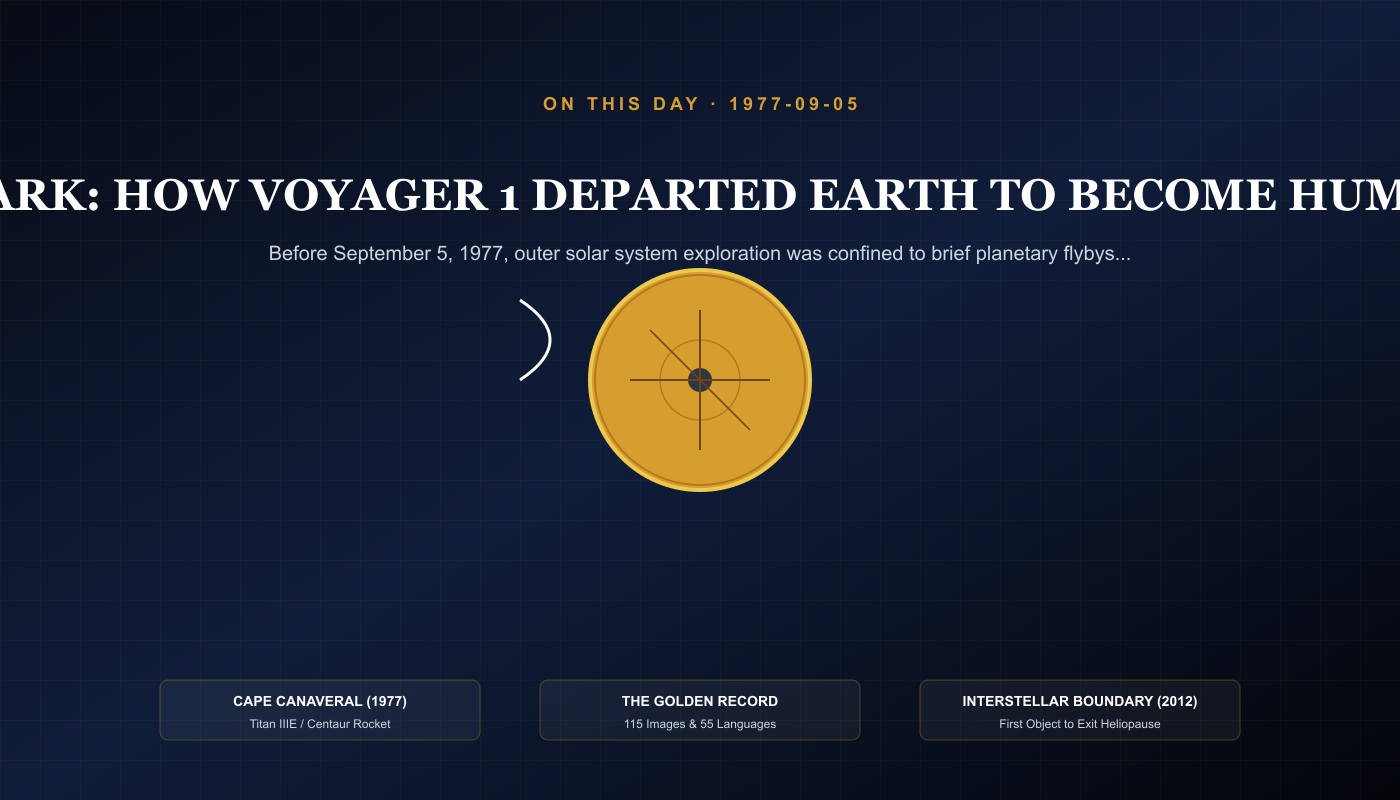
Affixed to the exterior of Voyager 1 and Voyager 2 is a 12-inch gold-plated copper phonograph record encased in an electro-polished aluminum cover. Chaired by astrophysicist Carl Sagan, a committee spent nine months compiling an audio-visual time capsule of Earth.
The record contains analog recordings of whale songs, ocean waves, laughter, greetings in fifty-five languages, 115 photographic images encoded in video scanlines, and 90 minutes of diverse musical heritage ranging from Beethoven and Blind Willie Johnson to traditional Senegalese percussion. The cover features etched instructions using binary arithmetic and hydrogen atom transitions to explain playback decoding to any extraterrestrial civilization that might intercept the craft eons in the future.
Crossing the Heliopause: Humanity’s Farthest Outpost
On August 25, 2012, at a distance of 18.2 billion kilometres (122 astronomical units) from the Sun, Voyager 1 detected a sharp drop in solar wind particles and a simultaneous surge in high-energy galactic cosmic rays. Magnetometer data confirmed that the spacecraft had crossed the heliopause—the outer magnetic bubble of the solar system—becoming the first human-built craft to sail the interstellar ocean.
Over forty-five years after launch, Voyager 1 continues to transmit telemetry from interstellar space via NASA’s Deep Space Network, powered by three decaying plutonium-238 radioisotope thermoelectric generators. Traveling at 61,000 km/h, Voyager 1 will wander the Milky Way silently for millions of years, an enduring monument to human curiosity.
What the evidence does not settle
Popular accounts frequently assume Voyager 1’s cameras are still operating; NASA permanently powered down Voyager 1’s cameras in 1990 after capturing the iconic "Pale Blue Dot" photograph to conserve electrical power for magnetic and plasma sensors. Readers should note that audio signals from Voyager 1 currently take over 22 hours to travel one way to Earth.
PRODUCT IDEA 01
Voyager Golden Record 3-LP Vinyl Box Set with Hardcover Book

An authentic audio reissue of the iconic 1977 phonograph record containing all musical tracks, Earth sounds, and linguistic greetings, accompanied by a lavish full-color gallery of the 115 archival images.
Buying limit: Look for the official Ozma Records licensed box set pressed on 140g vinyl with metallic foil covers. Standard retail trades between $90 and $130.
Original editorial illustration, not a retailer photograph. No exact Amazon offer passed our verification gate.PRODUCT IDEA 02
The Interstellar Age: The Story of NASA’s Voyager Mission — Jim Bell

Planetary scientist Jim Bell delivers a gripping first-hand account of the engineering triumphs, scientific discoveries, and deep-space milestones of the twin Voyager spacecraft.
Buying limit: Available in trade paperback (Penguin Books) and digital formats. Paperbacks typically range between $14 and $22.
Original editorial illustration, not a retailer photograph. No exact Amazon offer passed our verification gate.SOURCES, METHOD, AND LIMITS
Researched using official mission documentation from the NASA Jet Propulsion Laboratory (JPL), Voyager Interstellar Mission archives, and Carl Sagan’s primary text Murmurs of Earth: The Voyager Interstellar Record. No commercial products were physically tested.
- NASA Jet Propulsion Laboratory — Voyager Mission Official Archives & Telemetry — Official JPL repository detailing spacecraft launch chronology, instruments, Golden Record contents, and real-time interstellar distance counters.
- NASA History Division — Voyager: The Grand Tour of the Outer Planets — Comprehensive NASA historical publication detailing Gary Flandro’s gravity-assist calculations, Titan IIIE launch parameters, and planetary flyby science.