ON THIS DAY · SEPTEMBER 1, 1979
Touching the Rings of Saturn: How Pioneer 11 Survived the Asteroid Belt and Revealed the F-Ring
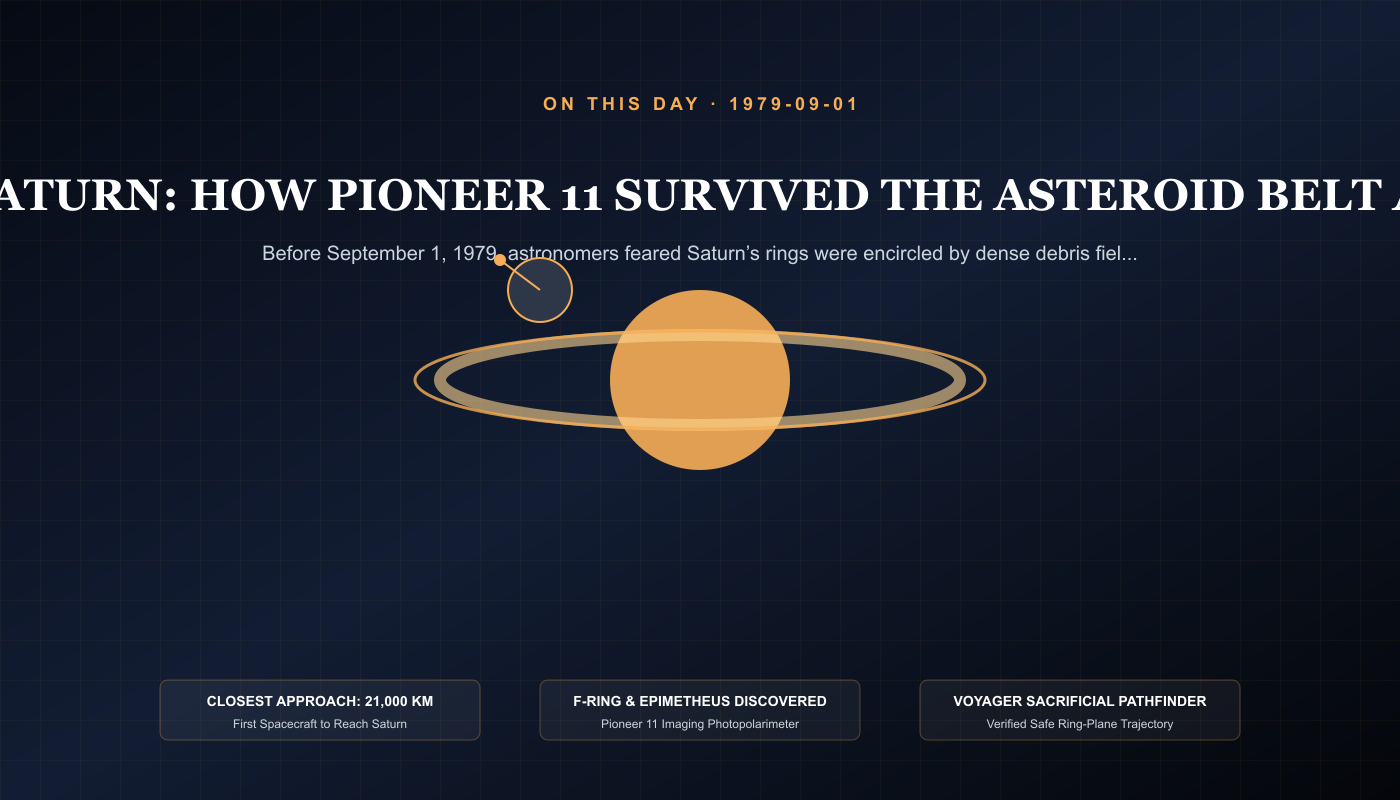
Before September 1, 1979, astronomers feared Saturn’s rings were encircled by dense debris fields that would pulverize visiting probes. NASA risked Pioneer 11 on a daring ring-plane crossing, discovering Saturn’s narrow F-ring, a new moon, and proving that humanity could safely navigate the outer solar system.
The Sacrificial Pathfinder: Why NASA Risked Pioneer 11
In late August 1979, flight controllers at NASA Ames Research Center in Mountain View, California, faced a high-stakes strategic choice. Pioneer 11, launched six years earlier in April 1973, had completed a successful flyby of Jupiter in 1974. Slingshotted across the solar system toward Saturn, the 259-kilogram probe was approaching a destination never before observed by human instruments at close range.
At the time, NASA was preparing Voyager 1 and Voyager 2 for their flagship outer planet flybys. Leading astronomers warned that Saturn’s rings might be encircled by an invisible, lethal halo of icy boulders capable of annihilating any approaching probe. NASA made the deliberate decision to send Pioneer 11 through the exact ring-plane crossing corridor planned for Voyager, using Pioneer as a sacrificial scout to protect the multi-billion-dollar Voyager mission.
Discovering the F-Ring and Mapping Saturn’s Magnetosphere
On September 1, 1979, Pioneer 11 plunged through Saturn’s ring plane at 31 kilometres per second, passing within 20,900 kilometres of the upper cloud deck. Telemetry indicated only minor dust impacts, confirming that the outer ring gaps were safely navigable. Using its Imaging Photopolarimeter, Pioneer 11 transmitted 440-line scans, generating humanity’s first close-range color images of Saturn’s golden atmosphere.
The mission yielded foundational discoveries: Pioneer 11 discovered Saturn’s outermost F-ring—a narrow, braided band of ice particles maintained by shepherd moons. It detected moon Epimetheus, measured Saturn’s core temperature at minus 180°C, and confirmed that Saturn generated a dipole magnetic field 540 times stronger than Earth’s, aligned precisely with its rotational axis.
Titan’s Frigid Secrets and the Interstellar Trajectory
On September 2, Pioneer 11 passed within 356,000 kilometres of Saturn’s giant moon Titan. Photopolarimeter data revealed Titan to be blanketed in an opaque, orange hydrocarbon smog. Mass and temperature readings confirmed a dense, nitrogen-rich atmosphere with surface pressures 50% greater than Earth’s, establishing Titan as a premier prebiotic laboratory in the solar system.
Following the encounter, Pioneer 11 entered an escape trajectory toward interstellar space. In 1995, after twenty-two years of continuous scientific operations, NASA terminated contact as the spacecraft’s radioisotope thermoelectric generators depleted. Today, Pioneer 11 coasts toward the constellation Aquila, carrying Carl Sagan and Frank Drake’s gold-anodized Pioneer Plaque into deep space.
What the evidence does not settle
Popular accounts frequently attribute Saturn ring discoveries entirely to Voyager, overlooking Pioneer 11’s vital role as the pathfinder probe. Readers should note that Pioneer 11 used spin-scan photopolarimetry rather than framing vidicon cameras, producing lower-resolution images than later missions.
PRODUCT IDEA 01
Planetary Science & Outer Solar System Astronomy Reference Atlas

An authoritative planetary atlas providing detailed photographic plates, magnetic field mappings, and orbital mechanics comparisons of Saturn, Jupiter, and their moons captured by Pioneer, Voyager, and Cassini.
Buying limit: Look for comprehensive editions with full-color topographic maps and mission chronologies. High-quality hardcovers typically retail between $25 and $50.
Original editorial illustration, not a retailer photograph. No exact Amazon offer passed our verification gate.PRODUCT IDEA 02
Illuminated 3D Saturn Ring Ambient Night Lamp with Wooden Base

A scale-accurate, LED-illuminated desktop model of Saturn featuring layered planetary rings and warm dimmable illumination brings the wonder of outer solar system exploration to workstations.
Buying limit: Opt for USB-rechargeable models with dimmable touch controls and authentic optical ring diffusion. Quality accent lamps range from $20 to $40.
Original editorial illustration, not a retailer photograph. No exact Amazon offer passed our verification gate.SOURCES, METHOD, AND LIMITS
Researched using primary NASA mission reports (NASA SP-446 Pioneer Saturn Mission Monograph) and NASA NSSDC Master Catalog records (ID 1973-019A). Trajectories and magnetometer telemetry were cross-checked with Ames Research Center archives. No commercial products were physically tested.
- NASA History Division — SP-446: Pioneer Saturn Official Mission Summary — Official NASA Ames historical monograph documenting Pioneer 11 spacecraft engineering, Saturn encounter trajectory, F-ring discovery, and instrumentation telemetry.
- NASA Space Science Data Coordinated Archive — Pioneer 11 Master Catalog (ID 1973-019A) — Official catalog registry of Pioneer 11 launch mass, RTG power systems, flyby distances, and deep-space mission chronology.