ON THIS DAY · OCTOBER 1, 1908
The Car That Put the World on Wheels: How Henry Ford's Model T and Moving Assembly Line Democratized Modern Transport
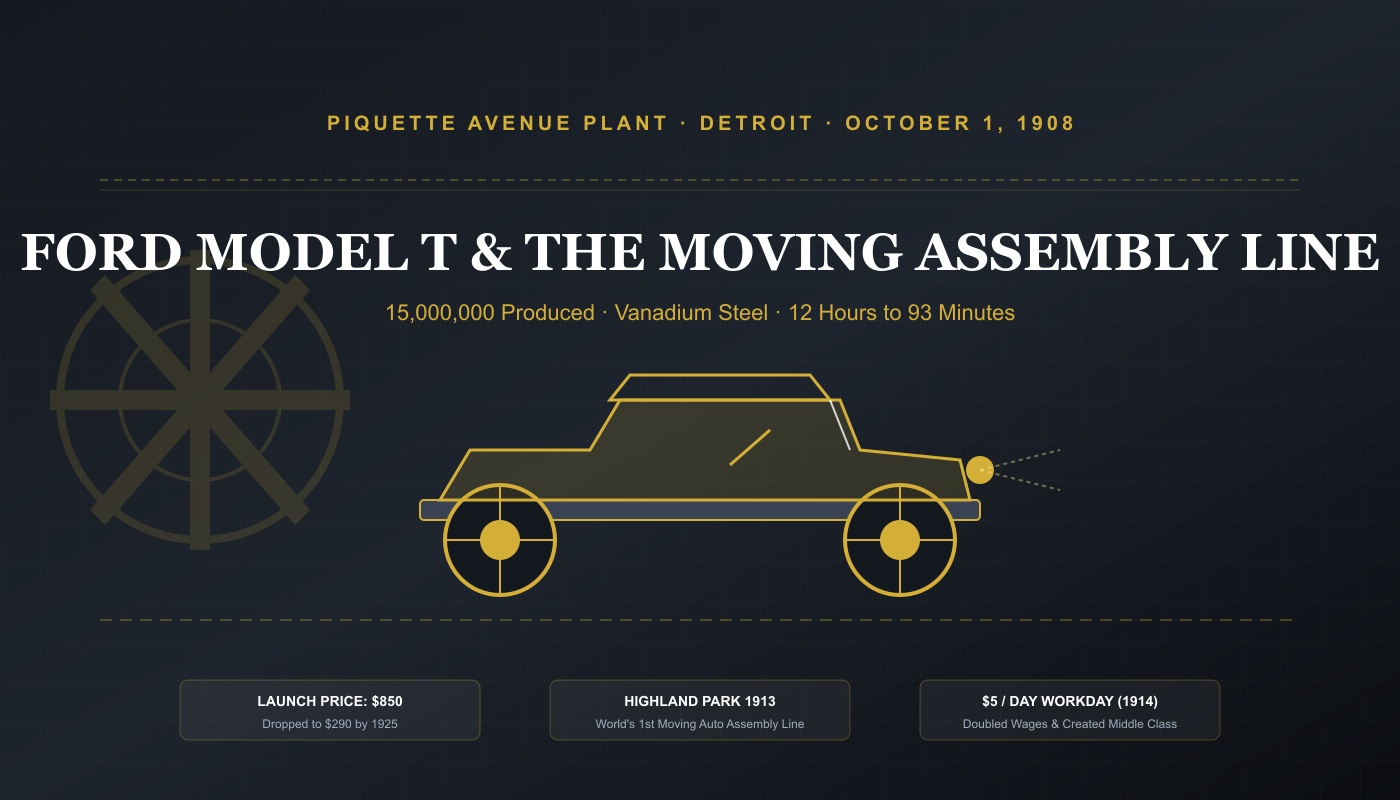
Before October 1, 1908, automobiles were bespoke luxury toys reserved for the wealthy elite. By engineering a rugged, standardized vehicle and perfecting the moving assembly line, Henry Ford transformed personal transportation, reduced build times from 12 hours to 93 minutes, and created the modern industrial middle class.
From Bespoke Craftsmanship to Vanadium Steel Standardization
In the first decade of the twentieth century, the automobile industry was an artisan guild. Cars were hand-assembled by teams of skilled machinists who fitted cast-iron engine blocks, hand-hammered wooden body panels, and custom-filed brass linkages onto stationary sawhorses. Because tolerances varied between individual mechanics, replacement parts rarely fit without extensive filing, and reliability was poor. Consequently, motorcars were priced as ostentatious luxury goods for urban aristocrats, costing several years of an average worker's annual wage.
Henry Ford, together with chief engineer Childe Harold Wills and draftsman Joseph Galamb, envisioned a fundamentally different machine: a 'universal car' rugged enough for unpaved American farm roads, simple enough for rural owners to repair with basic farm tools, and cheap enough for ordinary wage earners to afford. The critical metallurgical breakthrough occurred in 1905, when Ford examined the wreckage of a French racing car in Palm Beach, Florida, and noticed its lightweight valve stems were forged from a proprietary French vanadium steel alloy. Vanadium steel exhibited a tensile strength nearly three times greater than standard American carbon steels while remaining significantly lighter and more resilient to road vibration.
Ford invested heavily in specialized metallurgy at the Piquette Avenue Plant in Detroit, securing the American rights and establishing domestic foundries capable of casting vanadium steel for crankshafts, axles, and steering knuckles. When the first commercial Model T rolled out of Piquette Avenue on October 1, 1908, it weighed only 1,200 pounds yet offered unprecedented structural resilience. Powered by a flexible 20-horsepower, 177-cubic-inch four-cylinder engine with an enclosed monobloc casting and a removable cylinder head, the Model T tackled rutted mud tracks that had disabled heavier, more fragile luxury vehicles.
Highland Park and the 93-Minute Moving Assembly Line
Demand for the Model T overwhelmed Ford's Piquette Avenue capacity within months of its launch. To satisfy orders, Ford purchased a 60-acre tract in Highland Park, Michigan, commissioning architect Albert Kahn to design a state-of-the-art multi-story industrial complex with vast glass windows and modular floorplans. At Highland Park, production engineers Clarence Avery, Charles Sorensen, and C.W. Wills drew inspiration from Chicago meatpacking disassembly lines, grain elevator conveyor belts, and industrial canning operations to reimagine automotive assembly.
Rather than moving workers around stationary vehicle chassis, Ford engineers anchored the chassis to an endless chain-driven conveyor system pulled along the factory floor at a continuous speed of six feet per minute. Components were delivered to workers at waist height via overhead gravity chutes and motorized feeder lines. Sub-assemblies—such as magnetos, carburetors, and front axles—were broken down into precise, micro-timed sequential operations, each requiring only one or two repetitive actions per worker.
The quantitative impact of the moving assembly line, fully implemented between April and October 1913, revolutionized global manufacturing economics. The labor time required to assemble a single Model T chassis plummeted from 12 hours and 8 minutes (728 minutes) under stationary assembly to just 93 minutes on the moving line. This tenfold surge in labor productivity allowed Ford to aggressively cut consumer prices: from an initial $850 in 1908, the Model T's price fell to $550 in 1914, $440 in 1915, and eventually dropped to a historic low of $260 in 1925 for a runabout—bringing car ownership within reach of everyday factory workers.
Debunking the 'Any Color as Long as It Is Black' Myth and the $5 Day
One of the most persistent folklore myths in industrial history is Henry Ford's famous quote: 'Any customer can have a car painted any color that he wants so long as it is black.' While Ford did write this quip in his 1922 autobiography My Life and Work, historical production ledgers from the Benson Ford Research Center reveal that it applied only during a specific middle period of Model T production. From its debut in October 1908 through 1913, the Model T was not available in black at all; buyers chose from Brewster green, carmine red, dark royal blue, and French gray.
Black was adopted as the exclusive body color in 1914 solely because of chemical drying kinetics. The extreme speed of the Highland Park moving line created a severe bottleneck in the paint shop: traditional oil-based varnishes required up to two weeks to air-dry between coats. Asphaltum-based 'Japan Black' baking enamel was the only pigment that could be baked dry in industrial ovens in under an hour. When fast-drying Duco pyroxylin synthetic lacquers were developed in 1926, Ford immediately reintroduced an array of vibrant colors, including fawn gray, royal blue, and phoenix brown.
Simultaneously, the relentless pace of the assembly line generated severe workforce friction. In 1913, Ford's annual labor turnover exceeded 370%, forcing the company to hire 52,000 workers just to maintain a 14,000-man payroll. On January 5, 1914, Henry Ford and James Couzens announced the revolutionary '$5 Workday'—more than doubling the prevailing industrial wage of $2.34 per day while shortening the work shift from nine hours to eight. This bold labor policy curtailed absenteeism, turned assembly workers into consumer customers who could afford the products they built, and laid the foundation for the 20th-century American middle-class economy.
The Global Legacy: Infrastructure, Mobility, and Modern Industry
By the time the final Model T—chassis number 15,007,033—rolled off the line on May 26, 1927, the vehicle had irrevocably transformed the geographical and social landscape of the planet. In the United States, the explosion of Model T ownership catalyzed the passage of the Federal Aid Road Act of 1916 and the Federal Highway Act of 1921, compelling federal and state governments to pave hundreds of thousands of miles of rural roads and establishing national route networks like U.S. Route 66.
The ubiquity of affordable automobiles broke the isolation of rural agricultural communities, fostered suburban residential development, and gave rise to new consumer industries, from roadside motels and drive-in diners to gas stations and national tourism. Worldwide assembly plants in Manchester (England), Geelong (Australia), Buenos Aires (Argentina), and Berlin (Germany) exported Ford's mass-production methodology across the globe.
Beyond automotive engineering, 'Fordism' became the defining paradigm of 20th-century manufacturing, demonstrating that high wages, standardized components, continuous mechanized workflow, and aggressive price deflation could simultaneously generate immense corporate profitability and widespread social mobility. The Model T remains one of the few technological artifacts that fundamentally reordered how humanity lives, works, and travels.
What the evidence does not settle
Popular accounts frequently repeat two key misconceptions: first, that Henry Ford invented the automobile or the assembly line (Karl Benz patented the modern motorcar in 1886, and Ransom E. Olds patented the stationary automotive assembly line in 1901; Ford’s innovation was the moving continuous conveyor); second, that all Model Ts were painted black, when in fact black was not even offered between 1908 and 1913. Readers should note that collector scale models represent historical replicas rather than functional machinery, and historical book selections are curated for scholarly rigor without commercial endorsement.
PRODUCT IDEA 01
1:24 or 1:18 Scale Die-Cast 1908–1914 Ford Model T Touring Car Collector Replica

For automotive history enthusiasts, an authentic die-cast scale model of the early brass-era Model T captures the tactile engineering details that defined early motoring. High-quality 1:24 and 1:18 scale replicas from reputable manufacturers like Sun Star, Motor City Classics, and Danbury Mint showcase the exposed vanadium steel leaf springs, authentic wood-spoke artillery wheels, brass kerosene sidelamps, planetary transmission foot pedals, and opening dual-hinged hood revealing the detailed 20-hp four-cylinder engine block. Displaying a physical scale model offers an engaging visual perspective on how minimalist and utilitarian early motorcar architecture was compared to modern automobiles.
Buying limit: When selecting a Model T scale model, verify whether it represents the early 'Brass Era' (1908–1914 with brass radiator shell and carriage lamps) or the later mass-produced steel-shell variants (1915–1927). Premium die-cast editions featuring opening doors, working steering linkages, and genuine rubber tires typically range between $35 and $90 depending on scale and manufacturer. No specific Amazon ASIN was verified available with confirmed U.S. delivery on the date this article was written, so search by scale and manufacturer name before ordering.
Original editorial illustration, not a retailer photograph. No exact Amazon offer passed our verification gate.PRODUCT IDEA 02
Wheels for the World: Henry Ford, His Company, and a Century of Progress — Douglas Brinkley

Historian Douglas Brinkley's Wheels for the World is widely acclaimed as the definitive, unvarnished history of the Ford Motor Company and the birth of mass production. Drawing on unprecedented access to the vast Benson Ford Research Center archives, oral histories from assembly line pioneers, and private correspondence, Brinkley delivers a comprehensive 800-page narrative that explores the brilliant engineering breakthroughs of Childe Harold Wills, the grueling human realities of the moving assembly line, the socio-economic impacts of the $5 workday, and Henry Ford's complex, contradictory personality. It is essential reading for anyone seeking to understand how industrial automation created the modern consumer landscape.
Buying limit: Available in hardcover (Penguin Books, ISBN 978-0670031818), trade paperback (ISBN 978-0142004395), and digital e-book editions. When purchasing online or through used book specialists, look for copies in clean, unmarked condition with the comprehensive index and archival photographic plate sections intact. Trade paperback copies typically sell between $16 and $24. No specific Amazon ASIN was verified available with confirmed U.S. delivery on the date this article was written, so search by title and author before ordering.
Original editorial illustration, not a retailer photograph. No exact Amazon offer passed our verification gate.SOURCES, METHOD, AND LIMITS
This historical analysis was researched using primary archival materials from the Benson Ford Research Center and The Henry Ford Museum (including original Model T production records and Highland Park engineering logs), United States Department of Transportation historical monographs on early highway development, and the Library of Congress Historic American Engineering Record (HAER MI-1). Manufacturing timelines, vanadium metallurgy, and labor turnover statistics were cross-referenced with Douglas Brinkley’s 'Wheels for the World: Henry Ford, His Company, and a Century of Progress'. No commercial products were physically tested.
- The Henry Ford Museum & Benson Ford Research Center — Model T Primary Historical Collection — Official museum repository documenting original Model T production ledgers, Piquette Avenue blueprints, Highland Park moving line photographs, and Henry Ford's private papers.
- Library of Congress — Historic American Engineering Record: Ford Highland Park Plant (HAER MI-1) — Federal architectural and engineering documentation detailing Albert Kahn's factory design, the layout of the 1913 moving conveyor system, and industrial workflows.
- Smithsonian National Museum of American History — America on the Move: 1913 Ford Model T Touring Car — Curatorial analysis of early automotive mass production, consumer adoption, road infrastructure changes, and technological specifications of the 1913 Model T.