ON THIS DAY · OCTOBER 16, 1846
Gentlemen, This Is No Humbug: The 1846 Boston Ether Demonstration That Banished Surgical Pain
Before October 16, 1846, surgical speed was the only painkiller and operations were horrifying endurance ordeals. At Massachusetts General Hospital's Ether Dome, a Boston dentist and a skeptical chief surgeon successfully administered vaporized diethyl ether to Edward Abbott—banishing surgical agony and proving to a stunned medical world that painless healing was truly possible.
The Stopwatch Era: When Surgeons Were Judged by Seconds of Screaming
To comprehend the magnitude of what transpired on Friday morning, October 16, 1846, one must first confront the terrifying reality of early nineteenth-century surgery. For millennia, surgical intervention was an option of absolute last resort, regarded by patients and practitioners alike as an excruciating trial of physical endurance bordering on torture. Without effective anesthesia, the primary qualification of a master surgeon was not delicate anatomical precision, but ruthless, blistering speed. Renowned London surgeon Robert Liston famously challenged spectators in his operating pit to 'time me, gentlemen,' amputating adult limbs at the thigh in under thirty seconds while burly medical orderlies physically pinned thrashing patients to blood-soaked wooden tables.
Under such barbaric physiological conditions, human pain was not merely a subjective unpleasantness; it was a lethal clinical pathology. Patients routinely perished on the table from neurogenic shock, sudden cardiovascular collapse, and respiratory arrest triggered by sheer, unmitigated agony. Many preferred suicide or agonizing slow death from compound fractures and gangrene over submitting to the knife. Surgeons hardened their emotions against the horrifying screams that echoed through hospital corridors, operating under constant time pressure that made intricate exploratory procedures, internal organ repairs, or delicate tumor excisions near impossible.
Morton's Inhaler and the Bulfinch Amphitheater Assembly
Inside the newly erected surgical amphitheater atop the Bulfinch Building at Massachusetts General Hospital—situated beneath a high glass skylight specifically designed to capture Boston's morning sun and muffle surgical cries from the wards below—a skeptical audience of Harvard medical students, prominent Boston physicians, and curious spectators gathered. They had been summoned by Dr. John Collins Warren, the sixty-eight-year-old dean of New England surgery and co-founder of the hospital. Warren was placing his towering professional reputation on the line to host William Thomas Green Morton, a twenty-seven-year-old Boston dentist who boldly claimed he had synthesized a gaseous chemical compound capable of producing total, reversible insensibility to pain.
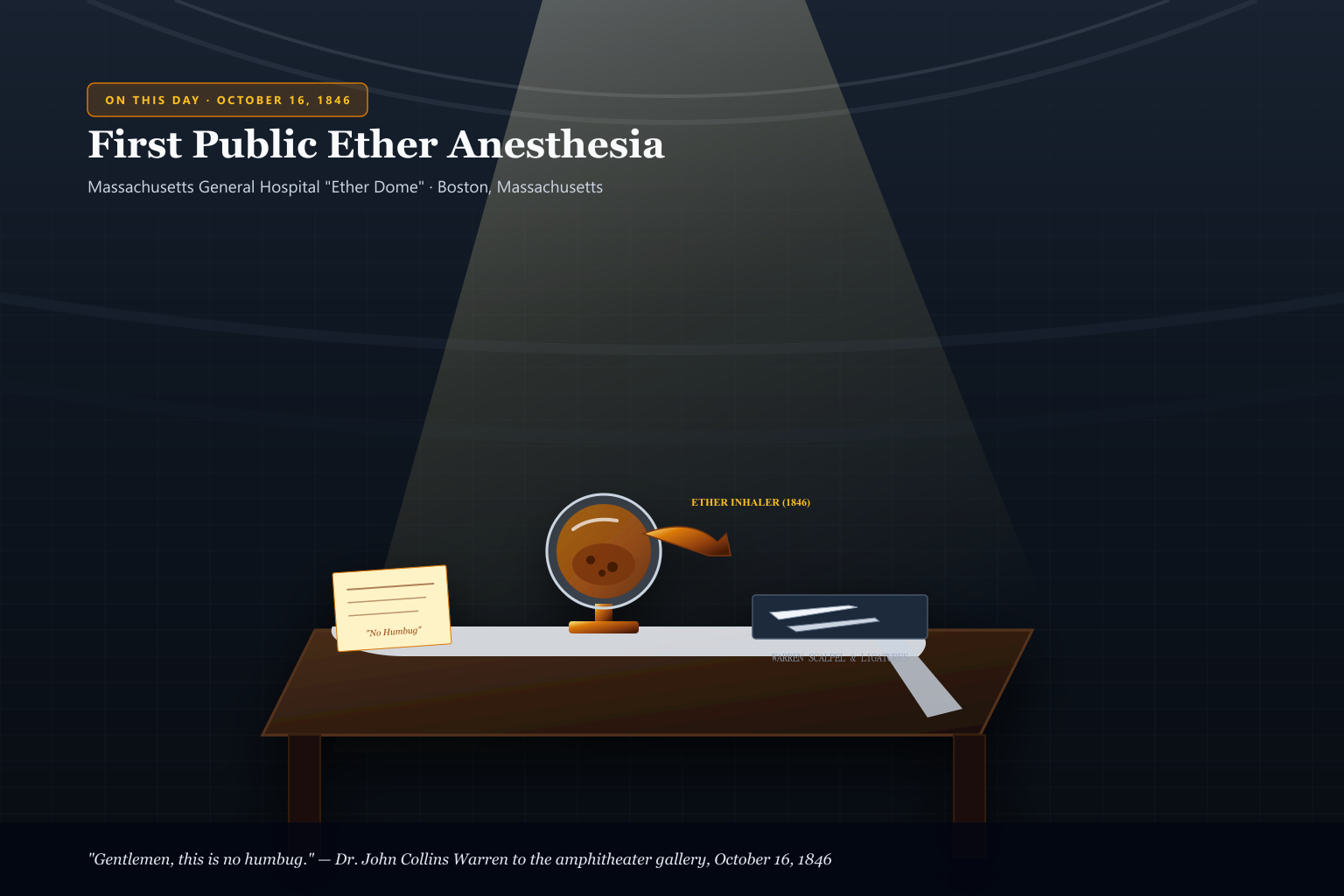
Skepticism in the amphitheater was palpable. Less than two years earlier, Morton's former dental partner, Horace Wells, had attempted a public demonstration of nitrous oxide ('laughing gas') in the very same room; the patient had cried out during a tooth extraction, prompting the students to hiss Wells out of the building with derisive shouts of 'Humbug!'. Morton arrived twenty-five minutes late, clutching a strange, newly crafted apparatus: a blown-glass globular reservoir fitted with brass intake valves, a wooden mouthpiece, and an internal natural sea sponge saturated with highly purified, rectified sulfuric ether (diethyl ether). Morton had spent the morning working with local instrument maker Joseph Burnett to perfect the inhaler's one-way breathing valves so the patient would inhale concentrated ether vapor without suffocating on their own exhaled carbon dioxide.
'Gentlemen, This Is No Humbug': The Demonstration That Changed History
The patient, a twenty-year-old local printer named Edward Gilbert Abbott, was seated in the red plush operating chair suffering from a congenital vascular tumor (venous malformation) beneath his left lower jaw. Facing the assembled gallery, Morton placed the wooden mouthpiece between Abbott's lips and instructed him to breathe deeply. For four to five minutes, Abbott inhaled the sweet, pungent vapors of diethyl ether. As the volatile hydrocarbon diffused across Abbott's alveolar membranes and crossed the blood-brain barrier to depress the central nervous system, his eyelids grew heavy, his limbs relaxed, and his breathing settled into a rhythmic, deep snoring slumber.
Morton stepped back and quietly bowed to the veteran surgeon: 'Your patient is ready, Doctor.' Dr. Warren picked up his two-edged scalpel and made a bold, three-inch incision through the skin of Abbott's neck, dissecting down to the tumor and ligating the feeding vessels. Throughout the entire surgical intervention, Abbott remained completely motionless. There were no bloodcurdling shrieks, no flailing limbs, no contorted spasms of agony. As Dr. Warren tied off the final sutures and Abbott began to stir, Warren gently asked if he had suffered. Abbott replied softly that he had felt no pain whatsoever—only a sensation as if his neck had been lightly scratched with a blunt hoe. Warren turned pale, looked upward at the stunned, pin-drop silent gallery, and uttered the immortal words that echoed across the history of healing: 'Gentlemen, this is no humbug.'
From Brutal Trauma to Deliberate Science: The Rebirth of Surgery
Word of the Boston demonstration spread across the Atlantic with unprecedented velocity. Within two months, surgeons in London, Paris, and Edinburgh were successfully administering ether. Dr. Oliver Wendell Holmes Sr. coined the Greek-derived terms 'anesthesia' (insensibility) and 'anesthetic' to describe the miraculous phenomenon. Almost overnight, the entire architectural paradigm of surgical medicine was revolutionized. The stopwatch was permanently retired. Freed from the desperate imperative of seconds, surgeons could afford to be deliberate, meticulous, and anatomical. They could take hours to trace nerve pathways, reconstruct damaged tissues, and clamp individual blood vessels, paving the way for abdominal surgery, cardiac repair, and modern neurosurgery.
Yet the human story following October 16 was marked by tragic discord. Morton sought to patent the chemical under the proprietary moniker 'Letheon' to secure his fortune, sparking a bitter, multi-decade legal war between himself, chemist Charles T. Jackson (who had suggested ether to Morton), and Georgia physician Crawford Long (who had quietly used ether in rural surgery in 1842 without publishing his results). Wells died by suicide in 1848, Morton died impoverished of a stroke in Central Park in 1868, and Jackson spent his final years in an asylum. Yet despite the human rivalries of its discoverers, the gift delivered to humankind inside the Ether Dome remains absolute: October 16, 1846 marks the exact morning that physical pain was stripped of its ancient dominion over the human body.
What the evidence does not settle
Popular accounts often present William Morton as a solitary, saintly savior, overlooking the bitter 'ether controversy' between Morton, Horace Wells (nitrous oxide pioneer), and chemist Charles T. Jackson over patent priority. In addition, early ether delivery was chemically primitive: diethyl ether is intensely flammable and frequently induced post-operative pulmonary irritation and vomiting. Decades of refined vaporizers and modern halogenated anesthetics were required to turn Morton's bold demonstration into the precision hemodynamic discipline practiced today.
PRODUCT IDEA 01
Antique Amber Glass Apothecary Ether Bottle Replica
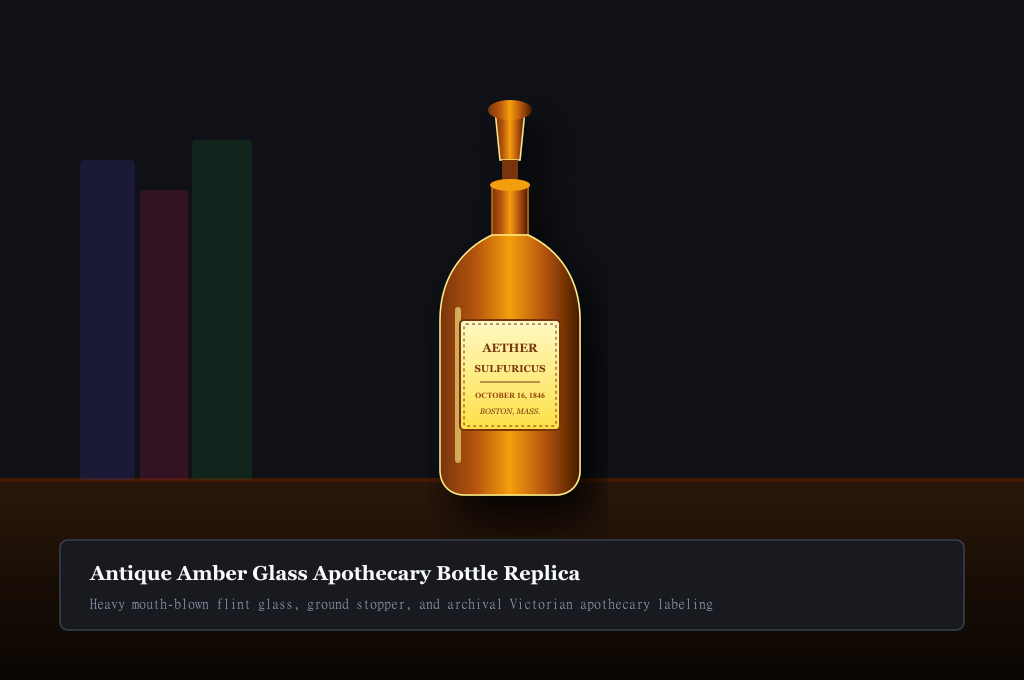
For medical historians, clinicians, and lovers of vintage scientific instruments, a hand-blown amber glass apothecary reagent bottle commemorates the aesthetic and material reality of nineteenth-century medicine. Crafted from heavy borosilicate or mouth-blown soda-lime flint glass with a precision ground-glass airtight stopper, the bottle protects light-sensitive compounds while displaying an authentic reproduction Victorian pharmaceutical label inscribed with 'Aether Sulfuricus - Boston 1846'. It serves as a dignified desk bookend, dry flower vase, or bookshelf accent that honors the foundational moment when surgical pain was conquered.
Buying limit: Look for authentic mouth-blown amber or cobalt glass vessels with hand-ground stoppers that fit snugly without rubber gaskets or modern plastic liners. Standard display heights range from 6 to 9 inches (250ml to 500ml capacity). Avoid lightweight machine-pressed decorative bottles with visible seam mold lines across the neck.
Original editorial illustration, not a retailer photograph. No exact Amazon offer passed our verification gate.PRODUCT IDEA 02
The Invention of Medicine: An Archival History of Surgery and Anesthesia
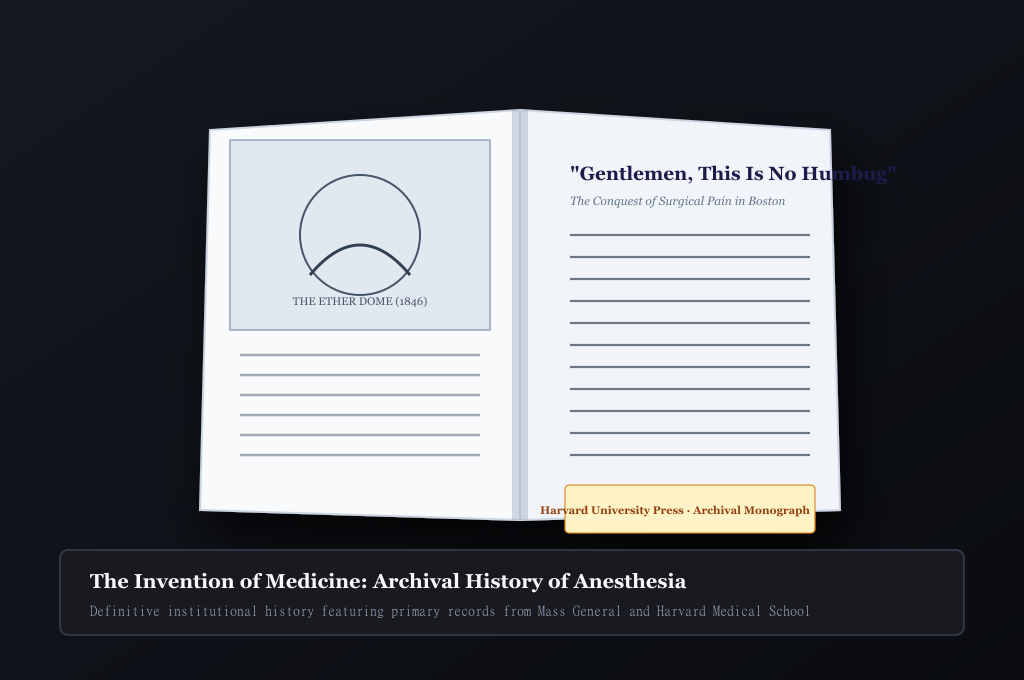
To truly grasp the radical transformation that occurred inside the Ether Dome, an authoritative hardcover medical monograph chronicles the clinical courage, personal rivalries, and societal skepticism that marked the birth of pain-free surgery. Featuring high-resolution reproductions of original hospital daybooks, early daguerreotypes, and nineteenth-century surgical diagrams, these volumes dissect how surgeons transitioned from thirty-second amputations to delicate microsurgical procedures. It provides an unsparing, richly documented journey through the greatest humanitarian breakthrough in medical history.
Buying limit: Select archival hardcover editions printed on acid-free archival paper with sewn bindings, such as scholarly monographs published by Harvard University Press, Oxford University Press, or the Wellcome Trust. Ensure the volume contains unedited excerpts from Warren and Morton's original 1846 case reports rather than abridged popular retellings.
Original editorial illustration, not a retailer photograph. No exact Amazon offer passed our verification gate.SOURCES, METHOD, AND LIMITS
Researched using primary historical archives from the Massachusetts General Hospital Archives (The Ether Dome Historical Collection and Surgical Records), the Harvard Medical School Francis A. Countway Library of Medicine Center for the History of Medicine, and original 1846 case publications in the Boston Medical and Surgical Journal by Dr. Henry Jacob Bigelow. Chemical volatility parameters of diethyl ether and nineteenth-century surgical mortality statistics were cross-referenced against academic medical history texts. No speculative or dramatized details were introduced.
- Massachusetts General Hospital — The Ether Dome Historical Landmark Archive — Official hospital institutional repository documenting the architectural history of the Bulfinch surgical amphitheater, the October 16, 1846 demonstration, and William Morton's original inhaler.
- Harvard Medical School — Countway Library of Medicine Center for the History of Medicine — Academic archival repository preserving nineteenth-century clinical lecture transcripts, surgical daybooks, and correspondence surrounding the Boston ether controversy.
- The New England Journal of Medicine — The 150th Anniversary of Ether Day in Boston — Peer-reviewed medical history analysis detailing John Collins Warren's surgical technique, Edward Abbott's postoperative recovery, and the global adoption of surgical anesthesia.