ON THIS DAY · OCTOBER 2, 1836
Five Years That Rewrote Biology: How Charles Darwin's Return from HMS Beagle Transformed Natural Science
When 22-year-old Charles Darwin boarded HMS Beagle in December 1831, his father feared he was embarking on a pointless diversion. When the ship anchored in Falmouth on October 2, 1836, Darwin carried 1,529 species in spirits, 3,907 dried specimens, and 770 pages of geological notes that would systematically dismantle the doctrine of static species and rewrite the foundations of biology.
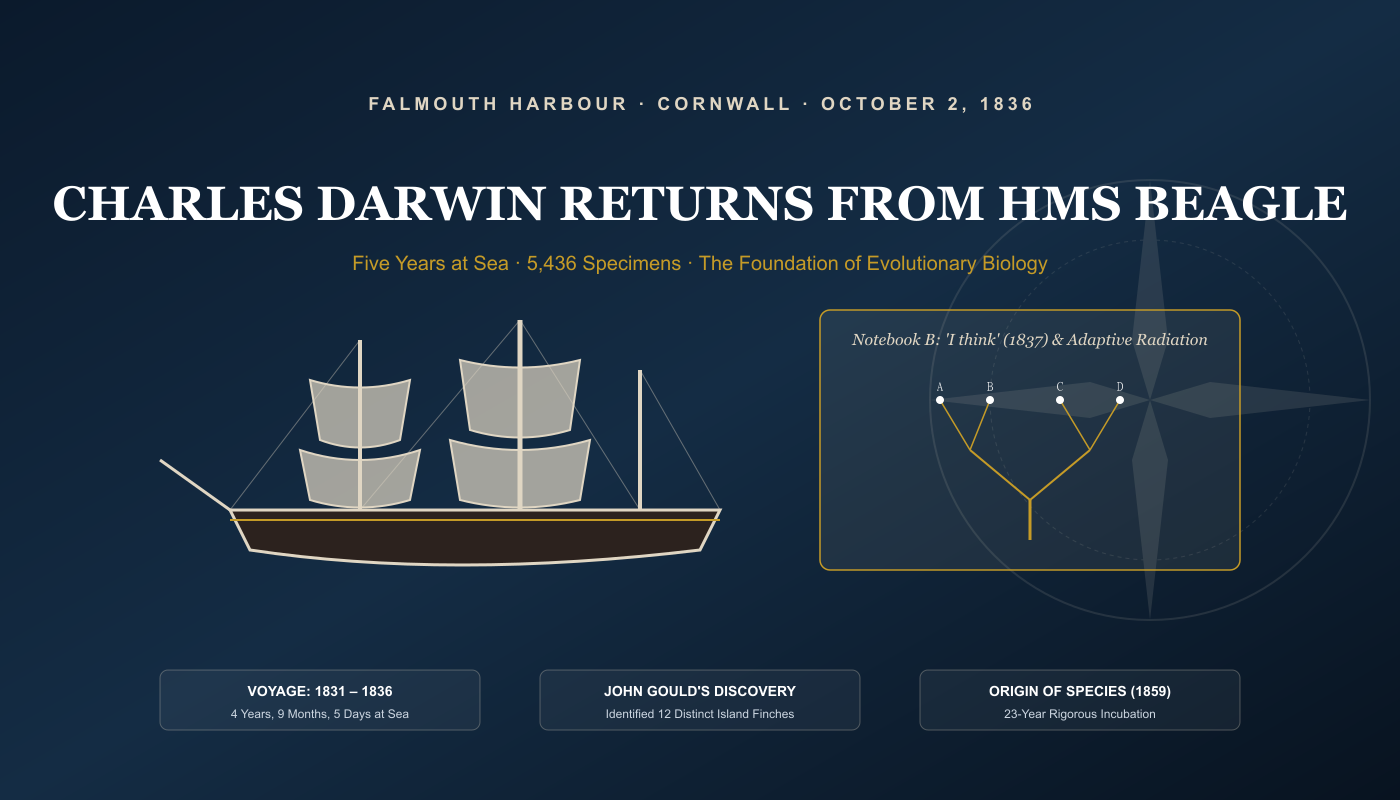
The Five-Year Circumnavigation: From Devonport to the Ends of the Earth
When 22-year-old Charles Darwin departed Plymouth aboard HMS Beagle on December 27, 1831, the expedition was planned as a two-year hydrographic survey of the South American coastline under the command of 26-year-old Captain Robert FitzRoy. Darwin's presence was unusual: he was not the official Admiralty ship's naturalist (a post initially held by the ship's surgeon, Robert McCormick), but rather an unpaid, self-funded gentleman companion invited to provide cultured conversation and prevent the severe psychological isolation that had driven FitzRoy's predecessor, Captain Pringle Stokes, to suicide in the desolate waters of Tierra del Fuego.
The voyage stretched across four years, nine months, and five days, spanning 40,000 miles and circumnavigating the globe. Aboard the cramped, 242-ton Cherokee-class ten-gun brig—which Darwin nicknamed a 'coffin ship' due to the class's propensity for capsizing in heavy seas—Darwin suffered chronic, debilitating seasickness. To escape the vessel, he spent over three of the five years conducting extensive inland expeditions across the pampas of Argentina, the cloud forests of Brazil, and the volcanic passes of the Chilean Andes, traveling thousands of miles on horseback accompanied by local gauchos.
In the fossil beds of Punta Alta and Bahía Blanca along the Argentine coast, Darwin made his first revolutionary discoveries. Excavating exposed sea cliffs with rock hammers, he unearthed colossal fossilized armors and skeletal remains of extinct giant ground sloths (Megatherium and Mylodon) and armadillo-like Glyptodon. Observing that these extinct prehistoric giants shared unmistakable anatomical blueprints with small, living South American armadillos and tree sloths occupying the exact same geographical territory, Darwin was confronted with the 'law of succession of types'—the first crack in his orthodox belief in the immutable, separate creation of species.
The Galápagos Observations and John Gould's Breakthrough
In September and October 1835, HMS Beagle spent five weeks surveying the volcanic Galápagos archipelago. Popular folklore often portrays Darwin stepping onto the black basalt shores of San Cristóbal and immediately deciphering the mechanism of evolution through a sudden flash of insight upon observing the beaks of native finches. The primary historical record preserved in Darwin's Beagle field notebooks tells a vastly more complex, human, and iterative story.
During his time in the islands, Darwin paid far greater attention to the mockingbirds (Mimus) and giant tortoises than to the finches. The vice-governor of the penal colony on Floreana Island, Nicholas Lawson, remarked to Darwin that he could tell which island any giant tortoise came from simply by observing the contour of its shell—noting saddleback shells on arid islands with high cactus vegetation and dome-shaped shells on lush, moist islands. When collecting finches, Darwin made a critical field error: he lumped his specimens from different islands into common collection bags without recording the specific island of origin for each bird.
The true conceptual breakthrough occurred eighteen months later in London. In March 1837, the distinguished ornithologist John Gould examined Darwin's bird specimens at the Zoological Society of London. Gould astonished Darwin by revealing that what Darwin had assumed were a miscellaneous mixture of blackbirds, wrens, 'gross-beaks', and finches were actually twelve distinct, closely related species of ground finches, all belonging to an entirely new, unified subfamily endemic to the Galápagos. Realizing that geographical isolation on separate volcanic islands had driven a single ancestral flock into diverse ecological niches—evolving specialized beaks for crushing hard seeds, probing cactus flowers, or stripping tree bark—Darwin grasped the concept of adaptive radiation.
From Notebook B to 'On the Origin of Species': The 23-Year Incubation
Upon docking in Falmouth on October 2, 1836, Darwin returned home not to publish a radical manifesto, but to distribute his specimen collections among British anatomists and establish his reputation as a meticulous geologist. In July 1837, in his private London study, Darwin opened a small, leather-bound notebook marked 'B' and wrote the phrase 'I think' above a revolutionary sketch: a simple, branching tree of life showing common ancestry, divergence, and extinction. It was the first visual representation of evolutionary descent in the history of science.
In October 1838, while reading Thomas Malthus's An Essay on the Principle of Population for amusement, Darwin identified the causal mechanism he had sought. Malthus observed that populations reproduce exponentially while food supplies grow arithmetically, creating a severe struggle for existence. Darwin realized that within any natural population, random inheritable variations that confer even a slight survival advantage in a competitive environment will be preserved, while unfavorable variations are systematically eliminated. He termed this unguided, selective filtering process 'natural selection'.
Deeply aware of the religious and social turbulence such a materialistic theory would provoke in Victorian Britain, Darwin spent more than two decades gathering overwhelming empirical evidence. He dissected barnacles for eight continuous years to master taxonomic classification, bred domestic fancy pigeons to document artificial selection, and conducted extensive seed-floating experiments to study oceanic dispersal. It was only in June 1858, when a younger naturalist named Alfred Russel Wallace sent Darwin an essay from the Malay Archipelago independently outlining the identical principle of natural selection, that Darwin was galvanized into action, leading to their joint presentation at the Linnean Society and the landmark publication of On the Origin of Species on November 24, 1859.
The Enduring Scientific Legacy: From Biogeography to Modern Genomics
The observations Darwin gathered during the Beagle voyage laid the empirical bedrock not only for evolutionary biology, but for modern biogeography, ecology, and plate tectonics. His geological treatise The Structure and Distribution of Coral Reefs (1842)—which accurately explained that coral atolls form as volcanic islands gradually subside while surrounding fringing reefs grow upward toward sunlight—was fully verified by deep ocean core drilling over a century later.
In evolutionary biology, modern molecular genetics has repeatedly confirmed and extended Darwin's Beagle insights with astonishing precision. Forty years of continuous field studies on the Galápagos island of Daphne Major by evolutionary biologists Peter and Rosemary Grant demonstrated natural selection occurring in real time: during severe droughts, finches with deeper beaks capable of cracking large, tough Tribulus cistoides seeds survived at significantly higher rates, shifting the population's genetic profile in a single generation.
Furthermore, 21st-century genomic sequencing of Darwin's Galápagos finches has identified the specific developmental genes—such as ALX1 (which regulates craniofacial beak shape) and Bmp4 (bone morphogenetic protein 4)—that natural selection altered across distinct island populations. When Charles Darwin stepped off HMS Beagle onto the Falmouth docks in October 1836, he carried the raw observational evidence that would dismantle centuries of biological dogma and reveal humanity's interconnected place within the grand, evolving tapestry of life.
What the evidence does not settle
Two common historical myths persist: first, that Darwin formulated the theory of natural selection on the beach in the Galápagos, when the conceptual breakthrough actually occurred in London months later after ornithologist John Gould classified the finch specimens; second, that the voyage was a dedicated scientific mission for Darwin, whereas HMS Beagle was a British Admiralty hydrographic survey expedition and Darwin was a private gentleman naturalist. Readers should note that optical field equipment suggestions are geared toward amateur naturalists, and book editions are evaluated for historical apparatus and textual accuracy.
PRODUCT IDEA 01
The Voyage of the Beagle & On the Origin of Species — Illustrated Annotated Hardcover

Reading Charles Darwin's own prose is the most immediate way to appreciate his exceptional powers of observation and lucid scientific storytelling. The Voyage of the Beagle (originally published in 1839 as his Journal and Researches) reads like a thrilling Victorian travel narrative, capturing his encounters with South American gauchos, volcanic eruptions in Chile, and the startling biodiversity of the Galápagos. Coupled with On the Origin of Species, an annotated edition provides modern readers with critical context, decoding Victorian scientific terminology, highlighting where Darwin's geological hunches proved remarkably prescient, and illustrating the specific specimens that inspired his evolutionary reasoning.
Buying limit: When selecting an edition, look for unabridged publications with scholarly annotations, introductory essays by evolutionary biologists, and reproductions of Darwin's original field sketches and woodcuts (such as the Harvard University Press or Penguin Classics Deluxe editions). Quality clothbound or leather-bound hardcover editions typically retail between $22 and $45. No specific Amazon ASIN was verified available with confirmed U.S. delivery on the date this article was written, so search by title and publisher before ordering.
Original editorial illustration, not a retailer photograph. No exact Amazon offer passed our verification gate.PRODUCT IDEA 02
Compact 8x42 Waterproof Roof-Prism Binoculars for Field Naturalists & Birding

Field observation of living wildlife in their natural habitats remains the cornerstone of ecological and evolutionary study. For amateur naturalists, birders, and outdoor enthusiasts inspired by Darwin's fieldwork, a quality pair of 8x42 roof-prism binoculars provides the ideal balance of magnification, wide field of view, and light transmission. The 8x magnification offers a stable, hand-held image without excessive shake, while the 42mm objective lenses gather ample light during early morning and late afternoon hours when wildlife is most active. Modern optical coatings and extra-low dispersion (ED) glass reveal fine feather markings, beak morphology, and behavioral details.
Buying limit: Look for optical specifications including fully multi-coated (FMC) lenses, BaK-4 phase-corrected prisms, nitrogen purging for waterproof and fog-proof performance, and a close-focus distance of under 6.5 feet (2 meters) for observing insects and plants. Reliable entry-to-intermediate field binoculars from established optics brands (such as Vortex Crossfire/Diamondback, Celestron Nature DX, or Nikon Prostaff P7) typically range from $120 to $240. No specific Amazon ASIN was verified available with confirmed U.S. delivery on the date this article was written, so search by optical specifications before ordering.
Original editorial illustration, not a retailer photograph. No exact Amazon offer passed our verification gate.SOURCES, METHOD, AND LIMITS
This study was researched using primary archival materials from the Darwin Correspondence Project (University of Cambridge), Charles Darwin’s original Beagle field notebooks and zoological diary preserved at the Cambridge University Library, and the Natural History Museum London specimen records. Historical voyage chronologies, Gould’s taxonomic reclassifications, and publication milestones were verified against Janet Browne’s definitive biography 'Charles Darwin: Voyaging' and Richard Keynes's 'Fossils, Finches and Fuegians'. No commercial products were physically tested.
- University of Cambridge — Darwin Correspondence Project: The Beagle Voyage (1831–1836) — Primary scholarly database containing transcripts of all letters exchanged during the five-year voyage, Darwin's communications with Captain FitzRoy, and specimen shipping manifests.
- Natural History Museum London — Darwin's Beagle Specimen Collection and Field Notes — Curatorial archives documenting the preservation, classification, and biological significance of the thousands of zoological, fossil, and geological specimens Darwin returned to Britain in 1836.
- Darwin Online (Cambridge University) — Beagle Field Notebooks and Zoological Diary — Complete digitized scans and scholarly transcriptions of Darwin's original handwritten Beagle pocket notebooks, geological diaries, and the 1837 Notebook B containing the 'I think' tree sketch.