ON THIS DAY · OCTOBER 3, 1962
Sigma 7 and the Textbook Flight: How Wally Schirra Proved Humans Were Pilots, Not 'Spam in a Can'
Early critics dismissed Project Mercury astronauts as passive biological specimens—'spam in a can' carried along by automated systems. On October 3, 1962, naval aviator Wally Schirra took Mercury capsule No. 16 into orbit for six precision laps around the Earth, conserving fuel, troubleshooting spacesuit overheating, and executing the most flawless splashdown in early space history.
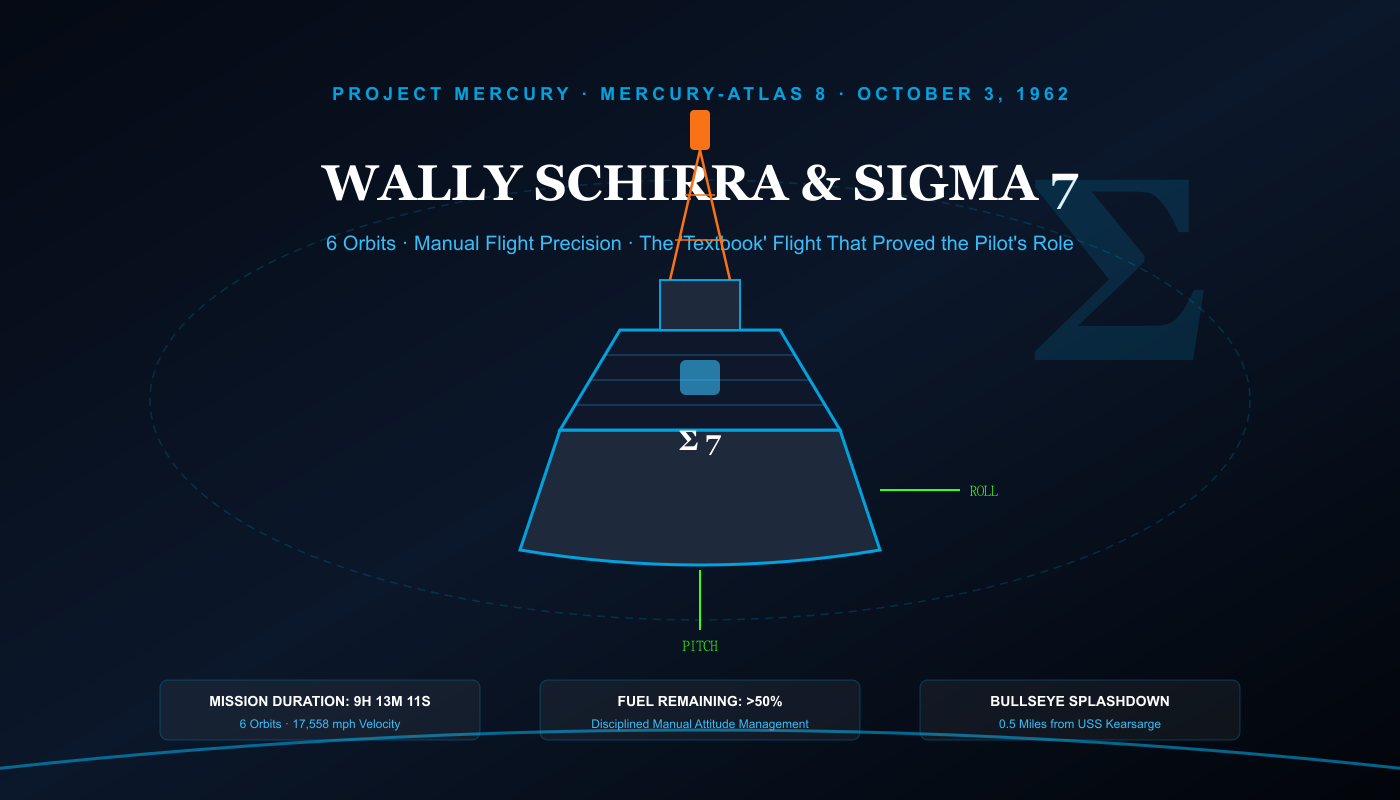
Overcoming the 'Spam in a Can' Critique: The Genesis of Sigma 7
In the early years of the American space program, elite military test pilots—most notably Chuck Yeager—derided the Mercury astronaut corps as mere passengers. Because the early Mercury capsule had been designed with fully automated launch, orbit, and re-entry sequences to ensure survival even if an astronaut suffered catastrophic acceleration-induced blackout, skeptics joked that 'a monkey was doing the same job.' Within NASA's Space Task Group at Langley and flight operations in Houston, engineers and flight controllers fiercely debated the division of control between automated gyroscopes and the human pilot in the cockpit.
The urgency of this debate reached a climax following the previous orbital flight in May 1962. During Mercury-Atlas 7, astronaut Scott Carpenter had become enthralled with scientific observations and tracking 'fireflies' (frost particles released from the capsule), inadvertently engaging multiple conflicting attitude-control thrusters simultaneously. Carpenter depleted his manual and automatic hydrogen peroxide fuel reserves, resulting in a misaligned retrofire burn that caused his capsule Aurora 7 to splash down 250 miles off-target in the Atlantic, leaving NASA and the world in agonizing silence for forty-five minutes before recovery.
For Mercury-Atlas 8, naval test pilot Walter M. 'Wally' Schirra Jr. determined that his mission would be an uncompromising demonstration of operational flight discipline and engineering precision. He rejected whimsical naming conventions, choosing instead the mathematical Greek symbol Sigma (Σ) followed by the number 7. In mathematics, Sigma represents summation; to Schirra, it symbolized the total synthesis of engineering design, ground support, and active, disciplined piloting.
Nine Hours of Orbital Precision and the Spacesuit Cooling Crisis
On October 3, 1962, at 07:15 EST, Atlas booster 113D lifted Sigma 7 smoothly off Launch Complex 14 at Cape Canaveral. Schirra was inserted into a 100-by-176-mile elliptical orbit with virtually perfect velocity parameters. However, within minutes of entering orbit, Schirra encountered a potentially mission-ending life-support anomaly: the environmental control system cooling valve in his BFG (B.F. Goodrich) pressure suit failed to regulate correctly, and his suit temperature climbed steadily toward 90 degrees Fahrenheit (32°C).
Flight controllers in Mercury Control Center, led by Flight Director Chris Kraft, prepared to initiate an immediate re-entry abort at the end of orbit one if the suit temperature could not be stabilized. Exhibiting calm, methodical test-pilot discipline, Schirra resisted panicky, drastic adjustments to the coolant dial. Instead, he made micro-incremental dial changes every five to ten minutes, allowing the heat-exchange thermal lag to settle. By the middle of the second orbit, the suit temperature stabilized at a comfortable 68 degrees, and Kraft granted clearance for the full six-orbit flight.
Throughout the remaining four orbits, Schirra executed a masterclass in fuel conservation. Operating in a passive 'fly-by-wire' and 'drifting flight' mode, he allowed the capsule to tumble gently through space without firing thrusters, using manual bursts of reaction control fuel only when required for precise navigational alignments. Schirra proved that an astronaut could maintain precise orbital awareness using the Earth horizon and star constellations viewed through the cockpit periscope and window, preserving critical life-support consumables.
The 'Bullseye' Splashdown and Flight Verification
As Sigma 7 approached the end of its sixth orbit over the Pacific Ocean, Schirra manually aligned the spacecraft's pitch and yaw to the exact 34-degree retrofire attitude. At 9 hours, 52 minutes after liftoff, the three solid-fuel retrorockets fired in flawless succession. Following re-entry through the ionization blackout, the drogue parachute deployed at 40,000 feet, followed by the main 63-foot ring-sail parachute at 10,000 feet.
Sigma 7 splashed down into the warm waters of the central Pacific Ocean at 16:28 UTC, just 0.5 miles (800 meters) from the prime recovery aircraft carrier USS Kearsarge (CVS-33)—so close that sailors and officers watching from the carrier's flight deck saw the parachute deploy and watched the capsule hit the water. It was the most accurate landing in the history of human spaceflight up to that date.
When naval recovery teams hoisted Sigma 7 onto the carrier deck, telemetry inspections revealed that Schirra had concluded the nine-hour flight with 52% of his automatic hydrogen peroxide fuel and 51% of his manual fuel still intact. By comparison, John Glenn and Scott Carpenter had exhausted virtually all of their fuel during their three-orbit flights. Schirra had definitively proven that a trained, disciplined human pilot was not 'spam in a can', but the ultimate fail-safe optimization system aboard a spacecraft.
The Engineering Bridge to Gemini and Apollo
The resounding operational success of Sigma 7 provided NASA engineers and management with the empirical confidence required to expand the boundaries of human space exploration. The fuel conservation techniques and thermal regulation protocols established by Schirra directly enabled NASA to approve Gordon Cooper's 22-orbit, 34-hour mission on Faith 7 in May 1963, concluding Project Mercury on a triumphant high note.
Schirra's flight methodologies became the standard operational doctrine for Project Gemini and the Apollo lunar program. In December 1965, Schirra commanded Gemini 6A, executing the world's first active rendezvous with Gemini 7—an intricate orbital ballet that relied directly on the manual piloting precision he had pioneered aboard Sigma 7. Later, in October 1968, Schirra commanded Apollo 7, the first crewed flight of the Apollo spacecraft following the tragic Apollo 1 fire.
Walter Schirra remains the only astronaut in history to have flown missions in all three pioneering American spacecraft programs: Mercury, Gemini, and Apollo. His six-orbit journey in Sigma 7 on October 3, 1962, stands as the textbook flight that transformed early space travel from automated biological experimentation into the sophisticated art of human orbital piloting.
What the evidence does not settle
Popular accounts frequently mischaracterize the 'spam in a can' debate as a personal feud between astronauts and engineers, whereas it represented a critical systems engineering debate over automation versus manual human-in-the-loop control during the earliest days of human spaceflight. Furthermore, while Schirra's flight is remembered as flawless, the initial orbit experienced a serious spacesuit temperature regulator anomaly that nearly triggered an emergency abort at the end of orbit one. Readers should note that hobby scale models require assembly and painting, and space memorabilia items are evaluated for collectible fidelity.
PRODUCT IDEA 01
Project Mercury Spacecraft 1:48 or 1:72 Scale Plastic Assembly Model Kit

Building a scale model kit of the Project Mercury spacecraft provides enthusiasts and modelers with a tactile appreciation of early space capsule engineering. Detailed 1:48 scale kits from established manufacturers like Horizon, Dragon, or Revell feature the distinctive corrugated exterior shingles (designed to expand under the extreme aerodynamic heat of re-entry without warping the pressurized cabin), the delicate tubular launch escape system tower, the three-point solid retrorocket pack, and decals for all Mercury Seven missions including Schirra's Sigma 7. Assembling the compact capsule highlights how tight the cockpit ergonomics were for early astronauts.
Buying limit: Plastic model kits require plastic cement, hobby knives, and acrylic paints (such as gloss black, matte white, and heat-shield metallic burnt iron) for complete finishing. Quality 1:48 and 1:72 scale Mercury kits typically retail between $25 and $55 depending on tooling vintage and aftermarket photo-etched detail parts. No specific Amazon ASIN was verified available with confirmed U.S. delivery on the date this article was written, so search by scale and manufacturer name before ordering.
Original editorial illustration, not a retailer photograph. No exact Amazon offer passed our verification gate.PRODUCT IDEA 02
The Right Stuff by Tom Wolfe & Schirra's Space — Manned Spaceflight Memoirs

Tom Wolfe's The Right Stuff remains the quintessential literary exploration of the test-pilot culture that defined the Mercury Seven, vividly chronicling the tension between the military aviators and the biomedical engineers who designed the automated spacecraft. Complementing Wolfe's narrative, Walter Schirra's own autobiography Schirra's Space offers an authentic, witty, and deeply technical insider account of his flights aboard Mercury, Gemini 6A, and Apollo 7. Schirra candidly discusses the spacesuit cooling crisis on Sigma 7, the orbital rendezvous maneuvers with Frank Borman and Jim Lovell, and his reputation as the master of the lighthearted 'gotcha' prank that kept flight crews grounded during high-stress missions.
Buying limit: Available in trade paperback, hardcover, and audiobook formats. When searching for Schirra's Space (Naval Institute Press, ISBN 978-1557507921) or The Right Stuff (Farrar, Straus and Giroux), look for complete unabridged editions. Paperback editions typically sell between $14 and $22. No specific Amazon ASIN was verified available with confirmed U.S. delivery on the date this article was written, so search by title and author before ordering.
Original editorial illustration, not a retailer photograph. No exact Amazon offer passed our verification gate.SOURCES, METHOD, AND LIMITS
This study was researched using primary archival flight logs and mission reports from the NASA History Division (including NASA SP-12 'Results of the Third United States Manned Orbital Space Flight' published in 1962), transcripts of air-to-ground communications from the Mercury-Atlas 8 mission archives, and official technical debriefs from the Smithsonian National Air and Space Museum. Orbital mechanics and fuel consumption telemetry were verified against NASA Special Publication SP-4001 'Project Mercury: A Chronology'. No commercial products were physically tested.
- NASA History Division — SP-12: Results of the Third U.S. Manned Orbital Space Flight, October 3, 1962 — Primary technical monograph detailing the Mercury-Atlas 8 mission chronology, spacecraft system performance, environmental control temperature telemetry, and fuel consumption records.
- NASA Space Science Data Coordinated Archive — Mercury-Atlas 8 / Sigma 7 Spacecraft (ID 1962-052A) — Official spacecraft catalog registry detailing orbital parameters (283 km apogee, 153 km perigee, 88.9 minute period), launch mass (1,379 kg), and recovery coordinates in the Pacific Ocean.
- Smithsonian National Air and Space Museum — Mercury Capsule 16 (Sigma 7) Collection Record — Curatorial documentation of the preserved Sigma 7 spacecraft, corrugated shingle construction, periscope optics, and Walter Schirra's flight suit artifacts.