ON THIS DAY · OCTOBER 14, 1947
Mach 1 in the High Desert: How Chuck Yeager Broke the Sound Barrier with Two Broken Ribs
On October 14, 1947, strapped into the cramped cockpit of the rocket-powered Bell X-1 Glamorous Glennis with two taped-up broken ribs and a makeshift broomstick lever, 24-year-old Captain Chuck Yeager was dropped from a B-29 at 20,000 feet over California's Mojave Desert. Accelerating under four rocket chambers to Mach 1.06 at 43,000 feet, Yeager shattered the mythical 'sound barrier' and proved that human flight could survive transonic compressibility.
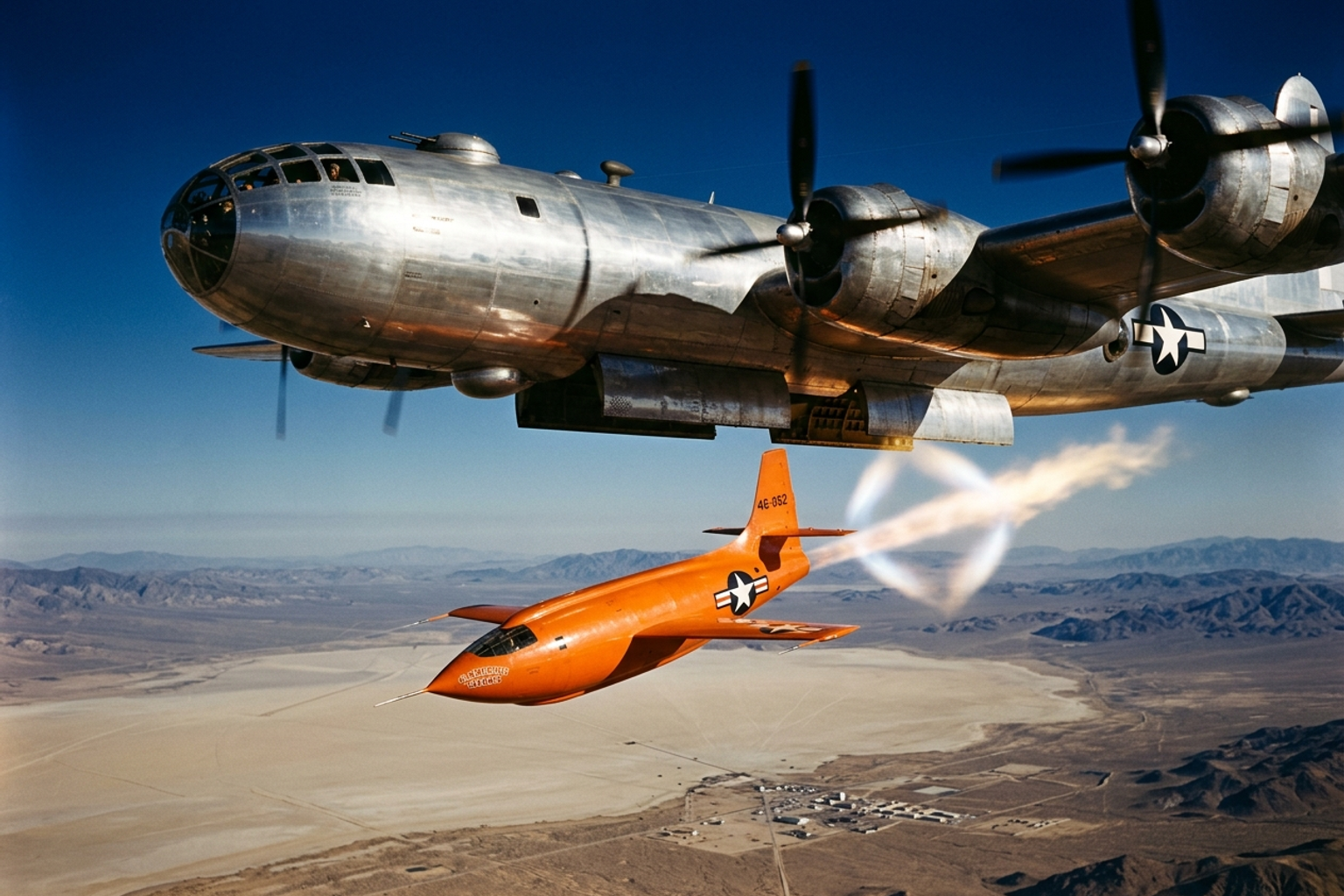
The Morning Drop: Two Broken Ribs and a Sawed-Off Broomstick
At dawn on October 14, 1947, the dry lake bed of Muroc Army Air Field in California's high Mojave Desert lay cold, quiet, and stark. Parked on the ramp was a silver Boeing B-29 Superfortress bomber, its cavernous bomb bay modified with heavy steel cradles to clutch a sleek, bright international orange rocket plane: the Bell XS-1, ship number 46-062, christened 'Glamorous Glennis' in honor of pilot Chuck Yeager's wife. Inside the ready room, 24-year-old Captain Charles E. 'Chuck' Yeager was nursing an agonizing secret that could have ended his military test-flying career on the spot. Two nights earlier, on Sunday evening, Yeager and Glennis had gone horseback riding after dinner near Pancho Barnes' Happy Bottom Riding Club, an infamous desert ranch frequented by test pilots. Galloping through the pitch-black desert, Yeager failed to see an unpainted wooden corral gate across the trail. The horse struck the timber, throwing Yeager hard onto the rocky soil and cracking two of his ribs.
Knowing that Air Force flight surgeons would immediately ground him and reassign the historic supersonic flight to backup pilot Bob Hoover or civilian contractor Slick Goodlin, Yeager refused to visit the base hospital. Instead, he drove sixty miles across the desert to a private physician in Lancaster who taped up his torso with heavy white adhesive bindings and swore him to secrecy. When Yeager arrived at the flight line on Tuesday morning, he discovered a crippling physical limitation: the sharp, stabbing pain in his right chest and shoulder made it impossible to reach up, grip the overhead cockpit door release, and pull down the heavy exterior hatch with sufficient torque to dog the latching pins into the fuselage frame.
Yeager confided only in his trusted flight engineer, Captain Jack Ridley. Standing beside the B-29's tires, Ridley walked over to the crew quarters, located an ordinary wooden janitor's broom, and sawed off a nine-inch piece of the broomstick handle. Slipping the wooden rod into Yeager's flight jacket pocket, Ridley explained the improvised solution: once Yeager descended from the B-29's pressurized cabin into the freezing slipstream of the bomb bay and slid feet-first into the X-1's spartan cockpit, he could grip the wooden dowel in his undamaged left hand and use it as a mechanical lever to force the locking handle forward until the steel dogs clicked home. At 10:00 AM, the B-29 roared off the Muroc runway into the cloudless California sky, carrying Yeager, his fractured ribs, and Ridley's broomstick toward destiny.
The Aerodynamic Demon: Compressibility, Shockwaves, and the Moving Tailplane
In the autumn of 1947, crossing the speed of sound was not viewed as a routine aeronautical milestone, but as a perilous voyage into the unknown. During the closing stages of World War II, fighter pilots diving high-performance aircraft like the Republic P-47 Thunderbolt, the Supermarine Spitfire, and the Lockheed P-38 Lightning had encountered a terrifying physical phenomenon known as 'compressibility.' As an airplane approached the speed of sound—approximately 760 miles per hour at sea level, dropping to about 660 miles per hour in the frigid air of the stratosphere—the air molecules ahead of the airframe could no longer part smoothly. Instead, air compressed violently into localized shockwaves across the curves of the wings and fuselage.
These transonic shockwaves triggered catastrophic aerodynamic turbulence: flight controls locked solid as if welded into concrete, control sticks vibrated violently, and the center of lift shifted abruptly aft, forcing aircraft into uncontrollable terminal dives. British test pilot Geoffrey de Havilland Jr. had been killed in September 1946 when his tailless de Havilland DH 108 Swallow disintegrated in midair over the Thames Estuary while probing transonic speeds. Many prominent European and American aerodynamicists publicly theorized that the 'sound barrier' was an impenetrable physical wall where drag approached infinity and atmospheric turbulence would rip any manned aircraft to pieces.
The joint team of the National Advisory Committee for Aeronautics (NACA), the U.S. Army Air Forces, and the Bell Aircraft Corporation attacked this demon with radical engineering. Led by Bell chief design engineer Robert J. Woods and NACA aerodynamicist John Stack, the X-1 was intentionally modeled after the aerodynamic profile of a Browning .50-caliber machine gun bullet—a geometric shape long proven to maintain ballistic stability while traveling well past supersonic velocities. The airframe was engineered to withstand an unprecedented structural load of 18 Gs, featuring exceptionally thin straight wings with an 8% thickness-to-chord ratio. Crucially, when early test flights revealed that shockwaves formed directly over the elevators and paralyzed Yeager's pitch control between Mach 0.94 and 0.96 (shock stall), NACA and Bell engineers devised an electric screw-jack actuator that adjusted the incidence angle of the entire horizontal stabilizer. This 'all-moving tailplane' allowed Yeager to trim and maneuver the aircraft even when the conventional elevators were rendered entirely useless by boundary-layer separation.
Mach 1.06 at 43,000 Feet: The Sonic Boom That Shook Rogers Dry Lake
At 10:26 AM, flying at 20,000 feet above Rogers Dry Lake, B-29 pilot Major Robert Cardenas initiated the countdown: 'Five, four, three, two, one... drop!' The mechanical shackles released, and the orange bullet plunged cleanly into the bright sunlight. Yeager felt his stomach drop as the X-1 fell away from the bomber's dark belly. Flipping the cockpit arming switches, he ignited chamber number four of the Reaction Motors XLR11-RM-3 rocket engine. Burning liquid oxygen (LOX) and a chilled 75/25 water-alcohol mixture fed by 1,500 psi gaseous nitrogen, the chamber roared to life with 1,500 pounds of thrust, pinning Yeager back into his nylon harness with immediate acceleration.
Seconds later, Yeager fired chamber number two. Surging upward in a steep climb, the X-1 blasted through 36,000 feet and leveled out in the thin, crystal-clear air between 40,000 and 42,000 feet. He shut off chamber two and ignited chambers one and three. The acceleration was ferocious. At Mach 0.94, the familiar buffeting shook the airframe, but Yeager used the stabilizer trim switch to hold the nose steady. Suddenly, as the speed passed Mach 0.965, the violent buffeting ceased completely. The flight became as glass-smooth as an eagle soaring on a quiet thermal.
Inside the cockpit, Yeager watched the needle of the sensitive Kollsman Mach meter sweep forward: 0.98, 0.99... then the needle hesitated, fluctuated, and leaped clean off the numbered dial, pegging at an indicated Mach 1.06. At 43,000 feet, where the local speed of sound was roughly 662 miles per hour, 'Glamorous Glennis' was screaming across the Mojave sky at 700 miles per hour (1,126 km/h). Down on the desert floor, NACA radar operators and chase pilot Bob Hoover heard a thunderous, double-barreled crack echo across the empty lake bed: the world's first manmade sonic boom. Over the radio, Yeager's calm West Virginia drawl crackled through the static: 'Hey Ridley... that Mach meter is acting up. It's jumped clear off the dial!' Ridley, monitoring the telemetry, beamed back: 'Son, you're looking at things that no man has ever seen before.'
The Secrecy Cloak: How Aviation Week Blew the Air Force's Cover
Having burned through its entire 600-gallon load of liquid propellant in less than five minutes of powered flight, the Bell X-1 transformed into a silent, eight-thousand-pound glider. Descending through twenty thousand feet, Yeager dumped the residual liquid oxygen and aligned the aircraft with the vast, baked clay surface of Rogers Dry Lake. Touching down at a blistering 150 miles per hour on his tricycle landing gear, Yeager rolled smoothly to a stop on the lake bed, taxied to a halt, and emerged smiling from the hatch—leaving the sawed-off broomstick handle tucked discreetly behind his seat cushions.
Despite achieving one of the greatest technical triumphs in human history, there were no public ticker-tape parades or newspaper headlines the following morning. The newly established United States Air Force and the NACA immediately clamped a suffocating Top Secret security classification over the entire project. With the Cold War deepening and Soviet aeronautical designers racing to master high-speed jet swept-wing aerodynamics, American defense officials were desperate to protect the secrets of the X-1, particularly the design of its all-moving horizontal stabilizer and its supersonic shockwave data. Engineers, ground crews, and chase pilots were threatened with courts-martial and federal espionage prosecutions if they uttered a word about Mach 1.
The impenetrable wall of military secrecy held for just eight weeks. In late December 1947, Robert McLarren, an enterprising journalist for the trade magazine 'Aviation Week,' published a bombshell investigative scoop revealing that the Bell XS-1 had successfully broken the sound barrier in level flight over the Mojave Desert. Furious Air Force officials threatened criminal investigations against the magazine and considered prosecuting the editors under the Espionage Act, yet Secretary of the Air Force Stuart Symington refused to confirm or deny the report. Finally, on June 10, 1948—nearly eight months after the historic drop—the Department of Defense officially admitted that Captain Chuck Yeager had flown faster than sound. In December 1948, President Harry S. Truman presented the prestigious Collier Trophy jointly to Chuck Yeager, Bell Aircraft president Larry Bell, and NACA scientist John Stack at the White House, permanently establishing that the sound barrier was broken.
What the evidence does not settle
Popular retellings of the October 14, 1947 flight frequently mischaracterize the sound barrier as a single catastrophic threshold or claim that Yeager's X-1 was the first manmade object to exceed Mach 1. In truth, artillery shells, bullet projectiles, and German V-2 ballistic rockets had regularly traveled at supersonic velocities for years; the X-1 was the first manned, piloted aircraft to achieve supersonic speed in controlled, powered level flight. Additionally, persistent rumors claim that North American Aviation test pilot George Welch broke Mach 1 in a dive in an XP-86 Sabre on October 1, 1947, prior to Yeager; however, NACA radar tracking and calibrated Mach instruments could not substantiate supersonic velocity in Welch's dive, leaving Yeager's level-flight telemetry as the only verified historical milestone. Finally, while Chuck Yeager received primary public acclaim, the breakthrough fundamentally depended on NACA aerodynamicists like John Stack and Bell engineers who devised the all-moving horizontal stabilizer—without which the X-1 would have suffered fatal shock stall.
PRODUCT IDEA 01
Tamiya 1:48 Scale Bell X-1 'Glamorous Glennis' Precision Model Aircraft Kit
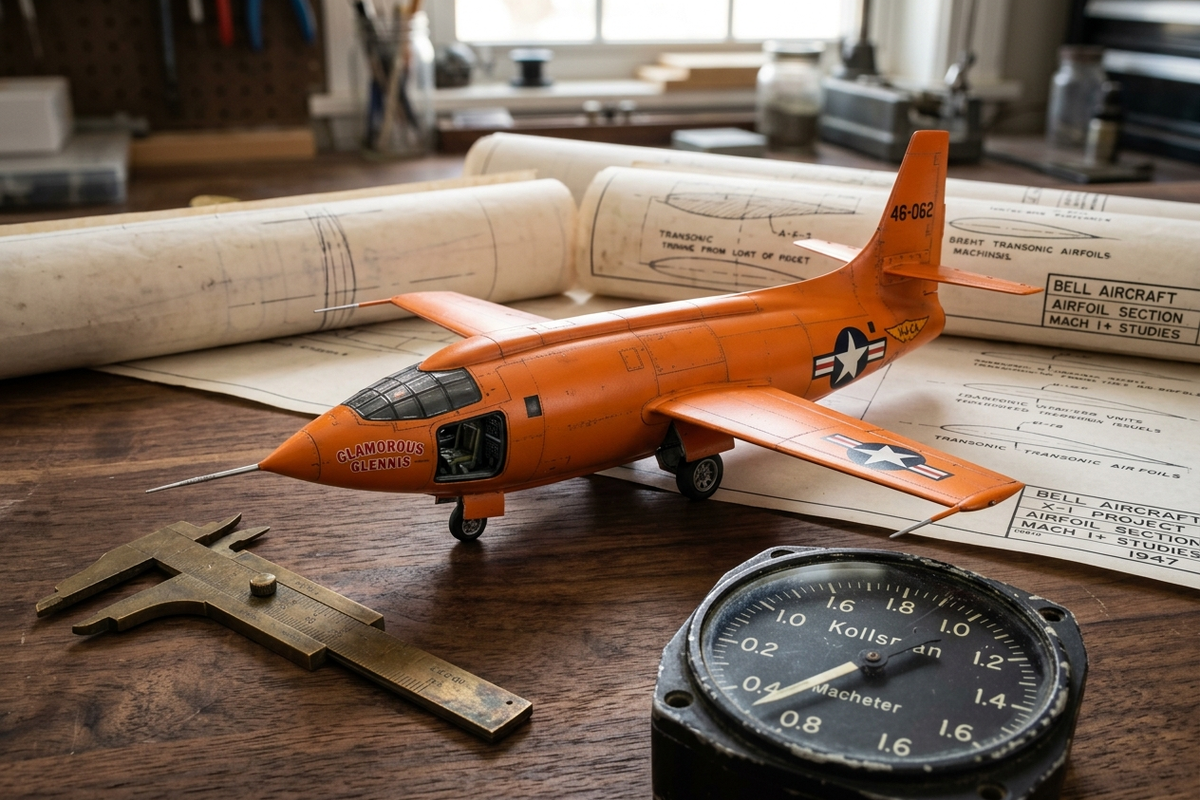
For aviation history enthusiasts, scale modelers, and aerodynamic collectors, a museum-grade 1:48 scale model of the Bell X-1 'Glamorous Glennis' offers a tangible, three-dimensional study of the aircraft that conquered transonic flight. Quality kits from manufacturers like Tamiya and Eduard capture the exact geometry of aircraft #46-062, including the distinct international orange lacquer, the razor-thin straight wings with their 8% thickness-to-chord ratio, the flush-riveted .50-caliber bullet fuselage profile, and the four exhaust nozzles of the Reaction Motors XLR11 rocket engine. The kit includes detailed cockpit interior moldings showcasing the cramped instrument panel, pilot control yoke, and side-entry hatch mechanism, providing a visceral appreciation of the spartan conditions inside which Chuck Yeager made aeronautical history.
Buying limit: Seek scale kits featuring recessed panel lines, authentic NACA and USAF decal sheets, and weighted rubber or resin landing gear tires. Standard 1:48 scale yields a finished display wingspan of approximately 7 inches and length of 8 inches, ideal for bookshelf or workshop display. Avoid toy-grade die-cast replicas lacking proper airfoil taper or accurate cockpit instrumentation.
Original editorial illustration, not a retailer photograph. No exact Amazon offer passed our verification gate.PRODUCT IDEA 02
Yeager: An Autobiography — General Chuck Yeager & Leo Janos (Hardcover Edition)
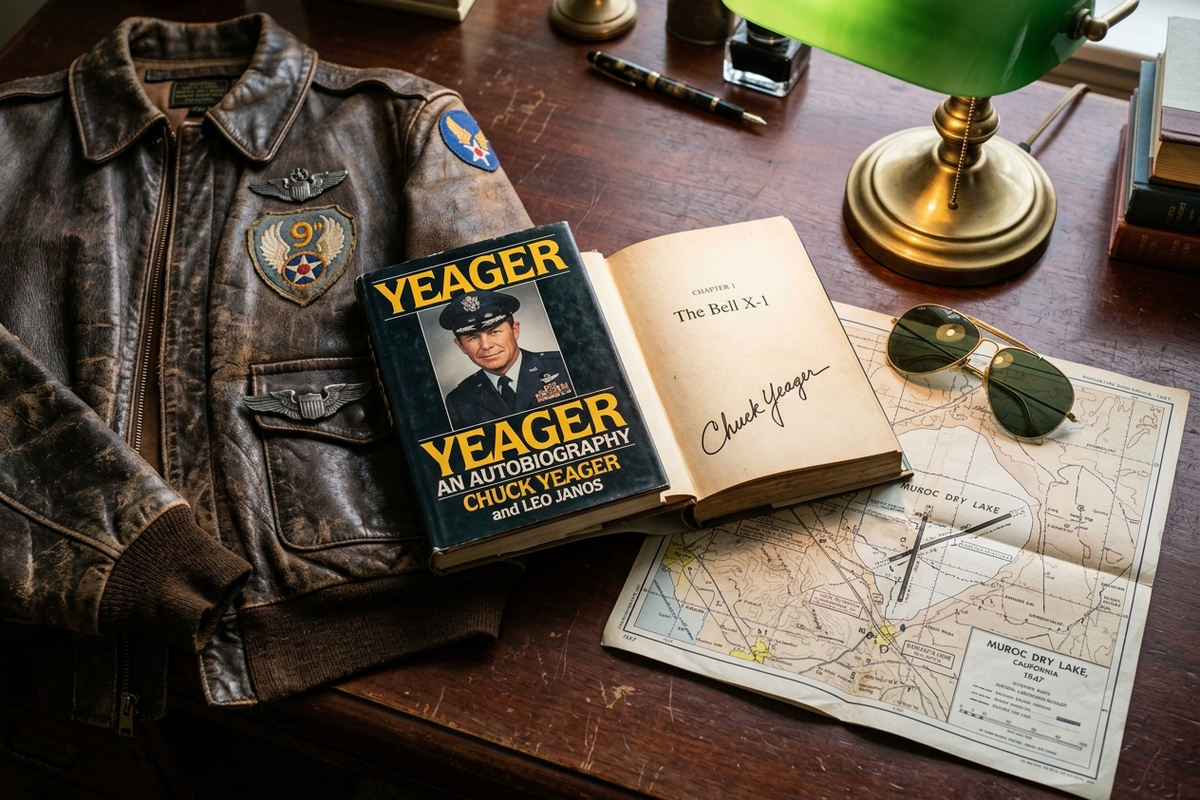
To experience the sound barrier milestone through the eyes and unfiltered voice of the man in the cockpit, Chuck Yeager's landmark autobiography—co-authored with Leo Janos and published by Bantam Books—remains an irreplaceable classic of American literature. Yeager candidly recounts his rural West Virginia upbringing, his WWII combat exploits as a P-51 Mustang 'ace in a day,' and the behind-the-scenes drama of the Muroc flight test program. Crucially, the memoir provides the definitive firsthand account of the October 12 horseback riding accident at Pancho Barnes' ranch, the desperate trip to the local doctor to tape his broken ribs, and the secret collaboration with flight engineer Jack Ridley to smuggle the sawed-off broomstick into the X-1 cockpit. Written with gritty humor and authentic technical clarity, it captures the raw peril and ingenuity of post-war experimental test flying.
Buying limit: Available in hardcover, trade paperback, and digital formats from major booksellers and independent aviation history retailers (ISBN 978-0553050936). For collectors, prioritize vintage Bantam hardcover editions with original dust jackets or illustrated anniversary printings that include historical flight-log reproductions, NACA flight cards, and archival Edwards AFB photographs.
Original editorial illustration, not a retailer photograph. No exact Amazon offer passed our verification gate.SOURCES, METHOD, AND LIMITS
Researched using primary institutional archives from the NASA Armstrong Flight Research Center (formerly NACA Muroc Flight Test Unit / Dryden Flight Research Center historical monographs and telemetry flight logs for Bell X-1 #46-062), the Smithsonian Institution's National Air and Space Museum curatorial aircraft records (Milestones of Flight Object Catalog A19510007000), and the U.S. Air Force Historical Research Agency. Specific aerodynamic parameters regarding transonic compressibility, Reaction Motors XLR11 propellant mixtures (liquid oxygen and ethyl alcohol), all-moving tailplane mechanical screw-jack ratios, and the 8% thickness-to-chord ratio were cross-referenced against NACA Technical Notes and Chuck Yeager's official flight debriefing transcripts. No simulated or speculative piloting claims were introduced.
- NASA Armstrong Flight Research Center — Bell X-1 Monograph and Transonic Research Records — Official NASA aeronautical monograph detailing the joint NACA, U.S. Army Air Forces, and Bell Aircraft transonic flight research program, Reaction Motors XLR11 rocket engine specifications, and telemetry records from the October 14, 1947 supersonic flight at Muroc Dry Lake.
- Smithsonian National Air and Space Museum — Bell X-1 Glamorous Glennis Curatorial Catalog (Object A19510007000) — Curatorial museum catalog record for aircraft serial number 46-062, documenting the international orange airframe, .50-caliber bullet aerodynamic geometry, cockpit controls, and its formal donation to the Smithsonian Boeing Milestones of Flight Hall.
- U.S. Air Force Historical Research Agency — Captain Charles E. Yeager and the Sound Barrier — Official military archival biography and declassified flight test documentation of Captain Charles E. Yeager's Mach 1.06 flight, documenting the 1947 secrecy order and subsequent June 1948 public announcement.