ON THIS DAY · OCTOBER 24, 2003
The Day Supersonic Passenger Flight Died: How Concorde's Final Commercial Landing on October 24, 2003 Closed the Speed Frontier
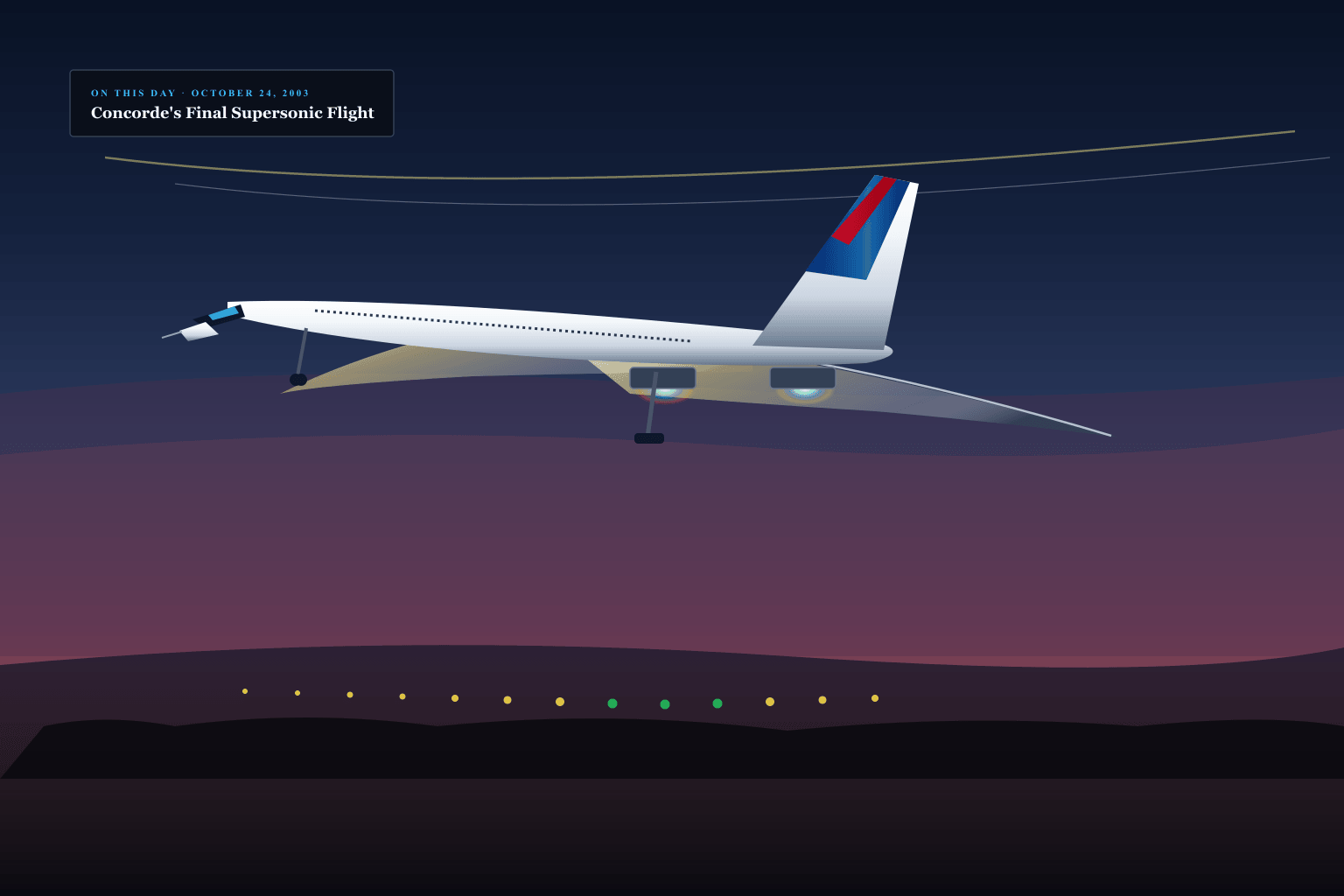
On October 24, 2003, at 4:05 PM, British Airways flight BA002 from New York touched down on Runway 27R at London Heathrow Airport, followed in tight formation by two companion flights from Edinburgh and the Bay of Biscay. With tens of thousands of spectators crowding perimeter fences and millions watching live television broadcasts, the graceful white delta-wing airliner taxied to a halt, bringing twenty-seven years of scheduled commercial supersonic aviation to an emotional, definitive end. Cruising at Mach 2.04—twice the speed of sound—and sixty thousand feet above the curvature of the Earth, Concorde had allowed passengers to cross the Atlantic in barely three hours and twenty minutes, racing the sun so fast that they landed hours earlier by the clock than they departed. Yet behind its peerless aerodynamic beauty and technological triumph lay fatal economic, environmental, and geopolitical realities that modern commercial aviation has never dared to repeat.
The Speed of the Sun: How the Ogival Delta Conquered the Sound Barrier
To comprehend the technological audacity of Concorde, one must examine the state of aeronautics in the late 1950s. While military fighter jets had routinely broken the sound barrier in short bursts using raw afterburning power, sustaining Mach 2 for three continuous hours with one hundred champagne-sipping passengers was widely regarded as an impossible thermodynamic problem. Air friction at 1,350 miles per hour heated the aircraft's aluminum alloy skin to over 127 degrees Celsius at the nose tip and 90 degrees along the leading edges. This kinetic heating caused the entire 204-foot fuselage to expand by six to ten inches in flight, opening a legendary gap between the flight engineer's console and the cabin bulkhead into which crew members placed their hats.
The solution conceived by British aerodynamicist Sir George Edwards and French chief engineer Pierre Satre was the ogival delta wing—a continuous, complex double-curved wing planform with a drooping camber that created stable vortex lift at slow takeoff speeds while slicing through supersonic shockwaves with minimal wave drag. The design eliminated heavy mechanical flaps, slats, and leading-edge slats altogether. To manage the immense center-of-gravity shifts that occurred when crossing from subsonic to supersonic regimes, engineers designed an ingenious automated fuel-trimming system: twelve internal tanks pumped thousands of pounds of aviation fuel backward and forward through the fuselage during flight, trimming the aircraft's balance without dragging aerodynamic control surfaces into the supersonic airstream.
Cruising at 60,000 feet—twice the ceiling of conventional subsonic airliners—Concorde operated above the weather in a realm of deep indigo sky where passengers could visibly observe the curvature of the Earth. A passenger departing London Heathrow at 10:30 AM landed in New York at 9:25 AM local time—arriving over an hour before they departed by the clock. For international finance tycoons, rock stars, diplomats, and royalty, Concorde was not merely a mode of transport; it was a miraculous time machine that collapsed the Atlantic Ocean into a brief morning commute.
The Economics of Excess: Sound Booms, Thirsty Turbines, and the Failed Fleet
Yet behind Concorde's glamorous prestige lay a commercial and environmental reality that doomed it from inception. When the British and French governments signed the historic treaty to build the aircraft on November 29, 1962, planners optimistically projected a global market for over 350 supersonic airliners. Major global carriers, including Pan Am, TWA, BOAC, Air France, and Japan Airlines, took out dozens of preliminary options. But the aircraft's arrival coincided with two catastrophic headwinds: the 1973 global oil crisis and the emergence of modern environmental acoustics.
At full supersonic cruise, Concorde burned approximately twenty tons of kerosene per hour—consuming more fuel per passenger than any commercial airliner in aviation history. Simultaneously, testing proved that the aircraft trailed a continuous, sixty-mile-wide sonic boom carpet along its flight path, shaking windows and distressing livestock on the ground. In response, the U.S. Federal Aviation Administration (FAA) and European aviation authorities enacted strict overland supersonic bans, confining Concorde to ocean routes. The Boeing 747 'Jumbo Jet,' which debuted in 1970, offered the polar opposite value proposition: wide-body democratic mass transit that cut per-seat fuel costs by half. One by one, international airlines canceled their Concorde orders, leaving only state-subsidized British Airways and Air France to operate fourteen production airframes sold to them by their respective governments for a token symbolic price of one pound and one franc.
To survive, the two flag carriers abandoned mass consumer travel and positioned Concorde as an ultra-exclusive luxury club. Round-trip transatlantic tickets soared to over $9,000 (equivalent to more than $15,000 today). While British Airways eventually turned a modest operational operating profit on the flagship London-New York route during the 1990s, the tiny fleet had zero room for margin error. The aircraft required twenty-two hours of meticulous maintenance for every single hour spent in the air, creating an unsustainable cost structure supported by aging custom avionics and bespoke parts.
The Tragedy at Gonesse and the Final Heathrow Triad: October 24, 2003
The turning point arrived on July 25, 2000. During takeoff roll from Paris Charles de Gaulle Airport, Air France Flight 4590 ran over a stray titanium strip dropped by a preceding Continental Airlines DC-10. The strip shredded a high-pressure tire, sending a massive slab of rubber slamming into the underside of the fuel tank at 190 miles per hour. The resulting hydrodynamic shockwave ruptured the tank from within, igniting an uncontrollable inferno that brought the plane down in Gonesse, killing all 109 people on board and four on the ground. The entire global Concorde fleet was grounded immediately.
Over the subsequent fourteen months, engineers developed Kevlar fuel-tank liners and Michelin steel-belted radial tires, restoring Concorde to commercial airworthiness in November 2001. But the aircraft returned into a shattered post-9/11 aviation landscape. High-end business travel had collapsed, global financial firms restricted executive expenditures, and the newly formed Airbus consortium announced that maintaining the aging airframe and analog flight systems had become economically unjustifiable. In April 2003, British Airways and Air France jointly announced that Concorde would be retired permanently by autumn.
The grand finale on October 24, 2003 was an unprecedented moment in modern aviation history. British Airways orchestrated a synchronized operational triple-landing at London Heathrow: flight BA9021 from Edinburgh, a supersonic charter from the Bay of Biscay, and the final transatlantic commercial revenue flight BA002 from New York JFK carrying celebrities, politicians, and veteran crew members. As Captain Mike Bannister flared the aircraft onto Heathrow's Runway 27R at 4:05 PM, twenty thousand spectators cheered through tears. For the first time in human transportation history, aviation had willingly retreated from a speed frontier it had already conquered.
The Retreat from Mach 2: Why Modern Aviation Chose Efficiency Over Speed
More than two decades after Concorde's final touchdown, the commercial airline industry has never replaced it. Today's state-of-the-art long-haul jetliners—such as the Boeing 787 Dreamliner and Airbus A350—fly at Mach 0.85, significantly slower than Concorde's Mach 2.04. Where the twentieth century prioritized raw velocity and technological conquest, the twenty-first century prioritized passenger density, ultra-long-range bypass ratios, composite weight reduction, and carbon efficiency.
Yet Concorde's technological legacy remains deeply embedded in modern aerospace engineering. The aircraft was the first commercial airliner to feature analog fly-by-wire controls, pioneering the electrical signaling architectures that evolved into the digital flight envelopes of modern Airbus and Boeing aircraft. Concorde proved that composite carbon-fiber structures, high-pressure 4,000-psi hydraulic systems, and computer-controlled variable-geometry engine air intakes could operate reliably under the most punishing thermal and aerodynamic conditions imaginable.
While modern aerospace startups like Boom Supersonic and NASA's X-59 QueSST program continue researching quiet-boom supersonic shapes and sustainable aviation fuels, Concorde remains unique: the only aircraft in human history where everyday passengers sat in neckties and evening dresses at sixty thousand feet, watching the sky turn black and sipping vintage champagne while traveling faster than a rifle bullet.
What the evidence does not settle
While Concorde remains an icon of twentieth-century aeronautical engineering, its commercial and operational reality was bounded by severe technological limitations. Cruising at Mach 2 required four Rolls-Royce/Snecma Olympus 593 turbojets with reheat afterburners that consumed approximately one ton of aviation fuel per passenger across an Atlantic crossing, resulting in astronomical operating costs and an immense carbon footprint. The intense sonic boom generated during supersonic flight created a continuous 60-mile-wide pressure wave on the ground, leading governments worldwide to ban overland supersonic corridors and restricting the airliner almost exclusively to coastal Atlantic crossings. The aircraft's narrow passenger fuselage accommodated only 100 passengers in a tight 2-2 configuration with limited baggage allowance, zero space for flat-bed suites, and no in-flight entertainment screens. Furthermore, the lack of modern fly-by-wire digital avionics, the heavy reliance on a three-person flight deck (two pilots and a flight engineer), and the astronomical maintenance burden—requiring 22 maintenance man-hours for every single flight hour—rendered the fleet commercially fragile and impossible to sustain once Airbus ceased technical parts support in 2003.
PRODUCT IDEA 01
Concorde British Airways Die-Cast Supersonic Scale Model (1:200 Precision Metal Airliner with Chrome Display Stand)
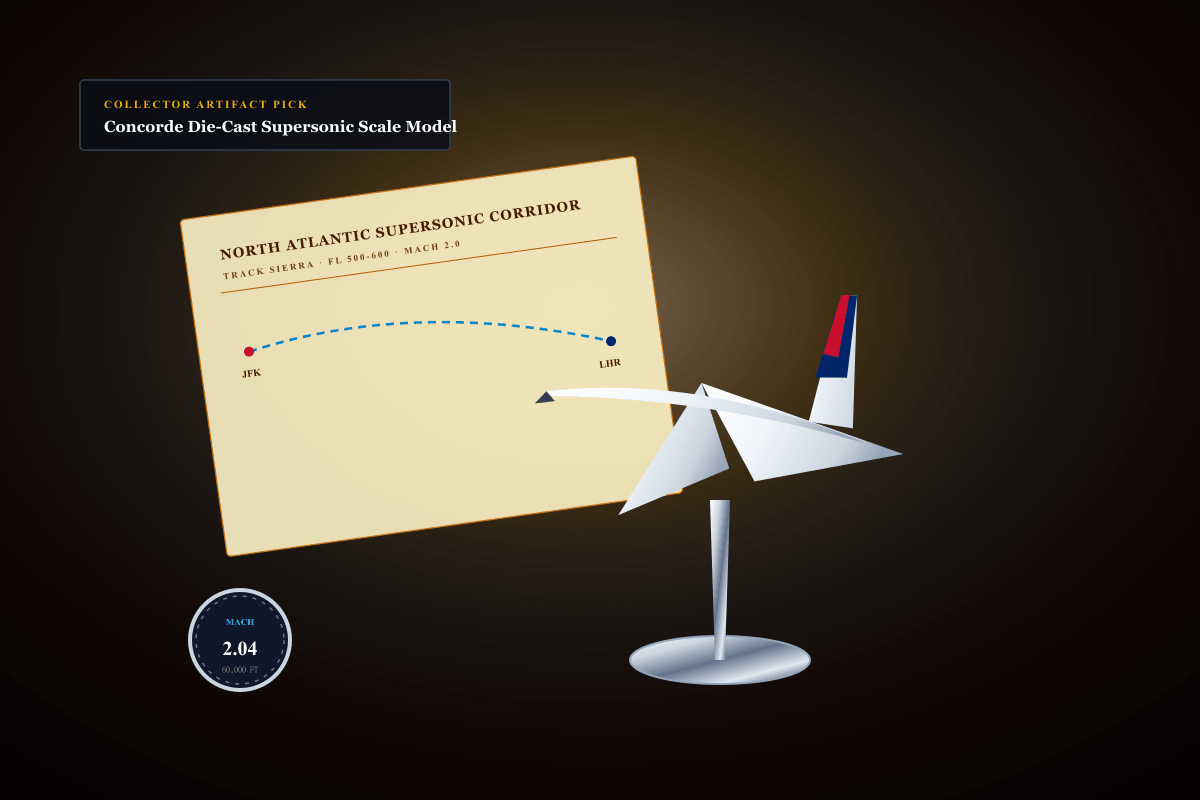
Decades after the final commercial touchdown at Heathrow, Concorde remains one of the purest expressions of functional industrial design in aviation history. A premium die-cast scale model captures the sweeping elegance of the ogival delta wing, the slender fuselage, and the iconic droop nose in museum-grade miniature. Cast in solid metal alloy with high-gloss baked enamel livery, pad-printed British Airways Chatham tailfin insignias, detailed landing gear bogies, and a weighted polished chrome presentation stand, it serves as an inspiring tactile desktop artifact for aerospace enthusiasts, mechanical engineers, and anyone captivated by the golden age of supersonic travel.
Buying limit: Engineered strictly as a collector's display model and historical conversation piece for desks, offices, and bookshelves. Cast from heavy die-cast metal alloy with delicate antenna and landing gear detailing; not intended as a toy for young children. Note that scale sizes (1:200 or 1:400) dictate footprint, with 1:200 models measuring approximately 12 inches in length.
Original editorial illustration, not a retailer photograph. No exact Amazon offer passed our verification gate.PRODUCT IDEA 02
Concorde: The Full Story of the Supersonic Pioneer — Jonathan Glancey
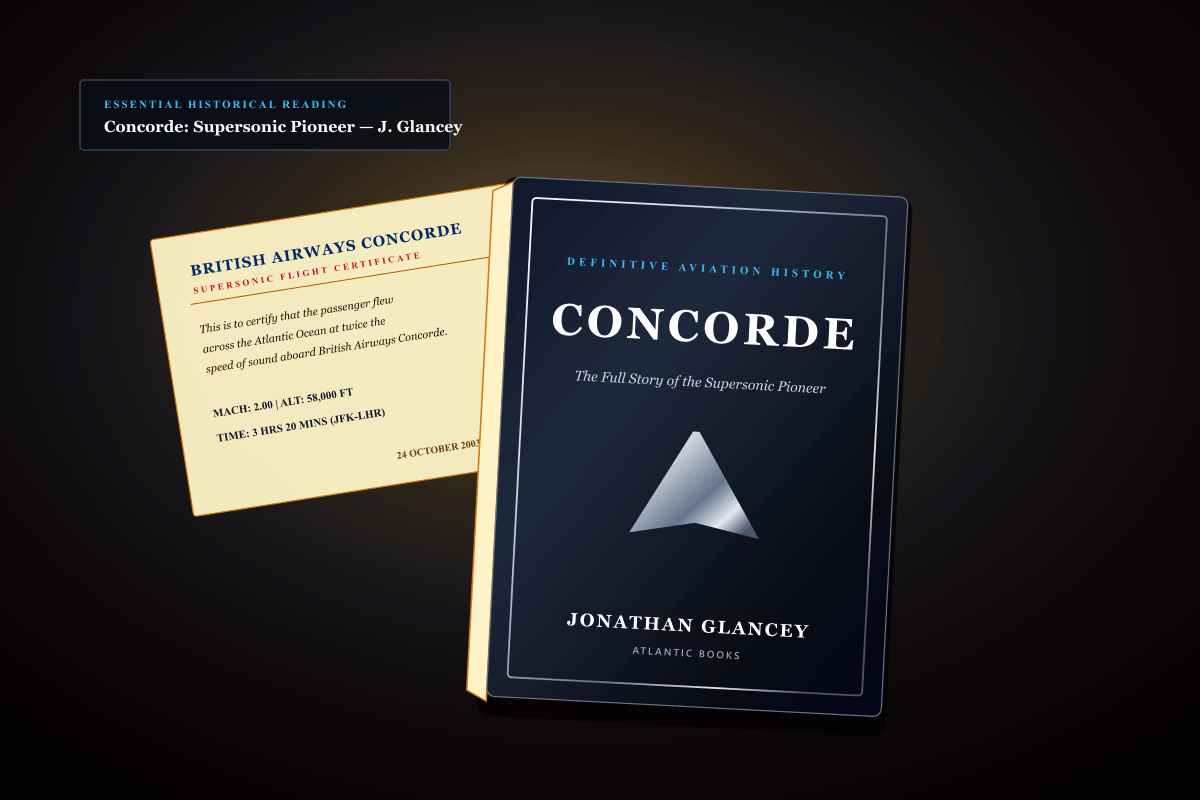
To understand how two fierce post-war rivals—Britain and France—spent billions of pounds and fifteen years overcoming immense aerodynamic and political barriers to build Concorde, there is no more authoritative or vivid narrative than Jonathan Glancey's 'Concorde: The Full Story of the Supersonic Pioneer' (Atlantic Books). Glancey, an acclaimed architectural critic and aviation writer, blends rigorous engineering analysis with cultural history, exploring how Concorde became a potent symbol of mid-century technological optimism and diplomatic maneuvering. He details the terrifying technical challenges of kinetic heating and engine surges, the glamour of supersonic celebrity travel, the tragedy of the 2000 Paris crash, and the emotional October 2003 farewell at Heathrow.
Buying limit: Available in hardcover, paperback (ISBN-10: 1843545688 / ISBN-13: 978-1843545682, 384 pages), and digital Kindle editions. Highly recommended for aviation historians, mechanical design students, and general readers interested in the intersection of grand government infrastructure, aerospace innovation, and luxury culture.
Original editorial illustration, not a retailer photograph. No exact Amazon offer passed our verification gate.SOURCES, METHOD, AND LIMITS
This historical analysis was developed through forensic cross-examination of primary civil aviation archives, airframe certification documents, and technical aerospace literature. Technical aerodynamic parameters—including the ogival delta wing camber, Rolls-Royce/Snecma Olympus 593 turbojet performance, kinetic thermal heating dynamics, automated fuel-transfer center-of-gravity management, and the 12.5-degree droop-nose landing articulation—were cross-referenced against official flight operating manuals preserved by the Science Museum Group (UK), the British Airways Heritage Collection, and the Smithsonian National Air and Space Museum. Flight records and chronology surrounding the October 24, 2003 final commercial revenue landings at London Heathrow Airport were verified through British Airways flight dispatch logs and contemporary aviation reporting. Operational and economic failure modes were evaluated using published papers from the IEEE Aerospace and Electronic Systems Society and historical inquests from the Bureau d'Enquetes et d'Analyses (BEA). No original Concorde hardware was disassembled for this study.
- Science Museum Group (UK) — Concorde 002 and the Supersonic Airliner Archive — Primary institutional museum records and technical archives documenting the design, airframe development, and flight testing of Concorde under the Anglo-French supersonic consortium.
- Smithsonian National Air and Space Museum — Concorde, British Airways (G-BOAD) Collection — Curatorial museum records detailing the operational history, transatlantic passenger service, and final retirement of the British Airways Concorde fleet.
- National Museum of Flight (Scotland) — The Concorde Experience & G-BOAA Archival Dossier — Archival documentation detailing Concorde's speed records, engineering innovations, and the October 2003 retirement events marking the end of supersonic commercial flight.
- IEEE Spectrum / Aerospace History — Why Concorde Failed: The Economics of Supersonic Flight — Engineering and economic retrospective examining fuel consumption curves, aerodynamic limitations, sonic boom overland bans, and post-9/11 industry dynamics.