ON THIS DAY · SEPTEMBER 29, 1988
32 Months to Earn Back Trust: How Discovery STS-26 Returned NASA to Flight After Challenger
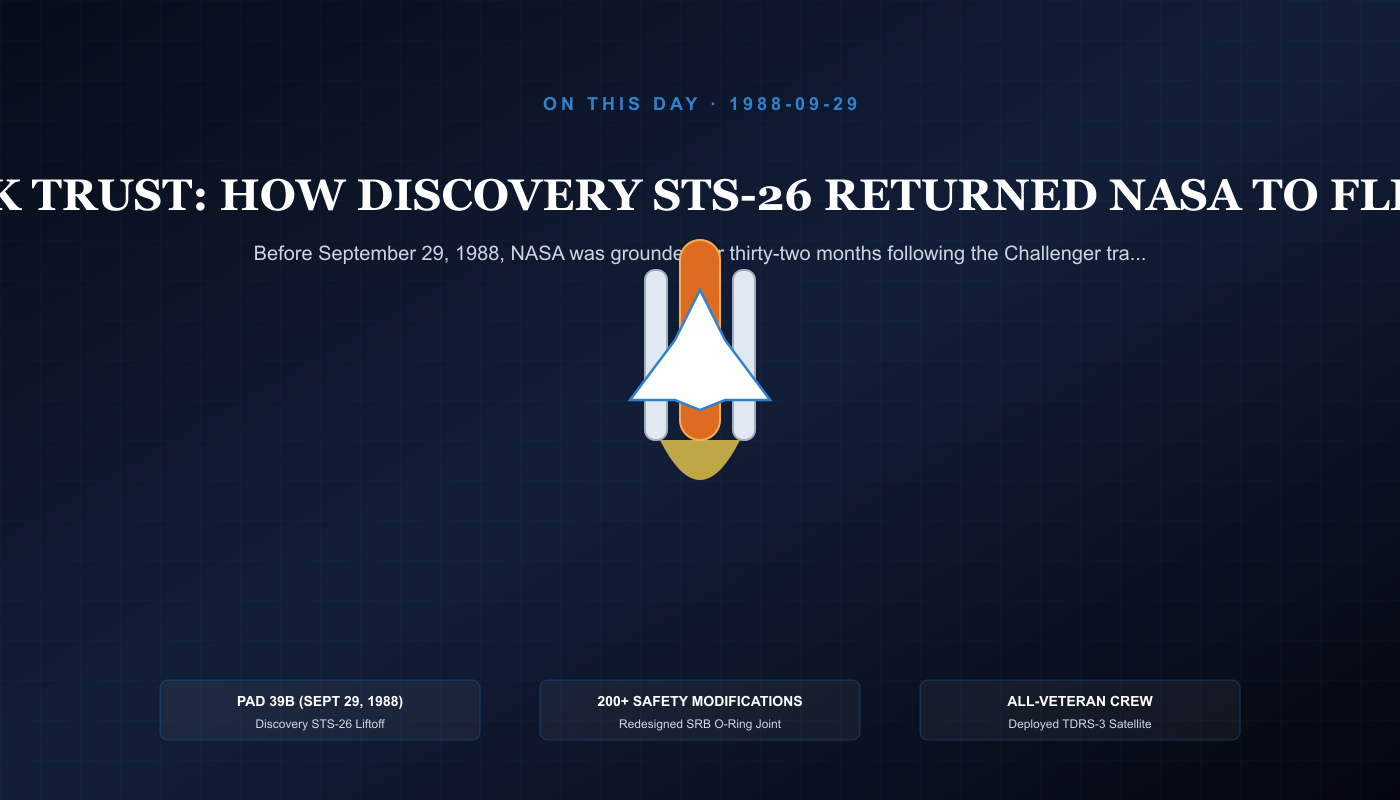
Before September 29, 1988, NASA was grounded for thirty-two months following the Challenger tragedy. When Space Shuttle Discovery lifted off from Pad 39B with an all-veteran crew, it marked the hardest-earned return to flight in aerospace history.
Thirty-Two Months of Reckoning: The Rogers Commission Directives
The loss of Space Shuttle Challenger and its seven crew members on January 28, 1986, plunged NASA into the most profound crisis in its history. The Presidential Commission on the Space Shuttle Challenger Accident, chaired by William P. Rogers with Nobel physicist Richard Feynman, uncovered critical design flaws and severe organizational communication breakdowns.
The Rogers Commission issued nine mandatory recommendations before the shuttle fleet could fly again. NASA instituted the longest safety stand-down in spaceflight history, lasting 975 days (thirty-two months). Engineers dismantled and re-evaluated every critical single-point failure mode across the orbiter, external tank, and solid rocket boosters.
Redesigning the Solid Rocket Motor Joint and Crew Safety
The primary mechanical cause of the Challenger accident—O-ring blowby caused by cold-temperature combustion gas blow-through at the casing field joints—was resolved through a radical redesign. The new Redesigned Solid Rocket Motor (RSRM) featured a steel capture tang that mechanically prevented joint deflection under ignition pressure, added a third primary O-ring, and installed built-in electric joint heaters to ensure rubber resilience regardless of weather.
Crew safety systems were completely overhauled. Astronauts were equipped with pressurized launch/entry escape suits (the iconic high-visibility orange "pumpkin suits") and an emergency telescoping crew escape pole that allowed the crew to slide clear beneath the orbiter’s wing in a controlled glide bailout situation.
September 29, 1988: Discovery Lifts Off from Pad 39B
On the morning of September 29, 1988, Commander Rick Hauck and his four veteran crew members boarded Discovery at Pad 39B. At 11:37 EDT, the redesigned booster rockets ignited, lifting Discovery smoothly into orbit amid worldwide relief and cheering crowds at Kennedy Space Center.
Over the four-day mission, Discovery deployed the Tracking and Data Relay Satellite (TDRS-3) to restore critical orbital space communications, performed eleven scientific experiments, and executed a flawless landing on Runway 17 at Edwards Air Force Base in California. Discovery’s flight restored American human space capability and re-established the culture of engineering verification.
What the evidence does not settle
Popular memory often portrays STS-26 as a triumphant return that permanently solved shuttle risk; however, as the 2003 Columbia accident investigation demonstrated, maintaining rigorous engineering vigilance against organizational normalization of deviance requires relentless institutional discipline. Readers should note the shuttle system remained an experimental spacecraft until its retirement in 2011.
PRODUCT IDEA 01
Challenger: A True Story of Heroism and Disaster on the Edge of Space — Adam Higginbotham

Adam Higginbotham delivers a masterclass in investigative aerospace journalism, drawing on declassified documents and hundreds of hours of interviews to chronicle the Challenger disaster, the Rogers Commission investigation, and the harrowing road to Discovery’s return to flight.
Buying limit: Available in hardcover (Simon & Schuster, ISBN 978-1ef982176610) and digital formats. Hardcovers typically trade between $24 and $35.
Original editorial illustration, not a retailer photograph. No exact Amazon offer passed our verification gate.PRODUCT IDEA 02
LEGO NASA Space Shuttle Discovery (10283) Building Set

An authentic 2,354-piece collector scale building set featuring Space Shuttle Discovery with opening payload bay doors, functional landing gear, elevons, and a deployable Hubble Space Telescope model.
Buying limit: Designed for adult collectors and display. Standard retail trades around $199.99 through authorized LEGO channels.
Original editorial illustration, not a retailer photograph. No exact Amazon offer passed our verification gate.SOURCES, METHOD, AND LIMITS
Researched using primary historical records from the Rogers Commission Report (June 1986), NASA NTRS Technical Document 19890006595 (STS-26: The Return to Flight), and the Columbia Accident Investigation Board (CAIB) Report. No commercial products were physically tested.
- NASA History Division — Report of the Presidential Commission on the Space Shuttle Challenger Accident — The primary federal commission report detailing the solid rocket booster joint design flaws, management decisions, and mandatory return-to-flight recommendations.
- NASA Technical Reports Server (NTRS) — STS-26: The Return to Flight (Document ID 19890006595) — Official NASA technical debrief analyzing Discovery’s launch dynamics, RSRM field joint telemetry, crew escape systems, and TDRS-3 deployment.