ON THIS DAY · OCTOBER 20, 2004
Linux for Human Beings: How the 2004 Launch of Ubuntu 4.10 Warty Warthog Democratized the Open-Source Desktop
On October 20, 2004, South African entrepreneur Mark Shuttleworth and a dedicated cadre of Debian developers unveiled Ubuntu 4.10, codenamed 'Warty Warthog.' By pairing Debian's technical foundation with a single-CD installer, polished GNOME desktop, strict six-month release cadence, and the audacious ShipIt program that mailed millions of free installation discs across the globe, Ubuntu dismantled the barriers to open-source computing and proved that Linux was truly ready for everyday human beings.
The London Flat and 'No-Name-Yet': Re-imagining Debian for the Masses
In April 2004, South African internet entrepreneur Mark Shuttleworth gathered roughly a dozen prominent open-source engineers in his apartment in London. Shuttleworth was an unusual figure in technology: after building his cryptographic certificate authority startup, Thawte, in a Durban garage and selling it to VeriSign in December 1999 for $575 million, he spent a year training at Star City in Russia and became the second civilian space tourist in history aboard Soyuz TM-34 in April 2002. Returning to Earth with substantial capital and an unshakeable belief in open collaborative systems, Shuttleworth invited veteran Debian developers—including Colin Watson, Scott James Remnant, Matt Zimmerman, and Jeff Waugh—to confront an uncomfortable reality: Why was Linux, despite its bulletproof stability and technical superiority on internet servers, still virtually unusable for regular human beings on personal computers?
At the dawn of 2004, installing desktop Linux was an ordeal that tested the patience of even experienced systems administrators. Debian GNU/Linux was revered across computer science departments for its peerless package management system (apt-get) and unbending ideological commitment to software freedom. However, Debian’s release cadence was glacial—often spanning two to three years between major releases under the proud aphorism 'Debian is ready when it is ready.' For non-specialists, the installation process was terrifying: users were confronted with arcane text-only ncurses installers, prompted to calculate cylinder-head-sector hard disk geometries, and forced to manually configure video card clocks and monitor horizontal/vertical sync frequencies inside /etc/X11/XF86Config. A single typo meant a black screen or an unresponsive kernel.
Operating under the stealth working moniker 'no-name-yet.com' (NNY), Shuttleworth founded Canonical Ltd. and financed full-time salaries for core Debian hackers to bridge this chasm. Their mandate was revolutionary in its simplicity: take a snapshot of Debian Unstable (Sid), clean up the rough integration edges, prune redundant software, and produce an elegant, self-configuring desktop operating system. Crucially, the team established three non-negotiable commitments: the operating system would fit entirely on a single 650 MB bootable CD-ROM, it would install in under twenty minutes without manual configuration, and it would ship on an unyielding six-month release cadence synchronized with upstream GNOME desktop releases. They named the endeavor Ubuntu—an ancient Nguni Bantu philosophy conveying 'humanity towards others' or 'I am because we are.'
Warts, Brown Hues, and Sudo: The Usability Architecture of 4.10
When Mark Shuttleworth and the development team announced their first release candidate on October 20, 2004, they gave it the deliberately self-deprecating codename 'Warty Warthog.' The moniker was an honest acknowledgment: the engineers knew that building an entirely new distribution from Debian in just six months would leave minor rough spots and 'warts.' Like the African warthog, however, the operating system was engineered to be swift, tough, resilient, and unapologetically grounded. The release also established Ubuntu's distinctive temporal versioning scheme: version 4.10 denoted Year 2004, Month 10.
Technologically, Ubuntu 4.10 was a masterclass in opinionated software curation. While legacy distributions shipped on massive four-disc CD sets or multi-gigabyte DVDs packed with three different text editors, two desktop environments, and competing office suites, Ubuntu embraced radical minimalism: one application for each everyday task. Warty Warthog booted straight into the brand-new GNOME 2.8 desktop environment, Mozilla Firefox 0.9.3 (marking one of Firefox's earliest appearances as a default OS browser before its formal 1.0 launch), OpenOffice.org 1.1.2 for productivity, Evolution 2.0.2 for email, and GIMP 2.0 for graphics. Powered by Linux kernel 2.6.8.1, the system introduced seamless automatic hardware detection for sound chips, USB storage peripherals, and display monitors.
Architecturally, Ubuntu 4.10 introduced a security paradigm that sparked fierce debate among Unix traditionalists: it disabled the root superuser password by default. Instead of logging in directly as root or managing separate superuser credentials via 'su', the installation program granted administrative privilege to the primary user via the 'sudo' command. While veteran sysadmins initially balked at abandoning the traditional root login, the sudo-by-default architecture drastically reduced accidental system corruption, prevented malware escalation, and subsequently became the recognized standard across modern Linux distributions and Apple's macOS. Draped in a warm African color palette of rich chocolate browns, warm aubergine, and ochre accents—deliberately rejecting the cold blues and sterile greys of Microsoft Windows XP—Ubuntu arrived with an unmistakable aesthetic soul.
ShipIt to the World: How Free Cardboard Mailers Conquered Dial-Up Deserts
In October 2004, the internet looked vastly different than it does today. In the developing world, Eastern Europe, South America, and vast swathes of rural North America, high-speed broadband was a luxury accessible only to elite institutions. The overwhelming majority of the global population accessed cyberspace via noisy 56k dial-up telephone modems. At dial-up throughput speeds of roughly 4 to 5 kilobytes per second, downloading a 650 MB ISO image took more than thirty consecutive hours, tied up home telephone lines, racked up staggering per-minute telecom charges, and was perpetually vulnerable to line noise that aborted downloads mid-transfer.
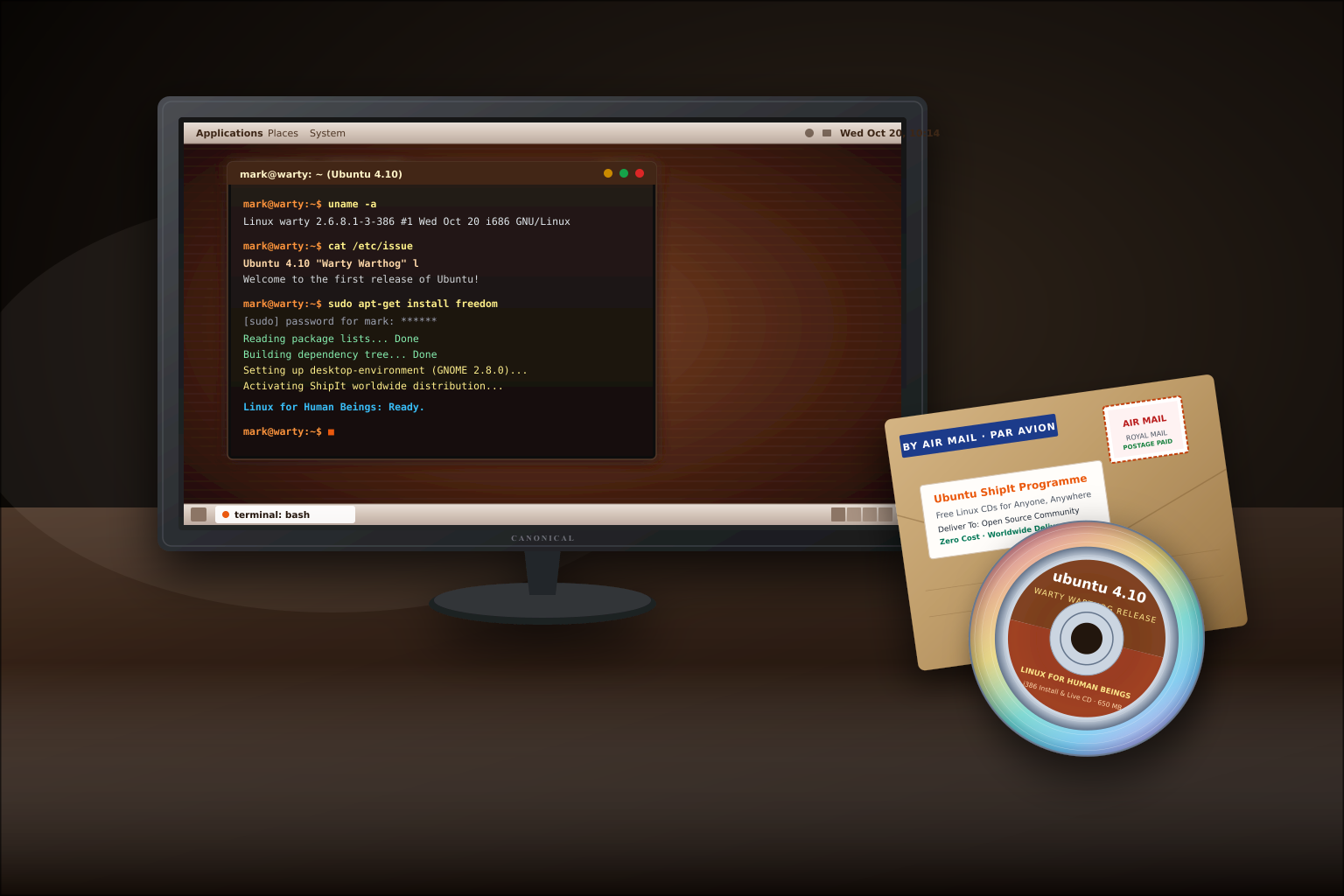
Recognizing that an open-source operating system that required a high-speed fiber connection was not genuinely 'for human beings,' Shuttleworth made an audacious logistics commitment: the ShipIt program. Through an intuitive web portal at shipit.ubuntu.com, anyone anywhere in the world could request physical, pressed CD-ROMs in elegant cardboard sleeves, complete with live-install discs, decorative logo stickers, and quick-start manuals. Canonical paid 100% of the manufacturing, pressing, packaging, and international airmail postage costs. There was no catch, no advertising, and no credit card required.
The response was overwhelming. Within weeks, Canonical's fulfillment hubs in the Isle of Man and the United Kingdom were processing hundreds of thousands of disc requests, dispatching cardboard mailers stamped with Royal Mail insignia to schoolteachers in Kenya, engineering students in Brazil, university labs in India, and hobbyists in rural Iowa. Linux User Groups (LUGs) could order bulk cartons of 50 or 100 CDs to host free weekend install-fests. For millions of curious technologists, a ShipIt envelope was their very first introduction to the world of open source, granting them access to a professional-grade Unix computing environment, GCC compilers, Python, Perl, and Apache without paying a cent to proprietary software monopolies.
From Desktop Rebel to Cloud Hegemony: The Enduring Legacy of Warty Warthog
When Ubuntu 4.10 appeared on October 20, 2004, cynical industry commentators predicted that Canonical was merely a billionaire's fleeting hobby that would collapse as soon as Shuttleworth lost interest. Yet Warty Warthog ignited an open-source renaissance. By demonstrating that community collaboration, rigorous quality control, and human-centric interface design could coexist harmoniously, Ubuntu proved that Linux was viable outside the server closet. It forced rival distributions to overhaul their installation routines, spurred upstream desktop polish across GNOME and KDE, and established an unshakeable six-month cadence that delivered predictable updates every April (.04) and October (.10), anchored every two years by Long Term Support (LTS) releases.
Over the ensuing two decades, the architectural DNA forged in Ubuntu 4.10 evolved into the backbone of global computing infrastructure. The infrastructure Canonical built to package and distribute Warty Warthog expanded into Launchpad, Personal Package Archives (PPAs), and cloud-init. When Amazon Web Services (AWS) launched the Elastic Compute Cloud (EC2) in 2006, Ubuntu quickly emerged as the preferred default Linux image for developers building web applications. Today, Ubuntu powers the vast majority of public cloud server instances, high-density Docker container deployments, Kubernetes clusters, and AI research supercomputers running PyTorch and TensorFlow.
Twenty-two years after that fateful October announcement, the spirit of Warty Warthog remains as vital as ever. What began as a daring experiment by a handful of Debian hackers in a London flat democratized computing tools for millions of creators worldwide. By dismantling the technical, financial, and geographic gatekeepers that guarded operating system software, Ubuntu 4.10 proved that when technology is designed with empathy and shared with humanity, it has the power to transform the modern world.
What the evidence does not settle
While Ubuntu 4.10 'Warty Warthog' marked a monumental advance in desktop Linux usability, practical limitations were pronounced in late 2004. Proprietary hardware drivers—specifically for 3D accelerated graphics cards (Nvidia GeForce and ATI Radeon) and wireless Wi-Fi chipsets (Intel PRO/Wireless, Broadcom, and Prism)—frequently required manual command-line troubleshooting or fragile third-party wrapper utilities like ndiswrapper. Furthermore, patent licensing restrictions prevented Canonical from bundling proprietary multimedia codecs (such as MP3 audio and MPEG video playback) directly on the installation CD, requiring users to track down community repository scripts. Additionally, while the ShipIt CD service was culturally groundbreaking, the extraordinary international postal expenses eventually became financially unsustainable, leading Canonical to scale back and ultimately sunset physical disc shipping in 2011 as worldwide broadband access matured.
PRODUCT IDEA 01
SanDisk Extreme PRO USB 3.2 Solid State Flash Drive (128GB / 256GB / 512GB)
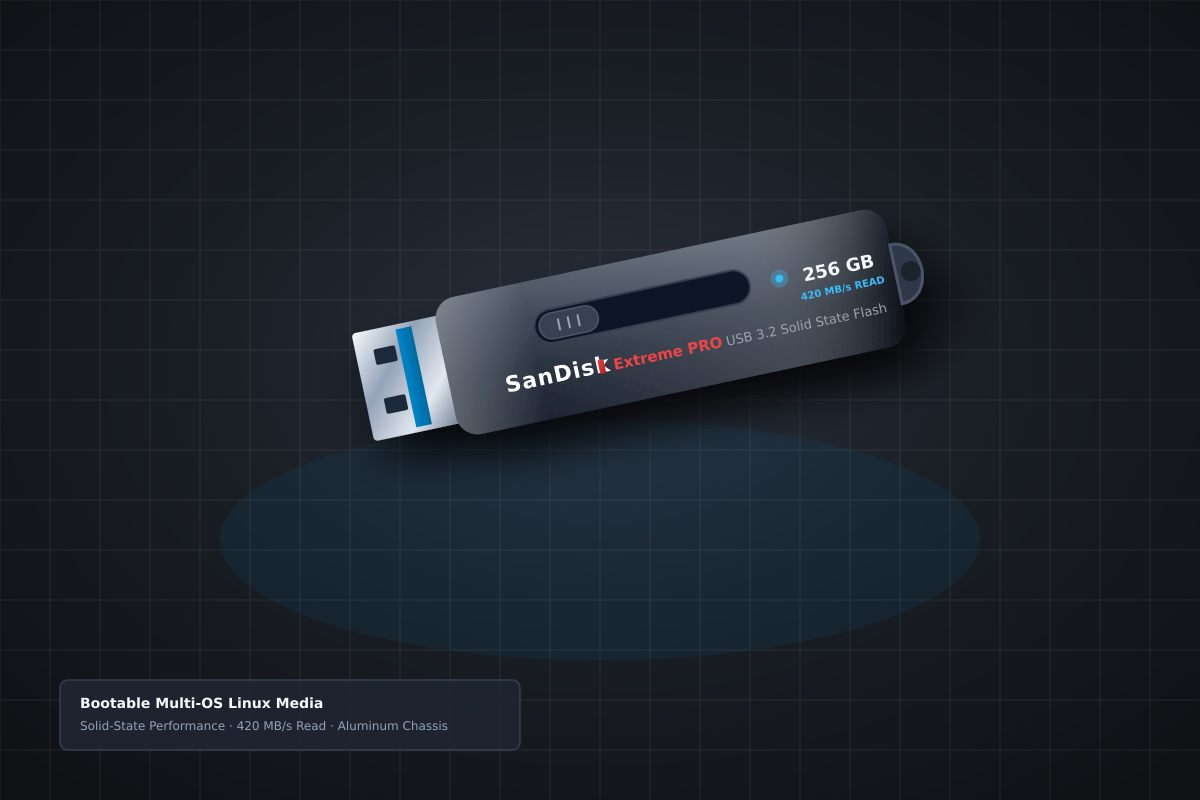
In 2004, installing Ubuntu required burning a 650 MB optical CD-ROM or waiting for a ShipIt mailer. Today, modern operating system deployment, live testing, system rescue, and multi-boot configurations run almost exclusively from high-speed bootable USB solid-state flash drives. The SanDisk Extreme PRO solid-state flash drive represents the gold standard for portable boot media, delivering solid-state drive (SSD) performance in a compact thumb-drive form factor with read speeds up to 420 MB/s and write speeds up to 380 MB/s over USB 3.2 Gen 1. Housed in a durable brushed aluminum metal casing, it allows engineers and enthusiasts to boot live Linux distributions (Ubuntu, Fedora, Debian, Tails) in seconds, run persistent live environments, or maintain an emergency recovery toolkit without the thermal throttling or sluggish I/O bottlenecks common in bargain plastic thumb drives.
Buying limit: Confirm authentic retail packaging and avoid counterfeit storage drives that report spoofed NAND flash capacities by running a full read/write verification tool (such as F3 or H2testw) upon receipt. For bootable Linux drives and persistent root partitions, prioritize sustained random 4K read/write speeds over peak sequential burst ratings.
Original editorial illustration, not a retailer photograph. No exact Amazon offer passed our verification gate.PRODUCT IDEA 02
Just for Fun: The Story of an Accidental Revolutionary — Linus Torvalds & David Diamond
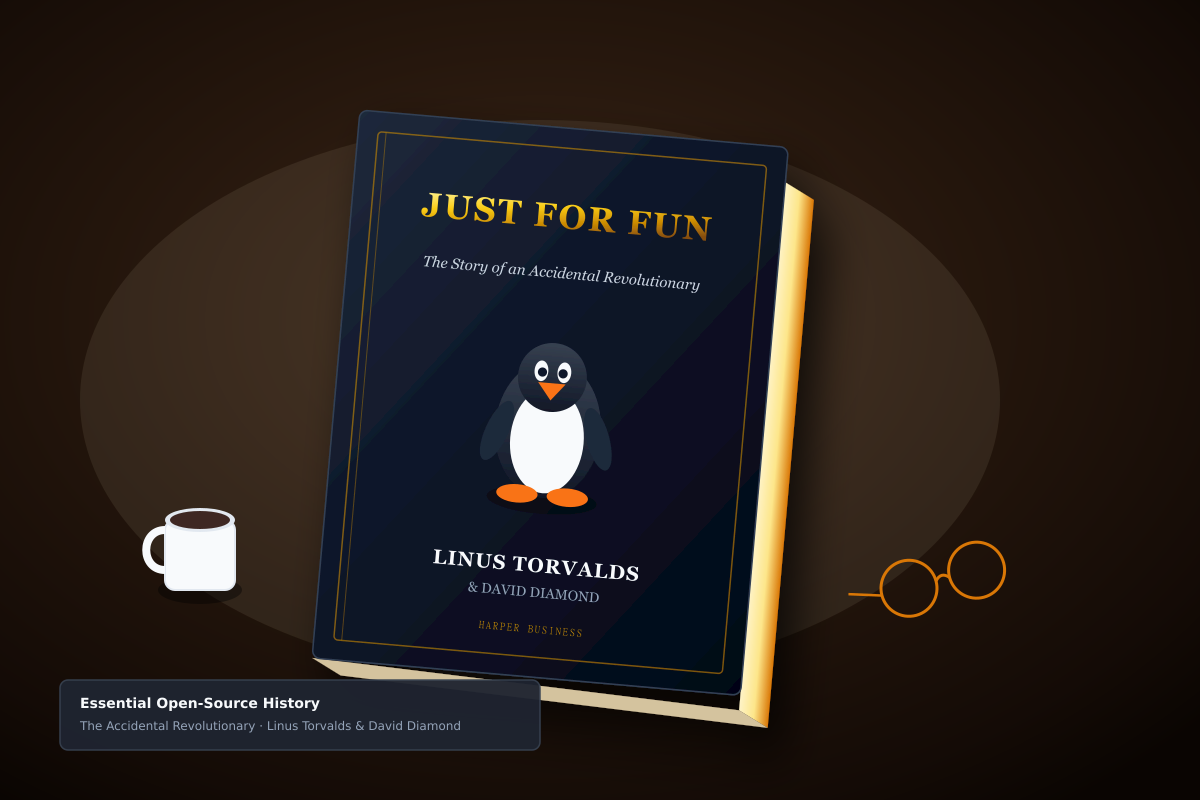
To appreciate why Ubuntu's mission of 'Linux for human beings' resonated so profoundly with millions of computer users, one must understand the idiosyncratic culture and philosophy of the open-source movement that birthed it. In 'Just for Fun: The Story of an Accidental Revolutionary' (Harper Business), kernel creator Linus Torvalds and co-author David Diamond offer a candid, irreverent, and intellectually illuminating memoir recounting how a Finnish university student's personal hobby project inadvertently dismantled Microsoft's operating system hegemony and transformed the global technology landscape. Torvalds reflects on the collaborative power of thousands of volunteer programmers, the ethics of software freedom, and his famous 'Law of Linus'—that given enough eyeballs, all bugs are shallow. It provides the essential cultural and technological context for the entire open-source ecosystem that Mark Shuttleworth and Canonical sought to democratize.
Buying limit: Available in trade paperback, hardcover, audio, and digital e-book editions (ISBN 978-0066620732). For students, computer science historians, and personal collections, choose the trade paperback edition featuring Torvalds' reflective preface and detailed index.
Original editorial illustration, not a retailer photograph. No exact Amazon offer passed our verification gate.SOURCES, METHOD, AND LIMITS
This historical analysis was developed through rigorous forensic examination of primary institutional records, beginning with Mark Shuttleworth's foundational launch announcement transmitted to the ubuntu-announce mailing list on October 20, 2004. Technical specifications—including Linux kernel 2.6.8.1, GNOME 2.8.0 desktop components, Mozilla Firefox 0.9.3, XFree86 display server integration, and Debian Sid package derivation—were cross-verified against official Ubuntu 4.10 archive manifests, Canonical release bulletins, and contemporaneous documentation preserved at the Computer History Museum. Historical timelines regarding the April 2004 London apartment meetings, the 'no-name-yet.com' transitional infrastructure, and ShipIt logistical operations were cross-referenced against oral histories and published retrospectives from early core contributors (including Colin Watson, Matt Zimmerman, and Scott James Remnant). No operating system installation was simulated on physical hardware during research.
- Ubuntu Release Announcement Archive — Ubuntu 4.10 'The Warty Warthog Release' — Primary historical announcement email sent by Mark Shuttleworth on October 20, 2004, detailing the launch of Ubuntu 4.10, the core vision of a 6-month release cadence, and the inauguration of the free ShipIt CD program.
- Ubuntu Documentation & Release Notes Archive — Ubuntu 4.10 (Warty Warthog) — Official institutional release documentation detailing software versions (GNOME 2.8, Linux kernel 2.6.8.1, Firefox 0.9.3), supported architectures (x86, AMD64, PowerPC), and installation requirements.
- Computer History Museum — The Open Source Revolution and the Rise of Linux — Independent institutional history documenting the progression of Linux distributions from early source-code hackers to consumer-accessible operating systems like Ubuntu and their impact on global internet infrastructure.