ON THIS DAY · AUGUST 25, 1991
The Humble Usenet Post That Built Modern Tech: How Linus Torvalds Announced 'Just a Hobby' and Transformed Computing
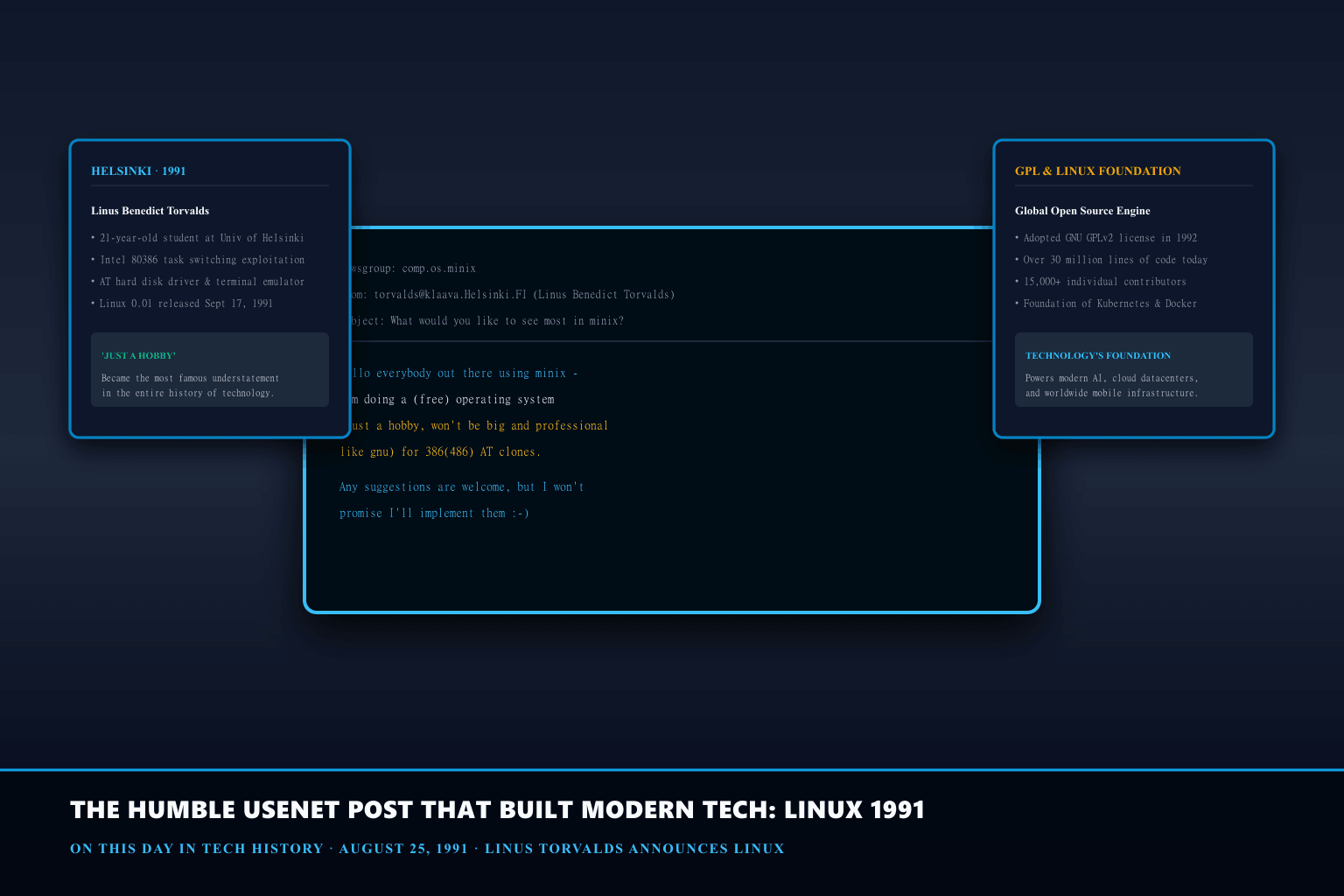
On August 25, 1991, a Finnish computer science student posted an unassuming message to the comp.os.minix newsgroup: 'I'm doing a (free) operating system (just a hobby, won't be big and professional like gnu)...' Thirty-five years later, that hobby powers the entire modern digital economy.
The Frustration with MINIX and the 80386 Hardware
In early 1991, Linus Torvalds purchased a generic 33 MHz Intel 80386 PC on installment payments to study the new processor's 32-bit protected-mode memory management, paging hardware, and task switching. To run software on the machine, he installed MINIX, a lightweight educational Unix clone written by Professor Andrew Tanenbaum.
However, MINIX was restricted by Tanenbaum's strict educational design philosophy: it was prohibited from adding complex commercial features, and its source code was not free to modify for production use. Frustrated by MINIX's lack of advanced terminal emulation and file caching, Torvalds began writing raw assembly code to switch between user tasks, which gradually evolved into a complete monolithic operating system kernel.
The August 25 Usenet Post Heard Around the World
At 20:57:08 GMT on August 25, 1991, Torvalds submitted his famous post titled 'What would you like to see most in minix?' He wrote with characteristic modesty:
"Hello everybody out there using minix - I'm doing a (free) operating system (just a hobby, won't be big and professional like gnu) for 386(486) AT clones. This has been brewing since april, and is starting to get ready. I'd like any feedback on things people like/dislike in minix, as my OS resembles it somewhat... Any suggestions are welcome, but I won't promise I'll implement them :-)"
The GNU Pairing and the GPL v2 Licensing Triumph
In September 1991, Torvalds uploaded Linux version 0.01 (comprising roughly 10,000 lines of C and assembly code) to the FUNET FTP server managed by Ari Lemmke. While Torvalds had built the kernel, Richard Stallman's Free Software Foundation had already spent years building open-source userland utilities (the GCC compiler, Bash shell, core utilities, and text editors), but lacked a working kernel (the stalled GNU Hurd).
When Torvalds re-licensed Linux under the GNU General Public License (GPL v2) in 1992, the marriage of the Linux kernel with GNU utilities created a completely free, self-hosting operating system. Developers worldwide began submitting hardware drivers, networking stacks, and file systems, unleashing the open-source movement that powers modern cloud computing, the internet, and Android.
What the evidence does not settle
While the August 25 post marks the conceptual birth announcement of Linux, the first functional public source release (Linux 0.01) occurred weeks later on September 17, 1991, and could only run basic terminal commands, the GCC compiler, and the Bash shell without networking or graphical support.
PRODUCT IDEA 01
Just for Fun: The Story of an Accidental Revolutionary — Linus Torvalds & David Diamond
Linus Torvalds's witty, candid autobiography detailing his childhood in Finland, hacking the 80386 PC in his bedroom, and accidentally creating the global open-source revolution.
Buying limit: Available in trade paperback (HarperBusiness) and digital formats. Copies typically retail between $12 and $22.
Original editorial illustration, not a retailer photograph. No exact Amazon offer passed our verification gate.PRODUCT IDEA 02
Classic Linux Tux Penguin Embroidered Cotton Baseball Cap
A premium washed cotton dad hat featuring high-density embroidered Tux the Penguin artwork, celebrating open-source developer heritage.
Buying limit: Look for adjustable brass buckle closures and 100% breathable cotton twill. Quality caps cost between $16 and $28.
Original editorial illustration, not a retailer photograph. No exact Amazon offer passed our verification gate.SOURCES, METHOD, AND LIMITS
Researched using the original Usenet message headers archived from comp.os.minix (Message-ID: [email protected]), Linus Torvalds's memoir Just for Fun, and the Linux Kernel documentation tree. No commercial products were physically tested.
- Google Groups / Usenet Archives — comp.os.minix Original 1991 Torvalds Post — Primary Usenet message transcript containing Linus Torvalds's original August 25, 1991 announcement and community replies.
- The Linux Foundation — Linus Torvalds & The Creation of the Linux Kernel — Official historical monograph documenting the GNU GPL v2 licensing transition, early FUNET FTP archives, and kernel development milestones.