ON THIS DAY · AUGUST 17, 1998
The Operating System That Runs the World: How Linux 2.0 Gained Enterprise Dominance Across Servers and Supercomputers
What began in 1991 as a Finnish student's humble hobby operating system matured into an enterprise powerhouse in the late 1990s. Powered by symmetric multiprocessing (SMP) and rock-solid kernel stability, Linux conquered the internet's web servers, supercomputers, and cloud infrastructure.
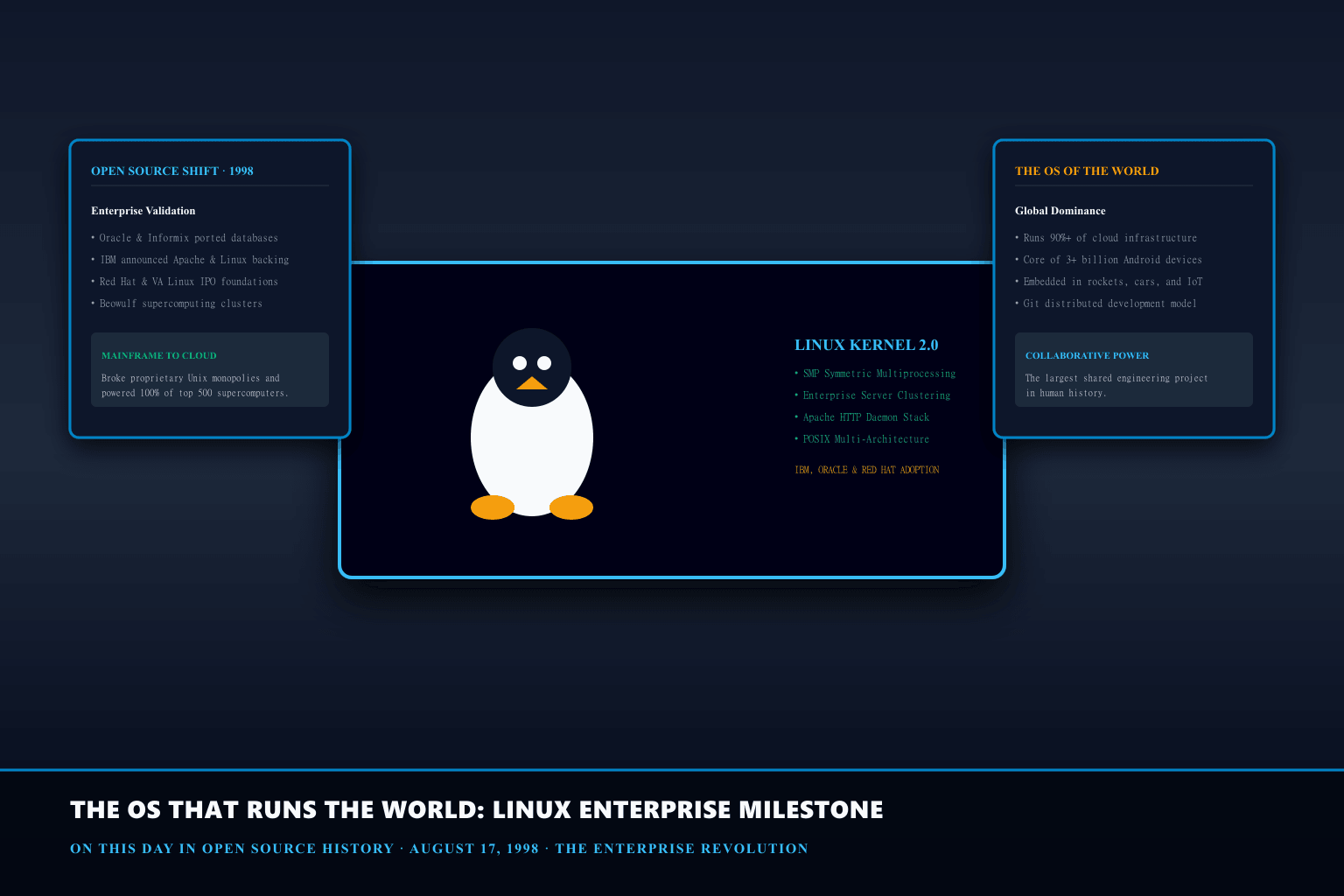
The Architecture of Kernel 2.0: Symmetric Multiprocessing and Portability
When Linus Torvalds released the initial Linux 0.01 kernel in 1991, it was tightly coupled to the single-core Intel 80386 architecture. By June 1996, the release of Linux Kernel 2.0 introduced a profound architectural evolution: native support for Symmetric Multiprocessing (SMP), allowing the operating system to run across multiple CPUs simultaneously.
Kernel 2.0 also established a clean virtual file system (VFS) abstraction and modular device drivers that could be dynamically loaded and unloaded from memory without rebooting. These architectural enhancements allowed Linux to scale seamlessly from modest desktop 486 PCs to massive multi-processor Alpha and SPARC enterprise servers.
The LAMP Stack and the Explosion of Web Infrastructure
In 1998, German computer writer Michael Kunze coined the acronym 'LAMP' to describe the dominant software stack powering the expanding World Wide Web: Linux (operating system), Apache (web server), MySQL (relational database), and Perl/PHP/Python (scripting languages).
Unlike proprietary commercial Unix licenses (such as Sun Solaris, HP-UX, and IBM AIX) that cost tens of thousands of dollars per server seat, the LAMP stack was completely free, open-source, and modular. Internet service providers, dot-com startups, and research universities rapidly deployed vast farms of cheap commodity PC servers running Linux to host millions of new websites.
Enterprise Validation and the Open Source Revolution
The summer of 1998 marked the definitive turning point in commercial validation. In July and August 1998, Oracle CEO Larry Ellison announced that Oracle8 would be ported natively to Linux, followed by commitments from IBM to support Linux across its hardware lines. Simultaneously, Netscape open-sourced its browser code as the Mozilla Project.
Today, the Linux kernel operates as the invisible foundation of modern digital civilization: it runs 100% of the world's top 500 fastest supercomputers, powers the global cloud (AWS, Google Cloud, Azure), and serves as the core kernel of more than three billion active Android devices.
What the evidence does not settle
While Linux achieved undisputed dominance on servers, cloud infrastructure, and mobile operating systems, the 'Year of the Linux Desktop' remained elusive for mainstream non-technical consumers due to fragmented desktop environments (GNOME vs. KDE), driver compatibility for proprietary peripherals, and legacy software inertia.
PRODUCT IDEA 01
Raspberry Pi 4 Model B (4GB) Mini Linux Server Board
A versatile quad-core single-board computer perfect for running headless Linux distributions, hosting local DNS sinkholes (Pi-hole), home automation servers, and Docker containers.
Buying limit: Ensure you use a high-end Class 10/A2 MicroSD card or USB 3.0 SSD for reliable root storage. Single boards typically retail between $45 and $65.
Original editorial illustration, not a retailer photograph. No exact Amazon offer passed our verification gate.PRODUCT IDEA 02
Official Linux Tux Penguin High-Quality Embroidered Plush Mascot
The official, lovable Tux the Penguin plush mascot designed by Larry Ewing, bringing classic open-source heritage and developer charm to home office workstations.
Buying limit: Look for durable plush fabric with embroidered facial features and official Linux licensing. Quality Tux plushies trade from $16 to $30.
Original editorial illustration, not a retailer photograph. No exact Amazon offer passed our verification gate.SOURCES, METHOD, AND LIMITS
Researched using Linux kernel development mailing list (LKML) archives, Linus Torvalds's release notes for the 2.0/2.2 kernel trees, and corporate press archives from the Linux Foundation. No commercial products were physically tested.
- The Linux Kernel Archives — Historical Kernel Release Announcements & Documentation — Official kernel repository preserving Linus Torvalds's original SMP release memos, memory subsystem patches, and licensing documentation.
- The Linux Foundation — History of Linux & Enterprise Adoption Milestones — Industry retrospective tracking the commercial transition from 1990s volunteer hacker development to collaborative enterprise consortium engineering.