ON THIS DAY · OCTOBER 26, 1861
The Day the Wire Silenced the Horse: How the 1861 Transcontinental Telegraph Ended the Pony Express and Created Real-Time America
On October 26, 1861, the Central Overland California and Pikes Peak Express Company issued a terse public notice that brought the most romanticized mail experiment in American history to an abrupt close: the Pony Express was discontinued. Just two days earlier in Salt Lake City, two rival construction crews working for Western Union joined the final strands of the transcontinental telegraph, allowing electrical pulses carrying Morse code to leap from Sacramento to Washington, D.C. in seconds. For eighteen months, wiry young riders had galloped 1,900 miles across deserts, blizzards, and hostile mountain passes in ten grueling days. But when electrons began coursing down a single galvanized iron wire at the speed of light, mammalian muscle power was rendered instantly obsolete, forever severing human communication from physical transportation.

Ten Days Across the Wilderness: The Athletic Triumph and Fatal Economics of the Pony Express
In the spring of 1860, the United States was a continental nation fractured by vast geographic isolation. California had surged into a prosperous Pacific powerhouse following the 1849 Gold Rush, yet communicating with the eastern states remained an agonizing ordeal. The fastest standard route—steamships carrying mail from New York to Panama, ferrying bags across the jungle isthmus by railroad, and steaming up the Pacific coast to San Francisco—took twenty-two to thirty days. The southern Butterfield Overland Mail stagecoach route through Texas and Arizona required nearly twenty-four days. In an era when political tension was hurtling toward civil war, an entire month of communication lag between Washington and the Pacific frontier was an existential vulnerability.
To bridge this chasm, freight tycoons William H. Russell, Alexander Majors, and William B. Waddell launched the Central Overland California and Pikes Peak Express Company—popularly christened the Pony Express—on April 3, 1860. The operational logistics were staggering. The founders established 190 relay stations spaced ten to fifteen miles apart along a 1,966-mile corridor between St. Joseph, Missouri, and Sacramento, California. They purchased over 400 prime horses—tough California mustangs and thoroughbred hybrids—and hired eighty wiry, lightweight riders, often recruited with the famously frank newspaper notice seeking 'young, skinny, wiry fellows... willing to risk death daily; orphans preferred.' Riders were equipped with lightweight Spencer carbines or Colt revolvers, a horn to alert station keepers, and a specially designed leather saddle cover called a mochila, which featured four padlocked cantinas holding up to twenty pounds of mail.
The Pony Express was an undisputed athletic and logistical marvel. Riders galloped seventy-five to one hundred miles per shift, vaulting from one exhausted horse to a fresh mount in under two minutes, braving blinding Rocky Mountain blizzards, desert heat, and armed conflict during the Pyramid Lake Paiute War. They slashed transcontinental transit times to a reliable ten days—and delivered Abraham Lincoln's inaugural address in March 1861 in an astonishing record of seven days and seventeen hours. Yet behind the heroic frontier mythology lay financial catastrophe. Setting mail tariffs at $5 per half-ounce (later reduced to $1) could never offset the astronomical expenses of maintaining armed station keepers, purchasing grain in the barren desert, and replacing stock. The company burned through cash at a ruinous rate, losing over $200,000 in eighteen months. More crucially, the founders always understood that the Pony Express was an interim proof-of-concept: a desperate gambit to win a lucrative federal mail subsidy while keeping the central corridor open until an invisible, infinitely faster competitor arrived.
Creighton, Gamble, and 27,500 Poles: The Desperate Race to Wire the Continent
The death warrant of the Pony Express had actually been signed before its riders completed their first summer in the saddle. On June 16, 1860, President James Buchanan signed the Pacific Telegraph Act, authorizing an annual federal subsidy of $40,000 for ten years to any contractor capable of constructing and operating an electric telegraph line connecting the western frontier of Missouri to San Francisco. Hiram Sibley, the visionary president of the Western Union Telegraph Company, recognized that transcontinental telegraphy would consolidate Western Union's corporate hegemony over American communications. While prominent engineers and Wall Street financiers declared the overland route impossible—predicting that wandering buffalo herds would topple poles, severe winter freezes would snap wires, and Native American tribes would burn stations—Sibley organized two coordinated subsidiaries to build inward from both coasts.
The eastern segment, the Pacific Telegraph Company, was overseen by Edward Creighton, a brilliant telegraph builder and surveyor. Creighton's crews mobilized in Omaha, Nebraska, in the early summer of 1861, driving westward across the desolate Great Plains toward Salt Lake City. Simultaneously, the western segment, the Overland Telegraph Company, was directed by James Gamble, who assembled teams in Carson City, Nevada, to push eastward across the brutal alkaline salt flats and desert basins of the Great Basin. The construction effort was an epic logistical triumph conducted under the looming shadow of the Civil War, which had erupted in April 1861 and threatened to cut the Union off from California's gold reserves.
To span the 2,000-mile wilderness, Creighton and Gamble's workforces had to fell, haul, and erect more than 27,500 cedar, pine, and cottonwood poles across treeless prairie where timber often had to be carted over two hundred miles by ox teams. Over 1,500 miles of single-strand No. 9 galvanized iron wire had to be unspooled, hoisted onto green glass 'beehive' insulators, and tensioned by hand. Creighton personally traveled ahead of the crews, negotiating right-of-way treaties with Shoshone, Sioux, and Cheyenne leaders. In one famous diplomatic demonstration, Creighton allowed tribal chiefs to experience an electric shock from a Grove chemical battery through the wire, convincing them that the singing wire carried the voice of the Great Spirit and should not be molested. Progress was astonishingly swift: while Congress had allowed two years for completion, Creighton and Gamble's crews erected up to ten to twelve miles of completed telegraph line every single day.
October 24 to 26, 1861: The Lightning Speaks to Lincoln and the Horses Stand Down
By mid-October 1861, the gap between the two converging construction fronts had narrowed to a few dozen miles in Utah Territory. On October 18, James Gamble's western line entered Salt Lake City. Six days later, on the afternoon of October 24, 1861, Edward Creighton's eastern crews tied the final connection into the Salt Lake City telegraph office, completing the first continuous electric communications circuit spanning the North American continent. That evening at 7:45 PM, California Chief Justice Stephen J. Field sat before a telegraph key in Sacramento and transmitted the inaugural transcontinental telegram to President Abraham Lincoln in Washington, D.C. Field declared that the completion of the line bound the Pacific coast indissolubly to the federal Union: 'The people of California desire to congratulate you upon the completion of this great work, and to express their loyalty to the Union and their determination to stand by its Government.' Lincoln immediately sent a grateful reply, recognizing that the wire secured California's vast gold reserves and strategic ports for the Union war effort.
For the Pony Express, the completion of the line was an instantaneous, fatal shock. For eighteen months, horses and men had strained mammalian muscle and bone to deliver a message in 240 hours. Now, an electrical impulse traveled the identical corridor in approximately one-fiftieth of a second. Two days later, on Saturday, October 26, 1861, the Central Overland California and Pikes Peak Express Company published its formal notice in San Francisco and Sacramento newspapers: 'The Pacific Telegraph Company has completed their line to San Francisco... The Pony Express will therefore be discontinued.'
There was no grand ceremony, no mourning procession, and no sentimentality. Stations were immediately ordered to stop accepting new express correspondence. A handful of riders who were already mid-route between Salt Lake City, Fort Laramie, and St. Joseph finished their runs over the following week to deliver the final letters already sealed inside their mochilas. By early November 1861, the last hoofbeats faded into Western silence. In total, the Pony Express had carried roughly 35,000 letters and lost only a single mail pouch in eighteen months of operation. But in the ruthless calculus of technological evolution, an entire transportation industry had been erased in forty-eight hours by a strand of iron wire no thicker than a pencil.
Detaching Information from Geography: The Infrastructure Legacy of the Talking Wire
The silencing of the Pony Express on October 26, 1861 marked a profound watershed in human civilization: the decisive moment when communication was permanently decoupled from physical transportation. Since the dawn of human history, information could travel no faster than the swiftest physical vessel—a runner, a galloping horse, a carrier pigeon, a sailing ship, or a steam locomotive. The electric telegraph eradicated the tyranny of geography. As Canadian media theorist Marshall McLuhan observed a century later, the telegraph transformed the planet into an electric nervous system, allowing human consciousness and commercial decision-making to occur instantaneously across continental distances.
The strategic impact on the American Civil War was immediate and decisive. The transcontinental telegraph gave the Lincoln administration an instant operational channel to military commanders on the Pacific coast, neutralizing Confederate sympathizers in Southern California and coordinating the maritime transport of millions of dollars in Comstock lode silver and California gold directly into the federal Treasury to finance the war effort. For the commercial world, the telegraph created unified national commodity and stock markets, eliminated price arbitrage across cities, and enabled newspapers to publish 'today's news today' under the revolutionary byline 'via Western Union Telegraph.'
Technologically, the 1861 overland line established the physical corridor and construction methodology that enabled the First Transcontinental Railroad, completed eight years later at Promontory Summit in 1869. The telegraph lines were moved to run alongside the iron rails, forming the twin backbones of American industrial expansion. More fundamentally, the humble Morse straight key, the discrete on-and-off electrical pulse, and the binary rhythm of dots and dashes laid the conceptual and architectural foundation for all modern digital networking. Long before fiber-optic cables crossed the Atlantic or packets routed through the internet, the singing iron wire that silenced the Pony Express proved that human intelligence travels best at the speed of light.
What the evidence does not settle
While the completion of the first transcontinental telegraph on October 24–26, 1861 was hailed as an engineering miracle, the initial overland system operated under severe technical and environmental limitations. The original network relied on a single uninsulated galvanized No. 9 iron wire strung across 2,000 miles of wilderness without automated duplexing or multiplexing, restricting transmission to a single simplex message stream at roughly 15 to 20 words per minute using manual Morse hand keys. In extreme winter storms, heavy icing, fallen timber, and prairie fires repeatedly snapped the wire, requiring linesmen to patrol hundreds of miles of desolate territory on horseback to locate breaks. Messages had to be manually re-keyed at intermediate repeater stations (such as Salt Lake City, Fort Laramie, and Omaha) because signal attenuation across thousands of miles exceeded the operational sensitivity of early electromagnetic relays. Furthermore, initial tariffs were extraordinarily expensive—costing $1 per word (equivalent to over $35 today)—limiting early commercial telegraphy to emergency military dispatches, banking remittances, and pressing government statecraft until multi-wire infrastructure followed the transcontinental railroad in 1869.
PRODUCT IDEA 01
Putikeeg Heavy Duty Solid Brass Morse Code Straight Key (CW Telegraph Manual Key & Practice Oscillator Interface)
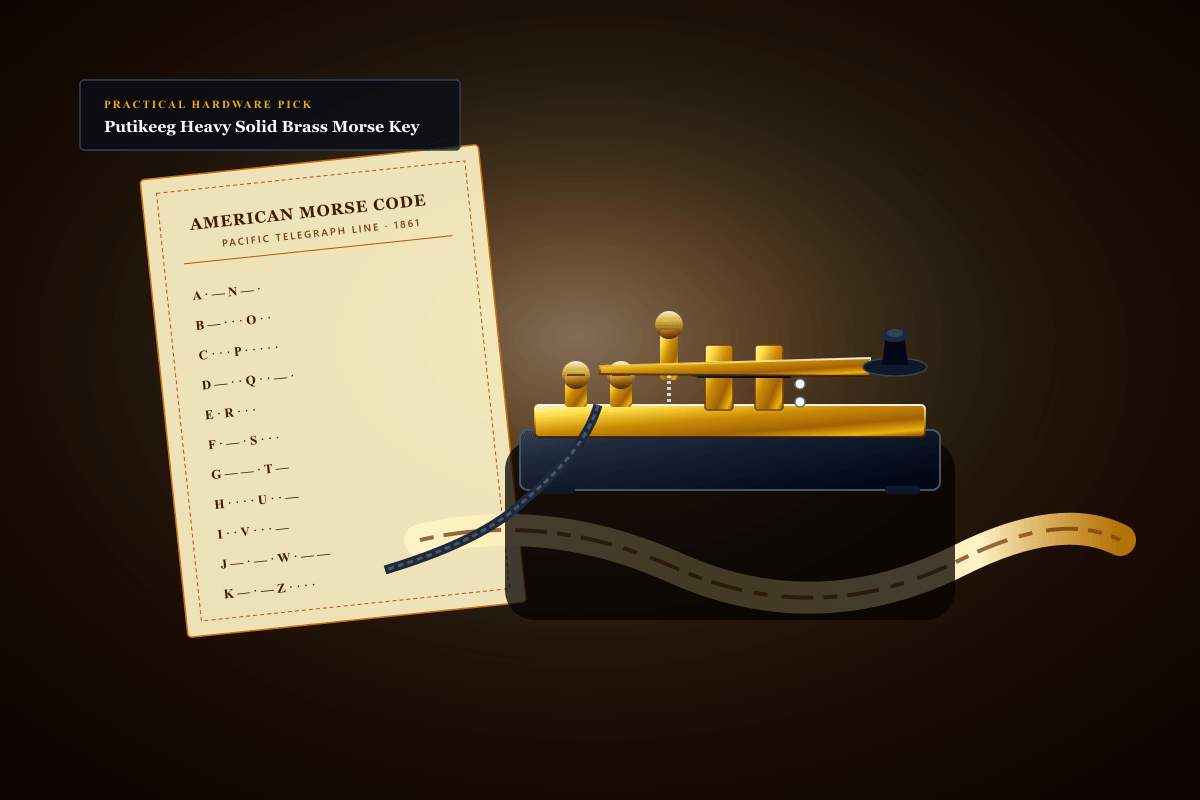
Well over a century after the transcontinental telegraph silenced the Pony Express, the manual straight key remains the foundational human-machine interface for discrete electronic communication. The Putikeeg Heavy Duty Solid Brass Straight Key is a precision-machined CW telegraph key built for amateur radio operators, electronics hobbyists, and STEM educators who want to experience the tactile mechanics that opened the telecommunications era. Machined from solid brass with dual sealed ball bearings, precision stainless steel contact screws, adjustable spring tension, and a weighted non-slip steel base, it provides the authentic tactile feedback of 19th-century telegraph stations. Fitted with a standard 3.5mm audio jack, it connects directly to modern amateur radio transceivers or standalone practice oscillators, allowing enthusiasts to practice the rhythmic dot-and-dash code that first transmitted information across the continent at the speed of light.
Buying limit: Engineered specifically for amateur radio (CW) operators, Morse code learners, and historical signaling demonstrations. It is a manual electromechanical signaling key and requires connection to either an amateur radio transceiver, code practice oscillator, or computer audio interface to produce audible sidetone sounds. Not intended for voice or automated digital packet communication.
Original editorial illustration, not a retailer photograph. No exact Amazon offer passed our verification gate.PRODUCT IDEA 02
The Victorian Internet: The Remarkable Story of the Telegraph and the Nineteenth Century's On-Line Pioneers — Tom Standage
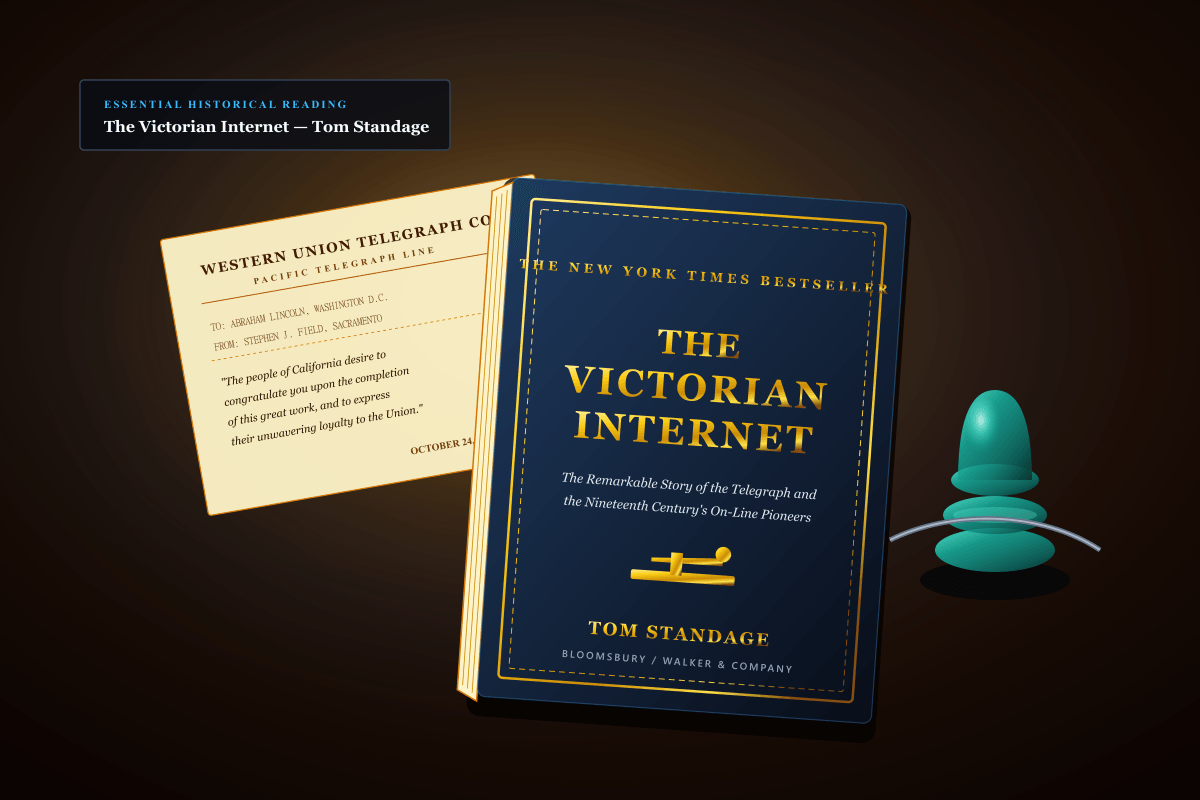
To understand how the transcontinental telegraph fundamentally altered human society, there is no more illuminating or engaging work than Tom Standage's classic history, 'The Victorian Internet' (Bloomsbury USA / Walker & Company). Standage, deputy editor at The Economist, traces the rise of the electric telegraph in the 19th century and uncovers astonishing parallels to the modern internet: online romances conducted over the wires, clandestine subcultures of telegraph operators, secret encryption keys, wire fraud and cybercrime, information overload, and breathless predictions that instantaneous global communication would bring an end to all human warfare. By connecting the drama of the 1861 overland line and transatlantic cables to our current digital dilemma, Standage demonstrates that our online obsessions and anxieties are far from new.
Buying limit: Widely available in paperback (ISBN-10: 162040592X / ISBN-13: 978-1620405925, 240 pages), hardcover, audiobook, and digital eBook formats. Essential reading for telecommunications engineers, historians, students of media theory, and anyone seeking perspective on how communication networks reshape culture. Note that this is a narrative history of technology and communications rather than a technical radio manual.
Original editorial illustration, not a retailer photograph. No exact Amazon offer passed our verification gate.SOURCES, METHOD, AND LIMITS
This historical analysis was developed through rigorous forensic examination of primary 19th-century legislative acts, institutional telegraph archives, and federal postal trail records. Technical construction parameters—including the Pacific Telegraph Act of 1860 (12 Stat. 41), the procurement of 27,500 cedar and pine poles, the deployment of No. 9 galvanized iron wire, and the installation of Grove chemical wet-cell battery plants—were cross-referenced against Western Union corporate archives preserved in the Library of Congress Hiram Sibley Papers and the Engineering and Technology History Wiki (IEEE Milestone: Transcontinental Telegraph, 1861). Primary telegrams exchanged on October 24, 1861 between California Chief Justice Stephen J. Field, Utah Territory Governor Brigham Young, and President Abraham Lincoln were verified against original records in the National Archives and Records Administration (NARA Record Group 107). Operational details and financial audits of the Central Overland California and Pikes Peak Express Company (COCPP)—including rider logistics, the four-pocket mochila saddle cover, and the formal October 26, 1861 discontinuation announcement—were verified through research collections at the Smithsonian National Postal Museum and the National Park Service Pony Express National Historic Trail. No original 1861 artifacts were physically handled during this research.
- IEEE History Center / ETHW — Milestones: Transcontinental Telegraph, 1861 — Official IEEE engineering milestone documentation detailing Western Union, the Pacific Telegraph Company, and the Overland Telegraph Company erecting over 2,000 miles of telegraph line across North America to link the Atlantic and Pacific coasts.
- Library of Congress — Today in History: The Transcontinental Telegraph and the End of the Pony Express — Primary institutional records documenting the completion of the first transcontinental telegraph on October 24, 1861, the inaugural telegrams sent to President Abraham Lincoln, and the formal termination of the Pony Express on October 26, 1861.
- National Park Service — Pony Express National Historic Trail: History & Culture — Official federal historical narrative detailing the operational mechanics of the 1,900-mile relay mail service from April 1860 to October 1861, including rider logistics, relay stations, and its swift discontinuation following telegraph activation.
- Smithsonian National Postal Museum — The Pony Express: Myth, Reality, and the Overland Mail — Curatorial analysis and archival records examining the financial realities, technological limitations, and enduring cultural mythology of the Central Overland California and Pikes Peak Express Company.