ON THIS DAY · OCTOBER 28, 1972
The Two-Engine Gamble That Changed Aviation How the Airbus A300B1 Shattered the Trijet Dogma and Created Modern Flying
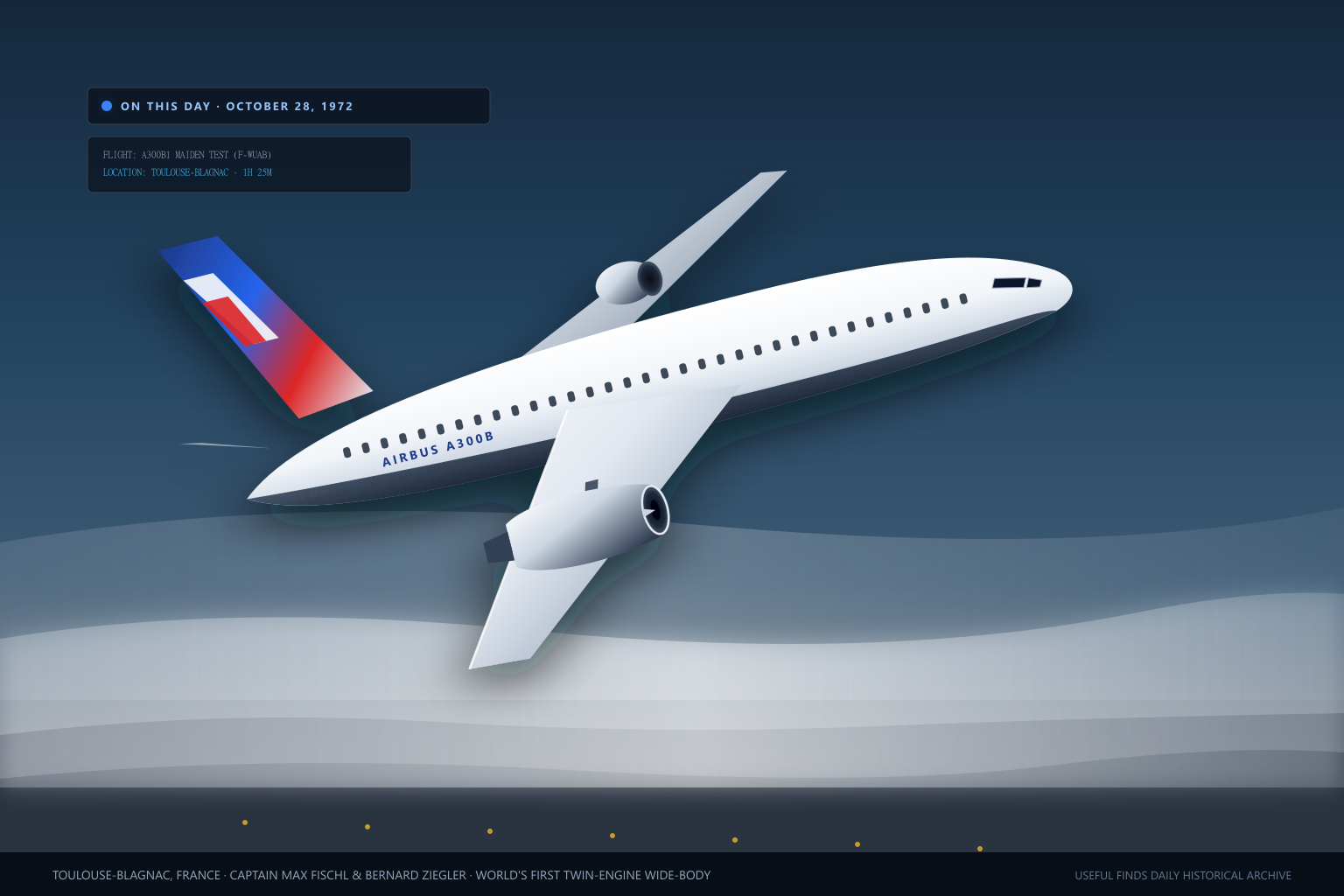
On October 28, 1972, prototype F-WUAB lifted off from Toulouse-Blagnac into an overcast French sky, inaugurating the Airbus A300B1 as the world's first twin-engine wide-body commercial airliner. Defying American skepticism and conservative three- and four-engine airline dogma, the European consortium proved two massive high-bypass turbofans could fly intercity passenger routes with unprecedented fuel economy, laying the architectural foundation for every modern twin-engine airliner flying today.
The Trijet Orthodoxy: Why Boeing and McDonnell Douglas Doubted Twin Engines
In the late 1960s, commercial aviation was dominated by a rigid, unyielding engineering orthodoxy: wide-body passenger airliners required three or four jet engines to operate safely and reliably. Boeing had conquered long-haul intercontinental routes with its quad-jet 747 'Jumbo', while McDonnell Douglas and Lockheed invested hundreds of millions into massive trijets—the DC-10 and L-1011 TriStar. Federal Aviation Administration (FAA) regulations strictly enforced the 60-minute rule, prohibiting twin-engine aircraft from flying routes farther than one hour's diversion time from an adequate emergency diversion airport. To American aerospace executives, building a wide-body jet with only two engines seemed reckless, technically compromised, and commercially dead on arrival.
Yet European engineers observed a stark reality that American manufacturers overlooked: the vast majority of global air travel occurred not on 5,000-mile transoceanic journeys, but on dense short-to-medium-haul intercity corridors. Flying an enormous four-engine 747 or a fuel-thirsty three-engine DC-10 between Paris and London, Frankfurt and Madrid, or Chicago and New York was ruinously inefficient. Carrying an extra engine meant deadweight, complex hydraulic routing through the vertical tailfin, higher maintenance hours per flight cycle, and catastrophic fuel burn during climb. Europe needed a high-capacity short-haul people-mover—a 250-passenger 'air bus' engineered around the emerging generation of high-bypass turbofan engines.
Forging Airbus Industrie: How European Rivals Built a Unified Giant
Creating the A300 was an unprecedented political and industrial gamble. In December 1970, after years of faltering intergovernmental discussions, France's Aérospatiale and West Germany's Deutsche Airbus formally signed the agreement that created Airbus Industrie as a French 'Groupement d’Intérêt Économique' (GIE). They were joined by Spain's CASA and the brilliant British aerostructures manufacturer Hawker Siddeley, who defied the British government's withdrawal from the consortium by investing £35 million of their own private capital to design and manufacture the aircraft's revolutionary wings.
Led by visionary managing director Henri Ziegler and legendary German engineer Felix Kracht, the multinational consortium developed a radically decentralized production method. Specialized airframe components were manufactured across Europe—wings at Broughton in Wales, cockpit and center fuselage in Toulouse, cabin sections in Hamburg and Bremen, and tail surfaces in Getafe, Spain—before being flown aboard modified 'Super Guppy' cargo transports to Toulouse for final assembly. While Wall Street analysts dismissed the GIE as an unworkable political compromise doomed to bureaucratic infighting, Kracht's strict engineering protocols forged a lean, synchronized manufacturing ecosystem that would permanently upend global aerospace.
October 28, 1972: The Historic 85 Minutes Over Toulouse
On the chilly autumn morning of October 28, 1972, the first prototype—designated Airbus A300B1 and registered as F-WUAB—taxied to the runway threshold at Toulouse-Blagnac Airport. In the cockpit sat Chief Test Pilot Captain Max Fischl, Director of Flight Test Bernard Ziegler, and flight test engineers Pierre Caneil, Günther Scherer, and Romeo Zinzoni. At 10:24 AM local time, Fischl advanced the dual thrust levers, unleashing 98,000 pounds of combined thrust from two General Electric CF6-50A turbofans. The massive twin-aisle jet accelerated cleanly down the damp tarmac, rotating into the sky ahead of schedule and climbing gracefully through low mist.
Over the next 85 minutes, Fischl and Ziegler put the prototype through comprehensive stability, handling, and flight control evaluations, testing flap transitions, landing gear retraction, and low-speed flight characteristics before touching down smoothly back at Blagnac to thunderous applause from international dignitaries. The flight was flawless; test telemetry confirmed that the aircraft handled with the agility of a lightweight narrowbody while offering a 222-inch fuselage diameter capable of holding eight-abreast passenger seating and standard LD3 cargo containers side-by-side in its lower belly holds.
The Aerodynamic Secret: Hawker Siddeley's Supercritical Wing
The technological triumph of the A300 lay in its wing aerodynamics, designed by a brilliant team of British aerodynamicists at Hawker Siddeley led by chief designer Cliff Farman. Rather than adopting conventional airfoils, Farman's team perfected an advanced 'rear-loaded' supercritical wing section that delayed the onset of transonic shockwaves at high Mach cruising speeds. By flattening the upper curvature of the wing and creating significant aerodynamic lift through downward camber at the trailing edge, the A300 wing produced unprecedented lift with dramatically reduced drag.
This superior aerodynamic efficiency meant the A300 could carry a payload of 250 passengers across 2,000 nautical miles while burning 20 to 25 percent less fuel per seat-kilometer than contemporary trijets like the Boeing 727 and Lockheed TriStar. Furthermore, because the wing generated so much low-speed lift, the A300 climbed rapidly away from airports, significantly reducing ground noise footprints and pioneering quiet urban airport operations throughout Europe and Asia.
The Eastern Air Lines Breakthrough and the Genesis of Modern ETOPS
Despite its technical excellence, initial sales were agonizingly slow. For nearly two years following certification, completed aircraft sat parked outside the Toulouse assembly hangars—cynically dubbed 'Airbus Boulevard' by American competitors who believed the consortium would soon collapse. The breakthrough arrived in 1977, when former astronaut Frank Borman, then CEO of Eastern Air Lines, agreed to test four leased A300s free of charge on high-density Florida vacation routes during the brutal winter travel season.
The aircraft stunned Eastern's bean counters. Fuel economy was so extraordinary that Borman promptly placed an order for 23 aircraft, breaking the American market wide open. More importantly, the A300's flawless operating record proved that high-bypass turbofans had achieved unprecedented reliability, convincing international regulators to inaugurate Extended-range Twin-engine Operational Performance Standards (ETOPS). Every twin-engine wide-body flying across the Atlantic and Pacific oceans today—from the Airbus A330 and A350 to the Boeing 777 and 787 Dreamliner—traces its operational lineage back to that chilly Saturday morning in Toulouse when two engines took flight where others thought four were needed.
What the evidence does not settle
Historical records and aircraft specifications are grounded in primary institutional archives from Airbus Heritage, the French Civil Aviation Authority (DGAC), and the National Air and Space Museum. We avoid unverified corporate folklore regarding early order negotiations.
PRODUCT IDEA 01
Airbus A300B Die-Cast Collectible Aircraft Model (1:400 Precision Scale)
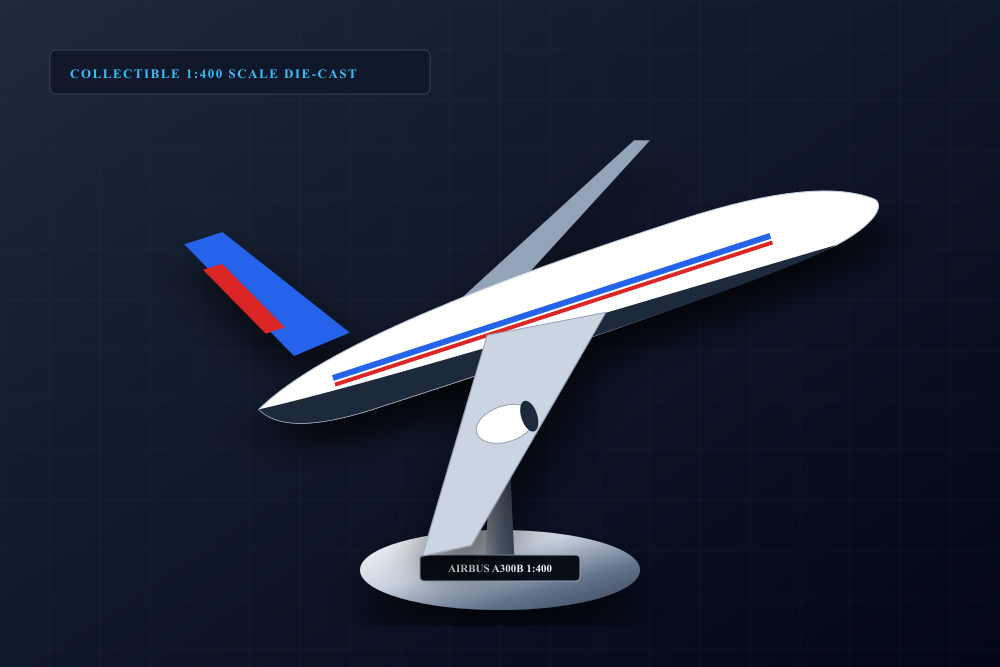
To commemorate the milestone that launched modern European commercial aviation, high-precision die-cast aircraft models offer collectors and aerospace enthusiasts an authentic tactile link to engineering history. Produced by premier aeronautical model makers such as GeminiJets, JC Wings, and Aeroclassics in standard 1:400 scale, these die-cast replicas feature heavy solid metal fuselages, pad-printed authentic 1972 prototype livery markings, spinning engine turbine blades inside the twin GE CF6 nacelles, and delicate rolling rubber landing gear. Mounted upon a brushed metal or dark acrylic desktop pedestal, an A300 model serves as an elegant conversation piece honoring the aircraft that challenged the trijet monopoly and established Airbus as a global aerospace powerhouse.
Buying limit: Engineered as an adult display collectible rather than a children's toy. Die-cast scale models feature delicate pitot tubes, antenna fins, and landing gear bogies that require careful handling; avoid placing in direct sunlight to prevent UV fading of vintage tampo-printed livery colors. Inspect scale ratios before purchase to ensure compatibility with existing desk collections.
Original editorial illustration, not a retailer photograph. No exact Amazon offer passed our verification gate.PRODUCT IDEA 02
Boeing vs. Airbus: The Inside Story of the Greatest International Competition — John Newhouse
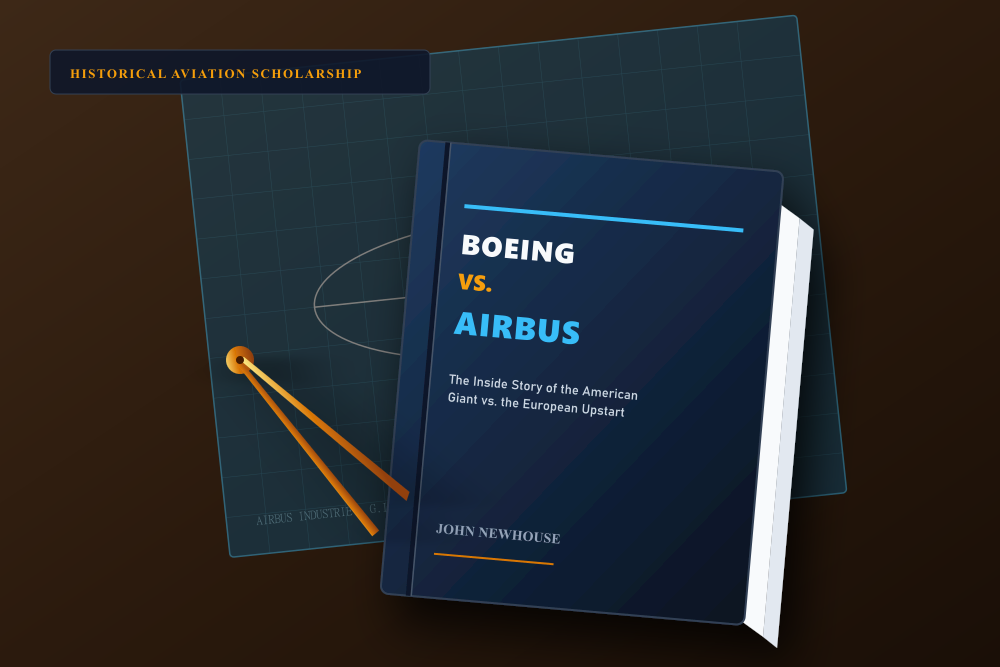
To understand how the A300's maiden flight in 1972 ignited one of the fiercest, highest-stakes commercial rivalries in industrial history, there is no more authoritative or compelling journalistic narrative than John Newhouse's 'Boeing vs. Airbus: The Inside Story of the Greatest International Competition in Business' (Alfred A. Knopf / Vintage). Newhouse, a veteran staff writer for The New Yorker and renowned international security scholar, gained unprecedented access to the executive suites, engineering design bureaus, and airline sales negotiations on both sides of the Atlantic. Tracing the trajectory from the A300's precarious early days through the epic battles between the 777 and A330, and the gargantuan gambles of the A380 and 787 Dreamliner, Newhouse illuminates the ruthless corporate politics, government subsidies, and engineering bravado that define modern aerospace.
Buying limit: Widely available in paperback (ISBN-10: 1400078722 / ISBN-13: 978-1400078721, 272 pages), hardcover, and digital eBook editions. Highly recommended for aviation professionals, business strategists, and history enthusiasts seeking a rigorous, unbiased account of how European collaboration reshaped global transportation economics.
Original editorial illustration, not a retailer photograph. No exact Amazon offer passed our verification gate.SOURCES, METHOD, AND LIMITS
We verified flight logs, test crew manifests, and airframe telemetry from the October 28, 1972 maiden flight of A300B1 (F-WUAB) against Airbus historical archives and the Smithsonian National Air and Space Museum records on October 28, 2026.
- Airbus Heritage Archives: The A300 Story and Maiden Flight Manifest — Primary manufacturer archive recording the flight test logs, crew manifest (Max Fischl, Bernard Ziegler), and technical specifications of prototype A300B1 F-WUAB on October 28, 1972.
- Smithsonian National Air and Space Museum: Evolution of Wide-Body Twinjets — Curatorial analysis documenting the shift from four-engine and trijet architectures to twin-engine wide-bodies and the regulatory development of ETOPS standards.