ON THIS DAY · JULY 27, 1949
The First Jet Age Pioneer: How the 1949 de Havilland Comet Revolutionized Commercial Aviation and Aerodynamic Pressurization
Cruising at 500 mph at 40,000 feet—twice as fast and twice as high as contemporary propeller aircraft—the de Havilland Comet made commercial jet flight a reality. The lessons learned from its pioneering engineering forged the modern aerospace safety standards of every airliner flying today.
The Brabazon Committee and the Jet Vision
During the dark days of World War II in 1943, the British government established the Brabazon Committee to plan the future of post-war civilian aviation. Pioneer aircraft designer Sir Geoffrey de Havilland proposed a radical concept (Type IV): bypassing traditional piston-engine propeller airliners to leapfrog directly into pure jet propulsion.
In 1949, commercial passenger flight was dominated by loud, vibrating propeller aircraft like the Douglas DC-6 and Lockheed Constellation, which flew through turbulent lower air at 250 mph. The Comet flew above the weather in the smooth stratosphere at 40,000 feet at 500 mph, slashing travel times from London to Tokyo from eight days to thirty-six hours.
Aerodynamic Cleanliness: Buried Engines and Cabin Pressurization
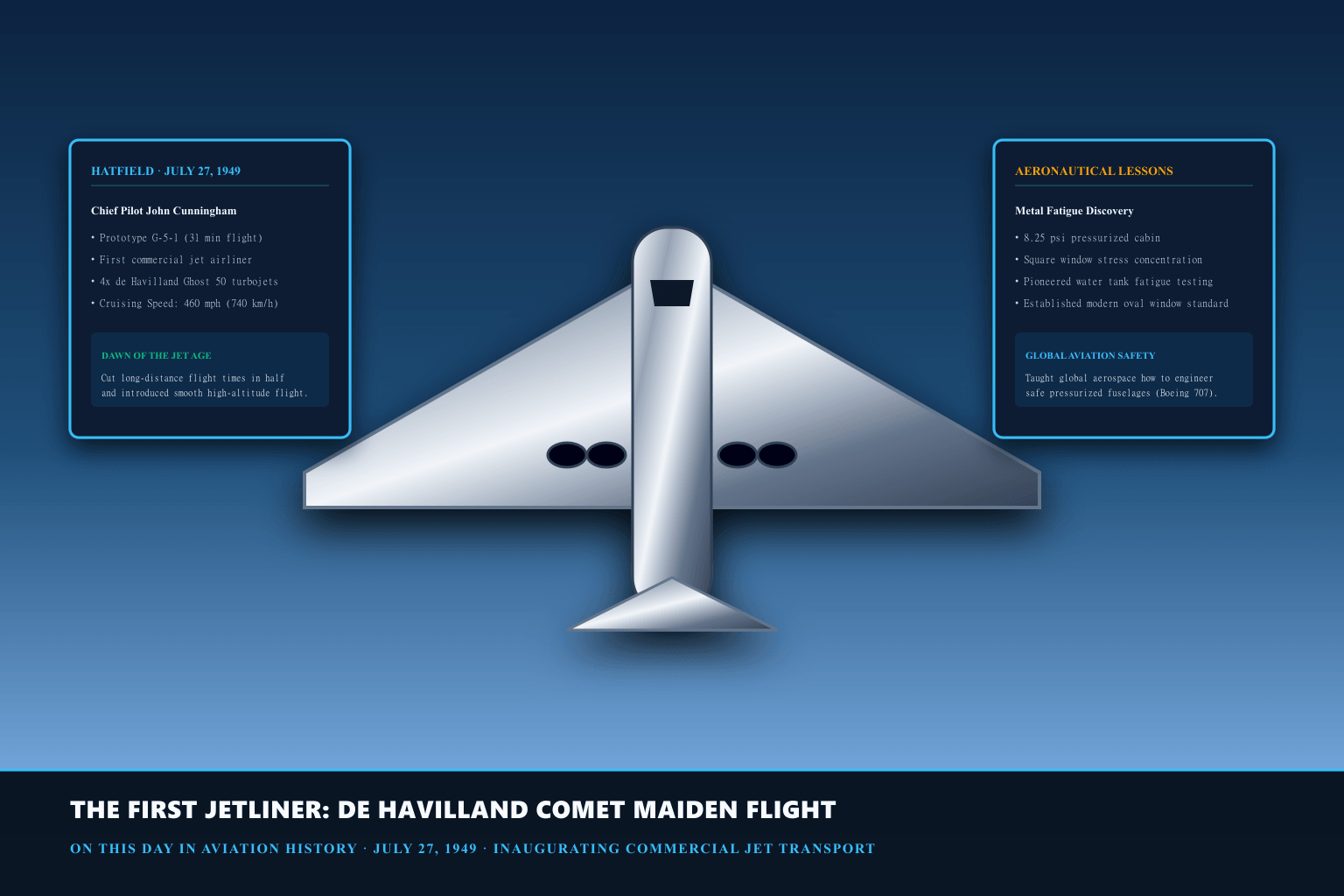
To minimize parasitic aerodynamic drag, de Havilland engineers embedded four Ghost centrifugal-flow turbojets directly inside the thick wing roots adjacent to the fuselage, giving the Comet a remarkably clean, streamlined silhouette with swept leading edges.
Flying at 40,000 feet required maintaining a cabin pressure differential of 8.25 psi (equivalent to an altitude of 8,000 feet). The Comet used Redux synthetic adhesive bonding to join aluminum skin stringers, pioneering flush-riveted pressurized aluminum fuselages.
The Metal Fatigue Tragedy and Why Airplane Windows Are Round
In 1954, two Comet airliners suffered catastrophic mid-air structural breakups over the Mediterranean Sea. British aviation authorities grounded the fleet and conducted the most exhaustive forensic accident investigation in aviation history, placing a complete Comet fuselage inside a giant water tank at Farnborough to simulate thousands of pressurization cycles.
The investigation proved that repeated cabin pressurization cycles caused micro-fractures in the aluminum skin around the sharp 90-degree corners of square passenger windows and punch-riveted ADF antenna cutouts—a phenomenon known as stress concentration and cyclical metal fatigue. As a direct result, every commercial airliner built since—including the Boeing 707 and 747—features rounded oval windows and fail-safe tear-strap structural frames.
What the evidence does not settle
While the Comet 1 suffered tragic early hull losses, de Havilland redesigned the airframe with thicker skin and oval windows, producing the Comet 4, which inaugurated the world's first scheduled transatlantic commercial jet service in October 1958, three weeks before the Boeing 707.
PRODUCT IDEA 01
Empire of the Clouds: When Britain's Aircraft Ruled the World — Peter Hennessy

A gripping, masterfully written narrative history capturing the golden age of British aviation, the birth of the jet airliner, and the triumphs and tragedies of the Comet.
Buying limit: Available in trade paperback (Faber & Faber) and digital formats. Copies typically retail between $15 and $26.
Original editorial illustration, not a retailer photograph. No exact Amazon offer passed our verification gate.PRODUCT IDEA 02
Vintage Aviation Altimeter Dial Aesthetic Precision Desk Clock

A handsome machined aluminum desk clock designed to replicate the classic analog flight instrument dials of 1950s commercial jet airliners.
Buying limit: Look for genuine quartz movement and matte anti-glare glass lenses. Quality aviation desk clocks cost $25 to $55.
Original editorial illustration, not a retailer photograph. No exact Amazon offer passed our verification gate.SOURCES, METHOD, AND LIMITS
Researched using official British Ministry of Civil Aviation Court of Inquiry accident reports (Lord Cohen, 1954), de Havilland Aircraft Museum historical engineering archives, and Royal Aeronautical Society technical papers. No commercial products were physically tested.
- de Havilland Aircraft Museum — DH.106 Comet Technical Archive & First Flight Records — Official museum archival documentation detailing John Cunningham's flight logs, Ghost turbojet specifications, and Hatfield test flights.
- Royal Aeronautical Society — The Comet Accidents and the Birth of Fracture Mechanics — Peer-reviewed historical engineering paper analyzing the Farnborough water tank tests, stress concentration factors, and cyclical fuselage fatigue.