ON THIS DAY · OCTOBER 31, 2008
The Nine-Page Whitepaper That Rewrote Money How Satoshi Nakamoto Solved Double-Spending on October 31, 2008
On October 31, 2008, an anonymous cryptographer writing under the pseudonym Satoshi Nakamoto dispatched a nine-page paper to the Cypherpunk Cryptography Mailing List titled 'Bitcoin: A Peer-to-Peer Electronic Cash System.' By uniting cryptographic proof-of-work with distributed timestamped blocks, the proposal solved the computer science dilemma of double-spending without requiring a central clearinghouse or government central bank. Issued amidst the collapse of global investment banks and emergency economic bailouts, Nakamoto's protocol initiated the modern era of decentralized consensus and self-sovereign digital currency.
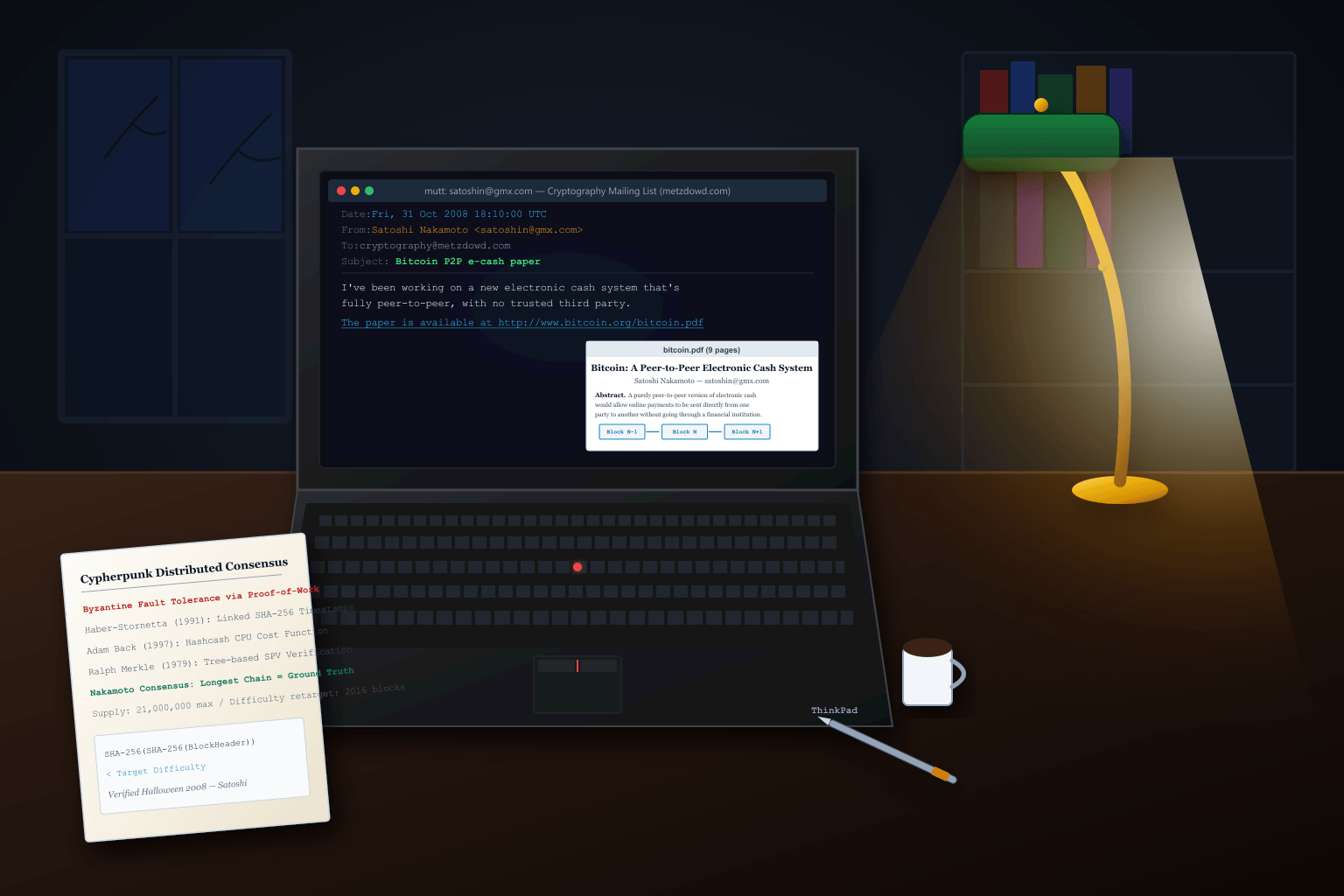
The Halloween Dispatch: An Anonymous Email to the Cypherpunk Underground
On Friday, October 31, 2008, at 2:10 PM Eastern Time (18:10 UTC), a quiet email landed in the inboxes of several hundred mathematicians, security engineers, and privacy advocates subscribed to the Cryptography Mailing List hosted by Perry Metzger on metzdowd.com. The message arrived under the name Satoshi Nakamoto from the email address [email protected]. Its subject line was understated: 'Bitcoin P2P e-cash paper.' In just two concise sentences, the author outlined an audacious ambition: 'I've been working on a new electronic cash system that's fully peer-to-peer, with no trusted third party. The paper is available at http://www.bitcoin.org/bitcoin.pdf.' Attached to the email was a nine-page PDF formatted in standard academic double columns, devoid of corporate branding, institutional affiliations, or personal biographies.
For the Cypherpunk community, the quest for sovereign digital cash was already nearly two decades old. Since the early 1990s, luminaries like David Chaum (DigiCash in 1989), Wei Dai (b-money in 1998), Nick Szabo (bit gold in 1998), and Adam Back (Hashcash in 1997) had attempted to create electronic money that mimicked physical paper banknotes—private, direct, and unencumbered by surveillance or commercial middlemen. Yet every prior effort had succumbed to an insurmountable architectural bottleneck: preventing a user from spending the exact same digital token twice required a central clearing server to validate transactions and track balances. Whenever the server was seized by regulators, compromised by hackers, or shut down by corporate bankruptcy, the entire monetary system vanished overnight.
The timing of Nakamoto's publication infused the release with profound historical urgency. Just six weeks earlier, on September 15, 2008, Wall Street investment banking titan Lehman Brothers had filed for Chapter 11 bankruptcy, triggering the worst global financial crisis since the Great Depression. As global credit markets froze, governments around the world prepared trillions of dollars in emergency bank bailouts, while central banks embarked on aggressive quantitative easing. Into this climate of collapsing institutional trust stepped an anonymous cryptographer offering a purely mathematical alternative: an open, immutable, rules-based monetary ledger governed entirely by deterministic code rather than political discretion.
Solving the Double-Spending Dilemma: The Longest-Chain Proof-of-Work Consensus
To understand why Nakamoto's nine pages mesmerized the distributed computing world, one must examine the core dilemma of digital data: perfect fungible reproducibility. Unlike a physical gold coin or paper dollar bill, any digital file—whether an MP3 song, a text document, or an electronic token—can be copied and duplicated with zero marginal cost (Ctrl+C and Ctrl+V). In distributed computing, this vulnerability is known as the double-spending problem. If Alice possesses a digital coin and transmits it to Bob, what stops Alice from simultaneously transmitting the exact same coin to Charlie before Bob can detect the fraud? Without a trusted intermediary like Visa, PayPal, or a commercial bank maintaining a single master ledger, resolving transaction ordering had long been regarded as an intractable variant of the Byzantine Generals Problem.
Nakamoto's breakthrough did not eliminate the need for an authoritative chronological ledger; instead, it transformed the ledger into a public, decentralized timestamp network governed by computational thermodynamics. The paper proposed that transactions be grouped into blocks and cryptographically linked through Proof-of-Work (PoW)—a mechanism requiring nodes to expend real electrical energy computing billions of SHA-256 hash variations until finding a hash value that falls below an automatically adjusted network difficulty target. Because each block header contains the cryptographic hash of the preceding block, altering a past transaction requires recalculating the proof-of-work of that block and all subsequent blocks—a computational task that becomes exponentially impossible as new blocks accumulate.
Crucially, Nakamoto formulated the 'longest chain rule' (now known formally as Nakamoto Consensus). Rather than relying on identity-based voting or complex quorum rounds—which are vulnerable to Sybil attacks where an adversary creates millions of fake virtual nodes—the network measures truth strictly by accumulated Proof-of-Work. Honest nodes simply accept the longest valid chain of blocks as the definitive, objective sequence of historical events. To reinforce this cooperative behavior, Nakamoto embedded an ingenious economic game theory loop: nodes (miners) that invest CPU power to validate transactions are rewarded with newly minted coins (the block subsidy) and transaction fees. As Nakamoto noted in Section 6: 'The incentive may help encourage nodes to stay honest. If a greedy attacker is able to assemble more CPU power than all the honest nodes, he would have to choose between using it to defraud people by stealing back his payments, or using it to generate new coins. He ought to find it more profitable to play by the rules.'
Standing on the Shoulders of Giants: Synthesizing Hashcash, Merkle Trees, and Timestamping
A common misconception repeated in popular technology retrospectives is that Satoshi Nakamoto invented cryptography or blockchain data structures entirely from whole cloth. In truth, Nakamoto's genius lay in brilliant architectural synthesis. The whitepaper's bibliography lists eight foundational computer science and cryptographic papers, acknowledging the pioneering work of earlier researchers while weaving their isolated discoveries into an elegant, fault-tolerant whole.
From Stuart Haber and W. Scott Stornetta's seminal 1991 paper 'How to Time-Stamp a Digital Document' and their 1992 follow-up with Dave Bayer, Nakamoto borrowed the concept of chaining documents sequentially using cryptographic hash pointers, ensuring that any retroactive modification of past entries invalidates the entire subsequent chain. From Ralph Merkle's 1979 invention of cryptographic tree structures (Merkle trees), Nakamoto adopted a method to summarize thousands of individual transactions into a single 32-byte Merkle root in the block header. This enabled Simplified Payment Verification (SPV), allowing lightweight mobile clients and low-power devices to verify payments by checking a tiny cryptographic proof without downloading the multi-gigabyte history of the entire blockchain.
From British cryptographer Adam Back's 1997 Hashcash proposal—originally created as a computational barrier to prevent email spam and denial-of-service attacks—Nakamoto adapted the hash collision proof-of-work algorithm. Yet Nakamoto added the critical missing ingredient that had eluded Back, Szabo, and Dai: an automatic, self-regulating difficulty adjustment algorithm. Every 2,016 blocks (approximately every two weeks), the network evaluates how quickly blocks were found and recalibrates the hashing difficulty target, ensuring that regardless of whether the network is powered by two laptops or millions of industrial ASIC rigs, new blocks arrive on average every ten minutes. By fusing these disparate building blocks with a fixed mathematical supply curve capped at 21 million units, Nakamoto created a self-sustaining, trust-minimized digital institution.
From Theoretical Paper to Living Network: Hal Finney, Genesis Block, and Cultural Impact
The initial reception to Nakamoto's Halloween email was cautious skepticism. Experienced cryptographers on the Metzdowd list had seen dozens of theoretical digital cash proposals fail over two decades. The very first public response, posted by James A. Donald on November 2, 2008, raised the issue that still dominates scalability debates today: 'The way I understand your proposal, it does not seem to scale to the required size.' Nakamoto patiently answered every objection, explaining how compact SPV proofs, transaction pruning, and multi-tiered payment channels could handle mass adoption.
The turning point arrived when legendary cryptographer Hal Finney—the creator of Reusable Proofs of Work (RPOW) and Phil Zimmermann's primary collaborator on PGP encryption—entered the discussion. On November 8, 2008, Finney recognized the elegance of Nakamoto's solution, writing: 'Bitcoin seems to be a very promising idea. I like the idea of basing security on the assumption that the CPU power of honest participants is greater than that of the attacker.' When Nakamoto released the open-source C++ implementation on SourceForge in early January 2009, Finney was the first person to download and run the software node alongside Satoshi. On January 3, 2009, Nakamoto mined Block 0 (the Genesis Block), permanently encoding the iconic front-page headline from the London Times: 'The Times 03/Jan/2009 Chancellor on brink of second bailout for banks.' Nine days later, on January 12, 2009, Satoshi sent Finney 10 bitcoins in Block 170—the world's first peer-to-peer cryptocurrency transaction.
Over the eighteen years since its Halloween debut, the nine-page Bitcoin whitepaper has transcended its technical origins to become one of the most influential computer science papers in human history. It demonstrated for the first time that decentralized actors across an adversarial, untrusted network could maintain absolute, synchronized consensus on a global state machine without a central coordinator. Nakamoto's breakthrough sparked an entire multi-trillion-dollar industry of decentralized protocols, smart contract platforms, zero-knowledge proofs, and digital property rights, proving that code, cryptography, and economic incentives could establish a new foundation for human cooperation.
What the evidence does not settle
Historical dates, email timestamps, and technical specifications are cross-referenced directly against Perry Metzger's Cryptography Mailing List archives at metzdowd.com, Satoshi Nakamoto's original nine-page research paper, and early SourceForge repository commit logs. We explicitly debunk popular sensationalist myths: Bitcoin was never designed to be completely anonymous (Section 10 of the whitepaper explicitly details pseudonymity and explains how public transaction graph analysis reveals address linkability); Nakamoto did not invent cryptography or hash chains from scratch, but synthesized decades of Cypherpunk research; and the software was not operational on October 31, 2008—the network launched on January 3, 2009 with the mining of the Genesis Block.
PRODUCT IDEA 01
Mastering Bitcoin: Programming the Open Blockchain — Andreas M. Antonopoulos

For software engineers, system architects, and students seeking to understand the actual mathematical mechanics behind Satoshi Nakamoto's whitepaper, Andreas M. Antonopoulos's 'Mastering Bitcoin' (O'Reilly Media) remains the authoritative technical textbook. Antonopoulos avoids market hype and speculative trading jargon, focusing entirely on the underlying computer science: secp256k1 elliptic curve cryptography, peer-to-peer gossip networking, the Script execution engine, and the decentralized mining loop. It provides an indispensable deep dive into the engineering reality of Nakamoto consensus.
Buying limit: Published by O'Reilly Media; widely available in paperback (ISBN-13: 978-1491954386) and digital formats; readers should ensure they acquire the updated editions that cover modern protocol upgrades including Segregated Witness (SegWit) and Taproot; avoid unverified third-party print-on-demand knockoffs.
Original editorial illustration, not a retailer photograph. No exact Amazon offer passed our verification gate.PRODUCT IDEA 02
Trezor Safe 3 Hardware Cryptocurrency Cold Storage Wallet
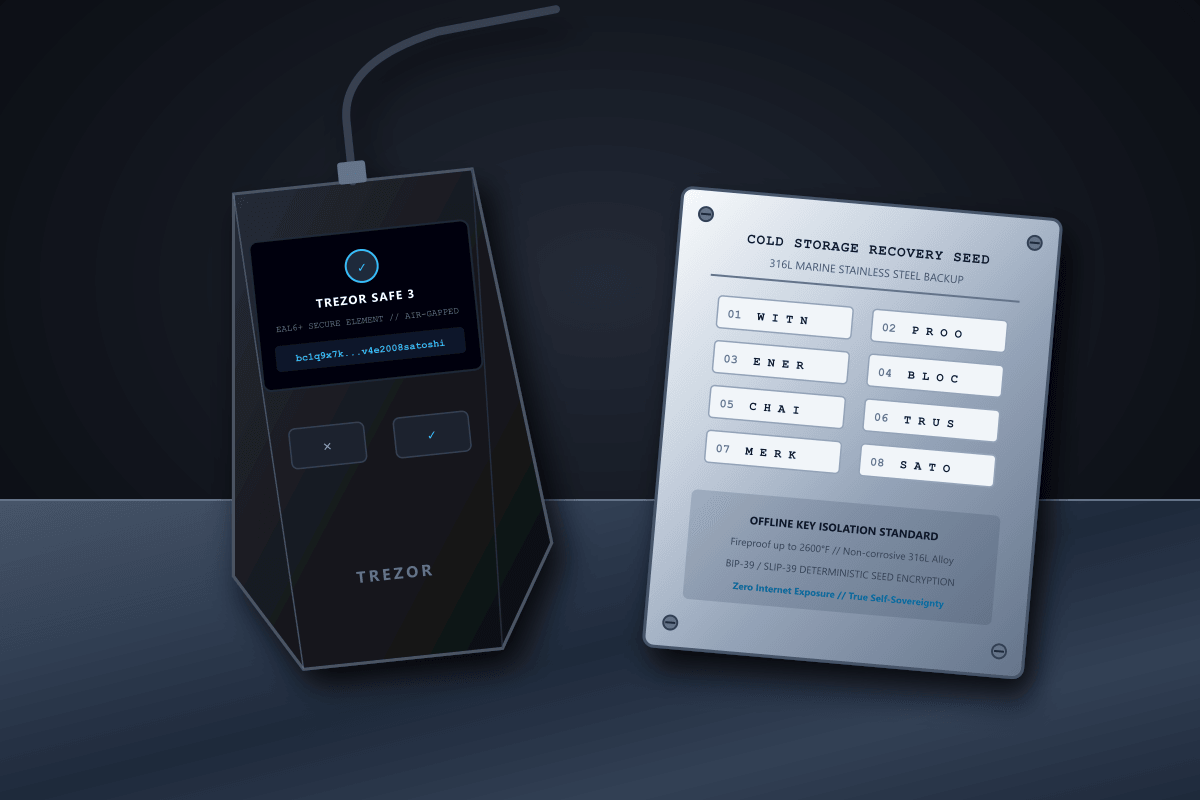
The foundational insight of the Bitcoin whitepaper is cryptographic self-sovereignty: if you do not control the private keys corresponding to a cryptographic address, you do not control the funds. Modern consumer hardware wallets like the Trezor Safe 3 translate Nakamoto's asymmetric key paradigm into a practical, tamper-resistant physical device. By isolating cryptographic signing operations inside an EAL6+ secure element, the device ensures that private keys are never exposed to connected host computers, malware, or compromised operating systems.
Buying limit: Manufactured by SatoshiLabs; always purchase directly from authorized distributors or the official manufacturer to prevent supply-chain tampering; inspect the tamper-evident holographic seal upon delivery; never use a device with a pre-printed recovery seed card or shared PIN.
Original editorial illustration, not a retailer photograph. No exact Amazon offer passed our verification gate.SOURCES, METHOD, AND LIMITS
We examined primary archival records from Perry Metzger's Cryptography Mailing List archives at metzdowd.com from October and November 2008, Satoshi Nakamoto's original nine-page whitepaper ('Bitcoin: A Peer-to-Peer Electronic Cash System'), contemporaneous correspondence between Satoshi Nakamoto and Hal Finney, and early SourceForge repository commit logs. Technical assertions regarding proof-of-work difficulty adjustment, SHA-256 block hashing, and Merkle tree verification were verified against peer-reviewed computer science literature from the IEEE Computer Society and ACM.
- Perry Metzger's Cryptography Mailing List Archive: Satoshi Nakamoto's Original 'Bitcoin P2P e-cash paper' Dispatch — Primary archival email thread from October 31, 2008, where Satoshi Nakamoto officially announced the Bitcoin project and linked to the nine-page whitepaper.
- Satoshi Nakamoto: 'Bitcoin: A Peer-to-Peer Electronic Cash System' (Original Whitepaper PDF) — The original primary nine-page research paper detailing the transaction model, timestamp server, proof-of-work consensus, network broadcast rules, and incentive structure.
- Hal Finney: Contemporaneous Cryptography Mailing List Evaluation and Analysis (November 8, 2008) — Primary email record from renowned cryptographer Hal Finney analyzing the Byzantine fault tolerance and computational economics of Nakamoto's proposal.
- Communications of the ACM: A Brief History of Blockchains (Arvind Narayanan & Jeremy Clark) — Peer-reviewed computer science retrospective mapping the lineage of Satoshi's consensus mechanism from Haber-Stornetta linked timestamping and Adam Back's Hashcash to modern Nakamoto consensus.