ON THIS DAY · AUGUST 13, 2001
The Code That Won the Digital Privacy War: How Pretty Good Privacy Made Military-Grade Encryption Accessible to All
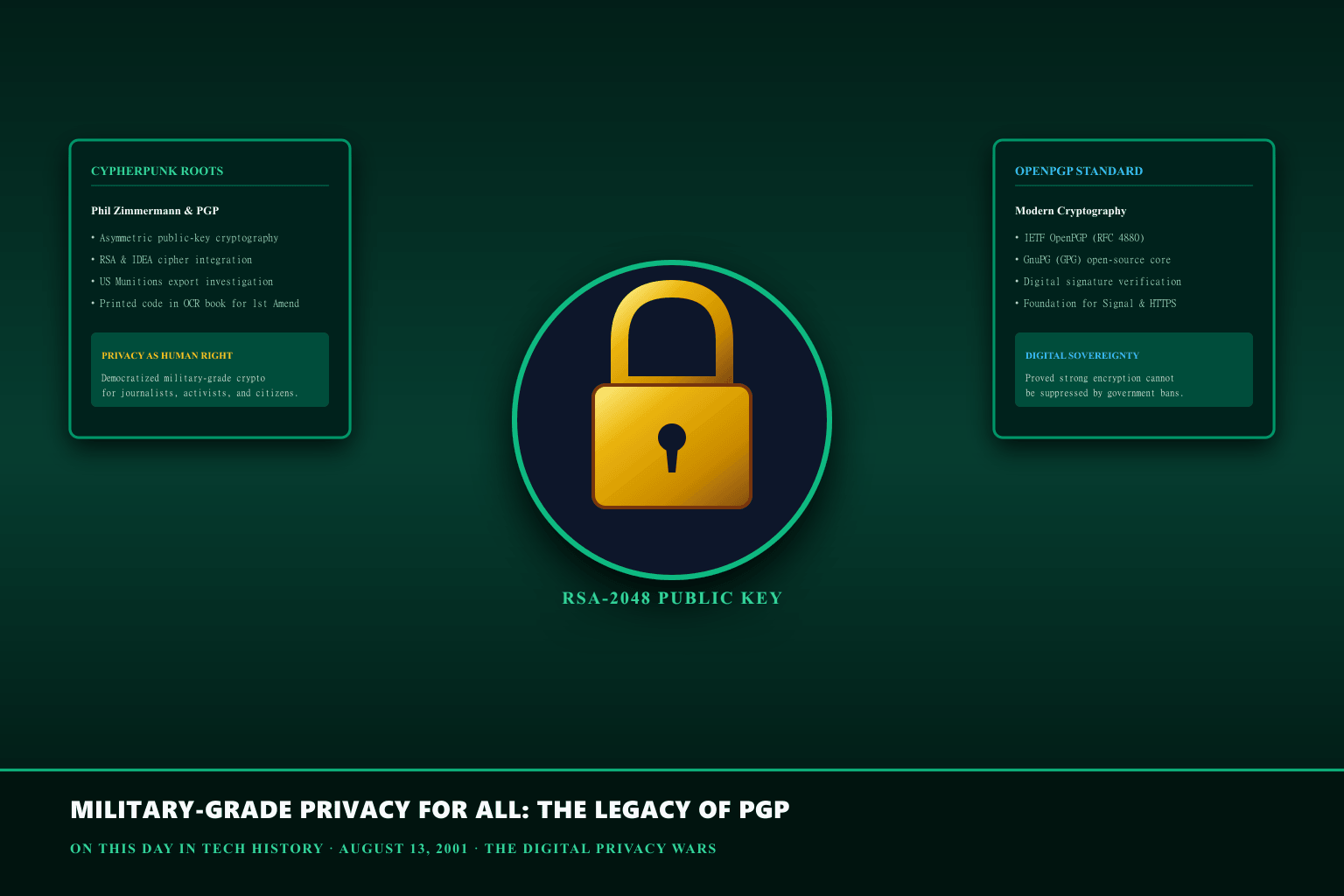
In 1991, strong public-key cryptography was legally classified as 'munitions' and subject to federal criminal arms-trafficking export laws. By the time PGP 7.0 was released in August 2001, Phil Zimmermann's open-source code had permanently won the cryptographic civil war.
The Asymmetric Cryptography Revolution and the Web of Trust
Before the invention of asymmetric public-key cryptography by Whitfield Diffie, Martin Hellman, and Ralph Merkle in the 1970s, encrypted communication required parties to share a secret key beforehand—a fatal logistical flaw across global computer networks.
Zimmermann packaged complex asymmetric math into an accessible, practical desktop tool. Each user generated a public key (which was distributed freely to friends or keyservers) and a private key (which remained encrypted on their personal machine). Rather than relying on centralized government or corporate Certificate Authorities, PGP introduced the 'Web of Trust,' where individuals digitally signed and verified each other's cryptographic identity keys at in-person key-signing parties.
The Crypto Wars: Export Restrictions and the Book Loophole
In 1993, the US federal government launched a formal criminal investigation into Phil Zimmermann for arms trafficking without a license after PGP 1.0 spread globally across Usenet newsgroups. At the time, the US International Traffic in Arms Regulations (ITAR) classified encryption algorithms with key lengths exceeding 40 bits as Category XIII military munitions, alongside artillery and nuclear warheads.
In an ingenious legal maneuver to defeat export bans, Zimmermann and MIT Press published PGP's complete, uncompiled C source code in an 8,000-page physical printed hardcover book. Because the physical export of books was unequivocally protected by First Amendment freedom of the press, foreign programmers legally purchased the book, scanned the pages with optical character recognition (OCR) software, recompiled the code overseas, and defeated the government's export ban.
From PGP 7.0 to the Modern OpenPGP Ecosystem
By the late 1990s, federal prosecutors dropped their investigation without indictment, and export regulations were permanently reformed. In 1997, Zimmermann submitted PGP's specifications to the Internet Engineering Task Force (IETF), creating the royalty-free OpenPGP standard.
The release of PGP 7.0 in August 2001 showcased an enterprise-ready system supporting 2048-bit RSA keys, CAST5, Triple-DES, and AES ciphers. PGP's cryptographic legacy directly underpins modern secure digital communication tools, from GNU Privacy Guard (GPG) to Signal's end-to-end messaging protocols.
What the evidence does not settle
While OpenPGP encryption is mathematically virtually unbreakable when configured with 4096-bit RSA or modern Ed25519 elliptic curve keys, it does not hide email metadata (sender, recipient, subject line, and transmission timestamps) from network surveillance. Complex manual key-management workflows also limited PGP's mainstream adoption compared to automated end-to-end messaging apps.
PRODUCT IDEA 01
YubiKey 5 NFC Hardware Security & OpenPGP Encryption Key
A military-grade hardware authenticator supporting FIDO2, WebAuthn, and onboard OpenPGP smartcard storage to safeguard cryptographic private keys from malware and phishing.
Buying limit: Opt for dual USB-A/C and NFC models with crush-resistant fiberglass bodies. Genuine security keys retail between $50 and $90.
Original editorial illustration, not a retailer photograph. No exact Amazon offer passed our verification gate.PRODUCT IDEA 02
Crypto: How the Code Rebels Beat the Government to Save Privacy in the Digital Age — Steven Levy
Steven Levy's definitive, electrifying journalistic history documenting the mathematical rebels, hackers, and civil libertarians who fought the First Crypto War to bring encryption to the public.
Buying limit: Available in trade paperback (Penguin Books) and digital formats. Copies typically range between $14 and $22.
Original editorial illustration, not a retailer photograph. No exact Amazon offer passed our verification gate.SOURCES, METHOD, AND LIMITS
Researched using IETF OpenPGP Working Group RFC standards (RFC 2440 / RFC 4880), legal case filings from the Electronic Frontier Foundation (EFF), and Phil Zimmermann's personal cryptographic writings. No commercial products were physically tested.
- Internet Engineering Task Force (IETF) — RFC 2440: OpenPGP Message Format Specification — Official internet standards document defining OpenPGP packet structures, asymmetric encryption key exchanges, and digital signature envelopes.
- Electronic Frontier Foundation (EFF) — The First Crypto Wars: Historical Overview & Legal Precedents — Legal history analyzing ITAR arms export classifications, First Amendment software speech rulings (Bernstein v. US), and Zimmermann's defense.