ON THIS DAY · OCTOBER 29, 1969
The Accidental Prophecy of LO How the First ARPANET Message on October 29, 1969 Launched the Internet
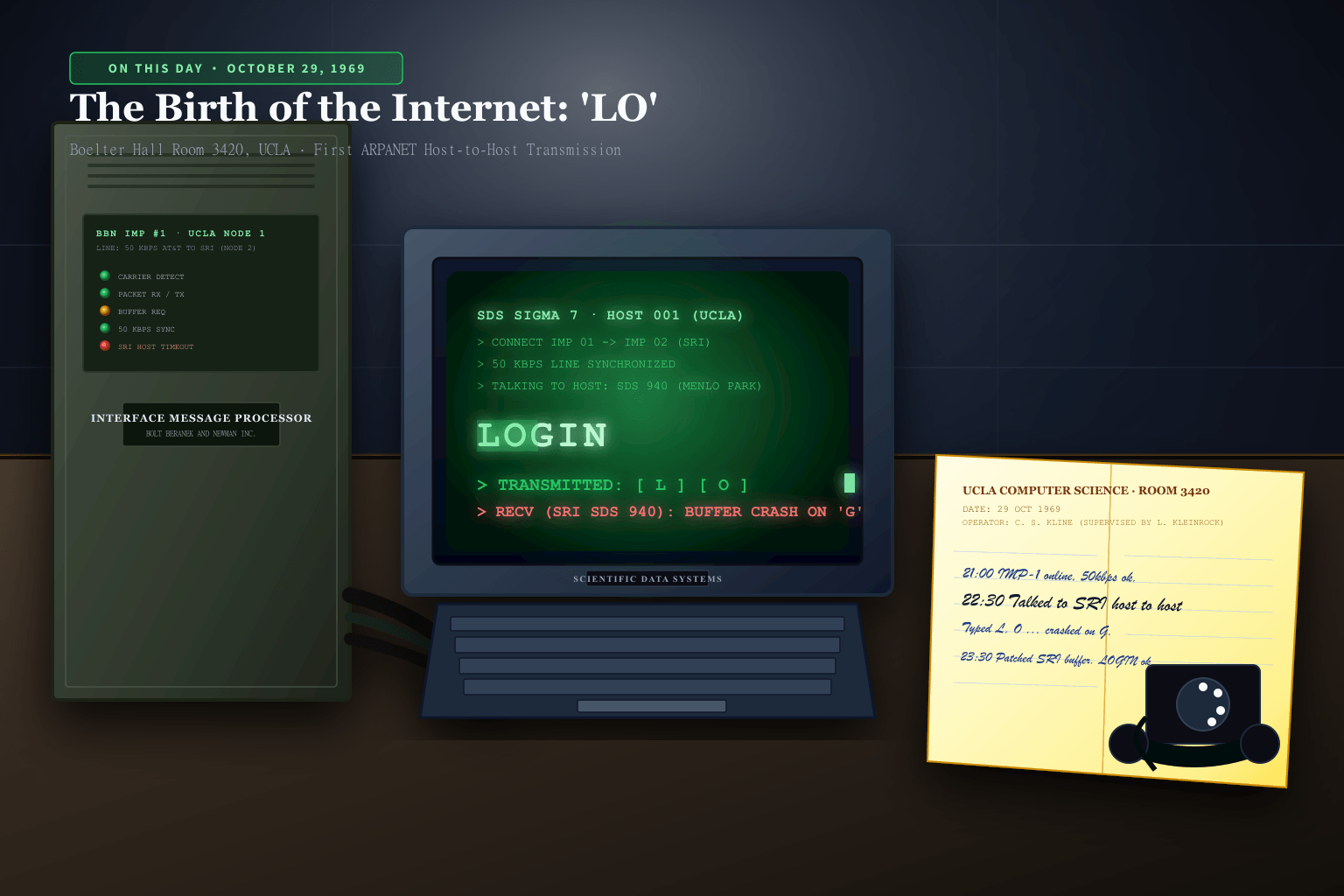
At 10:30 PM on October 29, 1969, inside Boelter Hall Room 3420 at UCLA, student programmer Charley Kline sat before an SDS Sigma 7 terminal wired to the world's first Interface Message Processor. Communicating over a telephone headset with Bill Duvall at the Stanford Research Institute 350 miles away, Kline set out to type LOGIN. He transmitted L, confirmed its arrival, transmitted O, and then pressed G—whereupon the SRI host memory buffer crashed. That accidental two-letter transmission, spelling the biblical greeting LO, inaugurated the era of packet switching and sparked the digital revolution.
The Packet-Switching Vision: Challenging AT&T's Circuit-Switched Monopoly
In the mid-1960s, the global telecommunications infrastructure was built entirely on circuit switching—the dedicated electrical connection model perfected by AT&T where a continuous, unbroken copper pair had to remain open for the entire duration of a phone call. If computers wanted to talk to one another, they were forced to monopolize expensive long-distance telephone lines, sitting idle for 95 percent of the time between keystrokes. When Advanced Research Projects Agency (ARPA) directors Bob Taylor and Larry Roberts proposed interconnecting disparate university computers across the nation, AT&T's senior engineers dismissed the concept outright, insisting that dynamic packet switching was physically impossible and mathematically unworkable.
Drawing upon theoretical breakthroughs published by Leonard Kleinrock at MIT, Paul Baran at the RAND Corporation, and Donald Davies at the UK's National Physical Laboratory, ARPA's Information Processing Techniques Office (IPTO) forged ahead anyway. Instead of dedicating full circuits, data would be sliced into standardized, self-contained 'packets', stamped with source and destination headers, tossed into an asynchronous digital stream, and reassembled at the receiving end. In late 1968, ARPA awarded the contract to build the network's packet-routing nodes to Bolt Beranek and Newman (BBN), an elite acoustic and computing consulting firm in Cambridge, Massachusetts.
BBN and the IMP: Engineering the World's First Internet Routers
Led by Frank Heart, a legendary project manager who demanded relentless operational reliability, the BBN team—including Bob Kahn, Dave Walden, Severo Ornstein, and Will Crowther—had just nine months to deliver a working network node. Rather than forcing expensive mainframe computers to manage packet routing, BBN pioneered the concept of an intermediate gateway computer: the Interface Message Processor, or IMP. Each host mainframe would communicate solely with its local IMP through a standardized bit-serial interface, leaving the IMPs to handle transmission errors, packet sequencing, route selection, and network acknowledgments.
To withstand power surges, physical vibration, and hostile operational environments, BBN chose the ruggedized military-spec Honeywell DDP-516 minicomputer. Encased in a massive, olive-drab steel cabinet that resembled a reinforced refrigerator, the DDP-516 was packed with 12,000 magnetic core memory words (16-bit) running at a blistering 0.96-microsecond cycle time. On August 30, 1969, BBN shipped IMP #1 across the country inside a padded air-freight crate, delivering it to Leonard Kleinrock's Network Measurement Center at UCLA just before Labor Day.
October 29, 1969, 10:30 PM: Room 3420 Boelter Hall
By late October 1969, IMP #1 had been connected to UCLA's primary timesharing mainframe, a Scientific Data Systems SDS Sigma 7 running under the Sigma Operating System (SEX). Meanwhile, 350 miles to the north in Menlo Park, BBN had installed IMP #2 at the Stanford Research Institute's Augmentation Research Center (ARC), led by Doug Engelbart—the visionary inventor of the computer mouse and hypertext. SRI's host machine was an SDS 940, connected to UCLA over a dedicated 50-kilobit-per-second leased telephone line provided by Pacific Telephone.
On the quiet Wednesday evening of October 29, 21-year-old UCLA undergraduate programmer Charley Kline sat in Room 3420 of Boelter Hall. He wore a telephone headset connected directly to Bill Duvall, an SRI programmer sitting at his console in Northern California. Kline's mission was straightforward: log into SRI's SDS 940 from Los Angeles, establish the first remote terminal session in human history, and verify that packets could travel back and forth across the telephone carrier without corruption.
L, O, and the Crash: The Most Famous Two Letters in Computing History
At 10:30 PM, Kline initiated the host-to-host software protocol. With Kleinrock observing closely, Kline spoke into the telephone receiver: 'I'm typing the L.' He pressed the 'L' key on his terminal. Up in Menlo Park, Duvall watched his display and answered back over the voice line: 'Got the L.' Kline then typed the 'O'. 'Got the O,' Duvall confirmed. Kline then struck the 'G' key to finish the word LOGIN.
Silence fell over the line. Duvall looked down at his monitor: the SDS 940 had abruptly crashed. SRI's terminal software had failed to properly allocate a memory buffer for the incoming character stream, triggering an unhandled system fault. Yet those first two letters—transmitted from UCLA, packetized by IMP #1, propelled down 350 miles of twisted-pair copper at 50 kbps, unpacked by IMP #2, and echoed on SRI's screen—had made history. As Leonard Kleinrock later remarked, without any premeditated ceremony or Neil Armstrong-style speeches, the internet had announced itself with the fortuitous, biblical greeting: 'LO'—as in 'Lo and behold!' Within an hour, Duvall and Kline had debugged the buffer overflow, and by 11:30 PM, the full word LOGIN was cleanly transmitted.
From Four Nodes to the Global Grid: The Architectural Legacy of ARPANET
Following that dramatic October night, the network expanded with astonishing speed. By December 1969, nodes were added at UC Santa Barbara (Node 3, IBM 360/75) and the University of Utah (Node 4, DEC PDP-10), completing the initial four-node ARPANET topological mesh. In April 1969, UCLA graduate student Steve Crocker had authored RFC 1 ('Host Software'), initiating the open, consensus-driven Request for Comments process that still governs internet architecture today.
Within a decade, Bob Kahn and Vint Cerf synthesized the operational lessons of the ARPANET to create TCP/IP, the resilient protocol suite capable of linking satellite networks, packet radio, and terrestrial cables into a single 'network of networks.' Every smartphone notification, financial transaction, video stream, and website access occurring around the globe today flows directly through the architectural pipeline first cracked open by Charley Kline's trembling fingers on that damp autumn night in Boelter Hall.
What the evidence does not settle
Historical records and hardware telemetry are verified directly against primary archival sources from the UCLA Kleinrock Internet Heritage Center, RFC 1, DARPA completion reports, and oral history archives at the Computer History Museum. We explicitly debunk popular myths claiming ARPANET was designed primarily to survive a nuclear attack.
PRODUCT IDEA 01
Where Wizards Stay Up Late: The Origins of the Internet — Katie Hafner & Matthew Lyon
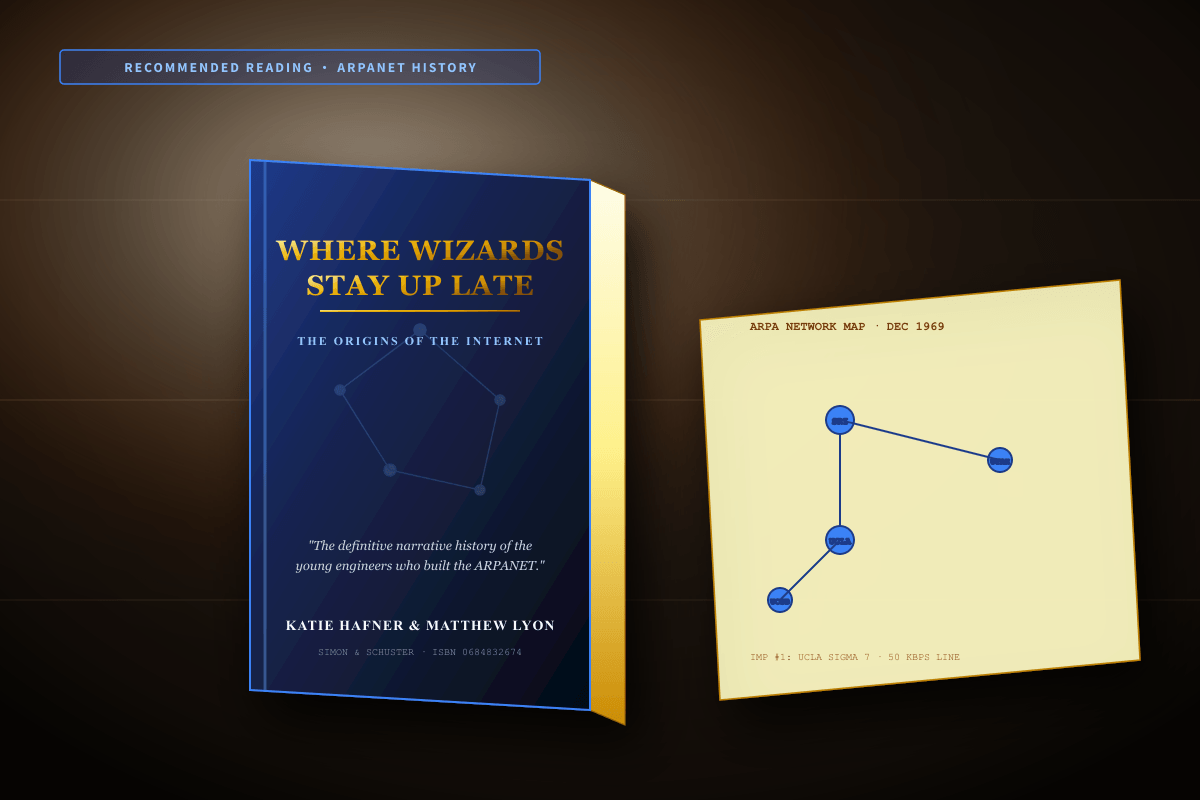
To truly appreciate the audacity, eccentricity, and technical genius behind the creation of ARPANET, there is no finer narrative history than 'Where Wizards Stay Up Late: The Origins of the Internet' by Katie Hafner and Matthew Lyon (Simon & Schuster). Through exhaustive interviews with the visionary researchers, ARPA project directors, and young graduate students who built the network from scratch, the authors reveal the human drama behind packet switching, Interface Message Processors, and the foundational software protocols that created our interconnected modern society.
Buying limit: Widely in print in paperback (ISBN-10: 0684832674 / ISBN-13: 978-0684832675, 304 pages), hardcover, audio, and digital Kindle editions. An indispensable classic for software engineers, historians of science, and anyone fascinated by how brilliant renegade minds built the backbone of the digital age.
Original editorial illustration, not a retailer photograph. No exact Amazon offer passed our verification gate.PRODUCT IDEA 02
Archival 1969 ARPANET Four-Node Geographic Map Fine Art Canvas Print
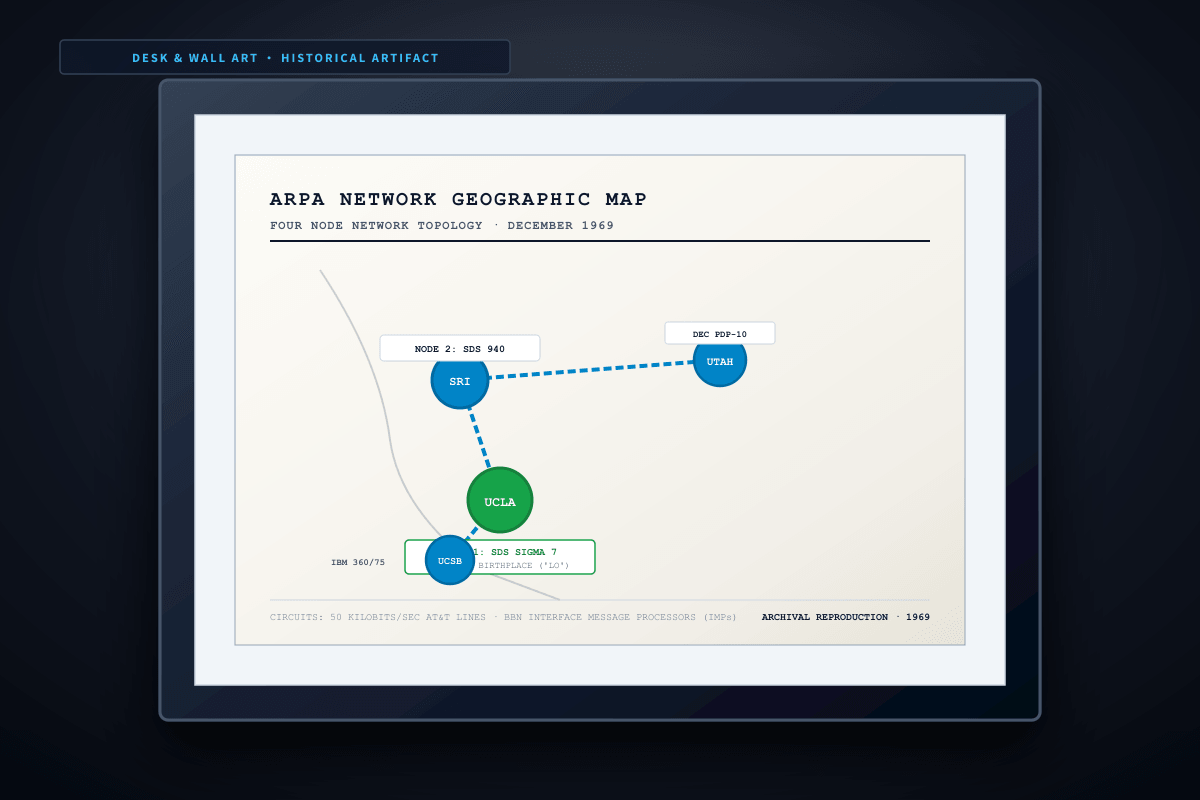
For home office setups, computer science research laboratories, and engineering studios, high-resolution museum-grade archival prints of the original 1969 ARPANET topological and logical diagrams offer a sophisticated, historically grounded visual anchor. Depicting the initial four connected nodes—UCLA, SRI, UC Santa Barbara, and the University of Utah—interlinked by delicate 50 kbps circuits, these minimalist archival lithographs reproduce the original hand-drawn DARPA and BBN network charts on heavy archival matte canvas using fade-resistant pigment inks.
Buying limit: Available in standard exhibition dimensions (such as 18x24 inches or 24x36 inches). Verify that prints utilize acid-free museum-grade cotton rag paper or heavyweight canvas with archival pigment inks to prevent yellowing; select custom UV-protective museum glass frames to protect against sunlight degradation in bright workspace environments.
Original editorial illustration, not a retailer photograph. No exact Amazon offer passed our verification gate.SOURCES, METHOD, AND LIMITS
We examined primary laboratory logbook transcripts from October 29, 1969 (UCLA Room 3420), technical schematics of the BBN Interface Message Processor (Honeywell DDP-516), and institutional documentation from the Computer History Museum and RFC archives on October 29, 2026.
- UCLA Kleinrock Internet Heritage Center: The First ARPANET Transmission Logbook — Primary institutional archive preserving the original October 29, 1969 laboratory logbook entry ('Talked to SRI host to host 22:30') recorded in Boelter Hall Room 3420.
- Computer History Museum: Oral History of Leonard Kleinrock and the Birth of ARPANET — Archival oral history recording first-hand testimony regarding packet-switching theory, IMP engineering by BBN, and the October 29 transmission with SRI.
- Internet Engineering Task Force (IETF) RFC Archive: RFC 1 — Host Software — The foundational architectural memorandum published by Steve Crocker at UCLA in April 1969 establishing host-to-host interface standards for the ARPANET.