ON THIS DAY · OCTOBER 12, 1964
Three Men, Zero Spacesuits: How the Voskhod 1 Gamble Stunned the World
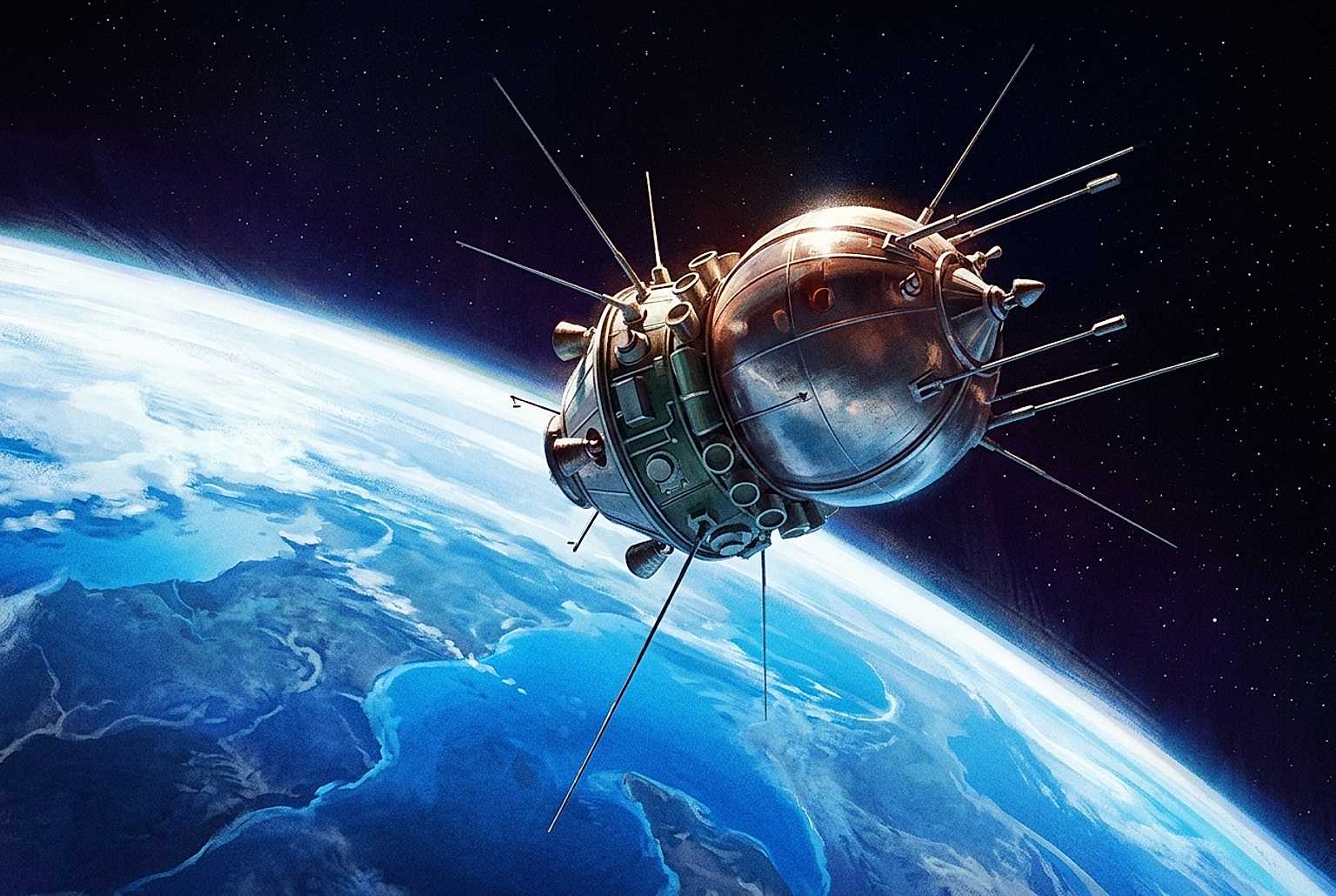
On October 12, 1964, the Soviet Union launched Voskhod 1 from Baikonur Cosmodrome, achieving humanity's first multi-person spaceflight. To beat NASA's upcoming two-man Project Gemini, Chief Designer Sergei Korolev stripped a single-seat Vostok capsule of its heavy ejection seat, squeezed three men into a 2.3-meter sphere without spacesuits, and flew the mission with zero launch escape system. The audacious 24-hour orbital mission stunned the Western world, even as Soviet Premier Nikita Khrushchev was being ousted from power back in Moscow.
The Propaganda Imperative: How Khrushchev Forced Korolev to Beat Project Gemini
In the autumn of 1964, the superpower contest for dominance in outer space was approaching a critical inflection point. The Soviet Union had built an early lead with Yuri Gagarin's historic 1961 flight and subsequent solo Vostok missions, but NASA was closing the gap rapidly. In Houston and Cape Kennedy, the United States was openly preparing to fly Project Gemini—a sophisticated, highly maneuverable two-man spacecraft equipped with radar docking capabilities, fuel cells, and ejection seats. Soviet Premier Nikita Khrushchev was acutely aware of the American schedule and demanded that Soviet engineers maintain the illusion of permanent technological superiority by launching a multi-man crew before Gemini could leave the pad.
The Chief Designer of the Soviet space program, Sergei Korolev, found himself in a dangerous operational corner. His planned second-generation spacecraft, the three-person Soyuz, was beset by developmental delays and years away from flight readiness. If Korolev waited for Soyuz, NASA's Gemini missions would dominate worldwide headlines throughout 1965. Khrushchev bluntly insisted on an immediate triumph: the Soviet Union had to launch not merely two cosmonauts, but three. With no time to design and qualify a new spacecraft from scratch, Korolev took an audacious and terrifying gamble: he ordered his design bureau, OKB-1, to radically rebuild the existing single-seat Vostok capsule into a three-man ship, designated Voskhod ('Sunrise').
The 2.3-Meter Sphere: Stripping Vostok to Fit Three Men
Transforming the Vostok 3KA into the Voskhod 3KV required engineering surgery that pushed safety margins past their absolute limits. The Vostok descent module was a sphere measuring only 2.3 meters (7.5 feet) in diameter, enclosed in an ablative heat shield. In its original configuration, more than half of the internal volume was consumed by a massive 800-kilogram ejection seat and its associated guide rails. In an emergency during launch, the ejection seat allowed the cosmonaut to escape through the hatch; during normal re-entry, the cosmonaut ejected at 7,000 meters altitude and parachuted separately because the capsule impacted the ground with bone-crushing force.
To squeeze three men into this tiny volume, Korolev took the controversial step of removing the ejection seat entirely. In its place, engineers bolted three custom contoured couches directly to the cabin floor, rotating the seating axis ninety degrees so the cosmonauts lay side-by-side. The cabin was so congested that the men could barely move their arms without brushing against each other or the walls. Because the instrument panel was still mounted in its original Vostok orientation, pilot Vladimir Komarov had to crane his neck awkwardly sideways to read the flight instruments and primary optical drift sight (Vzor).
The removal of the ejection seat created another critical engineering crisis: how could the crew survive touchdown? A heavy ballistic landing in the sphere would cause severe spinal trauma or death. Korolev's engineers devised an ingenious dual-parachute system paired with solid-fuel braking retrorockets mounted on the parachute suspension lines. A long mechanical sensor probe dangled beneath the descending capsule; the instant the probe touched the steppe soil, an electrical contact fired the braking rockets, reducing the descent rate to nearly zero just centimeters before ground impact.
Woolen Tracksuits in the Vacuum: Flying Without Escape Systems or Spacesuits
The most harrowing compromise of the Voskhod 1 mission was hidden from the global public until years later. Three bulky SK-1 pressurized spacesuits could not physically fit through the capsule hatch or inside the cramped cabin alongside the environmental control tanks. Over the fierce objections of several senior aviation physicians and test pilots, Korolev made the chilling decision that the crew would fly without spacesuits or helmets. Instead, Vladimir Komarov, Konstantin Feoktistov, and Boris Yegorov boarded the rocket wearing lightweight woolen tracksuits and soft cloth communications caps.
The implications were catastrophic if anything went wrong. If a seal leaked, if the hatch failed to maintain its airtight seal, or if a micrometeorite penetrated the thin hull, the cabin atmosphere would evacuate into the vacuum of space, killing all three cosmonauts within fifteen seconds from explosive decompression. Furthermore, because the ejection seats had been removed and the spacecraft lacked a launch escape tower like the American Mercury or Apollo rockets, there was zero abort capability during the first forty seconds of flight. If the modified R-7 booster suffered an engine failure or exploded on the pad, the crew had no escape pathway whatsoever.
To make the crew politically and scientifically unassailable, Korolev assembled a unique roster. Commander Vladimir Komarov was a seasoned military pilot and engineer. Konstantin Feoktistov was an OKB-1 spacecraft designer—becoming the first civilian and the first spacecraft architect in history to fly aboard his own creation. Boris Yegorov was a 27-year-old physician whose father was an influential brain surgeon, making him the first medical doctor to study human physiology in weightlessness. Despite the extreme dangers, all three men accepted the mission willingly, knowing they were walking an engineering tightrope across the edge of the cosmos.
Twenty-Four Hours in Orbit: Science, Soft Landings, and a Coup in Moscow
At 07:30 UTC on October 12, 1964, the Voskhod 11A57 booster roared off Site 1/5 at Baikonur, delivering Voskhod 1 cleanly into an elliptical orbit of 178 by 408 kilometers with an inclination of 64.9 degrees. Once in orbit, the mission was hailed worldwide as a monumental triumph of Soviet technology. Moscow radio interrupted regular programming with triumphal fanfares, announcing that three Soviet citizens—a pilot, a scientist, and a physician—were working together in shirtsleeve comfort in space, humiliating NASA months before the first manned Gemini flight.
Inside the capsule, the crew worked through a packed 24-hour schedule. Boris Yegorov recorded blood pressure, brain waves, and vestibular reactions, providing humanity's first clinical data on space motion sickness. Konstantin Feoktistov photographed polar auroras, horizon luminance, and tested optical navigation equipment. Vladimir Komarov handled manual orientation checks. Because life support consumables had zero safety margin for three men, Korolev strictly limited the flight to sixteen orbits—lasting twenty-four hours and seventeen minutes.
While the cosmonauts were circling the planet, an astonishing political drama was unfolding on the ground. Soviet Premier Nikita Khrushchev, who had phoned the cosmonauts from his vacation villa in Sochi during their third orbit to congratulate them, was being systematically overthrown in a Kremlin palace coup orchestrated by Leonid Brezhnev and Alexei Kosygin. By the time Voskhod 1 fired its retrorockets and executed a flawless soft landing in Soviet Kazakhstan on the morning of October 13, Khrushchev was out of power. When the triumphant crew returned to Moscow for their Red Square parade, it was Brezhnev who pinned the Gold Star of Hero of the Soviet Union to their chests. Voskhod 1 had delivered one of the greatest propaganda victories in history, executed on the thinnest razor's edge of engineering survival.
What the evidence does not settle
Popular historical accounts of Voskhod 1 frequently repeat four major inaccuracies: first, that Voskhod was an entirely new second-generation spacecraft, when archival engineering records from OKB-1 prove it was an extreme, hurried modification of the single-seat Vostok 3KA; second, that the crew flew without spacesuits because Soviet environmental control systems were considered infallible, whereas the omission was strictly caused by severe weight and cabin volume constraints; third, that the mission was planned as a multi-day flight, whereas it was strictly constrained to a 24-hour duration due to minimal emergency consumable margins; and fourth, that the cosmonauts were informed in flight about the political coup against Khrushchev, whereas Soviet state controllers kept the leadership struggle secret until after landing. Prospective readers and model enthusiasts should note that vintage Soviet model kits require specialized solvent adhesives and hobby finishing tools, and historical monographs provide unclassified technical analysis without commercial endorsement.
PRODUCT IDEA 01
Challenge to Apollo: The Soviet Union and the Space Race, 1945–1974 — Asif A. Siddiqi
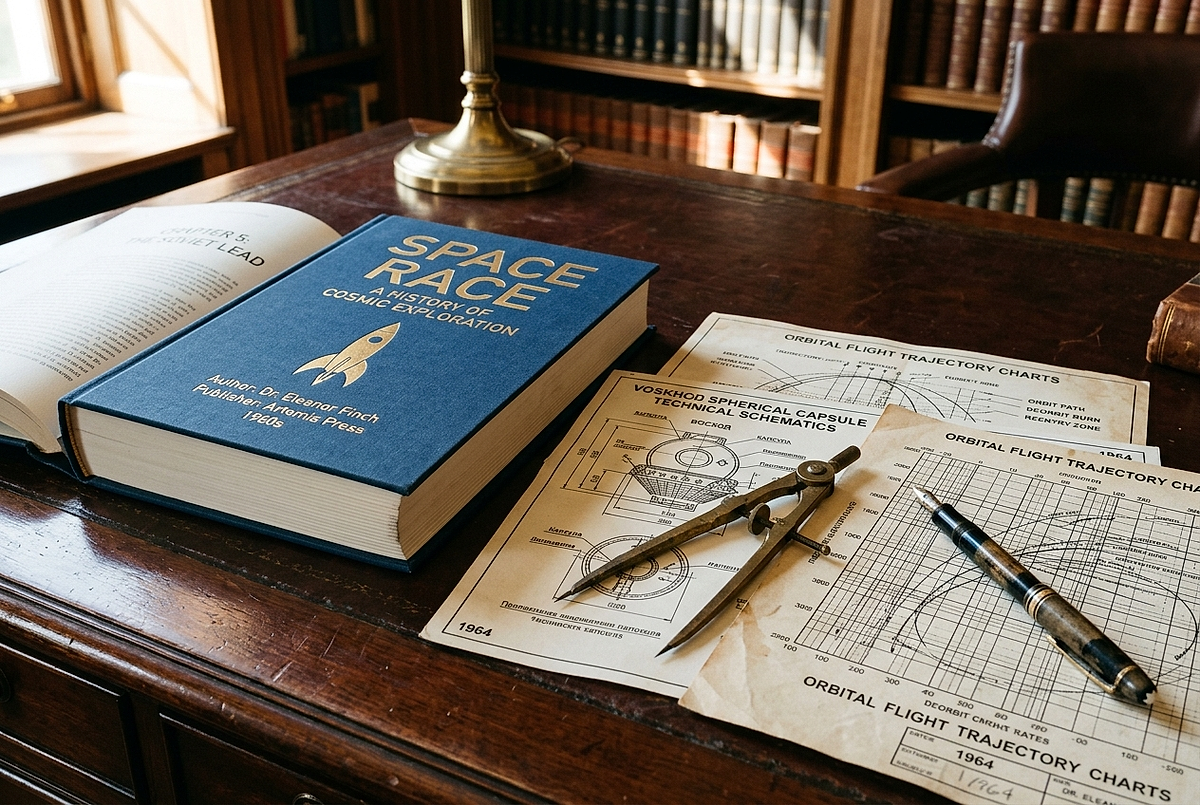
To truly understand the political pressures, secret rivalries, and harrowing engineering gambles behind missions like Voskhod 1, Dr. Asif A. Siddiqi's landmark monograph 'Challenge to Apollo' (published by the NASA History Division as NASA SP-2000-4408) stands as the definitive academic work. Drawing from declassified Soviet state archives, memoirs of OKB-1 designers, and military commission transcripts, Siddiqi chronicles Sergei Korolev's struggle to maintain Soviet preeminence while working with rudimentary technologies. The text provides an exhaustive, unromanticized breakdown of the Voskhod program, detailing how engineers stripped Vostok's safety margins, navigated Khrushchev's demands, and engineered the soft-landing braking thrusters that brought Komarov, Feoktistov, and Yegorov safely home.
Buying limit: Available as an official open-access digital monograph through the NASA History Program Office repository (NASA SP-2000-4408) and in physical hardcover and two-volume paperback editions through university and specialty aerospace booksellers. When sourcing physical copies for institutional or personal research libraries, ensure the edition includes the comprehensive appendices containing OKB-1 spacecraft serial indices, Soviet launch manifest tables, and declassified Central Committee decree citations.
Original editorial illustration, not a retailer photograph. No exact Amazon offer passed our verification gate.PRODUCT IDEA 02
Voskhod-1 Soviet Manned Spacecraft Desktop Scale Display Model Kit
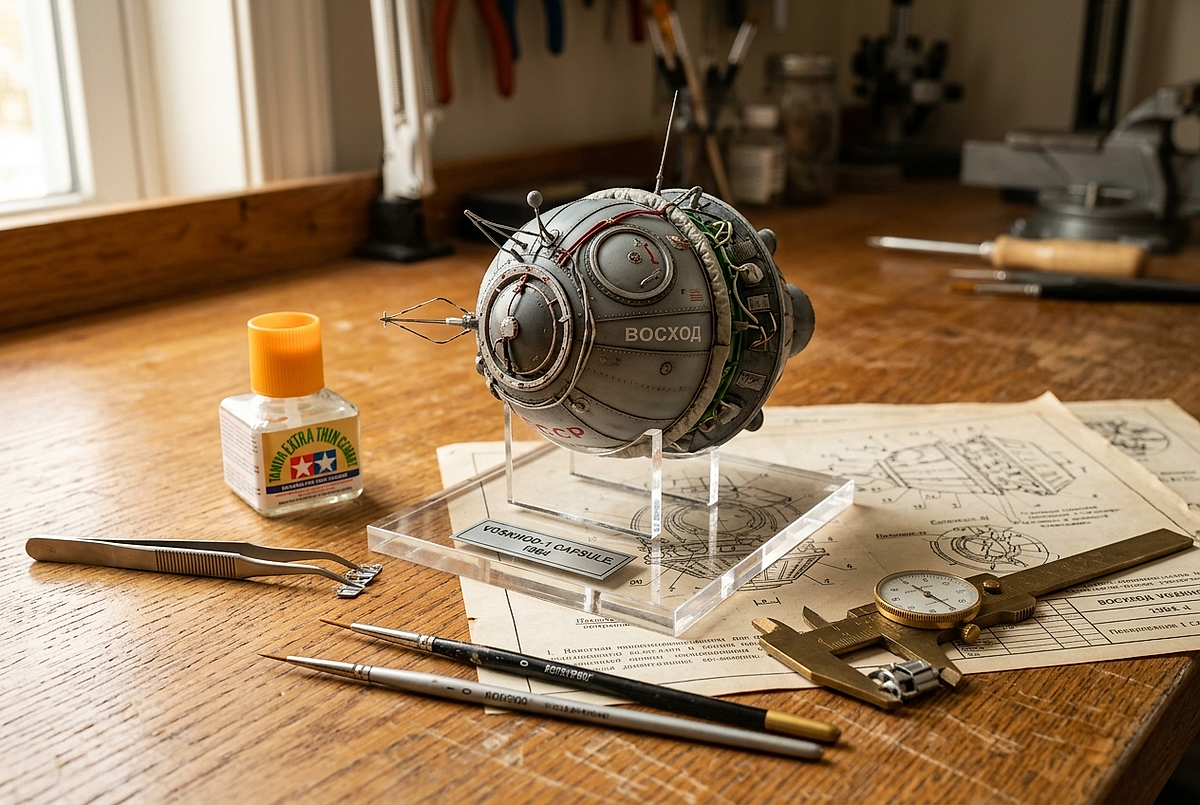
For educators, aerospace historians, and model builders, a high-detail precision scale model of the spherical Voskhod 3KV capsule illustrates the radical physical differences between Soviet and American spaceflight architecture. Unlike the cone-shaped American Mercury, Gemini, and Apollo capsules, the Soviet spacecraft utilized a 2.3-meter sphere for aerodynamic stability during ballistic re-entry. Scale models (typically produced in 1:24 or 1:48 scale by specialized European and historical hobby manufacturers) meticulously replicate the external thermal blanket quilting, whip antenna cluster, retro-rocket truss assembly, instrument equipment module, and the distinctive triple-couch interior layout, providing a tangible three-dimensional demonstration of how Korolev squeezed three cosmonauts into an impossibly compact orbital shell.
Buying limit: Verify whether the kit is an injection-molded polystyrene assembly kit requiring plastic liquid cement, acrylic paints, and fine decal setting solutions, or a pre-painted resin desktop collector model. Look for kits that accurately include the exterior soft-landing thruster housings and photo-etched metal antenna arrays. Assembly requires fine hobby tweezers, sprue cutters, and careful test-fitting of the delicate multi-piece spherical hull halves.
Original editorial illustration, not a retailer photograph. No exact Amazon offer passed our verification gate.SOURCES, METHOD, AND LIMITS
Researched using primary institutional records from the NASA Space Science Data Coordinated Archive (NSSDCA Spacecraft ID 1964-065A / Voskhod 1), the NASA History Division monograph SP-2000-4408 ('Challenge to Apollo: The Soviet Union and the Space Race, 1945–1974' by Dr. Asif A. Siddiqi), and declassified documents from the Wilson Center Digital Archive on Soviet Space Exploration. Technical parameters regarding the Voskhod 3KV capsule configuration, R-7 booster staging, and landing dynamics were cross-referenced against the Russian State Archive of Scientific and Technical Documentation (RGANTD) and Smithsonian National Air and Space Museum research files for Soviet human spaceflight artifacts. No historic spacecraft hardware was operated or dismantled.
- NASA Space Science Data Coordinated Archive (NSSDCA) — Voskhod 1 Master Catalog — Official NASA master catalog record documenting the October 12, 1964 launch of Voskhod 1, spacecraft mass of 5,320 kg, crew manifest, 16-orbit flight trajectory, and soft touchdown on October 13, 1964.
- NASA History Division — Challenge to Apollo: The Soviet Union and the Space Race 1945–1974 — Comprehensive NASA History Office monograph by Dr. Asif A. Siddiqi documenting OKB-1 design modifications, removal of ejection seats, spacesuit exclusion, and political background of Voskhod 1.
- Smithsonian National Air and Space Museum — Voskhod Human Spaceflight Program Archive — Curatorial museum record documenting the spherical descent capsule architecture, internal crew arrangement, and technological lineage connecting Vostok, Voskhod, and early Soyuz spacecraft.