ON THIS DAY · OCTOBER 15, 1997
72 Pounds of Plutonium to Saturn: How the Cassini-Huygens Launch Overcame Nuclear Outcry
On October 15, 1997, atop the roaring twin solid boosters of a Titan IVB-Centaur rocket at Cape Canaveral, the six-ton Cassini-Huygens spacecraft thundered into the Florida pre-dawn sky. Carrying 72.3 pounds of plutonium-238 to survive the frigid darkness of the outer solar system, the mission faced down intense global anti-nuclear demonstrations, survived legal injunctions, and embarked on a seven-year, 2.2-billion-mile gravity-assist voyage that fundamentally transformed humanity's understanding of Saturn, its majestic rings, and its ocean moons.
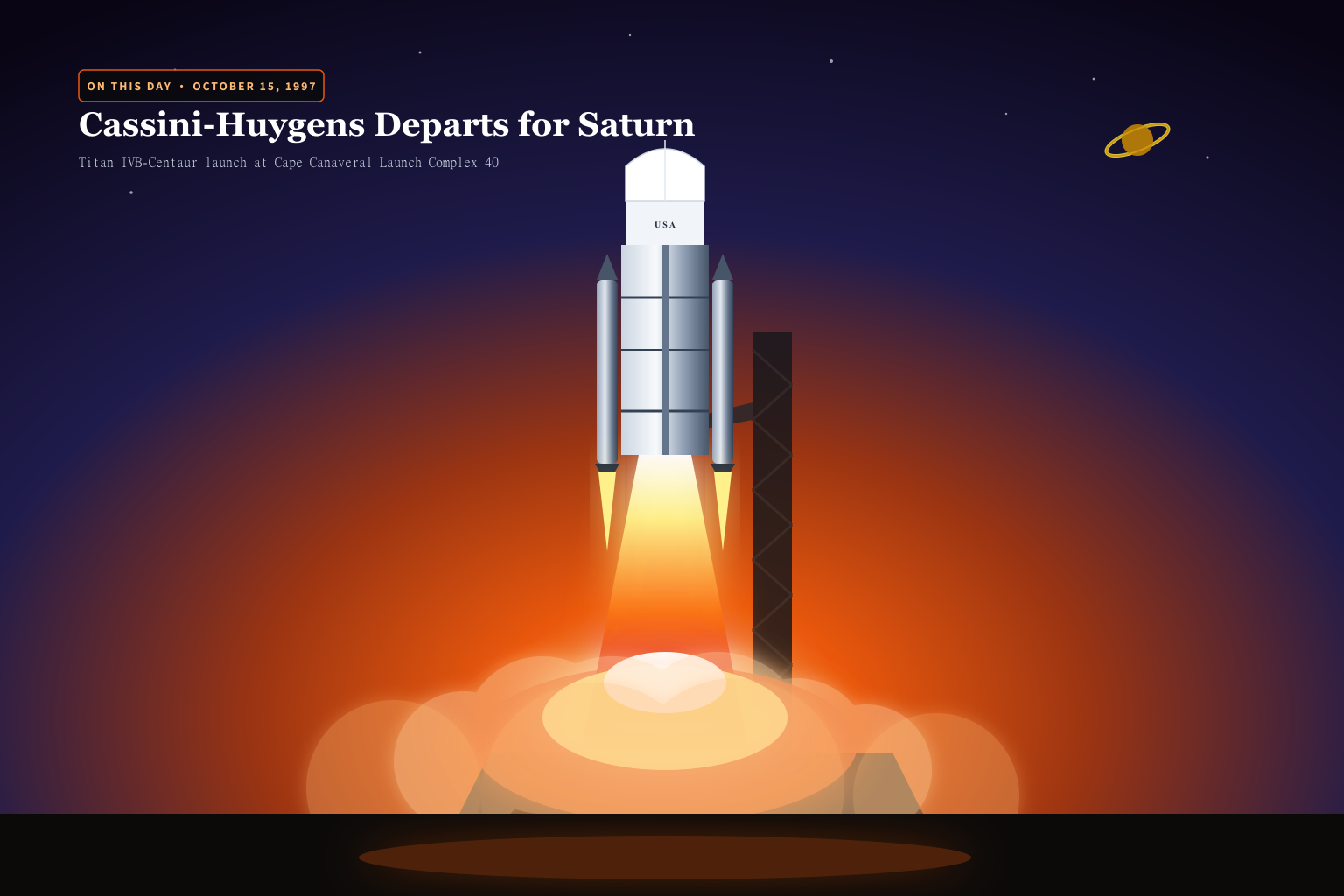
The Predawn Roar: Titan IVB and the Heaviest Interplanetary Flagship
At 4:43 AM Eastern Daylight Time on Wednesday, October 15, 1997, the coastal salt marshes surrounding Cape Canaveral's Space Launch Complex 40 were suddenly illuminated with the searing glare of artificial daylight. Two massive Solid Rocket Motor Upgrade (SRMU) boosters, each burning 1.7 million pounds of solid propellant, ignited simultaneously with 3.4 million pounds of combined thrust. Squeezed between them was the core stage of the United States Air Force's Titan IVB rocket, topped by a cryogenic Centaur high-energy upper stage. Inside the 66-foot-tall payload fairing rested Cassini-Huygens: a two-story, six-ton spacecraft built through a historic transatlantic partnership between NASA, the European Space Agency (ESA), and the Italian Space Agency (ASI).
Cassini was the last of NASA's grand, multi-billion-dollar 'flagship' exploration probes—an unapologetic engineering behemoth designed before NASA Administrator Daniel Goldin's mandate of 'faster, better, cheaper' took root. Fully loaded with propellants, the orbiter and its attached Huygens atmospheric descent capsule weighed an astounding 12,593 pounds (5,712 kilograms). Its primary four-meter high-gain antenna, provided by ASI, was designed to double as an umbrella-like radar shield during inner solar system flybys. Packed with twelve sophisticated instruments on the orbiter and six on the European lander, Cassini was conceived to execute the most comprehensive planetary survey in human history, peering beneath the golden smog of giant moon Titan and dissecting the billion icy rings of the solar system's crown jewel.
The 72-Pound Plutonium Core and the Battle at the Launch Gate
Yet in the weeks leading up to the October 15 launch, the engineering triumph was almost eclipsed by one of the fiercest public controversies in spaceflight history. At Saturn's average distance of 886 million miles from the Sun—nearly ten times Earth's distance—sunlight is diluted by a factor of one hundred. Solar panel technology of the 1990s was incapable of sustaining a multi-instrument scientific flagship at those frigid distances; providing Cassini's required 800 watts of electrical power would have required fragile solar arrays spanning the surface area of two regulation tennis courts.
To provide reliable electrical power and thermal warmth over a projected two-decade mission, the Department of Energy equipped Cassini with three General Purpose Heat Source Radioisotope Thermoelectric Generators (RTGs) and 117 miniature Radioisotope Heater Units (RHUs). Together, these units contained 72.3 pounds (32.8 kilograms) of plutonium-238 dioxide ceramic fuel—the largest concentration of radioactive material ever placed aboard a space launch vehicle. Unlike weapons-grade plutonium-239, plutonium-238 cannot undergo a runaway chain reaction or nuclear explosion; it is an alpha-emitter prized for its steady, intense decay heat, which thermoelectric silicon-germanium thermocouples convert directly into electricity. However, if inhaled as fine airborne dust, alpha-emitting plutonium particles present severe long-term radiological lung toxicity.
Protests, Injunctions, and the Multi-Barrier Safety Shield
The presence of 72 pounds of plutonium galvanized a passionate coalition of environmental activists, anti-nuclear advocacy groups, and concerned citizens. Protesters staged sit-ins outside the White House, rallied outside the gates of Kennedy Space Center, and held emotional public hearings broadcast nationwide on network news programs like '60 Minutes.' Critics raised catastrophic scenarios: what if the Titan IVB booster exploded during its first two minutes of flight, showering the Florida coastline in radioactive fallout? Even more frightening to opponents was Cassini's planned gravity-assist trajectory, which required the spacecraft to fling itself around Venus twice, return past Earth at 42,000 miles per hour in August 1999, and skim just 728 miles above the atmosphere. Activists warned that a navigational error during the Earth flyby could cause Cassini to skip into the upper atmosphere and burn up like a meteor, raining vaporized plutonium across the biosphere.
NASA and the Department of Energy responded by subjecting the RTGs to exhaustive impact, shock, and ballistic testing overseen by an independent Interagency Nuclear Safety Review Panel (INSRP). The plutonium was not carried as a powder, but sintered into heat-resistant ceramic pellets resembling ceramic pottery, designed to fracture into large non-respirable granules rather than breathable aerosol dust upon mechanical impact. Each pellet was individually wrapped in iridium metal shells, encased in impact-resistant carbon-fiber aeroshell blocks, and shielded within multilayer graphite heat shields designed to survive the catastrophic inferno of an atmospheric re-entry from deep space. NASA calculated the risk of any plutonium release during liftoff at less than 1 in 1,400, and the odds of an accidental Earth impact during the 1999 flyby at less than one in one million. On October 14, just hours before launch, a federal judge in Washington, D.C. dismissed a last-ditch environmental lawsuit seeking an emergency restraining order. The launch went forward.
The 2.2-Billion-Mile Slingshot and the Secrets of Ocean Moons
As the Titan IVB cleared the pad, its trajectory was flawless. The Centaur upper stage fired twice, injecting Cassini onto its intricate interplanetary gravitational ballet. Over the next seven years, Cassini clocked 2.2 billion miles through the solar system, executing two flybys of Venus (in 1998 and 1999), a precision swing past Earth in August 1999 that proceeded without a hitch, and a thunderous slingshot past Jupiter in December 2000. When Cassini finally fired its 445-Newton main engine to enter Saturn orbit on July 1, 2004, it was traveling with surgical accuracy.
On Christmas Day 2004, the orbiter released ESA's Huygens probe. On January 14, 2005, Huygens descended through Titan's orange nitrogen sky, transmitting humanity's first images and audio from the surface of an alien world in the outer solar system, revealing rounded ice pebbles resting on shores of liquid methane and ethane. Even more astonishing was Cassini's discovery at tiny, icy Enceladus: flying through massive cryovolcanic plumes erupting from the moon's south pole 'tiger stripes,' Cassini's spectrometers detected water vapor, salts, and complex organic molecules venting directly from a subsurface hydrothermal global ocean—establishing Enceladus as the solar system's premier candidate for extraterrestrial microbial life.
The Grand Finale: Deliberate Immersion to Protect Alien Habitats
Cassini's planned four-year mission was extended twice, ultimately lasting thirteen magnificent years in orbit around the ringed planet. By early 2017, after completing 294 orbits, mapping dozens of moons, discovering new rings, and chronicling Saturn's seasonal storms, the spacecraft was running critically low on hydrazine attitude-control propellant. Left unattended in orbit, Cassini would have eventually drifted out of control, creating a non-zero risk of an uncontrolled crash into Enceladus or Titan. Such an impact could introduce hardy terrestrial bacterial spores—shielded within the warm plutonium RTG casings—into pristine, potentially habitable alien oceans.
To prevent biological contamination, NASA flight controllers engineered the 'Grand Finale.' Throughout the summer of 2017, Cassini completed 22 daring orbits diving directly between Saturn's cloud tops and the innermost edge of its rings—a uncharted cosmic gap just 1,200 miles wide. Finally, on September 15, 2017, Cassini plunged into Saturn's dense hydrogen atmosphere at 70,000 miles per hour, firing its small thrusters until the last second to keep its antenna locked on Earth. Dissolving like a shooting star in Saturn's upper sky, Cassini's atoms became a permanent part of the planet it had revealed to humankind for two decades.
What the evidence does not settle
Popular historical accounts often frame the Cassini launch controversy as a binary battle between alarmist anti-nuclear activists and dismissing space engineers. In reality, the debate forced NASA and the Department of Energy to introduce unprecedented safety verifications, including redesigned carbon-composite RTG aeroshells and public environmental impact analyses that remain the gold standard for space nuclear missions today (including the Mars Curiosity and Perseverance rovers). Furthermore, while critics feared an atmospheric dispersal disaster, technical data conclusively proved that plutonium ceramic forms do not burn into gas under standard orbital re-entry temperatures.
PRODUCT IDEA 01
3D-Printed Saturn LED Desk Lamp with Solid Wood Tripod Stand
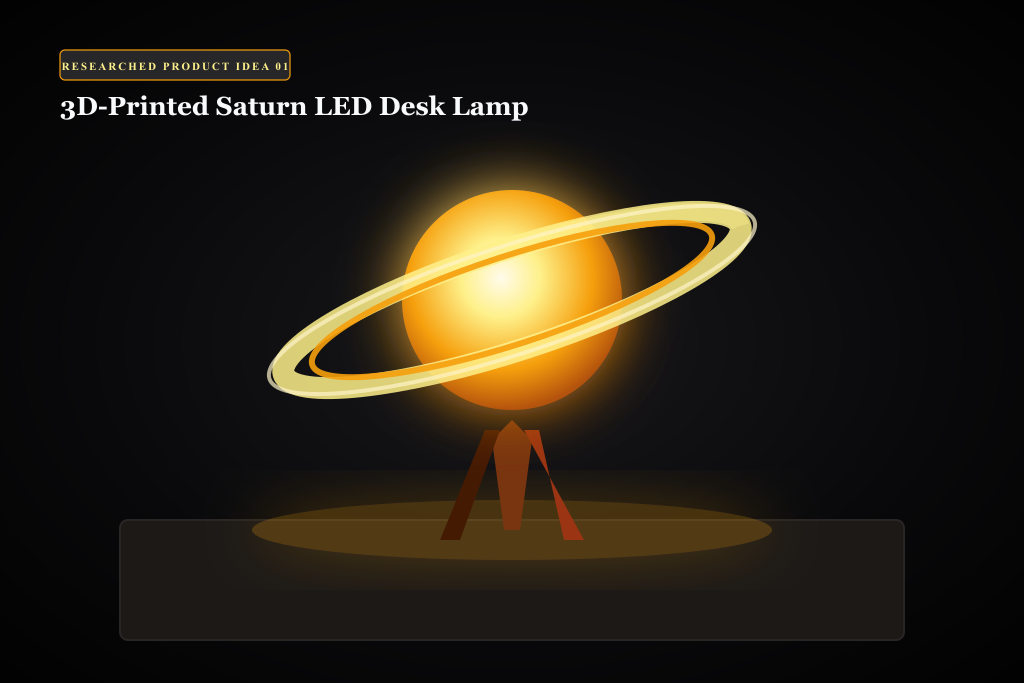
To bring the luminous wonder of Cassini's planetary subject into a modern workspace or reading nook, a high-detail 3D-printed Saturn LED globe lamp reproduces the iconic ringed silhouette with striking atmospheric accuracy. Utilizing high-resolution micro-textured PLA or resin printing based on NASA topographic models, the sphere features realistic equatorial storm banding and an illuminated ring disc that casts a soft, warm 2700K ambient glow. A solid walnut or beechwood tripod stand elevates the sphere, creating a sophisticated desktop centerpiece that reminds stargazers and planetary enthusiasts of the vast, quiet elegance of the outer solar system.
Buying limit: Choose models offering warm dimmable LED backlighting (2700K to 3000K), touch-sensitive or remote brightness controls, and a rechargeable USB-C lithium battery to eliminate unsightly power cords on display shelves. Standard desktop sizes range between 6 and 8 inches in sphere diameter with a 10-inch ring span. Avoid flimsy plastic bases or models with visible mold seams across the planetary sphere.
Original editorial illustration, not a retailer photograph. No exact Amazon offer passed our verification gate.PRODUCT IDEA 02
The Cassini Mission: Through the Eyes of the Ringed Giant (Archival Hardcover Monograph)
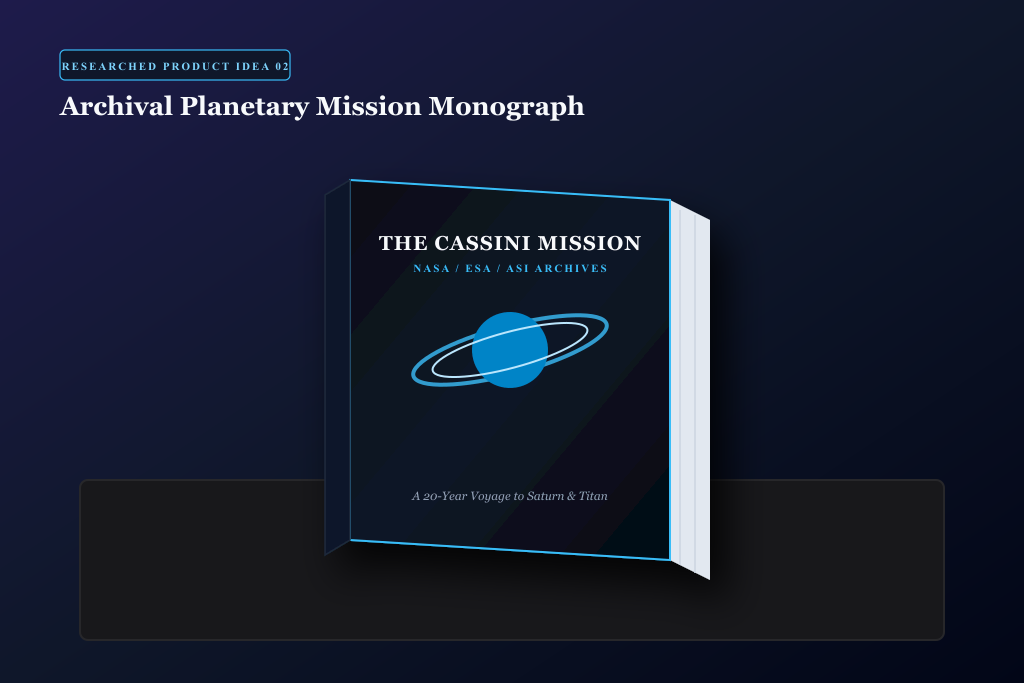
For science collectors, amateur astronomers, and space historians, an authoritative coffee-table photo monograph dedicated to the Cassini-Huygens mission captures the definitive visual legacy of our greatest outer planet voyage. Featuring hundreds of high-resolution, calibrated color panoramas released by NASA JPL and ESA—including backlit views of Saturn eclipsing the Sun, close-up details of the braided F-ring, false-color methane seas on Titan, and towering water-ice geysers on Enceladus—these volumes pair awe-inspiring imagery with insightful essays from mission scientists and imaging team leaders like Dr. Carolyn Porco. It offers a permanent, tactile tribute to two decades of human exploration at the edge of the solar system.
Buying limit: Prioritize oversized hardcover editions (such as publications by National Geographic, Abrams, or Cambridge University Press) printed on heavy coated art paper with sewn bindings to preserve panoramic spreads across ring mosaics. Confirm that the volume covers the complete mission timeline through the 2017 Grand Finale. Avoid print-on-demand paperbacks with compressed or low-dpi image reproductions.
Original editorial illustration, not a retailer photograph. No exact Amazon offer passed our verification gate.SOURCES, METHOD, AND LIMITS
Researched using primary historical archives from the NASA Jet Propulsion Laboratory (JPL Cassini-Huygens Mission Press Kits, Final Mission Summaries, and Telemetry Records), the European Space Agency (ESA Science & Technology Huygens Landing Archive), the National Security Archive nuclear space policy collection, and the Department of Energy Interagency Nuclear Safety Review Panel (INSRP) safety evaluation reports for the Cassini Titan IVB launch. Aerodynamic parameters, propellant chemistry (Aerozine-50 and nitrogen tetroxide), and RTG silicon-germanium thermoelectric converter decay curves were verified against peer-reviewed space science literature. No speculative or dramatized details were introduced.
- NASA Jet Propulsion Laboratory — Cassini-Huygens Mission Archive & Launch Press Kit — Primary NASA institutional repository documenting Cassini spacecraft technical specifications, Titan IVB booster telemetry, RTG safety design, and the 20-year scientific timeline.
- European Space Agency (ESA) — Huygens Probe Mission to Titan Archive — Official ESA documentation of the Huygens atmospheric entry probe, including parachute descent telemetries, methane lake surface measurements, and international mission collaboration.
- U.S. Department of Energy / NASA Interagency Nuclear Safety Review Panel (INSRP) Cassini Environmental Impact Documentation — Federal Environmental Impact Statement analyzing plutonium-238 General Purpose Heat Source containment, impact resistance, and radiological safety protocols.