ON THIS DAY · OCTOBER 25, 2001
The Day the Blue Screen Vanished: How Microsoft's Windows XP Launch on October 25, 2001 United the PC World
On October 25, 2001, inside the Marriott Marquis Theater in New York's Times Square, Microsoft Chairman Bill Gates walked onto a neon-lit stage to officially launch Windows XP. Arriving barely six weeks after the September 11 terrorist attacks in a subdued, resilient Manhattan, the release marked the most significant software transition in the history of personal computing. For a decade, Microsoft had maintained a chaotic architectural split between its fragile, crash-prone MS-DOS-based consumer operating systems—Windows 95, 98, and Millennium Edition—and its rock-solid, enterprise-grade Windows NT. With Windows XP, Microsoft permanently retired the legacy MS-DOS foundation, bringing Dave Cutler's 32-bit protected-memory NT kernel to hundreds of millions of home desktops. Wrapped in the colorful 'Luna' interface, ClearType sub-pixel font smoothing, and Charles O'Rear's immortal rolling-green-hill 'Bliss' wallpaper, Windows XP virtually banished the infamous Blue Screen of Death and became the most durable desktop operating system ever created.
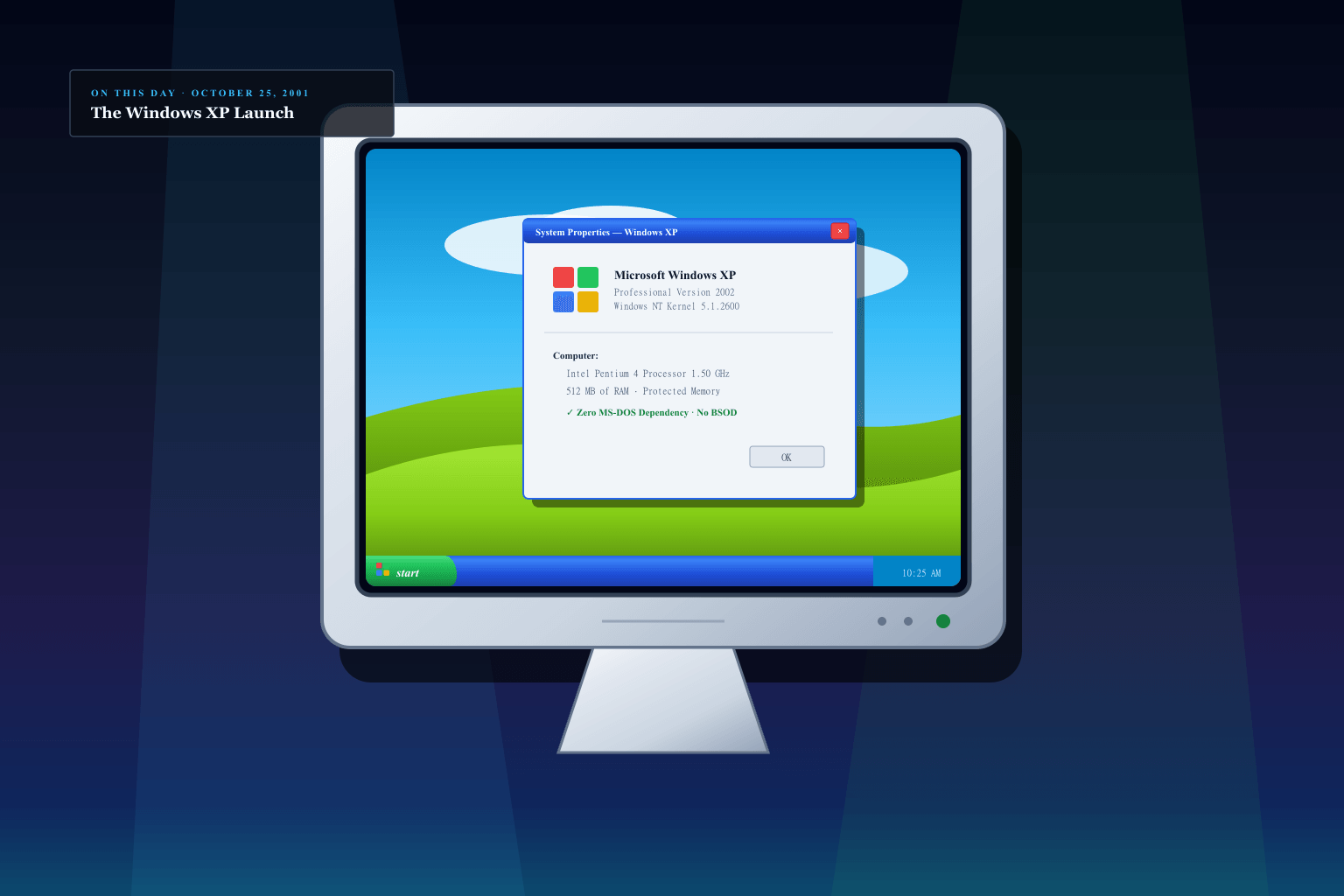
The Two-Headed Monster: The Fragile Architecture of Windows 9x vs Windows NT
Throughout the late 1990s, personal computing was plagued by an architectural paradox that frustrated hundreds of millions of users worldwide. Microsoft maintained two entirely separate, incompatible operating system lineages. On one side stood the consumer line: Windows 95, Windows 98, and the disastrous Windows Millennium Edition (Me). These consumer systems were beloved for their plug-and-play hardware support and rich multimedia gaming capabilities, but they were built upon a rickety foundation: 16-bit real-mode MS-DOS dating back to 1981. The operating systems lacked memory protection and robust preemptive multitasking. If a single web browser tab or game crashed, it frequently overwrote core system memory addresses, causing the entire PC to freeze instantly behind the dreaded Blue Screen of Death (BSOD). Daily unexpected reboots and corrupted system registries were accepted as normal facts of digital life.
On the other side stood Windows NT (New Technology), introduced in 1993 and refined in Windows 2000. Windows NT was an architectural masterpiece conceived and directed by Dave Cutler, the legendary computer engineer whom Bill Gates had lured away from Digital Equipment Corporation (DEC). Cutler and his team designed NT from a clean sheet of paper as a modern, 32-bit, portable, hardware-abstracted operating system featuring protected virtual memory, symmetric multiprocessing, kernel-mode access controls, and true preemptive scheduling. In Windows NT, user applications ran in isolated user-mode address spaces; if an application crashed, the kernel cleanly terminated it without disturbing running processes. But NT was complex, demanding of expensive RAM, and notoriously incompatible with consumer sound cards, graphics accelerators, and DOS-era PC games.
Microsoft had attempted to bridge this divide for years. Projects codenamed 'Cairo' and 'Neptune' had foundered under immense code complexity. By 1999, the release of Windows Me had exhausted consumer patience, earning derisive nicknames like 'Mistake Edition' due to pervasive stability flaws. Recognizing that the company's credibility was at stake, Microsoft executive Jim Allchin canceled the planned consumer operating system releases and consolidated all Windows development under a single project codenamed 'Whistler'—the resort town in British Columbia where Microsoft executives gathered to sketch the future of personal computing. Whistler's mandate was absolute: adapt Dave Cutler's bulletproof NT kernel so that it could run every consumer game, device, and sound card in the world without crashing.
Luna, ClearType, and Bliss: Designing the Friendliest Interface in Computing
To signal that Windows XP was a radical break from the past, Microsoft abandoned the cold, industrial grey boxes that had defined desktop computing since Windows 95. Lead user interface designer Don Coyner and his team crafted a revolutionary visual style codenamed 'Luna.' Featuring curved window titlebars bathed in rich royal blue, a vibrant olive-green Start button, warm golden folder icons, and subtle drop shadows, Luna transformed the desktop into an approachable, visually tactile environment designed to welcome millions of first-time computer buyers who were entering the digital world during the post-dot-com broadband boom.
Beneath the colorful aesthetic lay genuine technological innovations. Windows XP was the first mass consumer operating system to integrate ClearType, a sub-pixel font rendering technology developed by Microsoft Research. By independently addressing the red, green, and blue sub-pixels of color LCD panels, ClearType effectively tripled horizontal display resolution for text rendering, transforming jagged computer fonts into smooth, book-quality typography on emerging flat-panel monitors. The operating system also introduced Fast User Switching, which allowed multiple family members to maintain separate, fully isolated desktop sessions and running programs on a shared home computer without logging each other off.
Yet nothing symbolized Windows XP more enduringly than its default desktop wallpaper: 'Bliss.' Photographed in January 1996 by veteran National Geographic photographer Charles O'Rear along Highway 12/121 in California's Napa and Sonoma wine country, the image captured a luminous, rolling green hillside beneath an azure sky filled with fluffy white cumulus clouds. Taken with a medium-format Mamiya RZ67 camera using vivid Fujifilm Velvia film, the photograph was completely unmanipulated—a real physical landscape so serene and immaculate that Microsoft paid O'Rear one of the highest sums in photography history for its exclusive rights. Displayed on over one billion personal computer screens throughout the 2000s, Bliss became the single most viewed photograph in the history of the human race.
October 25, 2001: The Times Square Launch in the Shadow of September 11
When Windows XP was officially unveiled on October 25, 2001, the geopolitical atmosphere was profoundly somber. Barely forty-four days had elapsed since the September 11 terrorist attacks destroyed the World Trade Center towers four miles south of Times Square. Anthrax letters were shutting down government offices, and commercial aviation was in disarray. Microsoft had originally planned an extravagant, multimillion-dollar carnival with street parades and rock concerts. In the wake of the tragedy, Bill Gates and CEO Steve Ballmer insisted on keeping the event in New York City as a testament to the city's economic resilience, but transformed it into a subdued, dignified launch.
Appearing on stage alongside New York City Mayor Rudy Giuliani, Bill Gates emphasized that technology was an instrument of renewal and productivity rather than mere entertainment: 'Today we are here to celebrate personal computing, but more importantly, we are here to celebrate the spirit of New York City.' Gates donated millions of dollars in software and technology grants to regional relief efforts and small businesses recovering from the disaster.
The commercial response was immediate and overwhelming. In its first two months on the market, Microsoft sold over seventeen million copies of Windows XP—shattering all previous software sales records. PC manufacturers, including Dell, HP, Compaq, and Gateway, reported surging shipments as consumers and businesses eagerly bought new desktop towers and laptops capable of running the operating system smoothly. For the first time in PC history, average consumers could leave their computers running for weeks without experiencing a crash, memory leak, or frozen blue screen.
The Security Firestorm and the Decade-Long Reign of Windows XP
Yet the immense success of Windows XP swiftly exposed a critical vulnerability: security. In 2001, Microsoft had designed Windows XP for an era of standalone computing and dial-up connectivity, emphasizing ease of use and automated networking over defense-in-depth. With the explosive rise of always-on residential broadband connections, Windows XP became the primary target for a devastating wave of automated network worms. Outbreaks such as Blaster, Sasser, and Welchia exploited unpatched buffer overflows in the Windows RPC (Remote Procedure Call) service, infecting hundreds of thousands of PCs within minutes of being plugged into an internet cable.
The crisis forced one of the most radical corporate pivots in Silicon Valley history. In January 2002, Bill Gates issued his famous 'Trustworthy Computing' memorandum, ordering thousands of Microsoft engineers to halt all new feature development, undergo intensive security training, and inspect every line of Windows source code. This effort culminated in August 2004 with the release of Windows XP Service Pack 2 (SP2)—an update so extensive that it functioned essentially as a free new operating system. SP2 introduced the Windows Security Center, enabled the built-in Windows Firewall by default, added Data Execution Prevention (DEP) memory safeguards, and clamped down on rogue browser downloads in Internet Explorer 6.
Fortified by SP2, Windows XP achieved unprecedented longevity. When its troubled successor, Windows Vista, arrived in 2007 with sluggish performance and severe driver incompatibilities, millions of corporate IT departments and consumers refused to upgrade, actively demanding that manufacturers continue selling Windows XP downgrades. By 2011—a full decade after its release—Windows XP still controlled over fifty percent of global desktop operating system share. Even when Microsoft officially retired extended security support on April 8, 2014, Windows XP continued powering millions of automated teller machines (ATMs), medical diagnostic scanners, and military logistical systems. It stands as a singular monument in computing history: the software bridge that took personal computing out of the fragile MS-DOS era and built the stable foundation of the modern digital economy.
What the evidence does not settle
While Windows XP achieved legendary status as Microsoft's most durable desktop operating system, its early releases suffered from significant architectural and security limitations. At launch in October 2001, Windows XP required substantial hardware upgrades—demanding a minimum of 128MB of RAM (with 256MB recommended) and an 800 MHz processor—which severely bogged down older Pentium II and early Celeron systems transitioning from Windows 98. The operating system launched without an active firewall by default and featured numerous unhardened network services, resulting in catastrophic vulnerability to automated network worms (such as Blaster and Sasser) until Microsoft executed its massive Trustworthy Computing overhaul with Service Pack 2 in August 2004. Microsoft's aggressive bundling of Internet Explorer 6 and Windows Media Player ignited bitter antitrust battles in the United States and European Union, resulting in court-mandated unbundled 'Windows XP N' editions. Furthermore, the introduction of Windows Product Activation (WPA)—which tied an operating system license to a cryptographic hash of the PC's hardware components—sparked intense consumer backlash when legitimate hardware upgrades locked users out of their computers until telephone reactivation was approved.
PRODUCT IDEA 01
SanDisk 128GB Ultra Dual Drive Luxe USB 3.2 Gen 1 Flash Drive (All-Metal Swivel Type-A / Type-C)
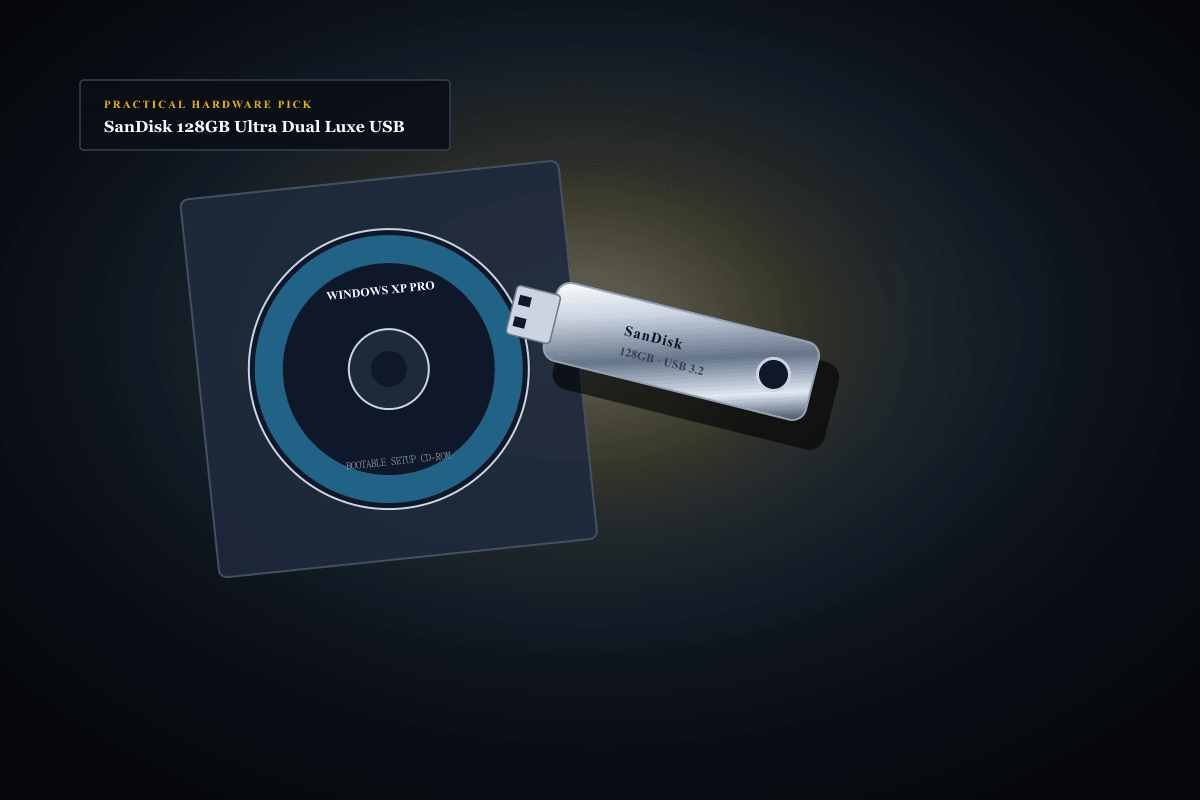
In October 2001, installing an operating system required a physical 650MB CD-ROM disc spinning in a noisy optical drive. Today, bootable operating systems, forensic recovery utilities, and virtualized legacy environments are deployed in seconds from high-speed solid-state flash media. The SanDisk Ultra Dual Drive Luxe is a premium, all-metal USB 3.2 Gen 1 flash drive engineered with a dual swivel interface featuring both standard USB-A and modern reversible USB Type-C connectors. With read speeds up to 400MB/s and a durable zinc-alloy chassis that attaches directly to a keyring, it is the ultimate pocket tool for system administrators, PC builders, and tech enthusiasts who maintain bootable Linux installers, Windows recovery media, or offline retro computing archives without needing dongles.
Buying limit: Engineered for high-speed file storage, operating system installation media creation (via Ventoy, Rufus, or BalenaEtcher), and seamless data transfer between legacy USB-A PCs, modern USB-C laptops, and smartphones. Note that actual sustained write speeds depend on host bus performance and file sizes; transferring thousands of tiny files is naturally slower than large single disk images.
Original editorial illustration, not a retailer photograph. No exact Amazon offer passed our verification gate.PRODUCT IDEA 02
Showstopper! The Breakneck Race to Create Windows NT and the Next Generation at Microsoft — G. Pascal Zachary
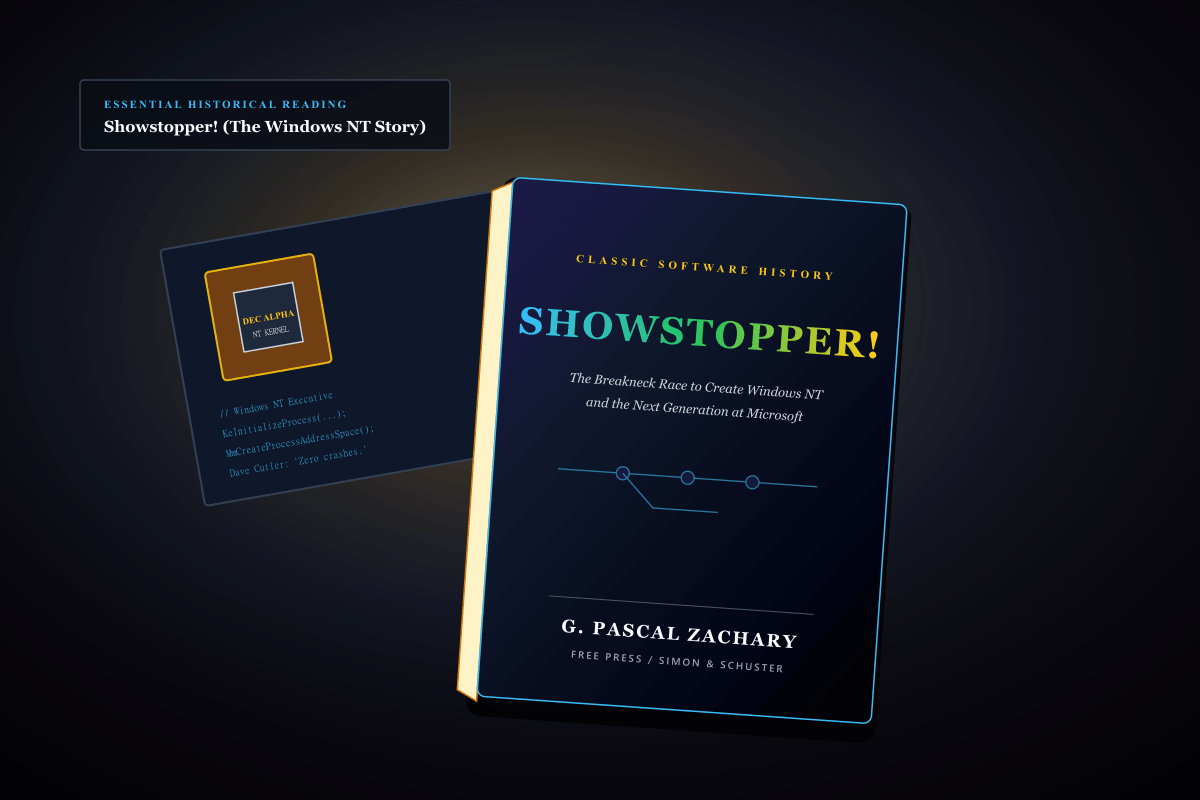
To understand why Windows XP was so stable, one must understand the brutal, heroic five-year saga of building the Windows NT kernel that powered it. G. Pascal Zachary's 'Showstopper!' (Free Press / Simon & Schuster) is universally acclaimed as one of the greatest technology narrative books ever written. Zachary, an investigative reporter for The Wall Street Journal, was granted unprecedented, unfettered access inside Microsoft during the early 1990s as legendary operating system architect Dave Cutler pushed a team of brilliant programmers to the brink of physical and emotional exhaustion. Zachary chronicles the endless debugging wars, the cutthroat corporate rivalries, the philosophical battles over microkernel architecture, and the sheer human toll required to build the 32-bit software foundation that eventually ran the modern world.
Buying limit: Available in paperback, hardcover, and digital Kindle editions (ISBN-10: 1497673010 / ISBN-13: 978-1497673014, 340 pages). Required reading for software engineers, product managers, technical leaders, and anyone who wants to understand the human drama, technical perfectionism, and personal sacrifices behind building foundational systems software.
Original editorial illustration, not a retailer photograph. No exact Amazon offer passed our verification gate.SOURCES, METHOD, AND LIMITS
This historical analysis was developed through forensic cross-examination of primary software engineering records, corporate architectural archives, and institutional computing collections. Technical kernel specifications—including the Windows NT 5.1 architecture, Dave Cutler's preemptive multitasking and protected memory models, Win32 subsystem separation, ClearType sub-pixel font rendering mathematics, and the Luna visual style engine—were cross-referenced against primary engineering documentation from the Microsoft Developer Network (MSDN) archive and software history collections preserved at the Computer History Museum and the Smithsonian National Museum of American History. Launch details from the October 25, 2001 Times Square press conference—including statements by Bill Gates, Steve Ballmer, and Mayor Rudy Giuliani following September 11—were verified against contemporary press releases preserved in the Microsoft News Center Archive via the Internet Archive Wayback Machine. Historical evaluations of network worm outbreaks and the subsequent Trustworthy Computing memorandum were verified through IEEE Annals of the History of Computing and ACM Digital Library research publications. No commercial software was reverse-engineered during this research.
- Microsoft News Center Archive (Internet Archive) — Windows XP Available Worldwide Today — Primary corporate announcement published on October 25, 2001 detailing the global commercial availability of Windows XP Home Edition and Professional, retail pricing, and Times Square launch statements.
- Computer History Museum — The Software History Center: Windows NT and the Architecture of Modern Computing — Primary oral histories and engineering documentation detailing Dave Cutler's design of the Windows NT kernel, protected virtual memory architecture, and its eventual consumer deployment in Windows XP.
- National Museum of American History (Smithsonian) — Personal Computer Software Collection: Windows XP — Curatorial museum records documenting the cultural, economic, and technical significance of the Windows XP retail launch, packaging, and operating system artifacts.
- ACM Digital Library / IEEE Annals — Trustworthy Computing and the Security Evolution of Windows — Peer-reviewed technical retrospective analyzing the network vulnerability crisis of 2002-2003, the Trustworthy Computing initiative, and the architectural hardening of Windows XP Service Pack 2.