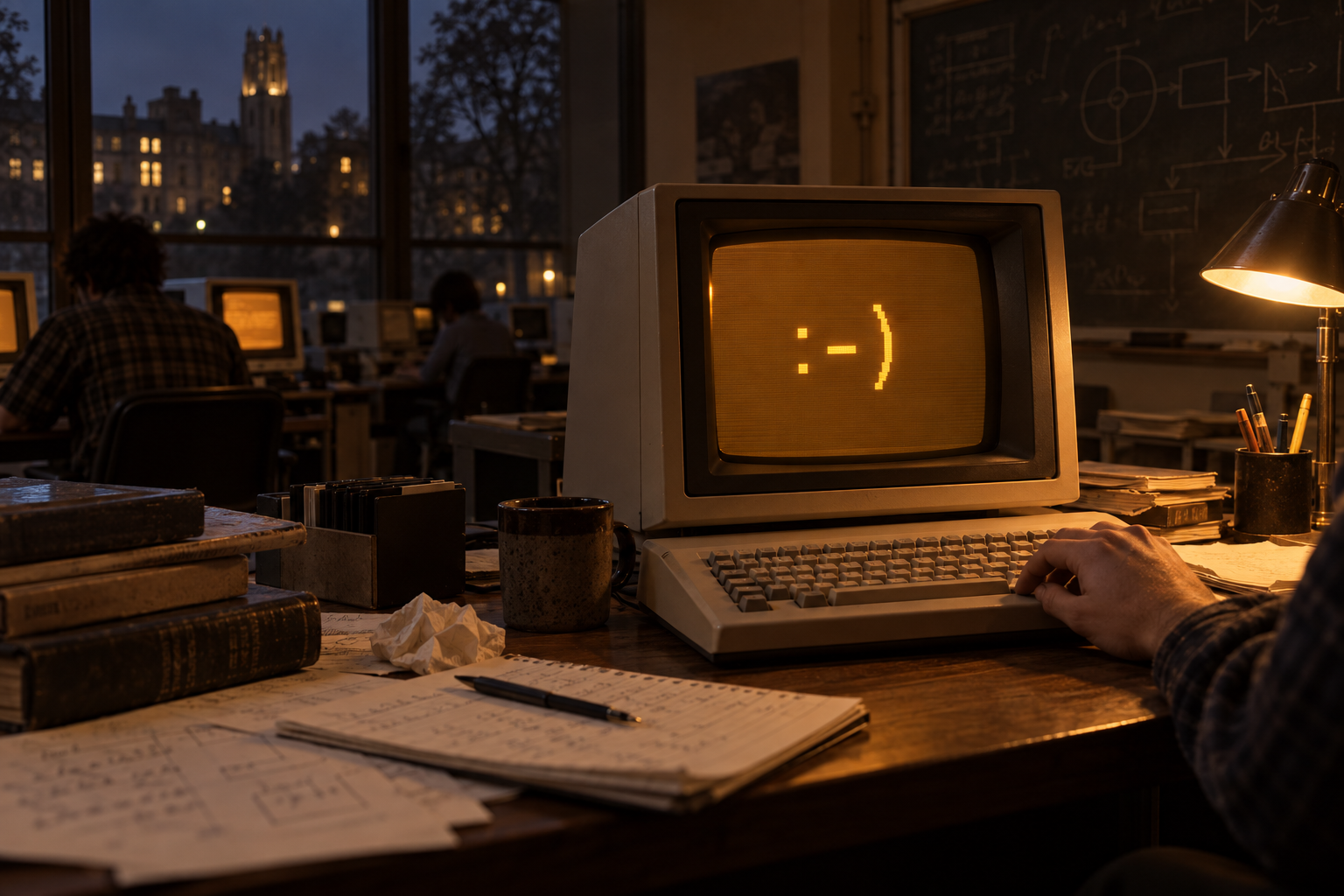
The famous post was not a burst of digital whimsy. It was a practical moderation tool. Carnegie Mellon’s computer-science community used online “bboards” for work, announcements, and jokes. Without a voice or face, a deliberately absurd warning could be mistaken for a real one. A prank about a contaminated elevator helped turn that ambiguity into an argument: should jokes carry a label?
Suggestions multiplied—an asterisk in the subject line, a percent sign, an ampersand. Fahlman’s answer used three characters already available on every terminal. Turn your head and the punctuation becomes a face. He also proposed :-( for serious posts, joking that it might be more economical to mark the messages that were not jokes.
Why three ordinary keys won
The design travelled because it asked almost nothing of the network. No image format, attachment, font, or software update was required. The receiver did the rendering in their own head. Fahlman later recalled spending perhaps ten minutes on the idea and expecting it to amuse only the small group in the discussion.
Instead, people copied it. Within weeks it appeared across CMU systems; within months it had reached other universities and laboratories through ARPANET. The original thread shows users immediately extending the grammar into helmets, candles, and increasingly elaborate faces. The convention was not merely a symbol. It was a tiny, user-built protocol for tone.
The message nearly vanished
Fahlman did not save the post. Disk space was expensive, old bulletin-board messages were cleared, and nobody yet knew this one would become cultural evidence. Two decades later, a search organized by Mike Jones reached old backup media. Jeff Baird recovered the thread from a tape on September 10, 2002.
That recovery matters. Without the timestamped conversation, the story would rest on memory and repetition. The surrounding messages also correct the neat myth: Fahlman did not wake up intending to invent a universal smile. He answered a local communication failure, and the network selected the solution.
Was it really the first?
Not in every possible sense. Printed punctuation faces predate computers, and other network communities may have improvised similar marks. Fahlman himself carefully says he is “one of the inventors.” The defensible claim is narrower: his 1982 post is the documented proposal that established the modern sideways smiley and frowny as online tone markers.
From :-) to the emoji keyboard
Emoji did not simply replace emoticons. They moved the same human need into a standardized visual vocabulary. Unicode assigns code points; platforms draw their own versions; readers still infer tone from tiny choices. The lesson from 1982 survives whenever a message needs one extra signal to keep irony from looking like instruction.
PRODUCT IDEA 01 · TACTILE PUNCTUATION
8BitDo Retro Mechanical Keyboard
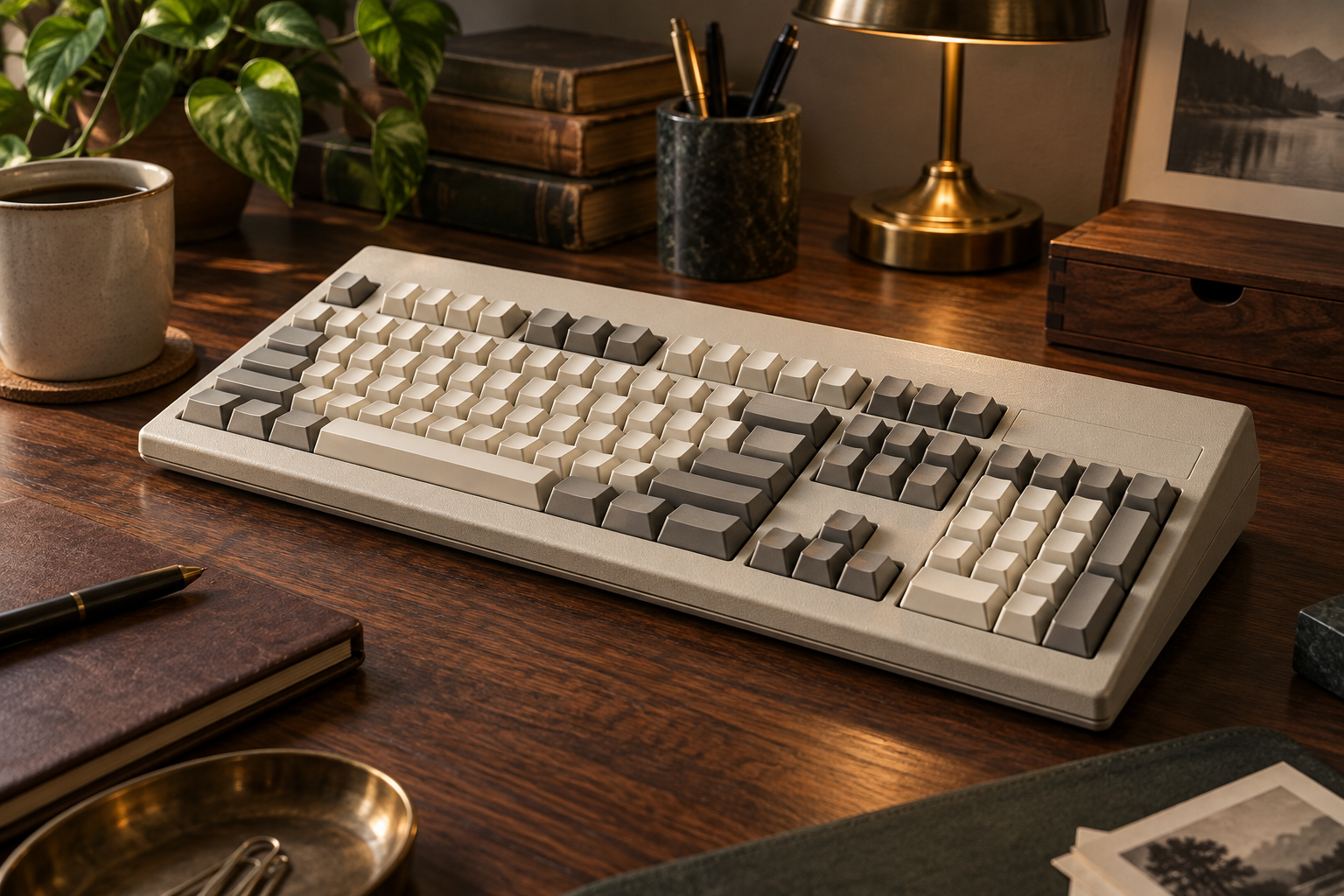
This is not “the keyboard that invented :-)”. It is a modern, hot-swappable 87-key board whose physical controls make the punctuation connection pleasantly literal. The N Edition supports wired USB-C, Bluetooth, and 2.4 GHz connections; it is aimed at Windows and Android, not buyers who require documented macOS support.
Check the verified N Edition on Amazon ↗Affiliate link. Exact ASIN B0CCP8KYGG. Confirm seller, layout, compatibility, price, and U.S. delivery before ordering.PRODUCT IDEA 02 · A LOW-TECH PUNCHLINE
An emoticon mug—without pretending every print is equal
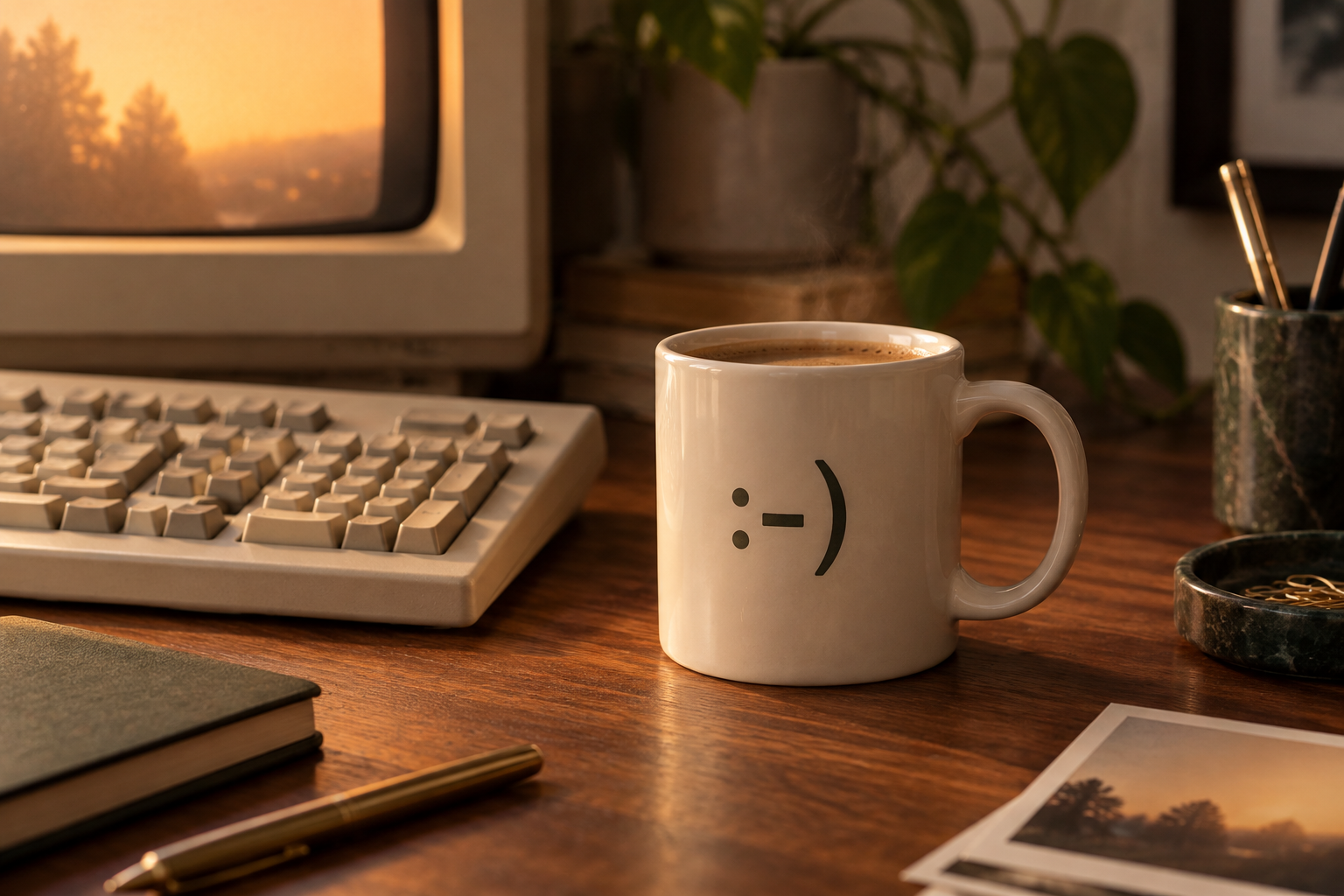
The calendar suggested an “I speak fluent emoticon” mug. We found plenty of near-matches, but not one exact Amazon.com listing with a stable ASIN, credible fulfillment, and enough quality evidence to recommend. So the idea stays in the story while the affiliate button stays out. A good mug should be dishwasher-safe, lead- and cadmium-tested, and printed by a seller with a traceable return policy.
No affiliate link was added. That is an editorial decision, not a missing button.FOUR USEFUL QUESTIONS
The details behind the sideways face
Who invented the emoticon :-)?
Carnegie Mellon computer scientist Scott Fahlman is widely credited with proposing the modern sideways :-) and :-( convention on September 19, 1982. Earlier typographic faces existed, so this is not a claim that he drew the first face from punctuation.
What time was the original message posted?
The recovered message is timestamped 11:44 on September 19, 1982. Fahlman proposed :-) for jokes and :-( for messages that were not jokes.
How was the original post recovered?
After a search led by Mike Jones, Jeff Baird retrieved the thread from a CMU backup tape in September 2002.
Is an emoticon the same as an emoji?
No. An emoticon is assembled from ordinary text characters. Emoji are encoded pictographs. Both add nonverbal cues, but they come from different technical traditions.
SOURCES, METHOD, AND LIMITS
We read the recovered CMU bulletin-board thread, Fahlman’s 2021 first-person account, and Carnegie Mellon’s institutional history. The article distinguishes a documented modern convention from older punctuation art. Product details were checked against 8BitDo’s documentation and the exact Amazon.com ASIN on September 19, 2026. We did not hands-on test either product direction.
FOLLOW THE THREAD
Browse the technology-history archive →Who owns the internet? Nobody. Sort of. →A practical tool for the keyboard beside you →