ON THIS DAY · SEPTEMBER 2, 1969
The Bank That Never Closes: How the First American Cash Machine Revolutionized Everyday Banking
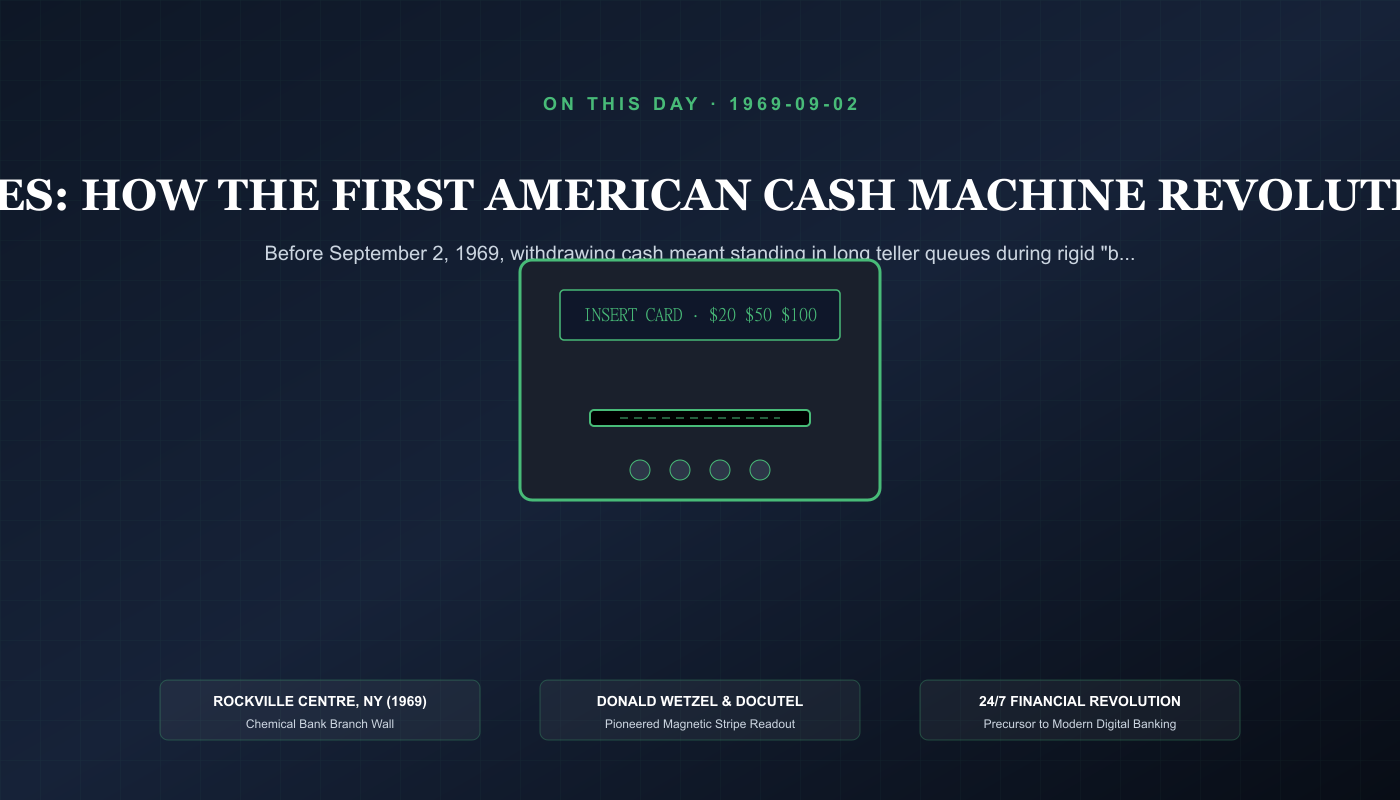
Before September 2, 1969, withdrawing cash meant standing in long teller queues during rigid "bankers hours". When Chemical Bank installed a Docutel cash dispenser in Long Island, it inaugurated the era of 24/7 automated financial self-service and laid the groundwork for electronic retail banking.
Escaping "Bankers' Hours": The Impetus for Automated Cash
Throughout the mid-20th century, consumer banking was constrained by rigid schedules known as "bankers' hours"—typically 9:00 AM to 3:00 PM on weekdays with zero weekend operations. For millions of commuters and workers, accessing cash required waiting in slow lobby teller lines during lunch breaks.
Donald Wetzel, an executive at automated baggage-handling firm Docutel, conceived the automated cash machine while waiting in a slow bank teller queue in Dallas. Realizing that the majority of teller transactions were identical cash disbursements, Wetzel led a development team with engineers Tom Barnes and George Chastain to build a secure, automated cash dispenser.
Magnetic Stripes and Offline Memory: The Docuteller Engineering
In 1969, real-time dial-up telecommunications connecting branches to mainframes were non-existent. The Docuteller had to operate offline, authenticating cards and dispensing cash securely without network access.
Wetzel’s team solved this using heat-bonded magnetic stripes on plastic cards to record account identifiers and spending limits. The machine verified customer PINs and recorded transaction journals onto magnetic tape drives for overnight batch processing at the central bank computing center.
From Novelty Dispenser to the Global ATM Network
Chemical Bank launched the Rockville Centre machine with the headline: "On Sept. 2 our bank will open at 9:00 and never close again." The installation was an immediate hit, transforming suburban cash habits.
By the late 1970s, as interbank networks like Cirrus and Plus emerged, cash dispensers evolved into modern networked ATMs. The Docuteller proved that everyday consumers would trust automated computerized hardware with their financial transactions, paving the way for debit cards and digital commerce.
What the evidence does not settle
John Shepherd-Barron installed a voucher-based dispenser at Barclays in London in 1967, but Donald Wetzel’s Docuteller was the first to use the modern magnetic stripe bank card standard. Readers should note modern ATMs rely on encrypted fiber networks vastly different from 1969 offline machines.
PRODUCT IDEA 01
RFID-Blocking Slim Minimalist Aluminum Cardholder Wallet

An aerospace-grade aluminum cardholder protects modern contactless chip cards from RFID skimming while maintaining a clean, pocket-friendly profile.
Buying limit: Choose models with dual-track elastic silicone bands and tested Faraday-cage shielding. Quality minimalist wallets trade between $20 and $55.
Original editorial illustration, not a retailer photograph. No exact Amazon offer passed our verification gate.PRODUCT IDEA 02
Personal Home Cash & Document Fireproof Security Safe

For secure physical document and emergency cash storage at home, a compact steel security safe with biometric fingerprint or digital keypad entry provides peace of mind.
Buying limit: Verify solid steel live-locking bolts, pry-resistant hinges, and pre-drilled mounting holes. Reliable home security safes range from $50 to $120.
Original editorial illustration, not a retailer photograph. No exact Amazon offer passed our verification gate.SOURCES, METHOD, AND LIMITS
Researched using US Patent 3,685,690 archives, Smithsonian National Museum of American History computing collections, and JPMorgan Chase historical records. No commercial products were physically tested.
- Smithsonian National Museum of American History — Docutel Automated Teller Machine Collection — Curatorial archive documenting Donald Wetzel’s original Docutel Docuteller terminal, magnetic stripe card prototypes, and Chemical Bank 1969 promotional artifacts.
- IEEE Global History Network / ETHW — The Automated Teller Machine History — Technical history tracing the evolution of magnetic stripe encoding, offline mechanical cash handling, and interbank transaction networks from 1969 to present.