ON THIS DAY · NOVEMBER 3, 1971
The Man Page That Built Modern Computing How Thompson and Ritchie's 1971 Unix Manual Redefined Software Ergonomics
On November 3, 1971, computer scientists Ken Thompson and Dennis Ritchie published the First Edition of the Unix Programmer's Manual at Bell Telephone Laboratories in Murray Hill, New Jersey. Documenting Unix running on a Digital Equipment Corporation PDP-11/20, this seminal binder established the standardized 'man page' architecture, introduced fundamental tools like cat, cp, and roff, and codified the Unix philosophy of building small, sharp programs that do one job well and compose through plain text.
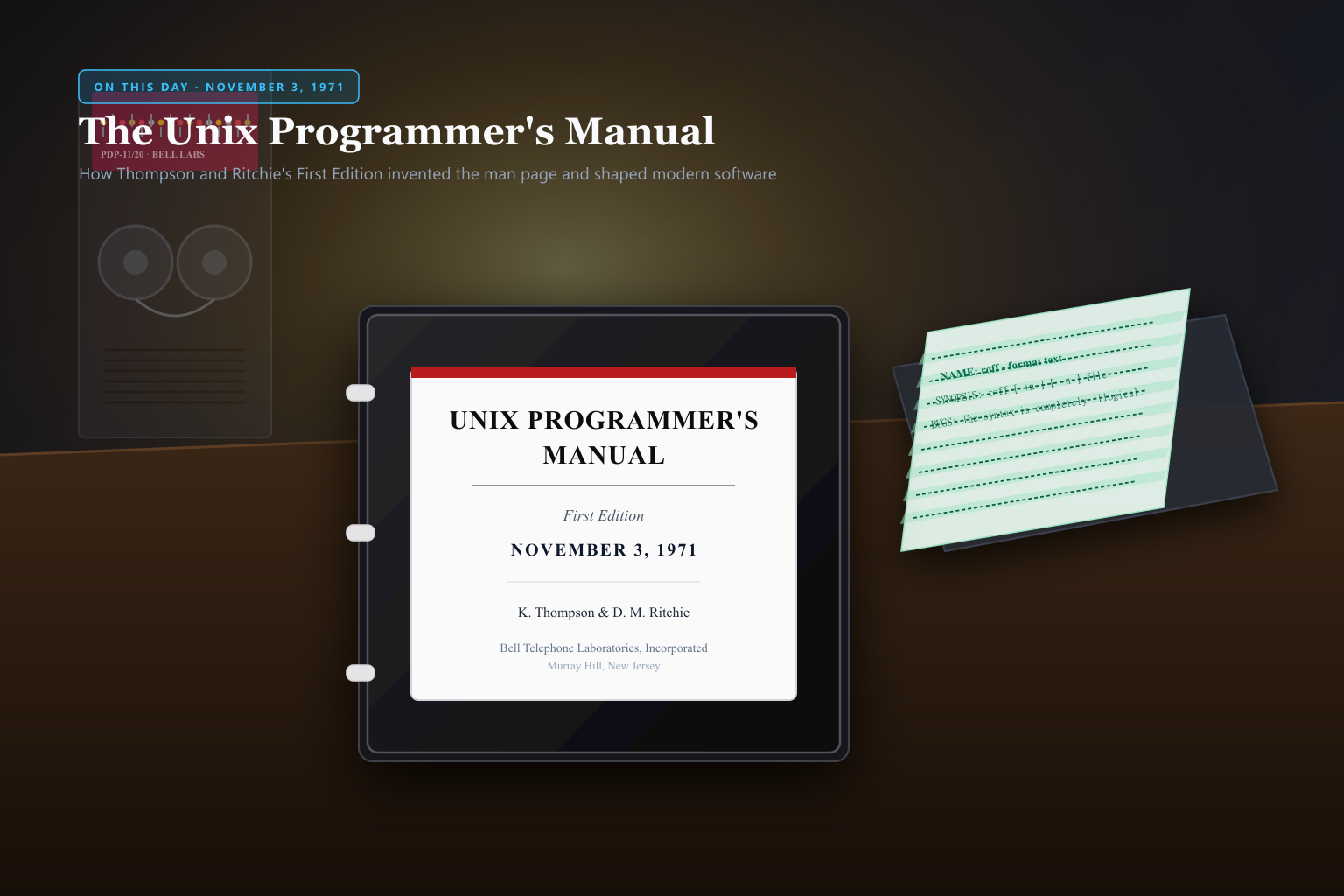
Room 2C-519: The Birth of Unix on a Scavenged Minicomputer
In late 1969, Bell Telephone Laboratories withdrew from the massive, over-engineered Multics time-sharing project. Left without an interactive operating system, researchers Ken Thompson, Dennis Ritchie, Rudd Canaday, and Doug McIlroy began crafting a lean, comfortable programming environment on an obsolete Digital Equipment Corporation (DEC) PDP-7 minicomputer. Thompson wrote a filesystem, an assembler, and the original shell in assembly language. To justify requesting funding for a modern computer, the team promised Bell Labs' legal department that they would construct a practical, automated patent-document preparation system.
In early 1971, Bell Labs management approved the acquisition of a PDP-11/20 featuring 24 kilobytes of core memory and a 512-kilobyte fixed-head disk. Porting Unix to the PDP-11, Thompson and Ritchie fulfilled their institutional pledge: three patent typists rapidly began using Unix, the 'ed' line editor, and the 'roff' text formatter to generate official Bell patent filings. But as the system matured into daily internal production, Thompson and Ritchie faced a pressing organizational challenge: how to document an evolving operating system concisely so that other researchers could write software without constant oral instruction.
The Anatomy of the Man Page: Precision, Brevity, and the Famous BUGS Section
On November 3, 1971, Thompson and Ritchie published the completed First Edition of the Unix Programmer's Manual. Typed directly on a Teletype Model 37 and formatted using 'roff', the manual was distributed in an expandable loose-leaf binder to allow continuous updates. Rather than writing an unwieldy, academic textbook, the authors divided the entire operating system into concise, self-contained reference entries organized into numbered sections: user commands (Section I), system calls (Section II), subroutines (Section III), special files (Section IV), file formats (Section V), user-maintained programs (Section VI), and system maintenance (Section VIII).
Each entry followed a rigid, functional typography that prioritized developer efficiency: NAME stated the command and a one-line summary; SYNOPSIS demonstrated exact command-line invocation flags; DESCRIPTION detailed input behavior and return values; and FILES listed relevant system paths. Most famously, Thompson and Ritchie instituted a mandatory BUGS section where they documented known flaws, corner-case failures, and design limitations with disarming technical honesty—such as noting under roff that 'The syntax is completely illogical.' This refusal to disguise software defects set a cultural precedent for open, rigorous engineering accountability.
The Enduring Architecture of Text Streams and Modular Tools
While Version 1 Unix in November 1971 had not yet introduced software pipes (invented by Doug McIlroy and implemented in Version 3 in 1973) or the C programming language (developed by Ritchie between 1972 and 1973 to rewrite Unix Version 4), the 1971 manual laid down the architectural DNA of modern computing. It detailed foundational utilities that software engineers still run billions of times a day in production data centers: cat, chdir, chmod, cp, date, du, find, ls, mail, mkdir, mv, rm, and sh.
Fifty-five years later, typing 'man' in any terminal window on Linux, macOS, iOS terminals, Android developer shells, or FreeBSD displays the exact layout authored in Murray Hill on November 3, 1971. By treating documentation as a first-class engineering artifact bound directly to executable code, Thompson and Ritchie established an enduring truth of software design: great tools are defined not merely by what their code executes, but by how cleanly their conceptual model can be communicated to other human minds.
What the evidence does not settle
The November 3, 1971 First Edition documented Unix Version 1 written in PDP-11 assembly; it preceded the C programming language rewrite (1973) and Doug McIlroy's shell piping mechanism. The original manual was distributed internally to Bell Labs staff in physical binders and was not commercially sold to the public until subsequent university licensing agreements.
PRODUCT IDEA 01
'The Unix Programming Environment' by Brian Kernighan & Rob Pike
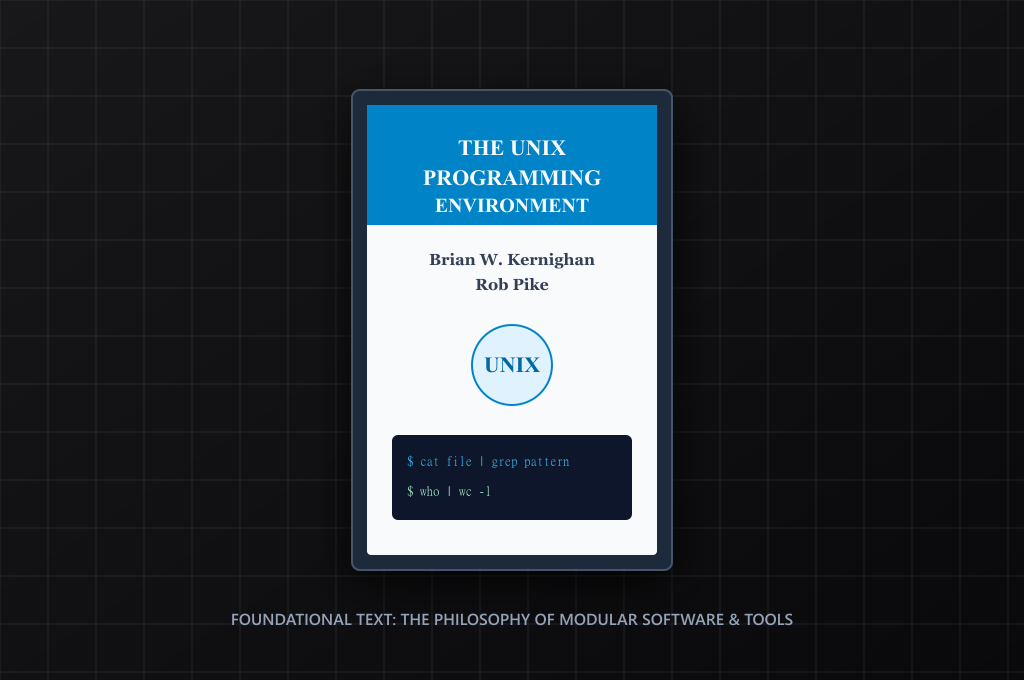
Written by Bell Labs pioneers Brian Kernighan and Rob Pike, this canonical volume articulates the foundational Unix philosophy: composing modular, single-purpose utilities through text streams. It remains required reading for systems engineers, programmers, and Linux system administrators seeking deep mastery of command-line craft.
Buying limit: Ensure you purchase an authorized Prentice Hall / Pearson edition; historical computing classics are frequently subject to low-quality scanned print-on-demand reprints.
Original editorial illustration, not a retailer photograph. No exact Amazon offer passed our verification gate.PRODUCT IDEA 02
Raspberry Pi 5 Desktop Starter Kit for Headless Linux Homelab Experiments
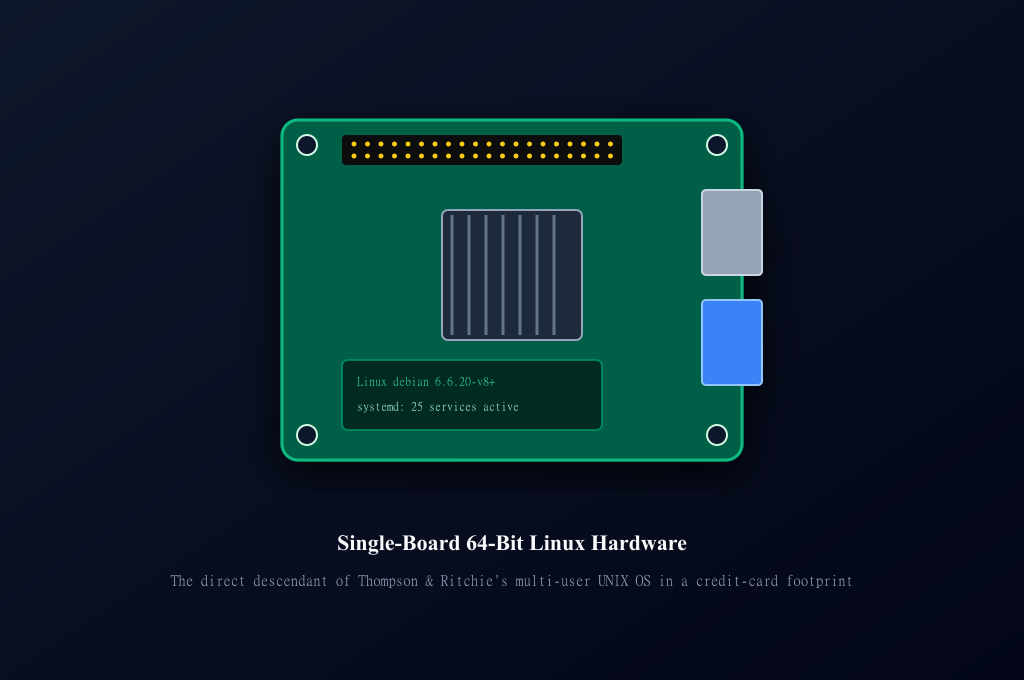
A credit-card-sized, quad-core 64-bit ARM microcomputer running Debian Linux represents the direct modern realization of Thompson and Ritchie's multi-user minicomputer. It gives students and developers an inexpensive, dedicated sandbox to run native shells, compile C programs, and deploy lightweight network servers without cloud fees.
Buying limit: Requires a verified 27W USB-C PD power supply and active heatsink cooling to prevent thermal throttling under heavy compilation workloads.
Original editorial illustration, not a retailer photograph. No exact Amazon offer passed our verification gate.SOURCES, METHOD, AND LIMITS
We examined archival scans and transcriptions of the First Edition Unix Programmer's Manual preserved by The Unix Heritage Society (TUHS) and Bell Laboratories archives, Dennis Ritchie's published retrospective essays on the evolution of Unix, and ACM historical computing records to verify exact command specifications, hardware limits, and publication timelines.
- Bell Telephone Laboratories / The Unix Heritage Society: Unix Programmer's Manual, First Edition Archive (November 3, 1971) — Primary institutional archive containing high-resolution scans and complete transcribed source texts of the original November 3, 1971 Unix manual by K. Thompson and D. M. Ritchie.
- Nokia Bell Labs: The Invention and Historical Evolution of UNIX Time-Sharing — Official Bell Labs institutional history detailing Dennis Ritchie and Ken Thompson's PDP-11 research milestones, patent office text processing, and system architecture.