ON THIS DAY · SEPTEMBER 15, 1997
From BackRub to Google.com: The 1997 Domain Registration That Anchored Modern Web Search
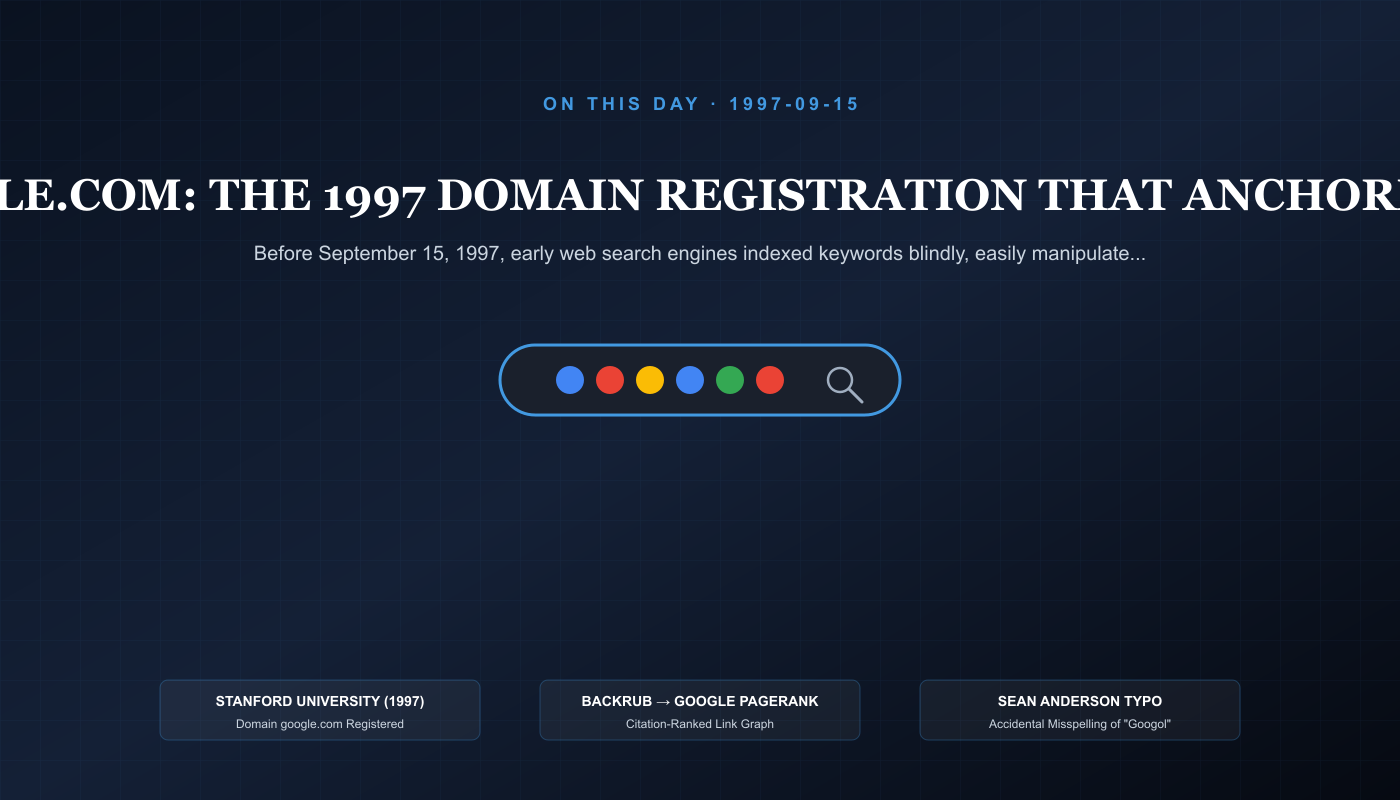
Before September 15, 1997, early web search engines indexed keywords blindly, easily manipulated by spam. When Larry Page and Sergey Brin registered google.com, they anchored a revolutionary citation-based link ranking algorithm that organized the chaos of the World Wide Web.
The Stanford Digital Library Project and BackRub
In 1995, Larry Page enrolled in the Computer Science Ph.D. program at Stanford University, searching for a dissertation topic. Page became fascinated by the mathematical graph structure of the World Wide Web, hypothesizing that hyperlinks between web pages functioned exactly like academic scientific citations.
Together with fellow student Sergey Brin, Page built an automated web crawler dubbed "BackRub" in 1996, operating on Stanford’s server network (google.stanford.edu). BackRub analyzed not just the words on a page, but the number and authoritative quality of incoming external links pointing to that page—an algorithm they formally named PageRank.
September 15, 1997: The Sean Anderson Typo and Registration
By the summer of 1997, BackRub was consuming nearly half of Stanford’s entire campus internet bandwidth, indexing over 75 million web pages. Page and Brin decided they needed a distinctive, scalable commercial name for their search engine.
During a brainstorming session in Gates Hall Room 360, graduate student Sean Anderson suggested "googol"—the mathematical number representing 1 followed by 100 zeros, coined in 1920 by mathematician Edward Kasner. Anderson checked domain name availability on a terminal and inadvertently typed "google.com" instead of "googol.com". Page liked the phonetic simplicity and immediately registered the domain on September 15, 1997.
From Academic Experiment to Global Information Gateway
For the first twelve months following domain registration, Google operated as an uncommercialized academic research portal without advertisements. In August 1998, Sun Microsystems co-founder Andy Bechtolsheim wrote a $100,000 seed check to "Google Inc."—a company that did not yet legally exist—prompting Page and Brin to incorporate on September 4, 1998, and relocate to Susan Wojcicki’s garage in Menlo Park.
The clean, white minimalist search interface and objectively superior PageRank algorithmic results swiftly dismantled incumbent portal search engines like AltaVista, Lycos, and Yahoo, forever transforming how humanity accesses, organizes, and navigates global knowledge.
What the evidence does not settle
Popular accounts frequently confuse Google’s domain registration date (September 15, 1997) with its official corporate incorporation date (September 4, 1998) or its traditional birthday celebration (September 27). Readers should note that early Google had no advertising system until AdWords was introduced in October 2000.
PRODUCT IDEA 01
In the Plex: How Google Thinks, Works, and Shapes Our Lives — Steven Levy

Veteran tech journalist Steven Levy delivers the definitive, deeply reported inside story of Google’s engineering culture, PageRank algorithm development, and corporate expansion.
Buying limit: Available in trade paperback (Simon & Schuster, ISBN 978-1416596585) and digital formats. Paperbacks typically sell between $15 and $22.
Original editorial illustration, not a retailer photograph. No exact Amazon offer passed our verification gate.PRODUCT IDEA 02
Ergonomic Mechanical Keyboard with Custom PBT Keycaps for Coders

A compact 75% mechanical keyboard featuring hot-swappable tactile switches, sound-dampening foam, and clean minimalist keycaps for productive programming and writing.
Buying limit: Choose models with multi-device Bluetooth/2.4GHz wireless support and programmable QMK/VIA firmware. Quality mechanical keyboards range from $65 to $130.
Original editorial illustration, not a retailer photograph. No exact Amazon offer passed our verification gate.SOURCES, METHOD, AND LIMITS
Researched using Larry Page and Sergey Brin’s seminal 1998 Stanford research paper ("The Anatomy of a Large-Scale Hypertextual Web Search Engine"), Stanford University Computer Science Department historical archives, and Steven Levy’s In the Plex: How Google Thinks, Works, and Shapes Our Lives. No commercial products were physically tested.
- Stanford University Computer Science — Page & Brin Original 1998 Search Engine Paper — The foundational academic paper detailing PageRank mathematics, web crawling architecture, inverted index storage, and search ranking benchmarks.
- Computer History Museum — The Google Founding and Early Infrastructure Collection — Curatorial archive documenting the 1997 domain records, Andy Bechtolsheim’s seed check, and the original 40GB LEGO server rack.