ON THIS DAY · SEPTEMBER 13, 1956
Five Megabytes on Fifty Disks: How IBM’s 1956 RAMAC Invented the Magnetic Hard Drive
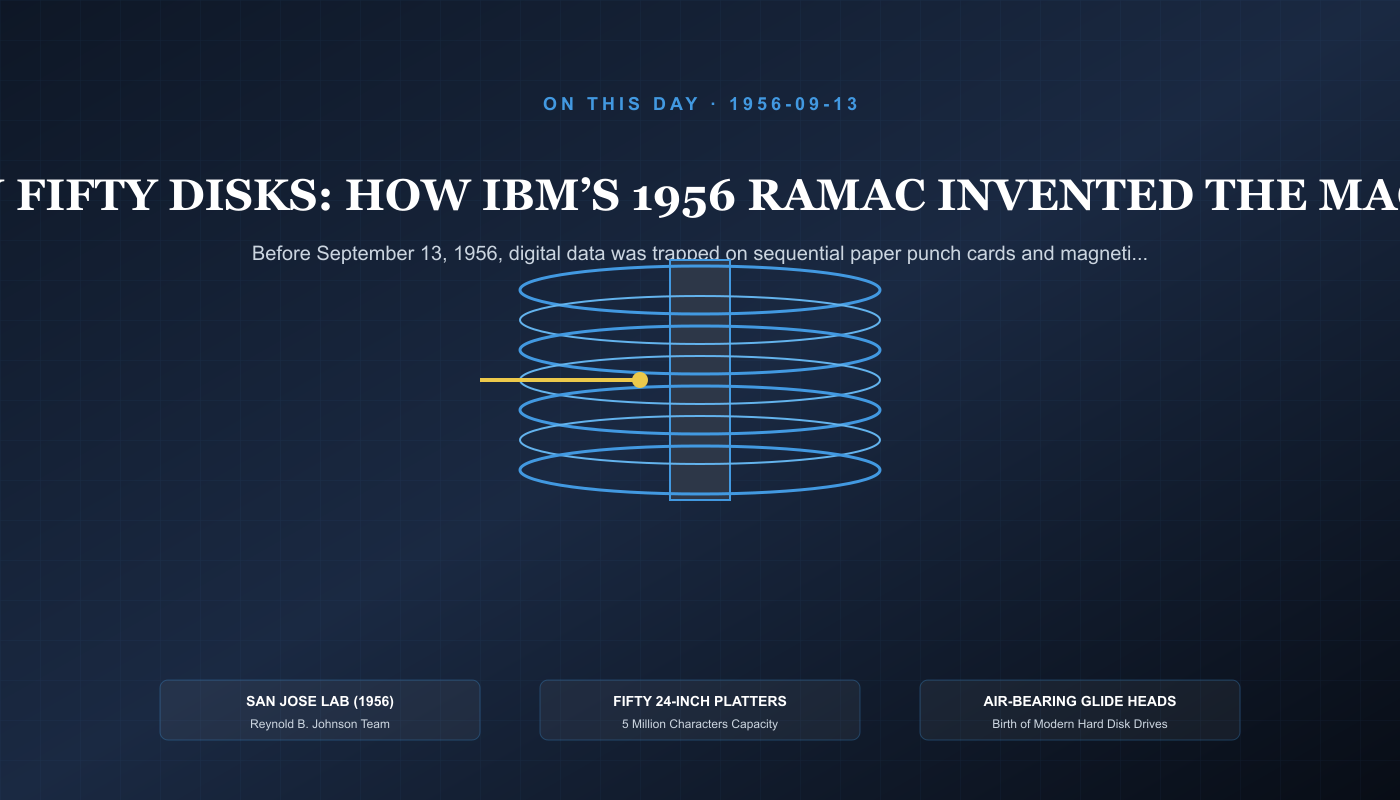
Before September 13, 1956, digital data was trapped on sequential paper punch cards and magnetic tape. When IBM unveiled the 305 RAMAC in San Jose, its stack of fifty magnetic platters gave humanity its first instantaneous, random-access digital storage.
The Punch-Card Bottleneck and the Birth of the San Jose Lab
In the early 1950s, corporate data processing was paralyzed by sequential storage. Businesses tracked inventories and accounting ledgers on millions of 80-column cardboard punch cards or magnetic tape reels. To find a single transaction record, machines had to mechanically sort through entire warehouses of cards in sequence, taking hours or days.
In 1952, IBM President Thomas J. Watson Jr. hired high school science teacher turned prolific inventor Reynold B. Johnson to establish an exploratory research laboratory in San Jose, California. Johnson was given a singular mission: invent a machine that could retrieve any random business record instantly without sequential sorting.
Fifty Aluminum Disks and Air-Bearing Heads: The Engineering
Johnson’s team evaluated magnetic drums, wire matrices, and tape loops before committing to rotating flat disks. The mechanical challenges were staggering: fifty 24-inch aluminum disks were stacked on a vertical spindle spinning at 1,200 RPM inside a cabinet the size of two large refrigerators.
To read and write magnetic flux transitions without scratching the delicate iron-oxide coating, engineer Louis Stevens developed the air-bearing head. Compressed air flowed through tiny nozzles in the magnetic read/write head, creating a microscopic cushion of air that allowed the head to glide thousandths of an inch above the spinning disks without physical contact. A pneumatic actuator arm moved vertically up and down the spindle, inserting itself between platters in under 600 milliseconds.
From 5MB to Terabytes: The Global Data Legacy
When IBM announced the 305 RAMAC on September 13, 1956, corporate customers were awestruck. The five-megabyte capacity—which weighed over a ton—allowed United Airlines to automate real-time seat reservations and the U.S. Army to manage supply chains instantaneously.
The architectural principles established on the IBM 350—spinning magnetic media, aerodynamic flying heads, track-and-sector addressing, and random access—became the foundational template for all hard disk drives that powered the personal computer revolution, cloud data centers, and the global internet.
What the evidence does not settle
Popular accounts frequently mock the 5MB capacity of the RAMAC for weighing over 2,000 pounds; in 1956, 5MB represented an immense storage breakthrough that replaced 64,000 punch cards. Readers should note that modern solid-state drives (SSDs) utilize NAND flash memory rather than magnetic spinning disks.
PRODUCT IDEA 01
Rugged USB-C External Solid-State Drive (1TB / 2TB NVMe SSD)

A modern continuation of random-access storage, this shock-resistant aluminum NVMe external solid-state drive delivers 1,050 MB/s transfer speeds in a pocket-sized form factor.
Buying limit: Choose models with IP55 water/dust resistance, hardware 256-bit AES encryption, and USB 3.2 Gen 2 connectivity. Quality 1TB SSDs trade between $75 and $120.
Original editorial illustration, not a retailer photograph. No exact Amazon offer passed our verification gate.PRODUCT IDEA 02
Disk: The Story of Magnetic Recording — Eric D. Daniel & C. Denis Mee

An authoritative technical history written by industry pioneers detailing the physics, materials science, and manufacturing breakthroughs of magnetic recording from RAMAC to modern high-density drives.
Buying limit: Available in academic hardcover (IEEE Press / Wiley, ISBN 978-0780347090). Hardcover copies typically trade between $40 and $75.
Original editorial illustration, not a retailer photograph. No exact Amazon offer passed our verification gate.SOURCES, METHOD, AND LIMITS
Researched using primary archives from the Computer History Museum (RAMAC 50th Anniversary Symposium records), IEEE Milestone citations, and IBM Corporate Archives technical white papers on the 350 Disk Storage Unit. No commercial products were physically tested.
- Computer History Museum — The IBM 350 RAMAC Disk Drive 50th Anniversary Archives — Primary historical archive documenting Reynold Johnson’s laboratory logs, mechanical blueprints of the 50-disk spindle, and original 1956 press announcements.
- IEEE History Center / ETHW — Milestone: RAMAC, 1956 — Official IEEE citation evaluating random-access magnetic recording, air-bearing glide slider physics, and corporate data processing impacts.