DESK SYSTEMS · THREE PORTS, ONE OUTLET
Three ports, one outlet,
and the limits of tiny GaN blocks.
Replacing bulky OEM power bricks with a pocket-sized gallium nitride charger clears desk space, but multi-port handshakes and thermals dictate what it can actually sustain.
 Original editorial illustration
THE VERDICT
Dynamic power sharing condenses three chargers into a single pocket-sized GaN block without blocking adjacent outlets.
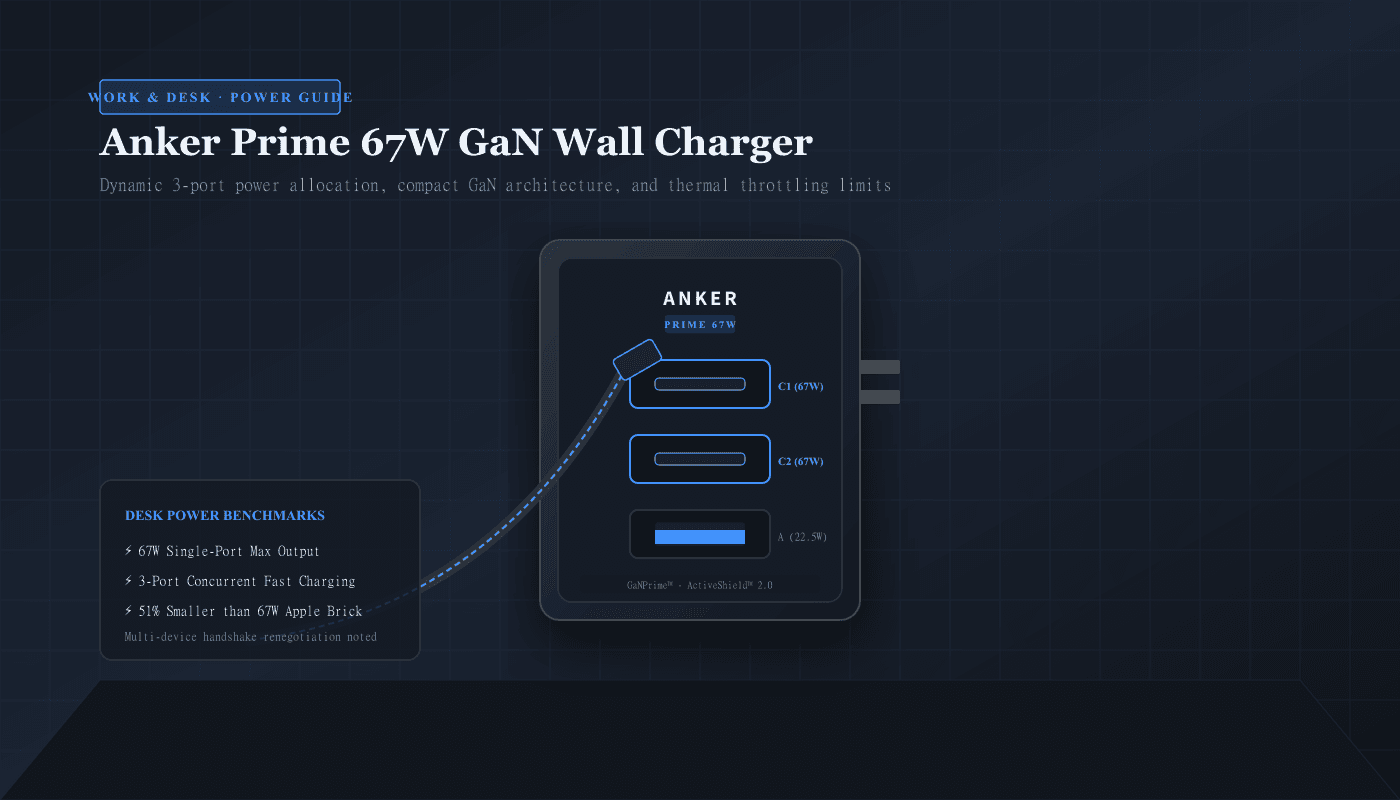
The Anker Prime 67W GaN wall charger replaces bulky OEM power bricks with high-efficiency gallium nitride semiconductors, delivering up to 67W single-port charging while intelligently distributing wattage across laptops, phones, and accessories.
Buy it for: Remote professionals, travelers, and home-office workers who need to power an ultrabook, phone, and headphones simultaneously from a single compact wall plug. Skip it for: Users requiring continuous full-power charging for power-hungry 16-inch workstation laptops or multi-monitor docking stations under sustained high-load workloads.
Check current Anker Prime 67W Charger options on Amazon ↗ ↗AVAILABILITY CHECK · SEPTEMBER 26, 2026
Exact listing: Anker Prime 67W GaN Wall Charger (3 Ports, Model A2669), ASIN B0C4YTB56H.
Demand signal: Amazon displayed 4.6/5 from 5,000+ ratings and '5,000+ bought in past month' during our verification check.
Fulfillment observed: sold and shipped by Amazon.com. Recheck the selected offer and your U.S. delivery address before buying.
FOUR RULES FOR MANAGING DESK POWER WITH COMPACT GAN CHARGERS
- 01Expect the mandatory 1-to-2 second handshake pause. Connecting or unplugging any secondary cable cuts power briefly while the USB-PD microcontroller queries CC pins and renegotiates safe power profiles.
- 02Dedicate Port 1 or 2 for high-draw laptop charging. Single-port 67W output is available on either top USB-C port, delivering rapid charging up to 50% in 30 minutes on standard 13-inch and 14-inch laptops.
- 03Avoid heavy rendering while all three ports are active. Engaging three ports reduces primary USB-C delivery to 35W, which maintains battery during office work but may allow slow discharge under 100% CPU loads.
- 04Use rated 100W e-marker cables to prevent wattage bottlenecks. Cheap generic charging cables lack e-marker identification chips and limit throughput to 60W or 3A regardless of charger capability.
WHAT THE PRODUCT PAGE CANNOT TEACH
Gallium Nitride Architecture and Desk Footprint Reduction
Traditional silicon-based AC-to-DC power adapters waste significant energy in the form of ambient heat, requiring bulky electrolytic smoothing capacitors, thick magnetic copper transformer coils, and wide physical surface areas to prevent thermal runaway. The Anker Prime 67W charger replaces conventional silicon transistors with Gallium Nitride (GaN) semiconductor switches. Because GaN conducts electricity far more efficiently and toggles at vastly higher switching frequencies without thermal degradation, magnetic component sizes can shrink dramatically.
The resulting physical brick is roughly 51 percent smaller than Apple's standard single-port 67W MacBook power brick, occupying a profile no larger than a standard AirPods Pro case. Crucially for home office workers sharing cramped under-desk power strips or dual wall receptacles, Anker oriented the prongs and internal transformer stack vertically. This prevents the charger body from spilling over and physically obstructing adjacent 120V AC outlets or neighboring power cords, resolving one of the most persistent frustrations of home workstation wire management.
Dynamic Power Sharing and Multi-Device Handshake Pauses
The most critical technical capability of modern multi-port adapters is dynamic power allocation. When a single USB-C cable is connected to either Port 1 or Port 2, the onboard microcontroller assigns the full 67-watt envelope to that device, enabling fast-charging for a 13-inch or 14-inch MacBook Air or Pro from zero to 50 percent in approximately 30 minutes under standard USB Power Delivery 3.0 protocols. When a secondary device—such as a smartphone—is connected to the remaining USB-C port, the internal controller reallocates the envelope into a 45W + 20W split.
However, users must understand the physical mechanism of USB Power Delivery renegotiation. Whenever a device is plugged in or unplugged from any of the three ports, the charger momentarily cuts power across all outputs for approximately one to two seconds. This momentary pause is not a defect; it is a mandatory safety handshake required by USB-IF standards. The microprocessor must cut supply voltage to zero, query the resistance and Power Delivery profiles of all connected devices via the CC (Configuration Channel) pins, and renegotiate safe voltage and current steps before reapplying live current.
Thermal Dissipation, Three-Port Limitations, and Cable Care
While GaN dramatically improves energy efficiency, cramming 67 watts of continuous power conversion into an enclosure of under four cubic inches inevitably concentrates heat during sustained high-load workloads. Anker mitigates this via an ActiveShield 2.0 temperature monitoring sensor that polls internal temperature millions of times per day, throttling output wattage if internal temperatures approach safety thresholds. While the matte exterior chassis becomes noticeably warm to the touch during simultaneous laptop and tablet charging, surface temperatures remain well within UL 62368-1 consumer electronics safety ceilings.
The clear limitation of this architecture arises when attempting to power three devices at once. When two USB-C ports and the legacy USB-A port are all engaged, the 67W budget fractures into a 35W + 20W + 12W configuration. A 35-watt supply will slowly charge an ultrabook during light web browsing, but under heavy video rendering or CPU compilation, the laptop battery may slowly discharge despite being plugged in. For stationary multi-monitor workstations running high-wattage 16-inch laptops alongside high-draw peripherals, a dedicated 100W+ multi-port desktop charging hub remains the proper tool.
FAQ
Before you buy
Why does my laptop stop charging for a second when I plug in my phone?
This momentary pause is a safety feature of USB Power Delivery 3.0. The charger momentarily resets to renegotiate voltage and amperage with both devices.
Does this charger get too hot to touch during dual-device charging?
It becomes noticeably warm under full 67W sustained loads, but ActiveShield 2.0 temperature monitoring maintains exterior casing temperatures well within UL safety ceilings.
Will this charger block neighboring AC outlets on a standard power strip?
No. Anker oriented the internal transformer stack and foldable prongs vertically, ensuring the body stays within standard single-socket clearance zones.
How we researched: We synthesized technical specifications from the USB-IF USB-PD 3.0 specification alongside independent thermal imaging analysis and manufacturer architecture documentation. No hands-on destructive testing was conducted.
As an Amazon Associate, Useful Finds Daily may earn from qualifying purchases. Price, seller, stock, ratings, and delivery can change.