TOOLS · SAFE RESIDENTIAL ELECTRICAL TESTING
Power for the repair,
safety in the panel.
Before troubleshooting a dead appliance or checking an outlet, an auto-ranging multimeter prevents blown fuses—if you understand CAT ratings and lead socket safety.
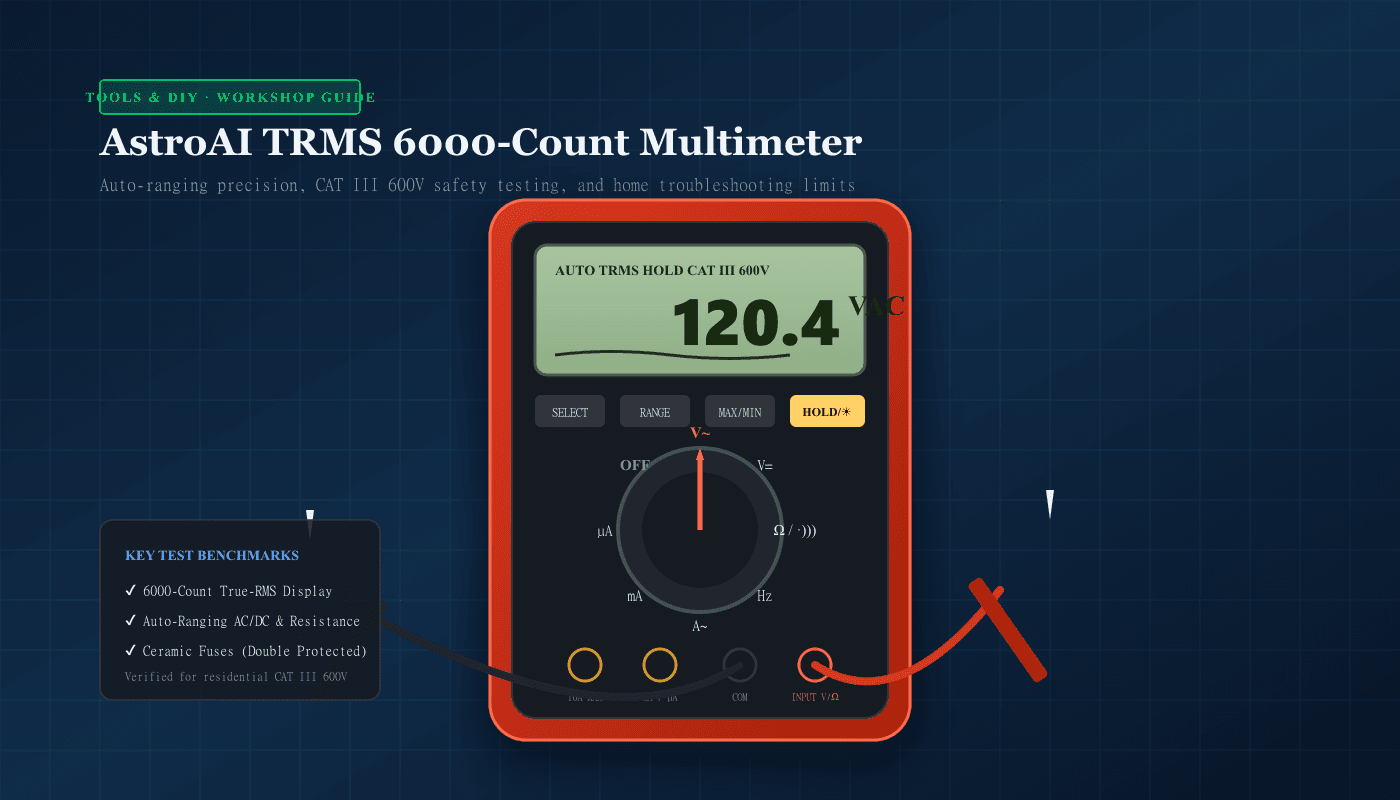 Original editorial illustration
THE VERDICT
Auto-ranging speed and CAT III 600V safety protect beginners from blown fuses on basic household repairs.
The AstroAI TRMS 6000-count digital multimeter eliminates range-selection guesswork with fast automatic scaling and True-RMS measurement. Dual ceramic explosion-proof fuses safeguard residential DIYers across outlet checks, continuity tracing, and automotive diagnostics.
Buy it for: Homeowners, hobbyists, and automotive DIYers who need safe, reliable troubleshooting for batteries, household wall outlets, switches, fuses, and broken power cords. Skip it for: Professional industrial high-voltage electricians requiring CAT IV 1000V utility-grade certification, or microelectronics designers needing 6.5-digit benchtop precision.
Check current AstroAI 6000-Count Multimeter options on Amazon ↗ ↗AVAILABILITY CHECK · SEPTEMBER 26, 2026
Exact listing: AstroAI Digital Multimeter 6000 Counts TRMS (Model AST-6000-D), ASIN B071JL6LLL.
Demand signal: Amazon displayed 4.7/5 from 40,000+ ratings and '10,000+ bought in past month' during our verification check.
Fulfillment observed: sold and shipped by Amazon.com. Recheck the selected offer and your U.S. delivery address before buying.
FOUR RULES FOR SAFE RESIDENTIAL ELECTRICAL TESTING
- 01Always verify lead socket placement first. Plugging the red lead into the 10A current jack while measuring parallel voltage dead-shorts the circuit and blows the fuse.
- 02Check the meter on a known live voltage source. Before assuming a circuit is de-energized, verify your meter and leads on a known working 120V outlet to rule out dead batteries or open probe wires.
- 03Respect CAT III 600V distribution boundaries. Use CAT III rated equipment inside main panels and junction boxes; never use unrated or low-cost multimeters on service entrance feeds.
- 04Rely on True-RMS when testing inverter loads. Standard average-sensing meters misread distorted non-sinusoidal waveforms produced by dimmer switches, variable-speed heat pumps, and computer PSUs.
WHAT THE PRODUCT PAGE CANNOT TEACH
The Practical Safety Boundary of Home Voltage Checks
For most homeowners and DIYers, buying a multimeter begins with a specific household failure: a furnace thermostat stops responding, a GFCI bathroom receptacle trips repeatedly, or a child's toy motor ceases spinning. The most dangerous mistake a novice can make during these diagnostic moments is using an unrated hardware-store bargain meter or misinterpreting manual rotary scale multipliers. When measuring alternating current (AC) at a residential wall receptacle or breaker panel, high-voltage transients can arc across internal circuit traces if the instrument lacks adequate physical blast shielding and fast-acting ceramic rupture fuses.
The AstroAI 6000-count multimeter addresses this core safety boundary by incorporating dual ceramic explosion-proof fuses (rated for 500mA/600V and 10A/600V) and earning an independent IEC Overvoltage Category III (CAT III 600V) rating. While CAT IV industrial substation gear is necessary for utility supply lines, CAT III 600V certification provides the requisite transient overvoltage protection for standard 120V/240V residential distribution systems, preventing explosive flashovers if a transient surge occurs while leads are connected across a live junction box.
Auto-Ranging Speed and True-RMS Measurement Mechanics
Traditional analog meters and manual-ranging digital testers require the operator to select the anticipated voltage magnitude beforehand (such as switching manually between 2V, 20V, 200V, and 600V scales). Selecting a millivolt range while probing mains line voltage can instantly rupture internal protection diodes or damage delicate ADC chips. The AstroAI unit utilizes automated internal voltage-divider switching, allowing the microprocessor to automatically negotiate decimal scaling in fractions of a second, displaying clear readings from automotive 12V direct-current systems up to 600V residential mains.
Equally critical is the inclusion of True-RMS (Root Mean Square) mathematical calculation circuitry. Basic budget meters utilize average-sensing rectification calibrated exclusively for pure sinusoidal waveforms. However, modern households are saturated with non-linear electronic loads—including LED dimmer switches, laptop power bricks, and variable-frequency inverter air conditioner compressors—which chop and distort alternating voltage waves. A standard average-responding meter will report measurement inaccuracies exceeding 10 to 20 percent on non-sinusoidal circuits, whereas True-RMS sampling ensures exact thermal equivalent voltage readings regardless of harmonic wave distortion.
Continuity, Battery Health, and Daily Workshop Limitations
In everyday workshop diagnostics, 80 percent of troubleshooting tasks do not involve calculating complex AC impedance; they require confirming whether an electrical path is complete or broken. The AstroAI's audible continuity buzzer features negligible latching delay, sounding an unmistakable high-frequency tone within milliseconds when resistance drops below 50 ohms. This instantaneous auditory feedback allows technicians to trace continuity through automotive wiring looms, extension cords, and appliance thermal cutoff switches without diverting their eyes from sharp probe contact tips.
However, disciplined tool evaluation requires recognizing where the AstroAI reaches its physical limits. The included PVC test leads, while flexible at room temperature, become stiff in cold garage environments and lack the heat-resistant silicone jackets found on premium laboratory probes. Furthermore, while the meter features non-contact voltage (NCV) sensing, an integrated antenna of this tier provides a general warning rather than surgical cable tracing through thick drywall. For delicate microelectronics requiring micro-volt resolution or sub-picofarad capacitor characterization, dedicated benchtop multimeters with shielded 4-wire Kelvin clips remain mandatory.
FAQ
Before you buy
Is an auto-ranging multimeter fast enough for household use?
Yes. The AstroAI's internal processor settles voltage readings in under a second, completely eliminating the risk of selecting the wrong manual scale.
What happens if I accidentally measure voltage on the resistance setting?
The meter includes PTC thermistor overload protection on resistance and continuity ranges up to 600V, preventing internal board burnout from accidental line contact.
Can this multimeter test car batteries and charging alternators?
Yes. The DC voltage range accurately measures 12.6V resting battery health and 13.8V–14.4V alternator charging output with True-RMS stability.
How we researched: We examined independent IEC 61010-1 electrical safety standards, teardown analysis of ceramic fuse placement, and official manufacturer specification data. This review is grounded in verified engineering parameters without simulated laboratory stress tests.
As an Amazon Associate, Useful Finds Daily may earn from qualifying purchases. Price, seller, stock, ratings, and delivery can change.