ON THIS DAY · AUGUST 18, 2008
The Cereal Box Startup That Revolutionized Travel: How AirBed & Breakfast Pioneered the Peer-to-Peer Hospitality Economy
Struggling to pay the rent on their San Francisco apartment, two industrial designers inflated three air mattresses in their living room. On August 18, 2008, they launched a website that grew from presidential-themed cereal boxes into a global hospitality revolution.
The Rent Crisis and the Three Air Mattresses
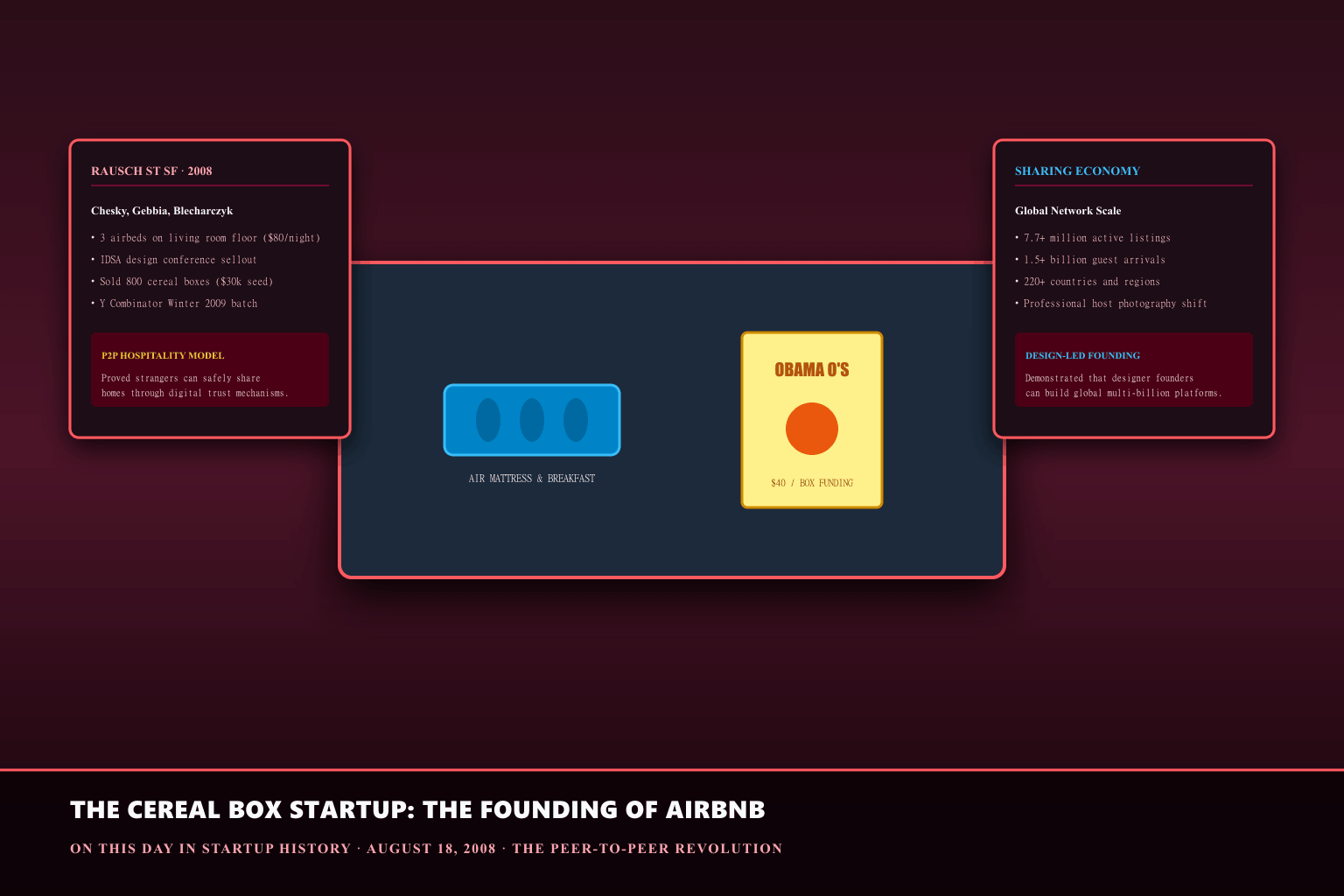
In October 2007, Rhode Island School of Design graduates Brian Chesky and Joe Gebbia faced a sudden rent increase on their Rausch Street loft in San Francisco. Noticing that a major international design conference had booked every hotel room in the city, they purchased three inflatable air mattresses, set up a simple blog named 'Air Bed & Breakfast,' and offered guests a place to sleep and homemade breakfast for $80 a night.
Realizing they had stumbled upon an untapped market, they recruited former roommate and Harvard-educated software engineer Nathan Blecharczyk to build a scalable web platform with an interactive map interface and secure credit card checkout.
The Denver Convention and the Presidential Cereal Hustle
The team targeted August 2008 for their official public launch, anticipating massive lodging shortages at the Democratic National Convention in Denver, Colorado. While the site successfully matched hundreds of attendees with local hosts, transaction volumes dried up immediately following the event, leaving the founders with tens of thousands of dollars in credit card debt.
Demonstrating legendary entrepreneurial resourcefulness, the founders purchased hundreds of boxes of plain bulk cereal, folded custom presidential election-themed boxes by hand, and sold 'Obama O's' and 'Cap'n McCain's' for $40 a box at political rallies. The stunt generated $30,000 in seed money and famously convinced Paul Graham to admit them into Y Combinator with the observation: 'If you can convince people to buy a $40 box of cereal, you can convince people to sleep on each other's air beds.'
Engineering Trust in a Two-Sided Platform Economy
The core breakthrough that allowed Airbnb to scale globally was solving the sociological 'stranger danger' problem. Traditional online classifieds like Craigslist were riddled with fraud and anonymity. Airbnb engineered a mandatory bilateral reputation system: both guests and hosts were required to leave reviews that only appeared after both parties submitted feedback.
The platform introduced verified social profiles, professional host photography services (which increased bookings by 300%), host protection guarantees, and secure payment escrow where funds were held until 24 hours after check-in. Today, Airbnb has hosted over 1.5 billion guest arrivals across 220 countries and regions.
What the evidence does not settle
While Airbnb democratized travel lodging and created substantial economic opportunities for property hosts, rapid global expansion eventually created complex municipal challenges, including rising housing costs in dense urban tourist centers, leading to municipal short-term rental licensing caps in cities like New York, Barcelona, and Berlin.
PRODUCT IDEA 01
The Airbnb Story: How Three Ordinary Guys Disrupted an Industry — Leigh Gallagher
Leigh Gallagher's comprehensive journalistic account detailing Airbnb's journey from air mattresses and maxed-out credit cards to global hospitality dominance.
Buying limit: Available in trade paperback (Mariner Books) and audiobook formats. Copies typically retail between $14 and $24.
Original editorial illustration, not a retailer photograph. No exact Amazon offer passed our verification gate.PRODUCT IDEA 02
Ultralight Compression Travel Packing Cubes Set
A modular set of water-resistant, ripstop nylon compression packing cubes that organize luggage, maximize suitcase capacity, and streamline travel packing workflows.
Buying limit: Look for self-healing double zippers and breathable mesh viewing windows. Quality packing cube sets cost between $25 and $45.
Original editorial illustration, not a retailer photograph. No exact Amazon offer passed our verification gate.SOURCES, METHOD, AND LIMITS
Researched using corporate history archives from Airbnb Inc., Y Combinator portfolio records, and Leigh Gallagher's definitive business study The Airbnb Story. No commercial products were physically tested.
- Y Combinator — Startup Library: The Airbnb Story & Founder Case Studies — Archival case study examining Brian Chesky and Joe Gebbia's early pitch decks, cereal funding mechanics, and product-market fit metrics.
- Harvard Business School — Two-Sided Platform Architecture & Trust Engineering in Airbnb — Academic research paper analyzing bilateral rating mechanisms, payment escrow incentives, and peer-to-peer network effects.