ON THIS DAY · JULY 24, 1969
Returning Safely to Earth: The Re-Entry Heat Shield, Pacific Splashdown, and Lunar Quarantine of Apollo 11
Slamming into Earth's atmosphere at 24,700 mph, Command Module Columbia was enveloped in an incandescent ball of white-hot ionized plasma. When three giant orange-and-white parachutes blossomed over the Pacific on July 24, 1969, President Kennedy's decade-long pledge was fulfilled.
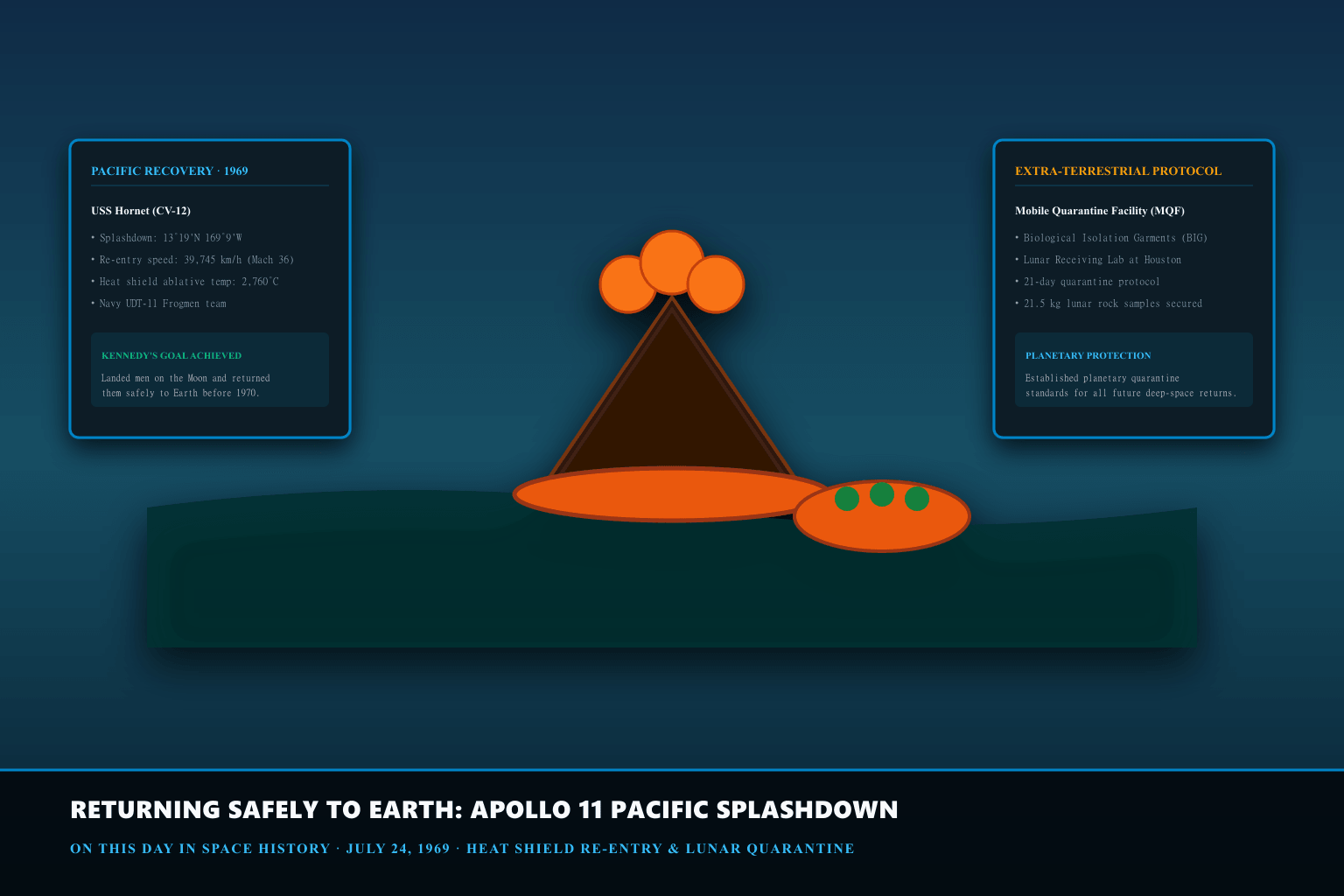
The 25,000 MPH Re-Entry: The Ablative AVCOAT Shield
Returning from the Moon required shedding vast kinetic energy. Columbia separated from its Service Module and struck the entry interface (400,000 feet altitude) at a blistering 24,700 mph (39,700 km/h)—far faster than standard low Earth orbit re-entries.
The blunt-body heat shield was coated with AVCOAT 5026-39—a fiberglass honeycomb matrix hand-injected with epoxy-novolac resin. As atmospheric friction heated the shockwave plasma to 5,000°F, the AVCOAT material intentionally melted, charred, and ablated away in a controlled vapor, carrying heat away from the cabin and keeping the astronauts inside at a comfortable 22°C (72°F).
The Recovery Operation and Biological Isolation Garments
Columbia deployed its drogue parachutes at 24,000 feet, followed by three main 83-foot ring-sail parachutes, gently settling into the Pacific waves. Navy Pararescue SEALs dropped from helicopters and attached a flotation collar to prevent the capsule from capsizing into Stable II inverted position.
Fearing that the Moon might harbor unknown extraterrestrial microorganisms or biological pathogens, NASA enforced strict planetary quarantine protocols. SEAL lieutenant Clancy Hatleberg opened the hatch momentarily to pass in green Biological Isolation Garments (BIG) and air-purifying respirators. The astronauts scrubbed themselves and the capsule hatch with Betadine disinfectant before stepping into an inflatable raft.
The Mobile Quarantine Facility and Fulfilling Kennedy's Dream
A Sikorsky SH-3 Sea King helicopter hoisted the crew aboard USS Hornet, where they walked directly through a sealed plastic tunnel into the Mobile Quarantine Facility (MQF)—a converted airtight Airstream trailer equipped with living quarters, medical examination rooms, and negative air pressure filtration.
Through the MQF window, President Richard Nixon formally welcomed the astronauts home. Transported by cargo aircraft to the Lunar Receiving Laboratory in Houston, the crew spent twenty-one days in medical isolation before being cleared of all biological risk. With Columbia's splashdown, NASA fulfilled President John F. Kennedy's 1961 challenge: landing a man on the Moon and returning him safely to the Earth before the decade was out.
What the evidence does not settle
While the Mobile Quarantine Facility was maintained rigorously, scientific consensus soon established that lunar regolith samples returned by Apollo were completely sterile, and NASA permanently abolished astronaut quarantine protocols following the Apollo 14 mission in 1971.
PRODUCT IDEA 01
Official NASA Apollo 11 Recovery Team USS Hornet Embroidered Baseball Cap
A premium washed cotton baseball cap featuring the authentic USS Hornet CVS-12 Apollo 11 recovery emblem and NASA meatball logo.
Buying limit: Look for adjustable metal buckle straps and 100% breathable cotton twill. Quality recovery caps cost $18 to $28.
Original editorial illustration, not a retailer photograph. No exact Amazon offer passed our verification gate.PRODUCT IDEA 02
Double-Wall Vacuum Insulated Stainless Steel Travel Tumbler (20 oz)
A rugged 18/8 food-grade stainless steel vacuum tumbler that keeps drinks icy cold for 24 hours or piping hot for 8 hours with splash-resistant lid.
Buying limit: Ensure BPA-free lids and durable powder-coated exterior finishes. Quality insulated tumblers cost $20 to $38.
Original editorial illustration, not a retailer photograph. No exact Amazon offer passed our verification gate.SOURCES, METHOD, AND LIMITS
Researched using NASA Apollo 11 Post-Flight Recovery Operations Reports (MSC-00171), USS Hornet historical recovery deck logs, and National Archives presidential greeting footage. No commercial products were physically tested.
- NASA History Division — Apollo 11 Splashdown & Recovery Operations Logs — Official mission repository recording Columbia re-entry trajectory, parachute deployment barometrics, and USS Hornet recovery helicopter logs.
- USS Hornet Sea, Air & Space Museum — Apollo 11 Mobile Quarantine Facility Collection — Curatorial technical record documenting the recovery crane equipment, Navy SEAL decontamination protocols, and MQF Airstream preservation.