ON THIS DAY · JULY 30, 1971
Touching Down at the Apennine Mountains: How Apollo 15 Landed at Hadley Rille and Discovered the Genesis Rock
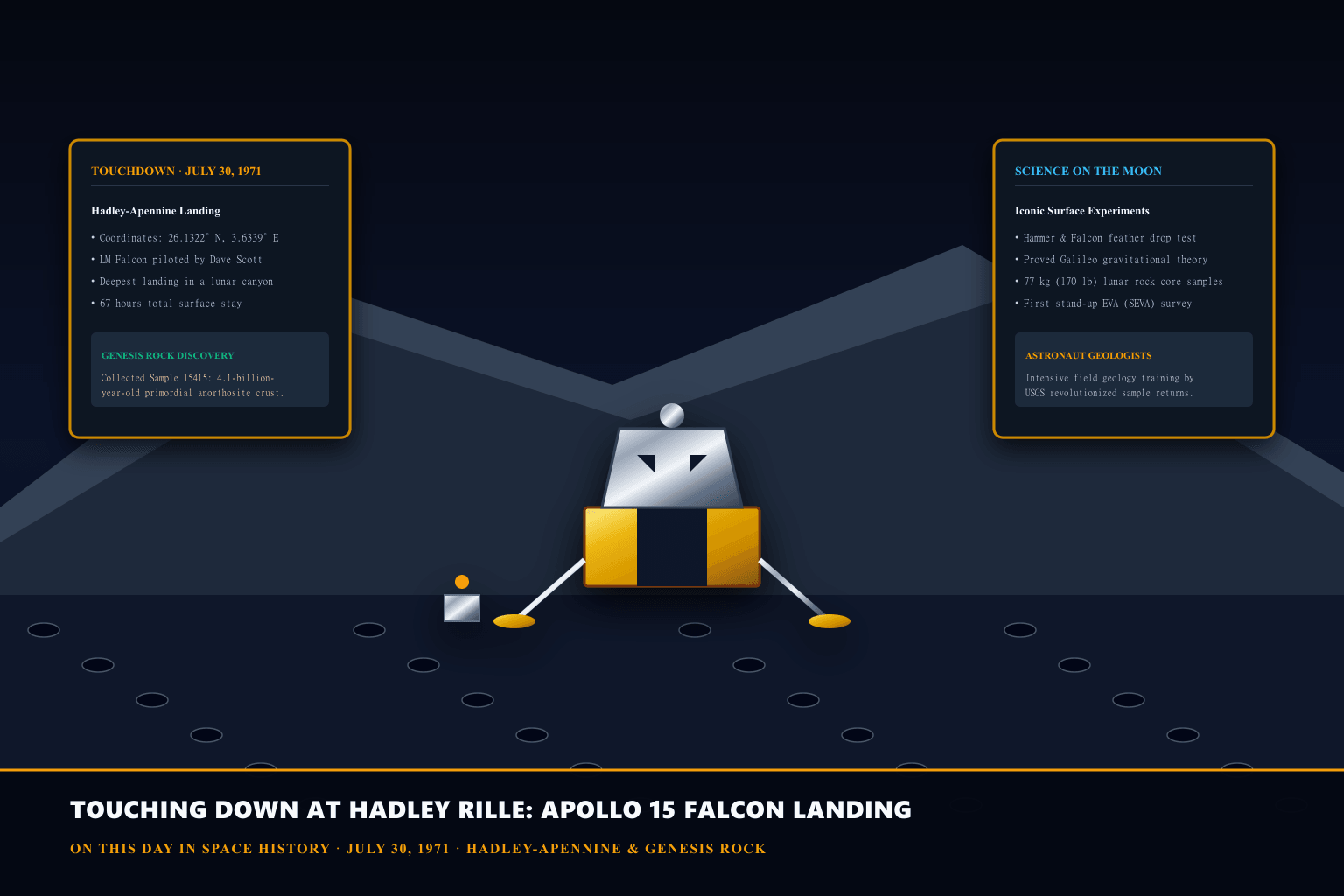
Towering 15,000 feet above the landing site, the lunar Apennine Mountains formed a dramatic backdrop as Lunar Module Falcon fired its descent engine. Touching down near the edge of a massive volcanic gorge, Apollo 15 initiated the golden age of lunar field geology.
The Steep Descent: Navigating the Apennine Mountain Front
Hadley-Apennine was by far the most topographically rugged landing site attempted during Project Apollo. To reach the smooth plain between the 15,000-foot peaks of Mount Hadley and Hadley Delta, Falcon had to fly over the mountain crest on a steep 26-degree descent trajectory—more than double the descent angle of Apollo 11.
Because radar altimeter lock was delayed while flying over the high peaks, Scott took manual control in the final 400 feet, touching down at a brisk 6.8 feet per second onto a gentle 10-degree crater rim slope, buckling one engine bell extension but establishing a secure base camp.
The Standup EVA and the Geology Training of Farouk El-Baz
Immediately after landing, Dave Scott executed Apollo's only 'Standup EVA' (SEVA). Depressurizing the cabin, he stood on the ascent engine cover and popped his head through the top docking hatch with a 500mm telephoto lens, taking a panoramic photographic survey of the surrounding mountain peaks before stepping onto the surface.
Under the intensive geological mentorship of Dr. Lee Silver and Dr. Farouk El-Baz, the Apollo 15 crew had undergone hundreds of hours of field geology training in the volcanic fields of Arizona, Hawaii, and New Mexico, training their eyes to recognize subtle mineral crystal structures under the harsh unfiltered lunar sun.
The Genesis Rock: Sample 15415 and the Magma Ocean
On August 1, during their second moonwalk along the slopes of Mount Hadley Delta, Scott and Irwin spotted a sparkling white rock perched atop a dark basalt boulder. Scott famously radioed: 'I think we found what we came for.'
Sample 15415 was a 269-gram chunk of pure plagioclase anorthosite. Isotopic dating confirmed it was 4.5 billion years old—dating back to the formation of the Moon itself. The discovery verified the fundamental 'Lunar Magma Ocean' hypothesis: that the young Moon was once covered in a molten ocean of magma where lightweight anorthositic crystals floated to the top to form the primordial lunar crust.
What the evidence does not settle
Falcon's descent engine bell struck a small crater rim during touchdown, causing a slight structural crimp in the nozzle extension, though the ascent engine remained in pristine condition for the successful lunar liftoff on August 2.
PRODUCT IDEA 01
A Geological Guide to the Moon — Don E. Wilhelms

The definitive geological masterwork published by USGS planetary geologist Don Wilhelms detailing the stratigraphic mapping and rock sample discoveries of the Apollo landing sites.
Buying limit: Available in trade paperback and digital formats. Copies typically retail between $22 and $40.
Original editorial illustration, not a retailer photograph. No exact Amazon offer passed our verification gate.PRODUCT IDEA 02
Professional Drop-Forged Steel Geological Rock Pick Hammer with Pointed Tip

A solid steel geologist's hammer featuring a bonded shock-reduction grip and drop-forged head for mineral sampling and geological field fieldwork.
Buying limit: Look for single-piece forged steel construction with nylon vinyl shock-absorbing handles. Quality rock picks cost $35 to $60.
Original editorial illustration, not a retailer photograph. No exact Amazon offer passed our verification gate.SOURCES, METHOD, AND LIMITS
Researched using NASA Apollo 15 Scientific Results Reports (NASA SP-289), Apollo 15 Lunar Surface Journal transcripts, and Lunar and Planetary Institute sample catalog 15415. No commercial products were physically tested.
- NASA History Division — Apollo 15 Lunar Surface Journal: Landing at Hadley Rille — Official verbatim transcript and engineering commentary of the steep mountain approach, Falcon touchdown, and Standup EVA photography.
- Lunar and Planetary Institute (LPI) — Apollo 15 Sample 15415 Genesis Rock Catalog — Scientific geochemical and isotopic dating analysis documenting plagioclase anorthosite composition and magma ocean crystallization ages.